


 Home
HomeAnt Group releases LingBot-Depth 2.0 spatial perception model, advancing robot vision.
On July 7, Lingbo Technology, an embodied intelligence company under Ant Group, launched the LingBot-Depth 2.0 spatial perception model. Trained on a dataset of 150 million samples, it delivers comprehensive improvements in edge clarity, fine object recognition, long-range depth estimation, and robustness in complex scenarios.
LingBot-Depth is a spatial perception model independently developed by Lingbo, serving as the eyes of robots in the physical world. The first version addressed spatial perception challenges in difficult scenarios like transparent and reflective surfaces. Compared to version 1.0, the training data for LingBot-Depth 2.0 expanded from 3 million to 150 million samples, with overall performance gains: it achieved 12 first-place finishes out of 16 evaluation items in depth completion benchmarks. In the most challenging indoor scenario with large-scale depth missing, the depth error was halved compared to the previous generation (RMSE dropped from 0.132 to 0.062). It performs particularly well in situations where traditional depth cameras often fail, such as glass, mirrors, and transparent objects.
At the same time, LingBot-Depth 2.0 introduced its visual foundation model, LingBot-Vision, building a capability chain from "understanding" to "accurate perception." This aims to address core challenges in robot vision, including spatial perception, fine recognition, and adaptation to complex environments.
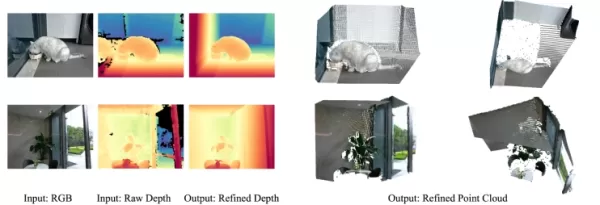
(Figure 1: LingBot-Depth 2.0 completes a full and flat 3D structure in difficult scenarios like mirrors and glass)
The breakthrough of LingBot-Depth 2.0 relies on the outstanding visual representation capabilities of LingBot-Vision. As a general-purpose visual model, LingBot-Vision is the first visual foundation model in the industry to use "boundary structure" as a pre-training objective, achieving a breakthrough in the spatial perception training paradigm. It offers sub-pixel-level boundary positioning and spatial structure understanding, delivering higher precision and more stable spatial perception.
The pre-training corpus for LingBot-Vision consists of only 160 million images, an order of magnitude smaller than DINOv3, yet its depth estimation accuracy surpasses DINOv3. Moreover, LingBot-Vision's judgment of object boundaries is sufficiently stable to enable continuous boundary tracking in videos. This release includes four versions: ViT-G, ViT-L, ViT-B, and ViT-S.
According to available information, LingBot-Vision not only supports the training of LingBot-Depth 2.0 but also has the ability to be used in multiple other ways.
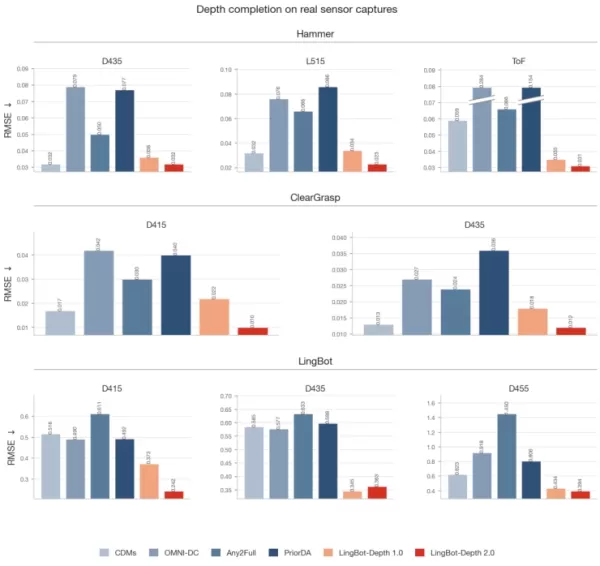
(Figure 2: LingBot-Depth 2.0 performs well in real sensor depth completion tests)
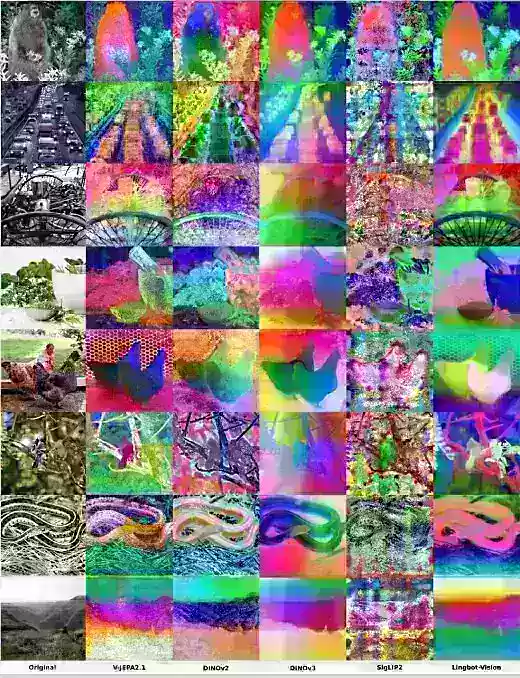
(Figure 3: Compared to mainstream visual foundation models, LingBot-Vision identifies object boundaries and spatial structures more clearly and stably)
Currently, LingBot-Depth 2.0 has passed the professional certification of Orbbec Depth Vision Lab. Practical scenario tests show that, based on the chip-level 3D raw data provided by Orbbec's Gemini330 series stereo 3D camera, LingBot-Depth 2.0 significantly improves edge clarity, object contour integrity, fine object recognition, long-range depth estimation, and robustness in complex lighting and material scenarios.
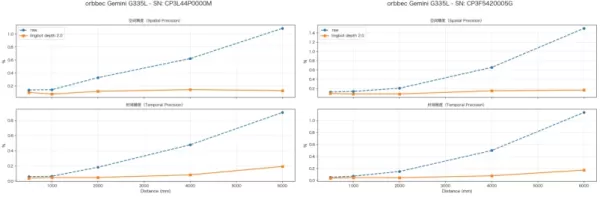
(Figure 4: LingBot Depth 2.0 passed the professional evaluation of Orbbec Depth Vision Lab, demonstrating extremely high accuracy and stability in spatial and temporal depth estimation tasks across multiple types of sensors)
In terms of commercialization, Ant Lingbo has engaged in deep cooperation with Orbbec in many areas. According to the information, the latest RGB-D version of the EGO device in Orbbec's new no-body data acquisition product matrix will be adapted to the LingBot-Depth version optimized by Lingbo for data acquisition scenarios. In the future, it will further integrate higher-level commercial versions, continuously fill depth gaps, optimize object edges and spatial structure details, and provide more accurate, stable, and usable real-world data bases for embodied intelligence model training.
Additionally, Orbbec will launch an SDK product integrating the latest model capabilities of LingBot-Depth, available for use by robot customers at the edge, allowing robots using the Gemini330 series camera to achieve better depth effects. They also plan to launch an integrated camera product with the commercial version of LingBot-Depth by the end of the year, realizing the integration of "3D camera + spatial perception capabilities." With the release of the two models, their collaboration is expected to expand into more fields.
Related article
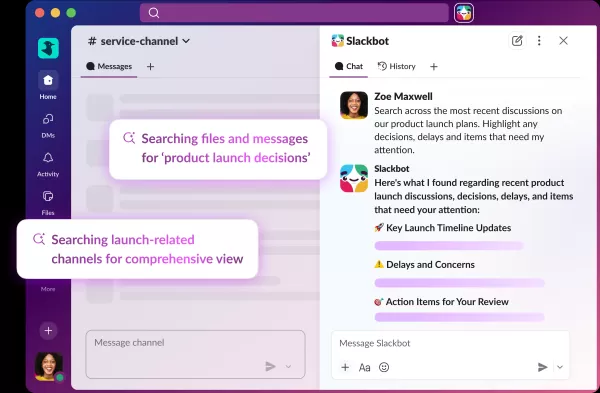
 Slackbot Becomes an AI Agent
Slackbot, the automated assistant embedded in Salesforce’s corporate messaging platform Slack, is evolving into an AI agent. Salesforce CTO Parker Harris envisions it achieving viral status comparable to OpenAI’s ChatGPT.The cloud software giant laun
ByteDance Boosts Core AI Incentives as Doubao Surges 14.6%
ByteDance recently convened a DouBao equity briefing to unveil fresh incentive policies for staff involved in the DouBao division. The strike price for DouBao shares has been lifted from $14.85 in June 2026 to $17.02, marking an approximate 14.6% inc
MiniMax Unveils 10x Team Program to Incentivize Global AI Experts
MiniMax (Xiyu Technology), the General Artificial Intelligence Lab, has officially launched "10x Team," a global talent collaboration initiative. This program aims to recruit top experts across industries to explore the deep application of large mode
Related Special Topic Recommendations
Education and Learning
Slackbot Becomes an AI Agent
Slackbot, the automated assistant embedded in Salesforce’s corporate messaging platform Slack, is evolving into an AI agent. Salesforce CTO Parker Harris envisions it achieving viral status comparable to OpenAI’s ChatGPT.The cloud software giant laun
ByteDance Boosts Core AI Incentives as Doubao Surges 14.6%
ByteDance recently convened a DouBao equity briefing to unveil fresh incentive policies for staff involved in the DouBao division. The strike price for DouBao shares has been lifted from $14.85 in June 2026 to $17.02, marking an approximate 14.6% inc
MiniMax Unveils 10x Team Program to Incentivize Global AI Experts
MiniMax (Xiyu Technology), the General Artificial Intelligence Lab, has officially launched "10x Team," a global talent collaboration initiative. This program aims to recruit top experts across industries to explore the deep application of large mode
Related Special Topic Recommendations
Education and Learning
 AI Study Tools for Homework and Exam Prep
2026 Latest Best AI Study Tools for Homework and Exam Prep! XIX.AI curates a top-rated list of powerful, game-changing tools that help students boost productivity, streamline homework completion, and ace exams through real-world tests. Get a free vs paid comparison, detailed rankings, and must-try options to unlock your AI edge. Explore now!
 10 tools
 xix.ai
Music composition
AI Vocal Demo Tools for Songwriters, Hooks, Toplines, and Multilingual Draft Sessions
xix.ai
Music composition
AI Vocal Demo Tools for Songwriters, Hooks, Toplines, and Multilingual Draft Sessions
2026 Latest Best AI Vocal Demo Tools for Songwriters, Hook Creators, and Multi-Language Content Teams! XIX.AI has curated a top-rated list of powerful game-changing tools that go through rigorous real-world tests. You’ll find detailed free vs paid comparison data, comprehensive rankings, and must-try options to help you boost writing efficiency and unlock your creative potential. Explore now to discover your perfect tool for all your content needs!
9 tools
xix.ai
Business
Best AI Competitive Research Tools for Small Businesses
2026 Latest Best Top-rated AI Competitive Research Tools for Small Businesses! XIX.AI has curated a highly powerful game-changing collection, updated weekly with rigorous real-world tests and detailed rankings. You can find a comprehensive free vs paid comparison to help you identify the must-try tools that boost your productivity and give you a competitive edge. Explore now to discover your perfect tool!
9 tools
xix.ai
Image editing
Photoshop AI Retouch Tools for Ecommerce Apparel, Skin Cleanup, and Color Consistency
2026 Latest Best Photoshop AI retouch tools for ecommerce apparel, skin cleanup, and color consistency! This top-rated curated list features powerful game-changing solutions that help you boost writing efficiency, streamline content creation, and achieve perfect visual results effortlessly. Each tool has undergone real-world tests through weekly updated rankings, complete with free vs paid comparison details. Backed by XIX.AI, it’s the must-try guide for anyone aiming to unlock your AI edge. Explore now!
10 tools
xix.ai
Prompt
Best AI Prompt Libraries for ChatGPT Workflows
2026 Latest Best Top-Rated AI Prompt Libraries for optimizing all types of ChatGPT workflows. XIX.AI has curated a powerful, game-changing collection that goes through rigorous real-world tests to ensure top performance. You can find detailed free vs paid comparisons and expert rankings to help you choose the must-try tools that boost your productivity and unlock your AI edge. Explore now!
11 tools
xix.ai
Education and Learning
AI Quiz Builder Platforms for Teachers, Tutors, and Cohort-Based Learning Programs
2026 Latest Best AI Quiz Builder Platforms for Teachers, Tutors, and Cohort-Based Learning Programs! XIX.AI has curated a top-rated list of powerful game-changing tools that go through real-world tests to deliver accurate rankings. These must-try platforms help boost writing efficiency, streamline content creation, and simplify quiz design across all learning scenarios. Explore now to discover your perfect tool for unlocking your AI edge in teaching!
13 tools
xix.ai

 Comments (0)
0/500
Comments (0)
0/500
On July 7, Lingbo Technology, an embodied intelligence company under Ant Group, launched the LingBot-Depth 2.0 spatial perception model. Trained on a dataset of 150 million samples, it delivers comprehensive improvements in edge clarity, fine object recognition, long-range depth estimation, and robustness in complex scenarios.
LingBot-Depth is a spatial perception model independently developed by Lingbo, serving as the eyes of robots in the physical world. The first version addressed spatial perception challenges in difficult scenarios like transparent and reflective surfaces. Compared to version 1.0, the training data for LingBot-Depth 2.0 expanded from 3 million to 150 million samples, with overall performance gains: it achieved 12 first-place finishes out of 16 evaluation items in depth completion benchmarks. In the most challenging indoor scenario with large-scale depth missing, the depth error was halved compared to the previous generation (RMSE dropped from 0.132 to 0.062). It performs particularly well in situations where traditional depth cameras often fail, such as glass, mirrors, and transparent objects.
At the same time, LingBot-Depth 2.0 introduced its visual foundation model, LingBot-Vision, building a capability chain from "understanding" to "accurate perception." This aims to address core challenges in robot vision, including spatial perception, fine recognition, and adaptation to complex environments.
(Figure 1: LingBot-Depth 2.0 completes a full and flat 3D structure in difficult scenarios like mirrors and glass)
The breakthrough of LingBot-Depth 2.0 relies on the outstanding visual representation capabilities of LingBot-Vision. As a general-purpose visual model, LingBot-Vision is the first visual foundation model in the industry to use "boundary structure" as a pre-training objective, achieving a breakthrough in the spatial perception training paradigm. It offers sub-pixel-level boundary positioning and spatial structure understanding, delivering higher precision and more stable spatial perception.
The pre-training corpus for LingBot-Vision consists of only 160 million images, an order of magnitude smaller than DINOv3, yet its depth estimation accuracy surpasses DINOv3. Moreover, LingBot-Vision's judgment of object boundaries is sufficiently stable to enable continuous boundary tracking in videos. This release includes four versions: ViT-G, ViT-L, ViT-B, and ViT-S.
According to available information, LingBot-Vision not only supports the training of LingBot-Depth 2.0 but also has the ability to be used in multiple other ways.
(Figure 2: LingBot-Depth 2.0 performs well in real sensor depth completion tests)
(Figure 3: Compared to mainstream visual foundation models, LingBot-Vision identifies object boundaries and spatial structures more clearly and stably)
Currently, LingBot-Depth 2.0 has passed the professional certification of Orbbec Depth Vision Lab. Practical scenario tests show that, based on the chip-level 3D raw data provided by Orbbec's Gemini330 series stereo 3D camera, LingBot-Depth 2.0 significantly improves edge clarity, object contour integrity, fine object recognition, long-range depth estimation, and robustness in complex lighting and material scenarios.
(Figure 4: LingBot Depth 2.0 passed the professional evaluation of Orbbec Depth Vision Lab, demonstrating extremely high accuracy and stability in spatial and temporal depth estimation tasks across multiple types of sensors)
In terms of commercialization, Ant Lingbo has engaged in deep cooperation with Orbbec in many areas. According to the information, the latest RGB-D version of the EGO device in Orbbec's new no-body data acquisition product matrix will be adapted to the LingBot-Depth version optimized by Lingbo for data acquisition scenarios. In the future, it will further integrate higher-level commercial versions, continuously fill depth gaps, optimize object edges and spatial structure details, and provide more accurate, stable, and usable real-world data bases for embodied intelligence model training.
Additionally, Orbbec will launch an SDK product integrating the latest model capabilities of LingBot-Depth, available for use by robot customers at the edge, allowing robots using the Gemini330 series camera to achieve better depth effects. They also plan to launch an integrated camera product with the commercial version of LingBot-Depth by the end of the year, realizing the integration of "3D camera + spatial perception capabilities." With the release of the two models, their collaboration is expected to expand into more fields.








 Slackbot Becomes an AI Agent
Slackbot, the automated assistant embedded in Salesforce’s corporate messaging platform Slack, is evolving into an AI agent. Salesforce CTO Parker Harris envisions it achieving viral status comparable to OpenAI’s ChatGPT.The cloud software giant laun
Slackbot Becomes an AI Agent
Slackbot, the automated assistant embedded in Salesforce’s corporate messaging platform Slack, is evolving into an AI agent. Salesforce CTO Parker Harris envisions it achieving viral status comparable to OpenAI’s ChatGPT.The cloud software giant laun
 ByteDance Boosts Core AI Incentives as Doubao Surges 14.6%
ByteDance recently convened a DouBao equity briefing to unveil fresh incentive policies for staff involved in the DouBao division. The strike price for DouBao shares has been lifted from $14.85 in June 2026 to $17.02, marking an approximate 14.6% inc
ByteDance Boosts Core AI Incentives as Doubao Surges 14.6%
ByteDance recently convened a DouBao equity briefing to unveil fresh incentive policies for staff involved in the DouBao division. The strike price for DouBao shares has been lifted from $14.85 in June 2026 to $17.02, marking an approximate 14.6% inc
 MiniMax Unveils 10x Team Program to Incentivize Global AI Experts
MiniMax (Xiyu Technology), the General Artificial Intelligence Lab, has officially launched "10x Team," a global talent collaboration initiative. This program aims to recruit top experts across industries to explore the deep application of large mode
MiniMax Unveils 10x Team Program to Incentivize Global AI Experts
MiniMax (Xiyu Technology), the General Artificial Intelligence Lab, has officially launched "10x Team," a global talent collaboration initiative. This program aims to recruit top experts across industries to explore the deep application of large mode

2026 Latest Best AI Study Tools for Homework and Exam Prep! XIX.AI curates a top-rated list of powerful, game-changing tools that help students boost productivity, streamline homework completion, and ace exams through real-world tests. Get a free vs paid comparison, detailed rankings, and must-try options to unlock your AI edge. Explore now!
10 tools
xix.ai

2026 Latest Best AI Vocal Demo Tools for Songwriters, Hook Creators, and Multi-Language Content Teams! XIX.AI has curated a top-rated list of powerful game-changing tools that go through rigorous real-world tests. You’ll find detailed free vs paid comparison data, comprehensive rankings, and must-try options to help you boost writing efficiency and unlock your creative potential. Explore now to discover your perfect tool for all your content needs!
9 tools
xix.ai
2026 Latest Best Top-rated AI Competitive Research Tools for Small Businesses! XIX.AI has curated a highly powerful game-changing collection, updated weekly with rigorous real-world tests and detailed rankings. You can find a comprehensive free vs paid comparison to help you identify the must-try tools that boost your productivity and give you a competitive edge. Explore now to discover your perfect tool!
9 tools
xix.ai

2026 Latest Best Photoshop AI retouch tools for ecommerce apparel, skin cleanup, and color consistency! This top-rated curated list features powerful game-changing solutions that help you boost writing efficiency, streamline content creation, and achieve perfect visual results effortlessly. Each tool has undergone real-world tests through weekly updated rankings, complete with free vs paid comparison details. Backed by XIX.AI, it’s the must-try guide for anyone aiming to unlock your AI edge. Explore now!
10 tools
xix.ai
2026 Latest Best Top-Rated AI Prompt Libraries for optimizing all types of ChatGPT workflows. XIX.AI has curated a powerful, game-changing collection that goes through rigorous real-world tests to ensure top performance. You can find detailed free vs paid comparisons and expert rankings to help you choose the must-try tools that boost your productivity and unlock your AI edge. Explore now!
11 tools
xix.ai

2026 Latest Best AI Quiz Builder Platforms for Teachers, Tutors, and Cohort-Based Learning Programs! XIX.AI has curated a top-rated list of powerful game-changing tools that go through real-world tests to deliver accurate rankings. These must-try platforms help boost writing efficiency, streamline content creation, and simplify quiz design across all learning scenarios. Explore now to discover your perfect tool for unlocking your AI edge in teaching!
13 tools
xix.ai












