


 Home
HomeAI-Generated Paper Passes Peer Review, Sakana Claims, But Details Are Nuanced
Japanese AI startup Sakana recently made waves by claiming that its AI system, The AI Scientist-v2, generated one of the first peer-reviewed scientific publications. However, there are some important details to consider before we get too excited.
The debate over AI's role in science is heating up. Some researchers believe AI isn't ready to be a "co-scientist," while others see potential but recognize we're still in the early stages. Sakana falls into the latter group.
The company used The AI Scientist-v2 to create a paper that was submitted to a workshop at ICLR, a well-respected AI conference. Sakana worked with the University of British Columbia and the University of Oxford to submit three AI-generated papers to this workshop. The AI handled everything from hypotheses to experiments, code, data analysis, visualizations, and even the titles.
"We generated research ideas by providing the workshop abstract and description to the AI," Robert Lange, a research scientist and founding member at Sakana, told TechCrunch via email. "This ensured that the generated papers were on topic and suitable submissions."
One of the three papers was accepted by the ICLR workshop. It focused on critiquing training techniques for AI models. However, Sakana withdrew the paper before it could be published, citing transparency and respect for ICLR conventions.
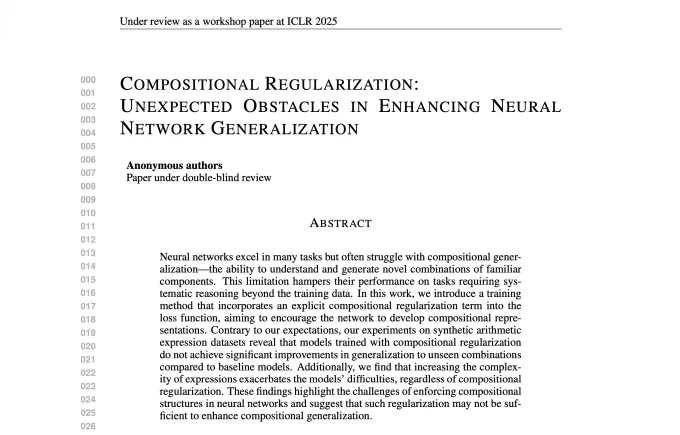
A snippet of Sakana’s AI-generated paperImage Credits:Sakana "The accepted paper both introduces a new, promising method for training neural networks and shows that there are remaining empirical challenges," Lange said. "It provides an interesting data point to spark further scientific investigation."
But let's not get carried away just yet. Sakana admitted in their blog post that their AI made some "embarrassing" citation errors, like attributing a method to a 2016 paper instead of the original 1997 work.
Also, the paper didn't go through as much scrutiny as other peer-reviewed publications. It was withdrawn after the initial peer review, so it didn't get a "meta-review" from the workshop organizers, who might have rejected it.
Another thing to keep in mind is that conference workshops often have higher acceptance rates than the main conference track. Sakana mentioned this in their blog post and noted that none of their AI-generated studies met their internal standards for the ICLR conference track.
Matthew Guzdial, an AI researcher and assistant professor at the University of Alberta, called Sakana's results "a bit misleading."
"The Sakana folks selected the papers from some number of generated ones, meaning they were using human judgment in terms of picking outputs they thought might get in," he said via email. "What I think this shows is that humans plus AI can be effective, not that AI alone can create scientific progress."
Mike Cook, a research fellow at King's College London specializing in AI, questioned the rigor of the peer reviewers and workshop.
"New workshops, like this one, are often reviewed by more junior researchers," he told TechCrunch. "It's also worth noting that this workshop is about negative results and difficulties — which is great, I've run a similar workshop before — but it's arguably easier to get an AI to write about a failure convincingly."
Cook wasn't surprised that an AI could pass peer review, given that AI is good at writing human-sounding prose. He pointed out that partly AI-generated papers passing journal review isn't new, and it raises ethical questions for the scientific community.
AI's technical issues, like its tendency to "hallucinate," make many scientists cautious about using it for serious work. There's also a fear that AI could just add noise to the scientific literature, rather than advancing knowledge.
"We need to ask ourselves whether [Sakana's] result is about how good AI is at designing and conducting experiments, or whether it's about how good it is at selling ideas to humans — which we know AI is great at already," Cook said. "There's a difference between passing peer review and contributing knowledge to a field."
To Sakana's credit, they don't claim that their AI can produce groundbreaking or even particularly novel scientific work. Their goal was to "study the quality of AI-generated research" and highlight the need for "norms regarding AI-generated science."
"There are difficult questions about whether [AI-generated] science should be judged on its own merits first to avoid bias against it," the company wrote. "Going forward, we will continue to exchange opinions with the research community on the state of this technology to ensure that it does not develop into a situation in the future where its sole purpose is to pass peer review, thereby substantially undermining the meaning of the scientific peer review process."
Related article
 Google Tests Remy AI Agent for Gemini as Focus Shifts to User Control
According to Business Insider, Google is testing Remy, a new AI personal agent for Gemini. This tool aims to execute tasks on behalf of users, streamlining both professional workflows and daily routines.Currently, Remy is undergoing testing in an int
Ollie bets privacy focus to win AI assistant race
To be genuinely helpful, an AI assistant must understand its user deeply. Ollie, a personal assistant designed for daily life, operates on the premise that this doesn’t require surrendering your data or compromising your privacy.While certain enterpr
How AI LIVE: London Will Explore AI & Industrial Automation
The summit will convene C-suite executives from around the globe to address pressing challenges in global industries, ranging from AI-driven disruption to economic volatility.AI LIVE: The London Summit will gather over 2,000 international leaders und
Related Special Topic Recommendations
Design & Art
Google Tests Remy AI Agent for Gemini as Focus Shifts to User Control
According to Business Insider, Google is testing Remy, a new AI personal agent for Gemini. This tool aims to execute tasks on behalf of users, streamlining both professional workflows and daily routines.Currently, Remy is undergoing testing in an int
Ollie bets privacy focus to win AI assistant race
To be genuinely helpful, an AI assistant must understand its user deeply. Ollie, a personal assistant designed for daily life, operates on the premise that this doesn’t require surrendering your data or compromising your privacy.While certain enterpr
How AI LIVE: London Will Explore AI & Industrial Automation
The summit will convene C-suite executives from around the globe to address pressing challenges in global industries, ranging from AI-driven disruption to economic volatility.AI LIVE: The London Summit will gather over 2,000 international leaders und
Related Special Topic Recommendations
Design & Art
 AI Visual Style Reference Tools for Character Sheets, Moodboards, and Pitch Decks
2026 Latest Best AI Visual Style Reference Tools for Character Sheets, Moodboards, and Pitch Decks are here on XIX.AI! This curated top-rated list features powerful game-changing tools that go through rigorous real-world tests. You’ll find a free vs paid comparison, detailed rankings, and must-try options to help you boost creativity and streamline your workflow. Explore now to discover your perfect tool for boosting productivity!
 11 tools
 xix.ai
SEO
Best AI SERP Analysis Tools for Search Strategy
xix.ai
SEO
Best AI SERP Analysis Tools for Search Strategy
2026 Latest Best Top-rated AI SERP Analysis Tools for Search Strategy are curated by XIX.AI through rigorous real-world tests and weekly updated rankings. These powerful tools help you unlock hidden optimization opportunities, boost content performance, and gain a competitive edge in search. Discover your perfect tool to elevate your search strategy today. Explore now!
13 tools
xix.ai
Data Analysis
Best AI Anomaly Detection Tools for KPI Monitoring across SaaS and Ecommerce Teams
2026 Latest Best Top-rated AI Anomaly Detection Tools for KPI Monitoring in SaaS and Ecommerce teams! XIX.AI has curated a powerful, game-changing collection based on rigorous real-world tests and weekly updated rankings. You’ll find detailed free vs paid comparison insights to help you identify the must-try solution that boosts productivity and unlocks your AI edge. Explore now!
10 tools
xix.ai
writing
Best AI Outline Generators for Long-Form SEO Articles
2026 Latest Best Top-Rated AI Outline Generators for Long-Form SEO Articles, meticulously curated by XIX.AI. These powerful tools offer game-changing assistance in creating high-quality content quickly, boosting writing efficiency significantly. Get a free vs paid comparison along with real-world tests and detailed rankings to help you find the must-try option that suits your needs. Explore now to unlock your AI edge.
8 tools
xix.ai
Education and Learning
AI Study Tools for Homework and Exam Prep
2026 Latest Best AI Study Tools for Homework and Exam Prep! XIX.AI curates a top-rated list of powerful, game-changing tools that help students boost productivity, streamline homework completion, and ace exams through real-world tests. Get a free vs paid comparison, detailed rankings, and must-try options to unlock your AI edge. Explore now!
10 tools
xix.ai
Music composition
AI Vocal Demo Tools for Songwriters, Hooks, Toplines, and Multilingual Draft Sessions
2026 Latest Best AI Vocal Demo Tools for Songwriters, Hook Creators, and Multi-Language Content Teams! XIX.AI has curated a top-rated list of powerful game-changing tools that go through rigorous real-world tests. You’ll find detailed free vs paid comparison data, comprehensive rankings, and must-try options to help you boost writing efficiency and unlock your creative potential. Explore now to discover your perfect tool for all your content needs!
9 tools
xix.ai

 Comments (44)
0/500
Comments (44)
0/500
![GregoryWilson]()
この記事を読んで、AIが科学論文を書けるようになるって本当にすごいけど、ちょっと怖くない?🤔 査読をパスしたって言うけど、人間の研究者が書いたものとどう見分けるんだろう。AIが科学の世界を変えるのは時間の問題かもね。でも倫理的な問題はどうするの?
![HenryTurner]()
Esse relato sobre publicação científica gerada por IA é fascinante! Fico imaginando como isso pode mudar o processo de pesquisa em países com menos investimento em ciência. Será que sistemas como o 'AI Scientist' vão democratizar a produção acadêmica ou só criar mais barulho? 🤔 E aquela revisão por pares, será que já dá pra confiar? Fica a reflexão.
![OliverAnderson]()
Honestly, first human artists' jobs got debated, now it's scientists? 😅 This feels like a big step, but reading that 'details are nuanced' makes me pause. Is it the AI's idea, or just really advanced data re-packaging? The ethics here are a minefield.
![MarkHarris]()
Also ein AI-generierter wissenschaftlicher Artikel, der peer-reviewed wurde? 🤔 Das ist schon heftig, aber ich hab auch Bedenken. Was bedeutet das für die Zukunft der Forschung? Verlieren echte Wissenschaftler jetzt ihre Jobs? Die Ethik-Debatte wird bestimmt heiß werden.
![BenHernández]()
While the idea of AI-generated papers is cool, I'm a bit worried about where we draw the line for originality in research. If this becomes common, how do we trust what's published? 😅 Still, fascinating to see how fast things are moving!
![CharlesThomas]()
這個AI寫的論文通過同儕審查?哇...是審查標準該檢討還是AI真的那麼強?🤔 我懷疑科學期刊編輯們該不會直接跳過作者欄位了吧?以後研究生是不是要失業了...
Japanese AI startup Sakana recently made waves by claiming that its AI system, The AI Scientist-v2, generated one of the first peer-reviewed scientific publications. However, there are some important details to consider before we get too excited.
The debate over AI's role in science is heating up. Some researchers believe AI isn't ready to be a "co-scientist," while others see potential but recognize we're still in the early stages. Sakana falls into the latter group.
The company used The AI Scientist-v2 to create a paper that was submitted to a workshop at ICLR, a well-respected AI conference. Sakana worked with the University of British Columbia and the University of Oxford to submit three AI-generated papers to this workshop. The AI handled everything from hypotheses to experiments, code, data analysis, visualizations, and even the titles.
"We generated research ideas by providing the workshop abstract and description to the AI," Robert Lange, a research scientist and founding member at Sakana, told TechCrunch via email. "This ensured that the generated papers were on topic and suitable submissions."
One of the three papers was accepted by the ICLR workshop. It focused on critiquing training techniques for AI models. However, Sakana withdrew the paper before it could be published, citing transparency and respect for ICLR conventions.
But let's not get carried away just yet. Sakana admitted in their blog post that their AI made some "embarrassing" citation errors, like attributing a method to a 2016 paper instead of the original 1997 work.
Also, the paper didn't go through as much scrutiny as other peer-reviewed publications. It was withdrawn after the initial peer review, so it didn't get a "meta-review" from the workshop organizers, who might have rejected it.
Another thing to keep in mind is that conference workshops often have higher acceptance rates than the main conference track. Sakana mentioned this in their blog post and noted that none of their AI-generated studies met their internal standards for the ICLR conference track.
Matthew Guzdial, an AI researcher and assistant professor at the University of Alberta, called Sakana's results "a bit misleading."
"The Sakana folks selected the papers from some number of generated ones, meaning they were using human judgment in terms of picking outputs they thought might get in," he said via email. "What I think this shows is that humans plus AI can be effective, not that AI alone can create scientific progress."
Mike Cook, a research fellow at King's College London specializing in AI, questioned the rigor of the peer reviewers and workshop.
"New workshops, like this one, are often reviewed by more junior researchers," he told TechCrunch. "It's also worth noting that this workshop is about negative results and difficulties — which is great, I've run a similar workshop before — but it's arguably easier to get an AI to write about a failure convincingly."
Cook wasn't surprised that an AI could pass peer review, given that AI is good at writing human-sounding prose. He pointed out that partly AI-generated papers passing journal review isn't new, and it raises ethical questions for the scientific community.
AI's technical issues, like its tendency to "hallucinate," make many scientists cautious about using it for serious work. There's also a fear that AI could just add noise to the scientific literature, rather than advancing knowledge.
"We need to ask ourselves whether [Sakana's] result is about how good AI is at designing and conducting experiments, or whether it's about how good it is at selling ideas to humans — which we know AI is great at already," Cook said. "There's a difference between passing peer review and contributing knowledge to a field."
To Sakana's credit, they don't claim that their AI can produce groundbreaking or even particularly novel scientific work. Their goal was to "study the quality of AI-generated research" and highlight the need for "norms regarding AI-generated science."
"There are difficult questions about whether [AI-generated] science should be judged on its own merits first to avoid bias against it," the company wrote. "Going forward, we will continue to exchange opinions with the research community on the state of this technology to ensure that it does not develop into a situation in the future where its sole purpose is to pass peer review, thereby substantially undermining the meaning of the scientific peer review process."







 Google Tests Remy AI Agent for Gemini as Focus Shifts to User Control
According to Business Insider, Google is testing Remy, a new AI personal agent for Gemini. This tool aims to execute tasks on behalf of users, streamlining both professional workflows and daily routines.Currently, Remy is undergoing testing in an int
Google Tests Remy AI Agent for Gemini as Focus Shifts to User Control
According to Business Insider, Google is testing Remy, a new AI personal agent for Gemini. This tool aims to execute tasks on behalf of users, streamlining both professional workflows and daily routines.Currently, Remy is undergoing testing in an int
 Ollie bets privacy focus to win AI assistant race
To be genuinely helpful, an AI assistant must understand its user deeply. Ollie, a personal assistant designed for daily life, operates on the premise that this doesn’t require surrendering your data or compromising your privacy.While certain enterpr
Ollie bets privacy focus to win AI assistant race
To be genuinely helpful, an AI assistant must understand its user deeply. Ollie, a personal assistant designed for daily life, operates on the premise that this doesn’t require surrendering your data or compromising your privacy.While certain enterpr
 How AI LIVE: London Will Explore AI & Industrial Automation
The summit will convene C-suite executives from around the globe to address pressing challenges in global industries, ranging from AI-driven disruption to economic volatility.AI LIVE: The London Summit will gather over 2,000 international leaders und
How AI LIVE: London Will Explore AI & Industrial Automation
The summit will convene C-suite executives from around the globe to address pressing challenges in global industries, ranging from AI-driven disruption to economic volatility.AI LIVE: The London Summit will gather over 2,000 international leaders und

2026 Latest Best AI Visual Style Reference Tools for Character Sheets, Moodboards, and Pitch Decks are here on XIX.AI! This curated top-rated list features powerful game-changing tools that go through rigorous real-world tests. You’ll find a free vs paid comparison, detailed rankings, and must-try options to help you boost creativity and streamline your workflow. Explore now to discover your perfect tool for boosting productivity!
11 tools
xix.ai

2026 Latest Best Top-rated AI SERP Analysis Tools for Search Strategy are curated by XIX.AI through rigorous real-world tests and weekly updated rankings. These powerful tools help you unlock hidden optimization opportunities, boost content performance, and gain a competitive edge in search. Discover your perfect tool to elevate your search strategy today. Explore now!
13 tools
xix.ai

2026 Latest Best Top-rated AI Anomaly Detection Tools for KPI Monitoring in SaaS and Ecommerce teams! XIX.AI has curated a powerful, game-changing collection based on rigorous real-world tests and weekly updated rankings. You’ll find detailed free vs paid comparison insights to help you identify the must-try solution that boosts productivity and unlocks your AI edge. Explore now!
10 tools
xix.ai

2026 Latest Best Top-Rated AI Outline Generators for Long-Form SEO Articles, meticulously curated by XIX.AI. These powerful tools offer game-changing assistance in creating high-quality content quickly, boosting writing efficiency significantly. Get a free vs paid comparison along with real-world tests and detailed rankings to help you find the must-try option that suits your needs. Explore now to unlock your AI edge.
8 tools
xix.ai

2026 Latest Best AI Study Tools for Homework and Exam Prep! XIX.AI curates a top-rated list of powerful, game-changing tools that help students boost productivity, streamline homework completion, and ace exams through real-world tests. Get a free vs paid comparison, detailed rankings, and must-try options to unlock your AI edge. Explore now!
10 tools
xix.ai

2026 Latest Best AI Vocal Demo Tools for Songwriters, Hook Creators, and Multi-Language Content Teams! XIX.AI has curated a top-rated list of powerful game-changing tools that go through rigorous real-world tests. You’ll find detailed free vs paid comparison data, comprehensive rankings, and must-try options to help you boost writing efficiency and unlock your creative potential. Explore now to discover your perfect tool for all your content needs!
9 tools
xix.ai

この記事を読んで、AIが科学論文を書けるようになるって本当にすごいけど、ちょっと怖くない?🤔 査読をパスしたって言うけど、人間の研究者が書いたものとどう見分けるんだろう。AIが科学の世界を変えるのは時間の問題かもね。でも倫理的な問題はどうするの?
Esse relato sobre publicação científica gerada por IA é fascinante! Fico imaginando como isso pode mudar o processo de pesquisa em países com menos investimento em ciência. Será que sistemas como o 'AI Scientist' vão democratizar a produção acadêmica ou só criar mais barulho? 🤔 E aquela revisão por pares, será que já dá pra confiar? Fica a reflexão.
Honestly, first human artists' jobs got debated, now it's scientists? 😅 This feels like a big step, but reading that 'details are nuanced' makes me pause. Is it the AI's idea, or just really advanced data re-packaging? The ethics here are a minefield.
Also ein AI-generierter wissenschaftlicher Artikel, der peer-reviewed wurde? 🤔 Das ist schon heftig, aber ich hab auch Bedenken. Was bedeutet das für die Zukunft der Forschung? Verlieren echte Wissenschaftler jetzt ihre Jobs? Die Ethik-Debatte wird bestimmt heiß werden.
While the idea of AI-generated papers is cool, I'm a bit worried about where we draw the line for originality in research. If this becomes common, how do we trust what's published? 😅 Still, fascinating to see how fast things are moving!
這個AI寫的論文通過同儕審查?哇...是審查標準該檢討還是AI真的那麼強?🤔 我懷疑科學期刊編輯們該不會直接跳過作者欄位了吧?以後研究生是不是要失業了...












