


 Home
HomeAI Verification: Fact-Checking LLMs through Knowledge Graphs
Can artificial intelligence truly distinguish fact from fiction? This article investigates the capabilities and limitations of AI in the essential task of fact verification. We explore the innovative techniques being developed to improve AI's ability to validate information, focusing on the application of knowledge graphs, graph neural networks (GNNs), and retrieval-augmented generation (RAG) architectures. From straightforward single-claim verifications to intricate multi-faceted analyses, we examine how AI is working to achieve precision and counter the dissemination of false information.
Key Takeaways
Emerging AI fact-checking models face significant challenges, including the tendency to invent non-existent sources.
Knowledge graphs improve accuracy by providing AI with a structured framework of information.
Graph Neural Networks (GNNs) facilitate advanced reasoning and relationship extraction for more sophisticated fact-checking.
RAG architectures enhance the accuracy of Large Language Models by integrating external knowledge.
The combination of these methods aims to strengthen AI's capacity to differentiate truth from falsehood in complex textual content.
The Challenge of AI Fact-Checking
The Limitations of Current AI Models in Verifying Truth
Although AI has achieved considerable progress in numerous fields, its capacity to definitively ascertain the truthfulness of information is still evolving. A primary obstacle is the propensity of AI models to 'hallucinate' or fabricate citations, creating references to sources that do not actually exist.
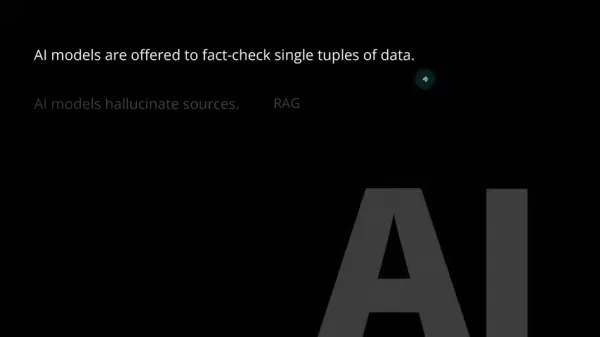
This issue fundamentally compromises their reliability as fact-checking tools.
Large Language Models (LLMs) demonstrate great potential but remain prone to errors, particularly with lengthy or complex content. LLMs can misinterpret subtleties, miss nuanced falsehoods, or lack the extensive background knowledge required for certain validations. These limitations often necessitate model refinement, leading to increasingly complex systems to tackle the challenges of misinformation—a process that is both computationally expensive and resource-intensive.
AI’s Role: Not Just Code or Science, But Investment
The video presents a perspective that AI's core is not purely scientific or technical, but is largely driven by its status as a highly lucrative investment.
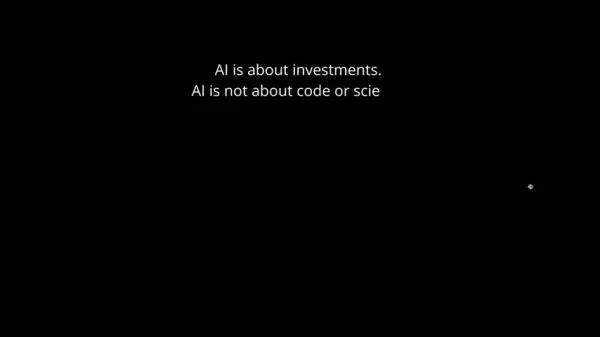
This thought-provoking viewpoint implies that the dynamics of investment capital frequently steer AI development, with significant portions of the Silicon Valley and broader US economies relying on AI growth. This focus may prioritize profitability over the pursuit of objective accuracy. As AI is primarily a vehicle for profit for global investors, financial motivations are heavily influencing research directions for fact-checking complex texts. For AI to become a truly dependable arbiter of truth, it must strike a balance between commercial incentives and the commitment to factual integrity. This raises a critical question: Is AI truly capable of reliably determining if a given statement is true?
Enhancing AI Fact-Checking: The Role of Knowledge Graphs
Structured knowledge with Knowledge Graph
The video underscores the importance of knowledge graphs in boosting AI's fact-checking abilities.
Knowledge graphs offer AI models a structured, interconnected framework, supplying essential contextual information. By mapping the relationships between various entities, these graphs enable AI systems to query connections and verify the truthfulness of statements, as well as explore historical accuracy.
Key advantages include:
- Data Organization: Knowledge graphs systematically arrange facts and their interrelationships, making this information readily available to AI algorithms.
- Reasoning: The interconnected structure allows AI to perform logical reasoning and spot inconsistencies within the data.
- Contextual Understanding: AI develops a deeper, more nuanced understanding of the context surrounding a claim, leading to more precise evaluations.
GNNs and RAGs: Advancing Fact-Checking Capabilities
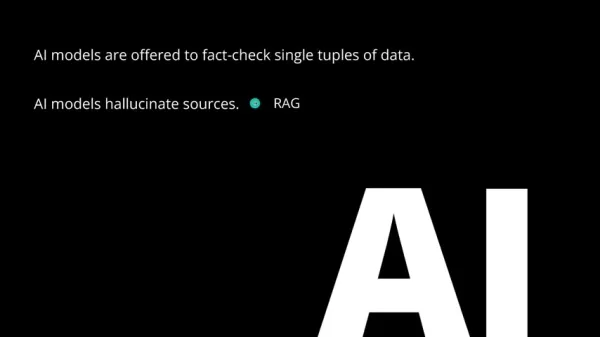
To counter problems like source hallucination and to improve relationship extraction, the video proposes the integration of Graph Neural Networks (GNNs) and Retrieval-Augmented Generation (RAG) architectures.
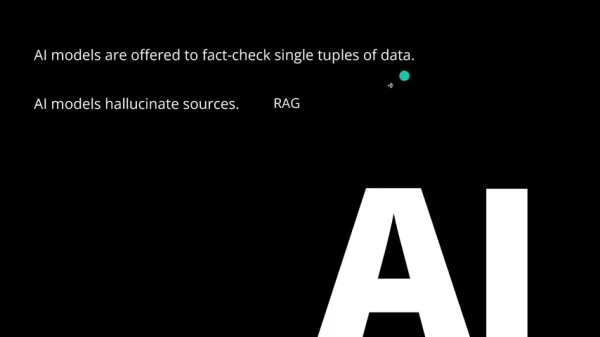
These are advanced AI models currently being offered by startups to verify individual data points or simple relationships.
- Graph Neural Networks: GNNs are specifically engineered to process data structured as graphs. They excel at deciphering complex relationships and performing sophisticated reasoning tasks. While RAG systems can also be prone to hallucinating sources, GNNs offer some mitigation against these errors.
- Retrieval-Augmented Generation: RAG systems broaden AI's information access by fetching relevant documents and data from external knowledge bases. This supplementary process lessens dependence on the AI's internal, pre-trained knowledge, thereby reducing the frequency of hallucinations. This strategy is designed to systematically address knowledge gaps for future AI generations.
Fact-Checking with LLMs: Deep Dive into Deep Research by OpenAI
OpenAI Deep Research
The presenter utilized a tool called "Deep Research" from OpenAI, which conducts automated research by aggregating information on various AI models like transformers and knowledge graphs, with an emphasis on evaluating logical consistency and historical accuracy.
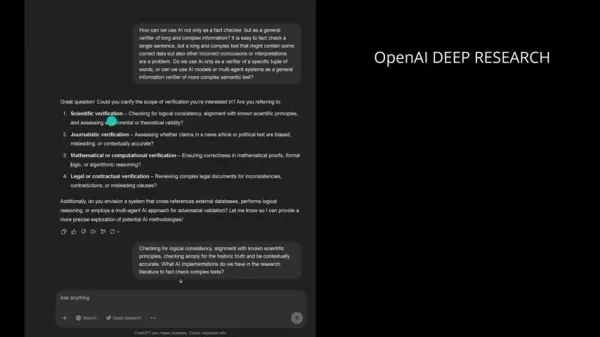
The service specifically searches for topics such as transformer-based text consistency verification and multi-agent adversarial fact-checking methodologies.
Is Deep Research Accurate?
The presenter conducted a test run in the video, carefully observing the AI's search queries to verify it was correctly executing the request.
During the demonstration, the AI sourced a considerable number of references that were outdated, not fully aligning with the requested recency criteria. This serves as a clear indicator that while LLMs are valuable tools for gathering preliminary research data, human oversight remains crucial in the final review and validation stage.
AI Fact-Checking: Weighing the Advantages and Disadvantages
Pros
Potential for massive scalability and high-speed processing
Capacity to analyze enormous datasets
Potential reduction of inherent human bias in evaluations
Can effectively augment and support human fact-checking efforts
Cons
Vulnerability to generating false information and being misled
Inherent limitations based on existing training data and algorithmic design
General absence of real-world common sense and intuitive understanding
Difficulty in accurately processing highly complex or nuanced subjects
Frequently Asked Questions
Why is AI not good at fact-checking?
AI models face several hurdles in fact-checking, such as their inherent reliance on their training datasets, a lack of genuine real-world comprehension, and a significant tendency to produce fabricated information, a phenomenon known as hallucination.
Are all the top search results facts?
Definitely not. Genuine fact-checking extends far beyond merely reviewing search engine results. It requires verifying logical consistency, ensuring alignment with established scientific principles, and assessing the validity of experimental or theoretical claims. Furthermore, journalistic verification processes are essential for evaluating claims in news reports, which can often be biased, misleading, or presented without proper context.
Why not just use external data to begin with?
For Large Language Models to perform deep, reliable reasoning, they must be capable of navigating immense repositories of knowledge, integrating this with their existing programming to solve intricate problems. Subsequently, applying scientific or computational verification methods can help deliver robust solutions.
Related Questions
What is retrieval augmentation and why is it important?
Retrieval augmentation is a methodology that enhances language models by enabling them to access and utilize information from external databases or sources during the response generation phase. The model retrieves this up-to-date knowledge to produce responses that are better informed and more accurate. This approach is especially valuable when a specific claim needs to be corroborated by reliable evidential documents. Additionally, through retrieval augmentation, LLMs can interface with search data or specific databases using various techniques, including direct links and specialized frameworks for retrieval-augmented generation.
Related article
 Apple, Google Partner With Anthropic to Address 27-Year-Old Vulnerability via Glass Wing Protection
As artificial intelligence advances rapidly in code generation and logical reasoning, the cybersecurity landscape faces unprecedented challenges. Recently, the prominent AI startup Anthropic officially launched a cross-industry collaboration called *
OpenAI Chief Scientist Addresses AI Reasoning Transparency Debate: Complexity Steady, No Sudden Jump
On September 2, Jakub Pachocki, OpenAI’s Chief Scientist, addressed public concerns on X regarding the AI model Astra, clarifying claims that it operates without oversight and lacks transparent reasoning.Why the Controversy Erupted: Deep Recurrence O
U.S. Navy Selects Blue Water Autonomy for Deep-Sea Survey Missions
Blue Water Autonomy’s Liberty Class is a 190-foot steel autonomous ship. | Source: Blue Water AutonomyBoston-based technology and shipbuilding firm Blue Water Autonomy has secured a multiple-award contract with the Naval Oceanographic Office (NAVOCEA
Related Special Topic Recommendations
Text-to-speech
Apple, Google Partner With Anthropic to Address 27-Year-Old Vulnerability via Glass Wing Protection
As artificial intelligence advances rapidly in code generation and logical reasoning, the cybersecurity landscape faces unprecedented challenges. Recently, the prominent AI startup Anthropic officially launched a cross-industry collaboration called *
OpenAI Chief Scientist Addresses AI Reasoning Transparency Debate: Complexity Steady, No Sudden Jump
On September 2, Jakub Pachocki, OpenAI’s Chief Scientist, addressed public concerns on X regarding the AI model Astra, clarifying claims that it operates without oversight and lacks transparent reasoning.Why the Controversy Erupted: Deep Recurrence O
U.S. Navy Selects Blue Water Autonomy for Deep-Sea Survey Missions
Blue Water Autonomy’s Liberty Class is a 190-foot steel autonomous ship. | Source: Blue Water AutonomyBoston-based technology and shipbuilding firm Blue Water Autonomy has secured a multiple-award contract with the Naval Oceanographic Office (NAVOCEA
Related Special Topic Recommendations
Text-to-speech
 Best AI Text to Speech Tools for Online Courses
2026 Latest Best Top-rated AI Text to Speech Tools for Online Courses are curated by XIX.AI based on rigorous real-world tests and weekly updated rankings. These powerful tools help creators deliver crystal-clear audio content effortlessly, boosting writing efficiency and streamlining course production. Check out the free vs paid comparison to find your perfect fit. Explore now to unlock your AI edge in online education.
 10 tools
 xix.ai
writing
AI Blog Title Tools for Higher Click Through Rates
xix.ai
writing
AI Blog Title Tools for Higher Click Through Rates
2026 Latest Best Top-Rated AI Blog Title Tools for Higher Click Through Rates! XIX.AI has carefully curated a powerful, game-changing collection of top tools that go through rigorous real-world tests. You’ll find a free vs paid comparison, weekly updated rankings, and detailed insights to help you boost your blog’s traffic efficiently. Must-try options are highlighted to help you unlock your AI edge. Explore now!
10 tools
xix.ai
automation
Best AI Task Routing Tools for Support Workflows
2026 Latest Best Top-rated AI Task Routing Tools for Support Workflows! XIX.AI has curated a highly powerful game-changing collection of must-try solutions, all undergoing rigorous real-world tests and updated weekly. These tools streamline workflows, boost productivity, and help teams deliver faster, more efficient support. Explore now to discover your perfect tool and unlock your AI edge!
17 tools
xix.ai
Academic Research
AI Citation and Paper Summary Tools
2026 Latest Best Top-Rated AI Citation and Paper Summary Tools Curated by XIX.AI. Get powerful game-changing solutions for quick content creation, improved writing efficiency, and boosting productivity. We offer a free vs paid comparison along with real-world tests and weekly updated rankings to help you find the must-try tool that fits your needs perfectly. Explore now to Unlock your AI edge.
10 tools
xix.ai
Productivity
Best AI Productivity Tools for Daily Work
2026 Latest Best Top-Rated AI Productivity Tools for Daily Work! XIX.AI has curated a powerful, game-changing selection based on rigorous weekly updated rankings and real-world tests. You’ll find must-try options that boost writing efficiency, streamline content creation, and help you overcome daily work challenges. Get a free vs paid comparison to find the perfect fit for your needs. Explore now to unlock your AI edge!
9 tools
xix.ai
Academic Research
AI Systematic Review Tools for Research Screening
2026 Latest Best Top-Rated AI Systematic Review Tools for Research Screening are here on XIX.AI! This curated collection includes powerful, game-changing solutions that go through rigorous real-world tests to deliver accurate results. We also offer a free vs paid comparison along with weekly updated rankings to help you find the must-try option that boosts your research efficiency significantly. Explore now to unlock your AI edge in academic work!
11 tools
xix.ai

 Comments (1)
0/500
Comments (1)
0/500
![CarlMartin]()
Cette approche par graphes de connaissances pour vérifier les faits des IA est vraiment maline ! 😄 J'aimerais savoir comment ça se compare aux méthodes traditionnelles de fact-checking humain. Est-ce que cette tech pourrait un jour être intégrée dans les moteurs de recherche ?
Can artificial intelligence truly distinguish fact from fiction? This article investigates the capabilities and limitations of AI in the essential task of fact verification. We explore the innovative techniques being developed to improve AI's ability to validate information, focusing on the application of knowledge graphs, graph neural networks (GNNs), and retrieval-augmented generation (RAG) architectures. From straightforward single-claim verifications to intricate multi-faceted analyses, we examine how AI is working to achieve precision and counter the dissemination of false information.
Key Takeaways
Emerging AI fact-checking models face significant challenges, including the tendency to invent non-existent sources.
Knowledge graphs improve accuracy by providing AI with a structured framework of information.
Graph Neural Networks (GNNs) facilitate advanced reasoning and relationship extraction for more sophisticated fact-checking.
RAG architectures enhance the accuracy of Large Language Models by integrating external knowledge.
The combination of these methods aims to strengthen AI's capacity to differentiate truth from falsehood in complex textual content.
The Challenge of AI Fact-Checking
The Limitations of Current AI Models in Verifying Truth
Although AI has achieved considerable progress in numerous fields, its capacity to definitively ascertain the truthfulness of information is still evolving. A primary obstacle is the propensity of AI models to 'hallucinate' or fabricate citations, creating references to sources that do not actually exist.
This issue fundamentally compromises their reliability as fact-checking tools.
Large Language Models (LLMs) demonstrate great potential but remain prone to errors, particularly with lengthy or complex content. LLMs can misinterpret subtleties, miss nuanced falsehoods, or lack the extensive background knowledge required for certain validations. These limitations often necessitate model refinement, leading to increasingly complex systems to tackle the challenges of misinformation—a process that is both computationally expensive and resource-intensive.
AI’s Role: Not Just Code or Science, But Investment
The video presents a perspective that AI's core is not purely scientific or technical, but is largely driven by its status as a highly lucrative investment.
This thought-provoking viewpoint implies that the dynamics of investment capital frequently steer AI development, with significant portions of the Silicon Valley and broader US economies relying on AI growth. This focus may prioritize profitability over the pursuit of objective accuracy. As AI is primarily a vehicle for profit for global investors, financial motivations are heavily influencing research directions for fact-checking complex texts. For AI to become a truly dependable arbiter of truth, it must strike a balance between commercial incentives and the commitment to factual integrity. This raises a critical question: Is AI truly capable of reliably determining if a given statement is true?
Enhancing AI Fact-Checking: The Role of Knowledge Graphs
Structured knowledge with Knowledge Graph
The video underscores the importance of knowledge graphs in boosting AI's fact-checking abilities.
Knowledge graphs offer AI models a structured, interconnected framework, supplying essential contextual information. By mapping the relationships between various entities, these graphs enable AI systems to query connections and verify the truthfulness of statements, as well as explore historical accuracy.
Key advantages include:
- Data Organization: Knowledge graphs systematically arrange facts and their interrelationships, making this information readily available to AI algorithms.
- Reasoning: The interconnected structure allows AI to perform logical reasoning and spot inconsistencies within the data.
- Contextual Understanding: AI develops a deeper, more nuanced understanding of the context surrounding a claim, leading to more precise evaluations.
GNNs and RAGs: Advancing Fact-Checking Capabilities
To counter problems like source hallucination and to improve relationship extraction, the video proposes the integration of Graph Neural Networks (GNNs) and Retrieval-Augmented Generation (RAG) architectures.
These are advanced AI models currently being offered by startups to verify individual data points or simple relationships.
- Graph Neural Networks: GNNs are specifically engineered to process data structured as graphs. They excel at deciphering complex relationships and performing sophisticated reasoning tasks. While RAG systems can also be prone to hallucinating sources, GNNs offer some mitigation against these errors.
- Retrieval-Augmented Generation: RAG systems broaden AI's information access by fetching relevant documents and data from external knowledge bases. This supplementary process lessens dependence on the AI's internal, pre-trained knowledge, thereby reducing the frequency of hallucinations. This strategy is designed to systematically address knowledge gaps for future AI generations.
Fact-Checking with LLMs: Deep Dive into Deep Research by OpenAI
OpenAI Deep Research
The presenter utilized a tool called "Deep Research" from OpenAI, which conducts automated research by aggregating information on various AI models like transformers and knowledge graphs, with an emphasis on evaluating logical consistency and historical accuracy.
The service specifically searches for topics such as transformer-based text consistency verification and multi-agent adversarial fact-checking methodologies.
Is Deep Research Accurate?
The presenter conducted a test run in the video, carefully observing the AI's search queries to verify it was correctly executing the request.
During the demonstration, the AI sourced a considerable number of references that were outdated, not fully aligning with the requested recency criteria. This serves as a clear indicator that while LLMs are valuable tools for gathering preliminary research data, human oversight remains crucial in the final review and validation stage.
AI Fact-Checking: Weighing the Advantages and Disadvantages
Pros
Potential for massive scalability and high-speed processing
Capacity to analyze enormous datasets
Potential reduction of inherent human bias in evaluations
Can effectively augment and support human fact-checking efforts
Cons
Vulnerability to generating false information and being misled
Inherent limitations based on existing training data and algorithmic design
General absence of real-world common sense and intuitive understanding
Difficulty in accurately processing highly complex or nuanced subjects
Frequently Asked Questions
Why is AI not good at fact-checking?
AI models face several hurdles in fact-checking, such as their inherent reliance on their training datasets, a lack of genuine real-world comprehension, and a significant tendency to produce fabricated information, a phenomenon known as hallucination.
Are all the top search results facts?
Definitely not. Genuine fact-checking extends far beyond merely reviewing search engine results. It requires verifying logical consistency, ensuring alignment with established scientific principles, and assessing the validity of experimental or theoretical claims. Furthermore, journalistic verification processes are essential for evaluating claims in news reports, which can often be biased, misleading, or presented without proper context.
Why not just use external data to begin with?
For Large Language Models to perform deep, reliable reasoning, they must be capable of navigating immense repositories of knowledge, integrating this with their existing programming to solve intricate problems. Subsequently, applying scientific or computational verification methods can help deliver robust solutions.
Related Questions
What is retrieval augmentation and why is it important?
Retrieval augmentation is a methodology that enhances language models by enabling them to access and utilize information from external databases or sources during the response generation phase. The model retrieves this up-to-date knowledge to produce responses that are better informed and more accurate. This approach is especially valuable when a specific claim needs to be corroborated by reliable evidential documents. Additionally, through retrieval augmentation, LLMs can interface with search data or specific databases using various techniques, including direct links and specialized frameworks for retrieval-augmented generation.








 Apple, Google Partner With Anthropic to Address 27-Year-Old Vulnerability via Glass Wing Protection
As artificial intelligence advances rapidly in code generation and logical reasoning, the cybersecurity landscape faces unprecedented challenges. Recently, the prominent AI startup Anthropic officially launched a cross-industry collaboration called *
Apple, Google Partner With Anthropic to Address 27-Year-Old Vulnerability via Glass Wing Protection
As artificial intelligence advances rapidly in code generation and logical reasoning, the cybersecurity landscape faces unprecedented challenges. Recently, the prominent AI startup Anthropic officially launched a cross-industry collaboration called *
 OpenAI Chief Scientist Addresses AI Reasoning Transparency Debate: Complexity Steady, No Sudden Jump
On September 2, Jakub Pachocki, OpenAI’s Chief Scientist, addressed public concerns on X regarding the AI model Astra, clarifying claims that it operates without oversight and lacks transparent reasoning.Why the Controversy Erupted: Deep Recurrence O
OpenAI Chief Scientist Addresses AI Reasoning Transparency Debate: Complexity Steady, No Sudden Jump
On September 2, Jakub Pachocki, OpenAI’s Chief Scientist, addressed public concerns on X regarding the AI model Astra, clarifying claims that it operates without oversight and lacks transparent reasoning.Why the Controversy Erupted: Deep Recurrence O
 U.S. Navy Selects Blue Water Autonomy for Deep-Sea Survey Missions
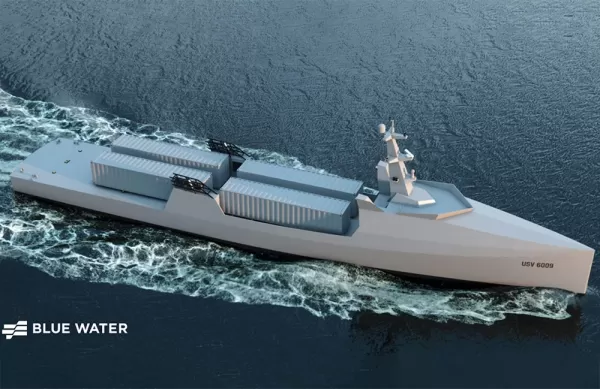
Blue Water Autonomy’s Liberty Class is a 190-foot steel autonomous ship. | Source: Blue Water AutonomyBoston-based technology and shipbuilding firm Blue Water Autonomy has secured a multiple-award contract with the Naval Oceanographic Office (NAVOCEA
U.S. Navy Selects Blue Water Autonomy for Deep-Sea Survey Missions
Blue Water Autonomy’s Liberty Class is a 190-foot steel autonomous ship. | Source: Blue Water AutonomyBoston-based technology and shipbuilding firm Blue Water Autonomy has secured a multiple-award contract with the Naval Oceanographic Office (NAVOCEA

2026 Latest Best Top-rated AI Text to Speech Tools for Online Courses are curated by XIX.AI based on rigorous real-world tests and weekly updated rankings. These powerful tools help creators deliver crystal-clear audio content effortlessly, boosting writing efficiency and streamlining course production. Check out the free vs paid comparison to find your perfect fit. Explore now to unlock your AI edge in online education.
10 tools
xix.ai

2026 Latest Best Top-Rated AI Blog Title Tools for Higher Click Through Rates! XIX.AI has carefully curated a powerful, game-changing collection of top tools that go through rigorous real-world tests. You’ll find a free vs paid comparison, weekly updated rankings, and detailed insights to help you boost your blog’s traffic efficiently. Must-try options are highlighted to help you unlock your AI edge. Explore now!
10 tools
xix.ai

2026 Latest Best Top-rated AI Task Routing Tools for Support Workflows! XIX.AI has curated a highly powerful game-changing collection of must-try solutions, all undergoing rigorous real-world tests and updated weekly. These tools streamline workflows, boost productivity, and help teams deliver faster, more efficient support. Explore now to discover your perfect tool and unlock your AI edge!
17 tools
xix.ai
2026 Latest Best Top-Rated AI Citation and Paper Summary Tools Curated by XIX.AI. Get powerful game-changing solutions for quick content creation, improved writing efficiency, and boosting productivity. We offer a free vs paid comparison along with real-world tests and weekly updated rankings to help you find the must-try tool that fits your needs perfectly. Explore now to Unlock your AI edge.
10 tools
xix.ai

2026 Latest Best Top-Rated AI Productivity Tools for Daily Work! XIX.AI has curated a powerful, game-changing selection based on rigorous weekly updated rankings and real-world tests. You’ll find must-try options that boost writing efficiency, streamline content creation, and help you overcome daily work challenges. Get a free vs paid comparison to find the perfect fit for your needs. Explore now to unlock your AI edge!
9 tools
xix.ai
2026 Latest Best Top-Rated AI Systematic Review Tools for Research Screening are here on XIX.AI! This curated collection includes powerful, game-changing solutions that go through rigorous real-world tests to deliver accurate results. We also offer a free vs paid comparison along with weekly updated rankings to help you find the must-try option that boosts your research efficiency significantly. Explore now to unlock your AI edge in academic work!
11 tools
xix.ai

Cette approche par graphes de connaissances pour vérifier les faits des IA est vraiment maline ! 😄 J'aimerais savoir comment ça se compare aux méthodes traditionnelles de fact-checking humain. Est-ce que cette tech pourrait un jour être intégrée dans les moteurs de recherche ?












