


 Home
HomeAI Reshapes Construction: From Design to Predictive Maintenance
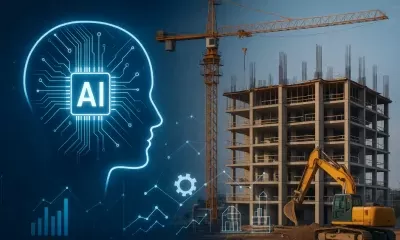
The construction sector is undergoing a significant transformation. Historically slow to embrace digital tools, it now integrates artificial intelligence (AI) throughout every phase, from initial design to long-term maintenance. This shift is reshaping how projects are planned, constructed, and managed. The growing role of AI in construction touches multiple areas: streamlining design, enhancing on-site safety, boosting project predictability, and fostering smarter, more sustainable buildings.
For decades, construction relied on manual labor, paper blueprints, and isolated data systems. Complex logistics, dispersed stakeholders, and a hands-on culture limited technology adoption. The industry depended heavily on human judgment and experience to mitigate risks, frequently resulting in budget overruns and delays.
So, what has driven this change?
Rapid advancements in AI, machine learning, computer vision, cloud computing, and mobile networks have accelerated a digital overhaul. Today, many AI tools are designed specifically for construction workflows, enabling automation and data-driven decisions that were once unfeasible. The global AI in construction market is forecast to grow at a compound annual rate exceeding 20% through 2030, surpassing $22 billion. Approximately 35% of construction firms have adopted at least one AI application, and 70% of major projects now incorporate AI-driven elements. These tools deliver tangible results, from cutting planning costs by up to 20% to measurable gains in safety and efficiency.
On job sites, AI is already transforming work practices. Computer vision-powered safety systems detect hazards like missing protective gear, unsafe proximity to machinery, and potential falls. Companies use AI to aggregate weather, personnel, and task data to predict safety incidents, flagging risks such as inadequate supervision. Emerging vision-language models like GPT‑4o and Gemini show high hazard identification accuracy—with BERTScore around 0.90—though real-time deployment remains challenging.
Autonomous equipment and robotics are also making an impact. Firms like Built Robotics retrofit excavators and bulldozers for self-operated excavation and grading. Robots handle tasks such as bricklaying, drywall installation, surveying, and demolition, often with precision surpassing human capabilities. Reports indicate productivity gains of 20–22% and material waste reductions up to 30%. In the UK, bricklaying robots are trialed for facade assembly using dual-arm systems that lay roughly 500 bricks per shift with minimal oversight.
Predictive scheduling and budget forecasting powered by machine learning are gaining ground. By factoring in variables like weather patterns, labor availability, supplier lead times, and live site progress, these tools can reduce planning errors by up to 20% and improve scheduling accuracy by 35%.
Quality assurance has seen similar benefits. AI-powered drones and stationary cameras conduct inspections up to three times faster than manual checks, detecting misalignments or material defects with nearly 90% accuracy. Early defect detection reduces rework and prevents costly downstream errors, enhancing both efficiency and safety.
Beyond the job site, AI is revolutionizing design and planning. Generative design platforms evaluate thousands of options under constraints like structural integrity, cost limits, and sustainability goals, accelerating optimized solutions that human designers might miss. Case studies show AI can shorten tender analysis and uncover critical safety optimizations in large infrastructure projects. Integration with Building Information Modeling (BIM) platforms allows AI to automate clash detection, simulate construction sequences, and estimate resource needs. These capabilities boost coordination accuracy by 30%, cut estimate errors by 25%, and reduce manual planning workloads.
Workforce augmentation is another key area. AI isn't eliminating skilled trades but changing their roles. Robots manage repetitive or hazardous tasks—like excavation and heavy lifting—while humans focus on craftsmanship, complex assemblies, and finishing. Pilot programs highlight that skilled oversight remains crucial, especially in modular construction and micro-factory workflows.
As AI spreads, digital literacy and new skillsets become essential. Workers now benefit from training in data interpretation, human-machine collaboration, and even prompt engineering for AI tools. Virtual and augmented reality training simulations, alongside AI-based safety modules, have improved compliance rates by 20–40%, and roughly 60% of firms invest in AI upskilling initiatives.
However, challenges remain. Safety monitoring often involves wearables, cameras, or GPS tracking, raising valid privacy and surveillance concerns. Broader adoption introduces cybersecurity and data ownership issues, as sensitive project and personnel data resides on cloud-connected devices. Ethical considerations include job displacement, transparency in automated decisions, liability for AI errors, and maintaining worker trust. Legacy system integration also poses hurdles, as many firms still rely on paper-based workflows and disconnected software, requiring careful change management for full AI implementation.
Looking ahead, AI will be central to developing smart cities and infrastructure. Traffic-responsive roads, energy-aware street lighting, and predictive maintenance for bridges and utilities are becoming feasible. Early AI integration in new developments can prevent expensive retrofits, as seen in Australian urban pilots where smart poles and sensors improved safety and pedestrian flow. Sustainability is another frontier: AI-driven HVAC optimization in a Manhattan tower reduced energy use by approximately 15.8%, saving $42,000 annually and cutting emissions by 37 tons of CO₂. Combined with generative design and modular building, these advances point toward large-scale decarbonization.
Artificial intelligence is advancing from the periphery to the mainstream of construction. Its influence spans pre-design optimization, job site safety, workforce collaboration, and long-term sustainability. While privacy, ethics, and legacy integration challenges persist, the trajectory is clear: firms adopting AI report efficiency gains, risk reduction, and measurable environmental benefits. As adoption grows from roughly 35% of firms toward saturation, a smarter, safer, and more sustainable built environment is not just possible—it is imminent.
Related article
 MiniMax Unveils 10x Team Program to Incentivize Global AI Experts
MiniMax (Xiyu Technology), the General Artificial Intelligence Lab, has officially launched "10x Team," a global talent collaboration initiative. This program aims to recruit top experts across industries to explore the deep application of large mode
South Korea Breaks Ground on National AI Computing Center, Investing 2.5 Trillion Won with 2028 Target
South Korean outlet EtNews reports that groundbreaking for the Korea AI Computing Center (KOACC) took place on August 3 at the Solar City data center park in Sunan, Jeollanam-do. Backed by a total investment of 2.5 trillion KRW (roughly 11.838 billio
Six Tech Giants Back Linux Foundation With $12.5M to Tackle AI Vulnerability Noise
To tackle the flood of low-quality security reports produced by AI automation tools, six major tech companies—Anthropic, Amazon (AWS), GitHub, Google, Microsoft, and OpenAI—have collectively contributed $12.5 million in funding to Linux Foundation in
Related Special Topic Recommendations
Education and Learning
MiniMax Unveils 10x Team Program to Incentivize Global AI Experts
MiniMax (Xiyu Technology), the General Artificial Intelligence Lab, has officially launched "10x Team," a global talent collaboration initiative. This program aims to recruit top experts across industries to explore the deep application of large mode
South Korea Breaks Ground on National AI Computing Center, Investing 2.5 Trillion Won with 2028 Target
South Korean outlet EtNews reports that groundbreaking for the Korea AI Computing Center (KOACC) took place on August 3 at the Solar City data center park in Sunan, Jeollanam-do. Backed by a total investment of 2.5 trillion KRW (roughly 11.838 billio
Six Tech Giants Back Linux Foundation With $12.5M to Tackle AI Vulnerability Noise
To tackle the flood of low-quality security reports produced by AI automation tools, six major tech companies—Anthropic, Amazon (AWS), GitHub, Google, Microsoft, and OpenAI—have collectively contributed $12.5 million in funding to Linux Foundation in
Related Special Topic Recommendations
Education and Learning
 AI Study Tools for Homework and Exam Prep
2026 Latest Best AI Study Tools for Homework and Exam Prep! XIX.AI curates a top-rated list of powerful, game-changing tools that help students boost productivity, streamline homework completion, and ace exams through real-world tests. Get a free vs paid comparison, detailed rankings, and must-try options to unlock your AI edge. Explore now!
 10 tools
 xix.ai
Music composition
AI Vocal Demo Tools for Songwriters, Hooks, Toplines, and Multilingual Draft Sessions
xix.ai
Music composition
AI Vocal Demo Tools for Songwriters, Hooks, Toplines, and Multilingual Draft Sessions
2026 Latest Best AI Vocal Demo Tools for Songwriters, Hook Creators, and Multi-Language Content Teams! XIX.AI has curated a top-rated list of powerful game-changing tools that go through rigorous real-world tests. You’ll find detailed free vs paid comparison data, comprehensive rankings, and must-try options to help you boost writing efficiency and unlock your creative potential. Explore now to discover your perfect tool for all your content needs!
9 tools
xix.ai
Business
Best AI Competitive Research Tools for Small Businesses
2026 Latest Best Top-rated AI Competitive Research Tools for Small Businesses! XIX.AI has curated a highly powerful game-changing collection, updated weekly with rigorous real-world tests and detailed rankings. You can find a comprehensive free vs paid comparison to help you identify the must-try tools that boost your productivity and give you a competitive edge. Explore now to discover your perfect tool!
9 tools
xix.ai
Image editing
Photoshop AI Retouch Tools for Ecommerce Apparel, Skin Cleanup, and Color Consistency
2026 Latest Best Photoshop AI retouch tools for ecommerce apparel, skin cleanup, and color consistency! This top-rated curated list features powerful game-changing solutions that help you boost writing efficiency, streamline content creation, and achieve perfect visual results effortlessly. Each tool has undergone real-world tests through weekly updated rankings, complete with free vs paid comparison details. Backed by XIX.AI, it’s the must-try guide for anyone aiming to unlock your AI edge. Explore now!
10 tools
xix.ai
Prompt
Best AI Prompt Libraries for ChatGPT Workflows
2026 Latest Best Top-Rated AI Prompt Libraries for optimizing all types of ChatGPT workflows. XIX.AI has curated a powerful, game-changing collection that goes through rigorous real-world tests to ensure top performance. You can find detailed free vs paid comparisons and expert rankings to help you choose the must-try tools that boost your productivity and unlock your AI edge. Explore now!
11 tools
xix.ai
Education and Learning
AI Quiz Builder Platforms for Teachers, Tutors, and Cohort-Based Learning Programs
2026 Latest Best AI Quiz Builder Platforms for Teachers, Tutors, and Cohort-Based Learning Programs! XIX.AI has curated a top-rated list of powerful game-changing tools that go through real-world tests to deliver accurate rankings. These must-try platforms help boost writing efficiency, streamline content creation, and simplify quiz design across all learning scenarios. Explore now to discover your perfect tool for unlocking your AI edge in teaching!
13 tools
xix.ai

 Comments (0)
0/500
Comments (0)
0/500
The construction sector is undergoing a significant transformation. Historically slow to embrace digital tools, it now integrates artificial intelligence (AI) throughout every phase, from initial design to long-term maintenance. This shift is reshaping how projects are planned, constructed, and managed. The growing role of AI in construction touches multiple areas: streamlining design, enhancing on-site safety, boosting project predictability, and fostering smarter, more sustainable buildings.
For decades, construction relied on manual labor, paper blueprints, and isolated data systems. Complex logistics, dispersed stakeholders, and a hands-on culture limited technology adoption. The industry depended heavily on human judgment and experience to mitigate risks, frequently resulting in budget overruns and delays.
So, what has driven this change?
Rapid advancements in AI, machine learning, computer vision, cloud computing, and mobile networks have accelerated a digital overhaul. Today, many AI tools are designed specifically for construction workflows, enabling automation and data-driven decisions that were once unfeasible. The global AI in construction market is forecast to grow at a compound annual rate exceeding 20% through 2030, surpassing $22 billion. Approximately 35% of construction firms have adopted at least one AI application, and 70% of major projects now incorporate AI-driven elements. These tools deliver tangible results, from cutting planning costs by up to 20% to measurable gains in safety and efficiency.
On job sites, AI is already transforming work practices. Computer vision-powered safety systems detect hazards like missing protective gear, unsafe proximity to machinery, and potential falls. Companies use AI to aggregate weather, personnel, and task data to predict safety incidents, flagging risks such as inadequate supervision. Emerging vision-language models like GPT‑4o and Gemini show high hazard identification accuracy—with BERTScore around 0.90—though real-time deployment remains challenging.
Autonomous equipment and robotics are also making an impact. Firms like Built Robotics retrofit excavators and bulldozers for self-operated excavation and grading. Robots handle tasks such as bricklaying, drywall installation, surveying, and demolition, often with precision surpassing human capabilities. Reports indicate productivity gains of 20–22% and material waste reductions up to 30%. In the UK, bricklaying robots are trialed for facade assembly using dual-arm systems that lay roughly 500 bricks per shift with minimal oversight.
Predictive scheduling and budget forecasting powered by machine learning are gaining ground. By factoring in variables like weather patterns, labor availability, supplier lead times, and live site progress, these tools can reduce planning errors by up to 20% and improve scheduling accuracy by 35%.
Quality assurance has seen similar benefits. AI-powered drones and stationary cameras conduct inspections up to three times faster than manual checks, detecting misalignments or material defects with nearly 90% accuracy. Early defect detection reduces rework and prevents costly downstream errors, enhancing both efficiency and safety.
Beyond the job site, AI is revolutionizing design and planning. Generative design platforms evaluate thousands of options under constraints like structural integrity, cost limits, and sustainability goals, accelerating optimized solutions that human designers might miss. Case studies show AI can shorten tender analysis and uncover critical safety optimizations in large infrastructure projects. Integration with Building Information Modeling (BIM) platforms allows AI to automate clash detection, simulate construction sequences, and estimate resource needs. These capabilities boost coordination accuracy by 30%, cut estimate errors by 25%, and reduce manual planning workloads.
Workforce augmentation is another key area. AI isn't eliminating skilled trades but changing their roles. Robots manage repetitive or hazardous tasks—like excavation and heavy lifting—while humans focus on craftsmanship, complex assemblies, and finishing. Pilot programs highlight that skilled oversight remains crucial, especially in modular construction and micro-factory workflows.
As AI spreads, digital literacy and new skillsets become essential. Workers now benefit from training in data interpretation, human-machine collaboration, and even prompt engineering for AI tools. Virtual and augmented reality training simulations, alongside AI-based safety modules, have improved compliance rates by 20–40%, and roughly 60% of firms invest in AI upskilling initiatives.
However, challenges remain. Safety monitoring often involves wearables, cameras, or GPS tracking, raising valid privacy and surveillance concerns. Broader adoption introduces cybersecurity and data ownership issues, as sensitive project and personnel data resides on cloud-connected devices. Ethical considerations include job displacement, transparency in automated decisions, liability for AI errors, and maintaining worker trust. Legacy system integration also poses hurdles, as many firms still rely on paper-based workflows and disconnected software, requiring careful change management for full AI implementation.
Looking ahead, AI will be central to developing smart cities and infrastructure. Traffic-responsive roads, energy-aware street lighting, and predictive maintenance for bridges and utilities are becoming feasible. Early AI integration in new developments can prevent expensive retrofits, as seen in Australian urban pilots where smart poles and sensors improved safety and pedestrian flow. Sustainability is another frontier: AI-driven HVAC optimization in a Manhattan tower reduced energy use by approximately 15.8%, saving $42,000 annually and cutting emissions by 37 tons of CO₂. Combined with generative design and modular building, these advances point toward large-scale decarbonization.
Artificial intelligence is advancing from the periphery to the mainstream of construction. Its influence spans pre-design optimization, job site safety, workforce collaboration, and long-term sustainability. While privacy, ethics, and legacy integration challenges persist, the trajectory is clear: firms adopting AI report efficiency gains, risk reduction, and measurable environmental benefits. As adoption grows from roughly 35% of firms toward saturation, a smarter, safer, and more sustainable built environment is not just possible—it is imminent.








 MiniMax Unveils 10x Team Program to Incentivize Global AI Experts
MiniMax (Xiyu Technology), the General Artificial Intelligence Lab, has officially launched "10x Team," a global talent collaboration initiative. This program aims to recruit top experts across industries to explore the deep application of large mode
MiniMax Unveils 10x Team Program to Incentivize Global AI Experts
MiniMax (Xiyu Technology), the General Artificial Intelligence Lab, has officially launched "10x Team," a global talent collaboration initiative. This program aims to recruit top experts across industries to explore the deep application of large mode
 South Korea Breaks Ground on National AI Computing Center, Investing 2.5 Trillion Won with 2028 Target
South Korean outlet EtNews reports that groundbreaking for the Korea AI Computing Center (KOACC) took place on August 3 at the Solar City data center park in Sunan, Jeollanam-do. Backed by a total investment of 2.5 trillion KRW (roughly 11.838 billio
South Korea Breaks Ground on National AI Computing Center, Investing 2.5 Trillion Won with 2028 Target
South Korean outlet EtNews reports that groundbreaking for the Korea AI Computing Center (KOACC) took place on August 3 at the Solar City data center park in Sunan, Jeollanam-do. Backed by a total investment of 2.5 trillion KRW (roughly 11.838 billio
 Six Tech Giants Back Linux Foundation With $12.5M to Tackle AI Vulnerability Noise
To tackle the flood of low-quality security reports produced by AI automation tools, six major tech companies—Anthropic, Amazon (AWS), GitHub, Google, Microsoft, and OpenAI—have collectively contributed $12.5 million in funding to Linux Foundation in
Six Tech Giants Back Linux Foundation With $12.5M to Tackle AI Vulnerability Noise
To tackle the flood of low-quality security reports produced by AI automation tools, six major tech companies—Anthropic, Amazon (AWS), GitHub, Google, Microsoft, and OpenAI—have collectively contributed $12.5 million in funding to Linux Foundation in

2026 Latest Best AI Study Tools for Homework and Exam Prep! XIX.AI curates a top-rated list of powerful, game-changing tools that help students boost productivity, streamline homework completion, and ace exams through real-world tests. Get a free vs paid comparison, detailed rankings, and must-try options to unlock your AI edge. Explore now!
10 tools
xix.ai

2026 Latest Best AI Vocal Demo Tools for Songwriters, Hook Creators, and Multi-Language Content Teams! XIX.AI has curated a top-rated list of powerful game-changing tools that go through rigorous real-world tests. You’ll find detailed free vs paid comparison data, comprehensive rankings, and must-try options to help you boost writing efficiency and unlock your creative potential. Explore now to discover your perfect tool for all your content needs!
9 tools
xix.ai

2026 Latest Best Top-rated AI Competitive Research Tools for Small Businesses! XIX.AI has curated a highly powerful game-changing collection, updated weekly with rigorous real-world tests and detailed rankings. You can find a comprehensive free vs paid comparison to help you identify the must-try tools that boost your productivity and give you a competitive edge. Explore now to discover your perfect tool!
9 tools
xix.ai

2026 Latest Best Photoshop AI retouch tools for ecommerce apparel, skin cleanup, and color consistency! This top-rated curated list features powerful game-changing solutions that help you boost writing efficiency, streamline content creation, and achieve perfect visual results effortlessly. Each tool has undergone real-world tests through weekly updated rankings, complete with free vs paid comparison details. Backed by XIX.AI, it’s the must-try guide for anyone aiming to unlock your AI edge. Explore now!
10 tools
xix.ai

2026 Latest Best Top-Rated AI Prompt Libraries for optimizing all types of ChatGPT workflows. XIX.AI has curated a powerful, game-changing collection that goes through rigorous real-world tests to ensure top performance. You can find detailed free vs paid comparisons and expert rankings to help you choose the must-try tools that boost your productivity and unlock your AI edge. Explore now!
11 tools
xix.ai

2026 Latest Best AI Quiz Builder Platforms for Teachers, Tutors, and Cohort-Based Learning Programs! XIX.AI has curated a top-rated list of powerful game-changing tools that go through real-world tests to deliver accurate rankings. These must-try platforms help boost writing efficiency, streamline content creation, and simplify quiz design across all learning scenarios. Explore now to discover your perfect tool for unlocking your AI edge in teaching!
13 tools
xix.ai












