


 Home
HomeAI Plugin from Sakana AI Simplifies Document Processing for Large Models
Large language models' struggle with processing long texts, often called "memory anxiety," may soon be a thing of the past. Recently, Tokyo-based AI startup Sakana AI unveiled two breakthrough technologies: Text-to-LoRA (T2L) and Doc-to-LoRA (D2L). Utilizing an innovative "super network" architecture, these technologies enable large models to "absorb" massive documents or learn new tasks in under a second, all without retraining.
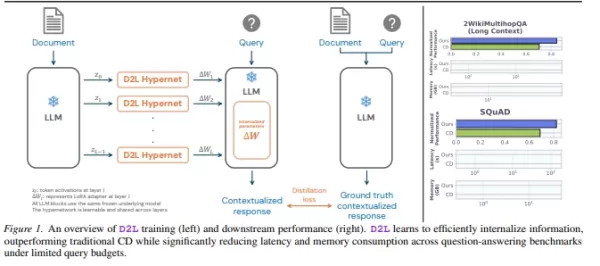
AI developers have long faced a difficult trade-off: cramming lengthy documents into a chat window—which slows responses and consumes high memory—or paying the high cost of fine-tuning a model. Sakana AI introduces a third option. Through a one-time payment for pre-training, it generates minuscule weight plugins (LoRA) to achieve low-cost, efficient model adaptation.
Doc-to-LoRA: Memory Needs Drop from 12GB to Just 50MB
This represents the most impressive technology in the latest release. Processing a 128,000-token document (roughly 100,000 words) with traditional methods demands over 12GB of VRAM to store information. With D2L, the model can directly "digest" this information into a plugin smaller than 50MB.
Remarkable Speed: Legacy technology requires 40 to 100 seconds to process a document, while D2L accomplishes it in under 1 second.
Pushing Boundaries: It allows models to handle text up to four times longer than their original context window, achieving near-perfect accuracy in "needle-in-a-haystack" retrieval tests.
Text-to-LoRA: Tailor AI with Everyday Language
Text-to-LoRA makes models more responsive. Users simply describe a task in natural language—for example, "help me solve a complex math competition problem"—and the system automatically generates a dedicated plugin to enhance performance. Experiments reveal that adapters created this way can outperform dedicated models trained from scratch on math and logical reasoning tasks.
Powerful Cross-Modal Tech: Enabling Text Models to "See" Images
Researchers discovered an unexpected bonus: D2L exhibits strong cross-modal abilities. By mapping visual information into the parameters of a pure text model, a model that has never processed images before can classify them with an accuracy of **75.03%**.
Sakana AI’s accomplishments significantly lower the barrier for individuals and companies to customize private AI models. They also pave a new way toward developing more lightweight and intelligent general artificial intelligence (AGI).
Paper: https://arxiv.org/pdf/2602.15902
Related article
 Six Tech Giants Back Linux Foundation With $12.5M to Tackle AI Vulnerability Noise
To tackle the flood of low-quality security reports produced by AI automation tools, six major tech companies—Anthropic, Amazon (AWS), GitHub, Google, Microsoft, and OpenAI—have collectively contributed $12.5 million in funding to Linux Foundation in
Musk Considered Leaving OpenAI to His Kids as Altman Testifies
This morning, OpenAI CEO Sam Altman took the stand to address former co-founder Elon Musk’s lawsuit challenging the company’s corporate structure.When asked about Musk’s claim that other founders “stole a charity” by launching a for-profit subsidiary
Sam Altman Sparks Debate Over AI's Deceleration
Listen onApple PodcastsListen onSpotifyOpenAI CEO Sam Altman recently suggested that it may be time to “pace the rate of AI development” to allow society to “harden around some of these new capability levels.”On the latest episode of TechCrunch’s Equ
Related Special Topic Recommendations
Business
Six Tech Giants Back Linux Foundation With $12.5M to Tackle AI Vulnerability Noise
To tackle the flood of low-quality security reports produced by AI automation tools, six major tech companies—Anthropic, Amazon (AWS), GitHub, Google, Microsoft, and OpenAI—have collectively contributed $12.5 million in funding to Linux Foundation in
Musk Considered Leaving OpenAI to His Kids as Altman Testifies
This morning, OpenAI CEO Sam Altman took the stand to address former co-founder Elon Musk’s lawsuit challenging the company’s corporate structure.When asked about Musk’s claim that other founders “stole a charity” by launching a for-profit subsidiary
Sam Altman Sparks Debate Over AI's Deceleration
Listen onApple PodcastsListen onSpotifyOpenAI CEO Sam Altman recently suggested that it may be time to “pace the rate of AI development” to allow society to “harden around some of these new capability levels.”On the latest episode of TechCrunch’s Equ
Related Special Topic Recommendations
Business
 Best AI Competitive Research Tools for Small Businesses
2026 Latest Best Top-rated AI Competitive Research Tools for Small Businesses! XIX.AI has curated a highly powerful game-changing collection, updated weekly with rigorous real-world tests and detailed rankings. You can find a comprehensive free vs paid comparison to help you identify the must-try tools that boost your productivity and give you a competitive edge. Explore now to discover your perfect tool!
 9 tools
 xix.ai
Image editing
Photoshop AI Retouch Tools for Ecommerce Apparel, Skin Cleanup, and Color Consistency
xix.ai
Image editing
Photoshop AI Retouch Tools for Ecommerce Apparel, Skin Cleanup, and Color Consistency
2026 Latest Best Photoshop AI retouch tools for ecommerce apparel, skin cleanup, and color consistency! This top-rated curated list features powerful game-changing solutions that help you boost writing efficiency, streamline content creation, and achieve perfect visual results effortlessly. Each tool has undergone real-world tests through weekly updated rankings, complete with free vs paid comparison details. Backed by XIX.AI, it’s the must-try guide for anyone aiming to unlock your AI edge. Explore now!
10 tools
xix.ai
Prompt
Best AI Prompt Libraries for ChatGPT Workflows
2026 Latest Best Top-Rated AI Prompt Libraries for optimizing all types of ChatGPT workflows. XIX.AI has curated a powerful, game-changing collection that goes through rigorous real-world tests to ensure top performance. You can find detailed free vs paid comparisons and expert rankings to help you choose the must-try tools that boost your productivity and unlock your AI edge. Explore now!
11 tools
xix.ai
Education and Learning
AI Quiz Builder Platforms for Teachers, Tutors, and Cohort-Based Learning Programs
2026 Latest Best AI Quiz Builder Platforms for Teachers, Tutors, and Cohort-Based Learning Programs! XIX.AI has curated a top-rated list of powerful game-changing tools that go through real-world tests to deliver accurate rankings. These must-try platforms help boost writing efficiency, streamline content creation, and simplify quiz design across all learning scenarios. Explore now to discover your perfect tool for unlocking your AI edge in teaching!
13 tools
xix.ai
code
AI Pull Request Review Tools for GitHub Teams Handling Refactors, Bugs, and Security Gaps
2026 Latest Best AI Pull Request Review Tools for GitHub Teams are here on XIX.AI! This top-rated curated list showcases powerful game-changing solutions that streamline refactoring, bug fixing, and security gap detection across all team workflows. Enjoy a free vs paid comparison along with real-world tests and detailed rankings to help you find the perfect tool that boosts productivity significantly. Explore now to unlock your AI edge!
12 tools
xix.ai
Text-to-speech
Best AI Text to Speech Tools for Natural Voiceovers
2026 Latest Best Top-rated AI Text to Speech Tools for Natural Voiceovers are here on XIX.AI! This curated list features powerful, game-changing options that deliver crystal-clear voices for every use case, backed by real-world tests and weekly updated rankings. Get a free vs paid comparison to find the must-try solution that boosts your productivity instantly. Explore now to Unlock your AI edge!
11 tools
xix.ai

 Comments (0)
0/500
Comments (0)
0/500
Large language models' struggle with processing long texts, often called "memory anxiety," may soon be a thing of the past. Recently, Tokyo-based AI startup Sakana AI unveiled two breakthrough technologies: Text-to-LoRA (T2L) and Doc-to-LoRA (D2L). Utilizing an innovative "super network" architecture, these technologies enable large models to "absorb" massive documents or learn new tasks in under a second, all without retraining.
AI developers have long faced a difficult trade-off: cramming lengthy documents into a chat window—which slows responses and consumes high memory—or paying the high cost of fine-tuning a model. Sakana AI introduces a third option. Through a one-time payment for pre-training, it generates minuscule weight plugins (LoRA) to achieve low-cost, efficient model adaptation.
Doc-to-LoRA: Memory Needs Drop from 12GB to Just 50MB
This represents the most impressive technology in the latest release. Processing a 128,000-token document (roughly 100,000 words) with traditional methods demands over 12GB of VRAM to store information. With D2L, the model can directly "digest" this information into a plugin smaller than 50MB.
Remarkable Speed: Legacy technology requires 40 to 100 seconds to process a document, while D2L accomplishes it in under 1 second.
Pushing Boundaries: It allows models to handle text up to four times longer than their original context window, achieving near-perfect accuracy in "needle-in-a-haystack" retrieval tests.
Text-to-LoRA: Tailor AI with Everyday Language
Text-to-LoRA makes models more responsive. Users simply describe a task in natural language—for example, "help me solve a complex math competition problem"—and the system automatically generates a dedicated plugin to enhance performance. Experiments reveal that adapters created this way can outperform dedicated models trained from scratch on math and logical reasoning tasks.
Powerful Cross-Modal Tech: Enabling Text Models to "See" Images
Researchers discovered an unexpected bonus: D2L exhibits strong cross-modal abilities. By mapping visual information into the parameters of a pure text model, a model that has never processed images before can classify them with an accuracy of **75.03%**.
Sakana AI’s accomplishments significantly lower the barrier for individuals and companies to customize private AI models. They also pave a new way toward developing more lightweight and intelligent general artificial intelligence (AGI).
Paper: https://arxiv.org/pdf/2602.15902








 Six Tech Giants Back Linux Foundation With $12.5M to Tackle AI Vulnerability Noise
To tackle the flood of low-quality security reports produced by AI automation tools, six major tech companies—Anthropic, Amazon (AWS), GitHub, Google, Microsoft, and OpenAI—have collectively contributed $12.5 million in funding to Linux Foundation in
Six Tech Giants Back Linux Foundation With $12.5M to Tackle AI Vulnerability Noise
To tackle the flood of low-quality security reports produced by AI automation tools, six major tech companies—Anthropic, Amazon (AWS), GitHub, Google, Microsoft, and OpenAI—have collectively contributed $12.5 million in funding to Linux Foundation in
 Musk Considered Leaving OpenAI to His Kids as Altman Testifies
This morning, OpenAI CEO Sam Altman took the stand to address former co-founder Elon Musk’s lawsuit challenging the company’s corporate structure.When asked about Musk’s claim that other founders “stole a charity” by launching a for-profit subsidiary
Musk Considered Leaving OpenAI to His Kids as Altman Testifies
This morning, OpenAI CEO Sam Altman took the stand to address former co-founder Elon Musk’s lawsuit challenging the company’s corporate structure.When asked about Musk’s claim that other founders “stole a charity” by launching a for-profit subsidiary
 Sam Altman Sparks Debate Over AI's Deceleration
Listen onApple PodcastsListen onSpotifyOpenAI CEO Sam Altman recently suggested that it may be time to “pace the rate of AI development” to allow society to “harden around some of these new capability levels.”On the latest episode of TechCrunch’s Equ
Sam Altman Sparks Debate Over AI's Deceleration
Listen onApple PodcastsListen onSpotifyOpenAI CEO Sam Altman recently suggested that it may be time to “pace the rate of AI development” to allow society to “harden around some of these new capability levels.”On the latest episode of TechCrunch’s Equ

2026 Latest Best Top-rated AI Competitive Research Tools for Small Businesses! XIX.AI has curated a highly powerful game-changing collection, updated weekly with rigorous real-world tests and detailed rankings. You can find a comprehensive free vs paid comparison to help you identify the must-try tools that boost your productivity and give you a competitive edge. Explore now to discover your perfect tool!
9 tools
xix.ai

2026 Latest Best Photoshop AI retouch tools for ecommerce apparel, skin cleanup, and color consistency! This top-rated curated list features powerful game-changing solutions that help you boost writing efficiency, streamline content creation, and achieve perfect visual results effortlessly. Each tool has undergone real-world tests through weekly updated rankings, complete with free vs paid comparison details. Backed by XIX.AI, it’s the must-try guide for anyone aiming to unlock your AI edge. Explore now!
10 tools
xix.ai

2026 Latest Best Top-Rated AI Prompt Libraries for optimizing all types of ChatGPT workflows. XIX.AI has curated a powerful, game-changing collection that goes through rigorous real-world tests to ensure top performance. You can find detailed free vs paid comparisons and expert rankings to help you choose the must-try tools that boost your productivity and unlock your AI edge. Explore now!
11 tools
xix.ai

2026 Latest Best AI Quiz Builder Platforms for Teachers, Tutors, and Cohort-Based Learning Programs! XIX.AI has curated a top-rated list of powerful game-changing tools that go through real-world tests to deliver accurate rankings. These must-try platforms help boost writing efficiency, streamline content creation, and simplify quiz design across all learning scenarios. Explore now to discover your perfect tool for unlocking your AI edge in teaching!
13 tools
xix.ai

2026 Latest Best AI Pull Request Review Tools for GitHub Teams are here on XIX.AI! This top-rated curated list showcases powerful game-changing solutions that streamline refactoring, bug fixing, and security gap detection across all team workflows. Enjoy a free vs paid comparison along with real-world tests and detailed rankings to help you find the perfect tool that boosts productivity significantly. Explore now to unlock your AI edge!
12 tools
xix.ai

2026 Latest Best Top-rated AI Text to Speech Tools for Natural Voiceovers are here on XIX.AI! This curated list features powerful, game-changing options that deliver crystal-clear voices for every use case, backed by real-world tests and weekly updated rankings. Get a free vs paid comparison to find the must-try solution that boosts your productivity instantly. Explore now to Unlock your AI edge!
11 tools
xix.ai












