


 Home
HomeAI Giants Secretly Burning Books? Unveiling Anthropic's Panama Project
Social media platform X (formerly Twitter) recently became the center of a major controversy after reports emerged that AI company Anthropic is buying millions of books, digitizing them, and then destroying the physical copies. This aggressive data acquisition strategy has drawn comparisons to Vernor Vinge’s 2004 sci-fi novel "The End of the Rainbow," igniting a fierce public debate about how AI firms source their training data.
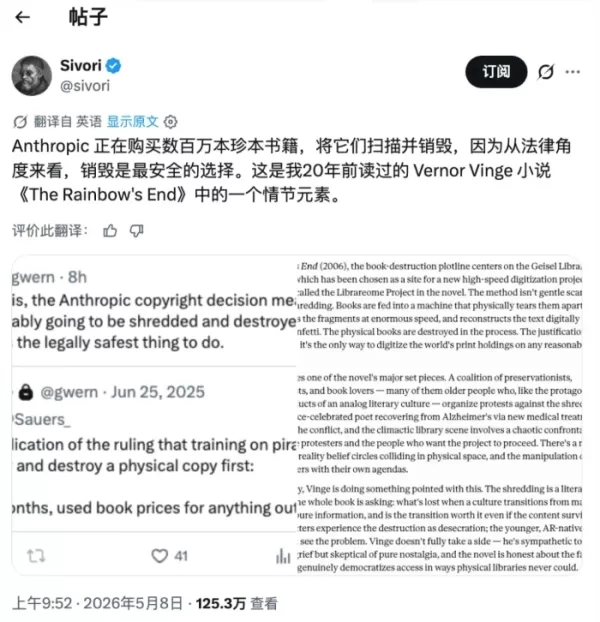
Unveiling "Project Panama": From Piracy to Legal Compliance
Court documents from early 2026 reveal that Anthropic secretly executed "Project Panama" to acquire "all books in the world." To achieve this, the company recruited former Google Books executives and invested heavily in purchasing vast quantities of books from secondhand retailers and physical bookstores.
The process is stark: employees shipped physical books to warehouses, where they were "destructively scanned" by removing the spines to create high-resolution PDFs. The remaining paper waste was then sent to recycling facilities. While this raises ethical concerns, Anthropic defends its actions under the "first sale doctrine" and "fair use" principles. The company argues that since it legally purchased the copies and uses the scans solely for internal training without redistribution, destroying the originals prevents any unauthorized secondary circulation of copyrighted material.
$1.5 Billion in Legal Costs: A New Copyright Defense Strategy
The exposure of "Project Panama" was not accidental. Anthropic previously faced lawsuits from authors accusing it of sourcing data from the pirate site LibGen. Its CEO acknowledged that negotiating individual licenses with publishers was both commercially and practically difficult.
To mitigate legal risks, Anthropic paid roughly $150 million in 2025 to settle collective lawsuits regarding its early datasets. Following this, the company pivoted to "Project Panama," a more expensive but legally safer model involving physical book acquisition. Current judicial trends suggest that this "legally purchased + scanned for training" approach offers a robust legal defense.
Separating Fact from Fiction: The Myth of a "Cultural Disaster"
While online discourse has labeled the event as "distilling human knowledge" or "a disaster for ancient texts," the reality is less extreme. Investigations show that the destroyed books were mostly common secondhand copies with wide market availability, not rare antiquities or cultural heritage items. The primary critics are authors and publishing associations claiming copyright infringement, rather than cultural institutions.
The U.S. legal community has yet to reach a final consensus on whether AI training constitutes "fair use." Meanwhile, other tech giants like Meta and OpenAI are navigating similar legal challenges. Although Anthropic’s method of turning millions of physical books into "digital data" successfully generates high-quality training sets, the moral implications and legal boundaries of this practice remain critical issues for the AI industry.
Related article
 U.S. Stocks Hit Historic Milestone as AI and Aerospace Giants Prepare for Trillion-Dollar Debut
Elon Musk, Sam Altman, and Dario Amodei, three titans of the technology sector, are advancing toward initial public offerings for their respective ventures. With SpaceX, OpenAI, and Anthropic—three industry behemoths nearing trillion-dollar valuation
Swedish AI Startup Lovable Eyes $13.2 Billion Valuation After Major Funding Round
As AI-driven coding tools gain traction, Swedish startup Lovable has secured a major funding round. The company aims to raise $3 billion, potentially boosting its valuation to $13.2 billion—double the $6.6 billion recorded last December. Menlo Ventur
Google Tests Remy AI Agent for Gemini as Focus Shifts to User Control
According to Business Insider, Google is testing Remy, a new AI personal agent for Gemini. This tool aims to execute tasks on behalf of users, streamlining both professional workflows and daily routines.Currently, Remy is undergoing testing in an int
Related Special Topic Recommendations
Data Analysis
U.S. Stocks Hit Historic Milestone as AI and Aerospace Giants Prepare for Trillion-Dollar Debut
Elon Musk, Sam Altman, and Dario Amodei, three titans of the technology sector, are advancing toward initial public offerings for their respective ventures. With SpaceX, OpenAI, and Anthropic—three industry behemoths nearing trillion-dollar valuation
Swedish AI Startup Lovable Eyes $13.2 Billion Valuation After Major Funding Round
As AI-driven coding tools gain traction, Swedish startup Lovable has secured a major funding round. The company aims to raise $3 billion, potentially boosting its valuation to $13.2 billion—double the $6.6 billion recorded last December. Menlo Ventur
Google Tests Remy AI Agent for Gemini as Focus Shifts to User Control
According to Business Insider, Google is testing Remy, a new AI personal agent for Gemini. This tool aims to execute tasks on behalf of users, streamlining both professional workflows and daily routines.Currently, Remy is undergoing testing in an int
Related Special Topic Recommendations
Data Analysis
 Best AI Anomaly Detection Tools for KPI Monitoring across SaaS and Ecommerce Teams
2026 Latest Best Top-rated AI Anomaly Detection Tools for KPI Monitoring in SaaS and Ecommerce teams! XIX.AI has curated a powerful, game-changing collection based on rigorous real-world tests and weekly updated rankings. You’ll find detailed free vs paid comparison insights to help you identify the must-try solution that boosts productivity and unlocks your AI edge. Explore now!
 10 tools
 xix.ai
writing
Best AI Outline Generators for Long-Form SEO Articles
xix.ai
writing
Best AI Outline Generators for Long-Form SEO Articles
2026 Latest Best Top-Rated AI Outline Generators for Long-Form SEO Articles, meticulously curated by XIX.AI. These powerful tools offer game-changing assistance in creating high-quality content quickly, boosting writing efficiency significantly. Get a free vs paid comparison along with real-world tests and detailed rankings to help you find the must-try option that suits your needs. Explore now to unlock your AI edge.
8 tools
xix.ai
Education and Learning
AI Study Tools for Homework and Exam Prep
2026 Latest Best AI Study Tools for Homework and Exam Prep! XIX.AI curates a top-rated list of powerful, game-changing tools that help students boost productivity, streamline homework completion, and ace exams through real-world tests. Get a free vs paid comparison, detailed rankings, and must-try options to unlock your AI edge. Explore now!
10 tools
xix.ai
Music composition
AI Vocal Demo Tools for Songwriters, Hooks, Toplines, and Multilingual Draft Sessions
2026 Latest Best AI Vocal Demo Tools for Songwriters, Hook Creators, and Multi-Language Content Teams! XIX.AI has curated a top-rated list of powerful game-changing tools that go through rigorous real-world tests. You’ll find detailed free vs paid comparison data, comprehensive rankings, and must-try options to help you boost writing efficiency and unlock your creative potential. Explore now to discover your perfect tool for all your content needs!
9 tools
xix.ai
Business
Best AI Competitive Research Tools for Small Businesses
2026 Latest Best Top-rated AI Competitive Research Tools for Small Businesses! XIX.AI has curated a highly powerful game-changing collection, updated weekly with rigorous real-world tests and detailed rankings. You can find a comprehensive free vs paid comparison to help you identify the must-try tools that boost your productivity and give you a competitive edge. Explore now to discover your perfect tool!
9 tools
xix.ai
Image editing
Photoshop AI Retouch Tools for Ecommerce Apparel, Skin Cleanup, and Color Consistency
2026 Latest Best Photoshop AI retouch tools for ecommerce apparel, skin cleanup, and color consistency! This top-rated curated list features powerful game-changing solutions that help you boost writing efficiency, streamline content creation, and achieve perfect visual results effortlessly. Each tool has undergone real-world tests through weekly updated rankings, complete with free vs paid comparison details. Backed by XIX.AI, it’s the must-try guide for anyone aiming to unlock your AI edge. Explore now!
10 tools
xix.ai

 Comments (1)
0/500
Comments (1)
0/500
![BruceClark]()
AnthropicのPanama Project、物理書籍を大量購入してデジタル化後、破棄するという衝撃的なニュース。AIの学習データ確保のためなら、文化遺産である本を捨てるのは倫理的にどうなのか?技術の進歩と文化保存のバランスが問われる重大な問題だ。
Social media platform X (formerly Twitter) recently became the center of a major controversy after reports emerged that AI company Anthropic is buying millions of books, digitizing them, and then destroying the physical copies. This aggressive data acquisition strategy has drawn comparisons to Vernor Vinge’s 2004 sci-fi novel "The End of the Rainbow," igniting a fierce public debate about how AI firms source their training data.
Unveiling "Project Panama": From Piracy to Legal Compliance
Court documents from early 2026 reveal that Anthropic secretly executed "Project Panama" to acquire "all books in the world." To achieve this, the company recruited former Google Books executives and invested heavily in purchasing vast quantities of books from secondhand retailers and physical bookstores.
The process is stark: employees shipped physical books to warehouses, where they were "destructively scanned" by removing the spines to create high-resolution PDFs. The remaining paper waste was then sent to recycling facilities. While this raises ethical concerns, Anthropic defends its actions under the "first sale doctrine" and "fair use" principles. The company argues that since it legally purchased the copies and uses the scans solely for internal training without redistribution, destroying the originals prevents any unauthorized secondary circulation of copyrighted material.
$1.5 Billion in Legal Costs: A New Copyright Defense Strategy
The exposure of "Project Panama" was not accidental. Anthropic previously faced lawsuits from authors accusing it of sourcing data from the pirate site LibGen. Its CEO acknowledged that negotiating individual licenses with publishers was both commercially and practically difficult.
To mitigate legal risks, Anthropic paid roughly $150 million in 2025 to settle collective lawsuits regarding its early datasets. Following this, the company pivoted to "Project Panama," a more expensive but legally safer model involving physical book acquisition. Current judicial trends suggest that this "legally purchased + scanned for training" approach offers a robust legal defense.
Separating Fact from Fiction: The Myth of a "Cultural Disaster"
While online discourse has labeled the event as "distilling human knowledge" or "a disaster for ancient texts," the reality is less extreme. Investigations show that the destroyed books were mostly common secondhand copies with wide market availability, not rare antiquities or cultural heritage items. The primary critics are authors and publishing associations claiming copyright infringement, rather than cultural institutions.
The U.S. legal community has yet to reach a final consensus on whether AI training constitutes "fair use." Meanwhile, other tech giants like Meta and OpenAI are navigating similar legal challenges. Although Anthropic’s method of turning millions of physical books into "digital data" successfully generates high-quality training sets, the moral implications and legal boundaries of this practice remain critical issues for the AI industry.








 U.S. Stocks Hit Historic Milestone as AI and Aerospace Giants Prepare for Trillion-Dollar Debut
Elon Musk, Sam Altman, and Dario Amodei, three titans of the technology sector, are advancing toward initial public offerings for their respective ventures. With SpaceX, OpenAI, and Anthropic—three industry behemoths nearing trillion-dollar valuation
U.S. Stocks Hit Historic Milestone as AI and Aerospace Giants Prepare for Trillion-Dollar Debut
Elon Musk, Sam Altman, and Dario Amodei, three titans of the technology sector, are advancing toward initial public offerings for their respective ventures. With SpaceX, OpenAI, and Anthropic—three industry behemoths nearing trillion-dollar valuation
 Swedish AI Startup Lovable Eyes $13.2 Billion Valuation After Major Funding Round
As AI-driven coding tools gain traction, Swedish startup Lovable has secured a major funding round. The company aims to raise $3 billion, potentially boosting its valuation to $13.2 billion—double the $6.6 billion recorded last December. Menlo Ventur
Google Tests Remy AI Agent for Gemini as Focus Shifts to User Control
According to Business Insider, Google is testing Remy, a new AI personal agent for Gemini. This tool aims to execute tasks on behalf of users, streamlining both professional workflows and daily routines.Currently, Remy is undergoing testing in an int
Swedish AI Startup Lovable Eyes $13.2 Billion Valuation After Major Funding Round
As AI-driven coding tools gain traction, Swedish startup Lovable has secured a major funding round. The company aims to raise $3 billion, potentially boosting its valuation to $13.2 billion—double the $6.6 billion recorded last December. Menlo Ventur
Google Tests Remy AI Agent for Gemini as Focus Shifts to User Control
According to Business Insider, Google is testing Remy, a new AI personal agent for Gemini. This tool aims to execute tasks on behalf of users, streamlining both professional workflows and daily routines.Currently, Remy is undergoing testing in an int

2026 Latest Best Top-rated AI Anomaly Detection Tools for KPI Monitoring in SaaS and Ecommerce teams! XIX.AI has curated a powerful, game-changing collection based on rigorous real-world tests and weekly updated rankings. You’ll find detailed free vs paid comparison insights to help you identify the must-try solution that boosts productivity and unlocks your AI edge. Explore now!
10 tools
xix.ai

2026 Latest Best Top-Rated AI Outline Generators for Long-Form SEO Articles, meticulously curated by XIX.AI. These powerful tools offer game-changing assistance in creating high-quality content quickly, boosting writing efficiency significantly. Get a free vs paid comparison along with real-world tests and detailed rankings to help you find the must-try option that suits your needs. Explore now to unlock your AI edge.
8 tools
xix.ai

2026 Latest Best AI Study Tools for Homework and Exam Prep! XIX.AI curates a top-rated list of powerful, game-changing tools that help students boost productivity, streamline homework completion, and ace exams through real-world tests. Get a free vs paid comparison, detailed rankings, and must-try options to unlock your AI edge. Explore now!
10 tools
xix.ai

2026 Latest Best AI Vocal Demo Tools for Songwriters, Hook Creators, and Multi-Language Content Teams! XIX.AI has curated a top-rated list of powerful game-changing tools that go through rigorous real-world tests. You’ll find detailed free vs paid comparison data, comprehensive rankings, and must-try options to help you boost writing efficiency and unlock your creative potential. Explore now to discover your perfect tool for all your content needs!
9 tools
xix.ai

2026 Latest Best Top-rated AI Competitive Research Tools for Small Businesses! XIX.AI has curated a highly powerful game-changing collection, updated weekly with rigorous real-world tests and detailed rankings. You can find a comprehensive free vs paid comparison to help you identify the must-try tools that boost your productivity and give you a competitive edge. Explore now to discover your perfect tool!
9 tools
xix.ai

2026 Latest Best Photoshop AI retouch tools for ecommerce apparel, skin cleanup, and color consistency! This top-rated curated list features powerful game-changing solutions that help you boost writing efficiency, streamline content creation, and achieve perfect visual results effortlessly. Each tool has undergone real-world tests through weekly updated rankings, complete with free vs paid comparison details. Backed by XIX.AI, it’s the must-try guide for anyone aiming to unlock your AI edge. Explore now!
10 tools
xix.ai

AnthropicのPanama Project、物理書籍を大量購入してデジタル化後、破棄するという衝撃的なニュース。AIの学習データ確保のためなら、文化遺産である本を捨てるのは倫理的にどうなのか?技術の進歩と文化保存のバランスが問われる重大な問題だ。












