


 Home
HomeAI for fiction writers in 2025: what mistakes to avoid and tools to embrace?
In the dynamic world of fiction writing, artificial intelligence (AI) offers a range of new tools, presenting both exciting possibilities and significant concerns. Understanding the appropriate boundaries for AI is essential for any writer. This article examines the two areas where fiction writers should avoid using AI entirely and outlines three practical ways it can genuinely enhance the creative process. The goal is to foster a balanced approach, allowing writers to embrace this technology while safeguarding the originality and personal voice that lie at the heart of great storytelling. This guide is designed for writers navigating the AI landscape, helping them harness its power without compromising their artistic vision.
Key Points
Avoid using AI for the core act of writing to protect your unique authorial voice.
Do not depend on AI to generate original story ideas, as this often leads to generic narratives.
Use AI as a brainstorming tool to overcome creative blocks and spark inspiration.
Leverage AI for targeted writing exercises to practice and refine specific skills.
Employ AI for efficient preliminary research to gather background information quickly.
AI and Fiction Writing: Navigating the Ethical and Practical Cons
iderations
The Two Things Fiction Writers Should Never Use AI For
The advent of AI has ignited considerable discussion among fiction writers. While it provides various aids for the creative journey, two crucial areas must remain distinctly human to preserve a writer's authentic voice and originality.
1. Outsourcing the Core Writing Act:
The very essence of fiction writing is the act of composing the narrative. Allowing AI to generate prose, craft dialogue, or paint descriptions dilutes the writer's personal perspective, voice, and unique style. It's akin to commissioning a machine to paint a portrait: the result may be technically sound, but it lacks the soul and emotional depth inherent to human artistry.
Cons
ider this analogy:Writing with AI Human Writing Often generic, lacking nuanceInherently unique, shaped by personal experienceAlgorithmic and predictableEmotionally resonant and surprisingEfficient yet impersonalImperfect, but deeply meaningful2. Generating Core Story Ideas:
Although AI can offer prompts, relying on it to conceive the foundational idea for a story frequently leads to formulaic and unoriginal plots. The most compelling narratives typically emerge from a writer's personal experiences, keen observations, and distinct worldview—elements beyond an AI's capacity to replicate. Letting an algorithm dictate your story's direction can stifle true creativity, yielding predictable and uninspired work. At its core, storytelling is about offering readers a fresh perspective on the world, which demands a human touch.
Embrace AI as a Tool, Not a Replacement
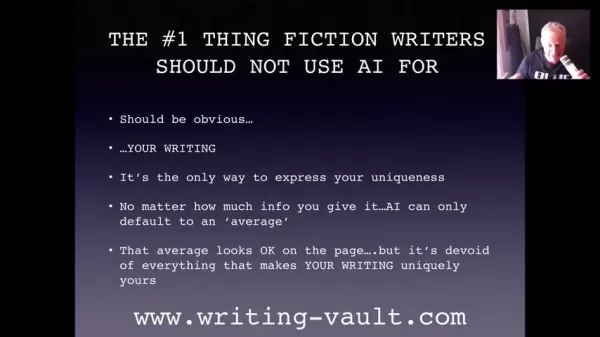
Rather than viewing AI as a substitute for human creativity, treat it as 'algorithmic intelligence'—a sophisticated tool, like an advanced predictive text function. Recognizing its limitations is crucial for using its strengths effectively without sacrificing what makes your writing uniquely valuable.
Training Data: The Caveat to AI's Potential
Understanding the Limitations of Training Data
AI models from companies like Anthropic and OpenAI are trained on vast datasets. A significant caveat is that this training data encompasses everything from masterpieces to mediocre content.
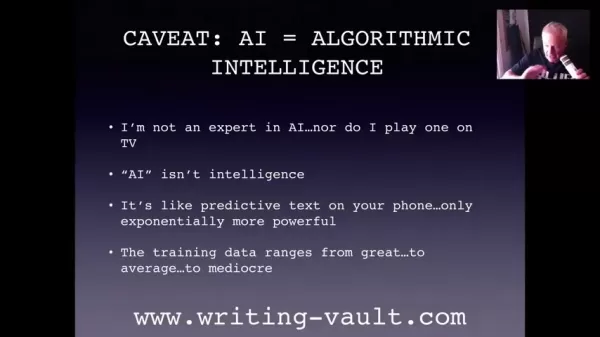
The AI's output is fundamentally shaped by training data of varying quality, with a substantial portion being average at best.The training data for these Large Language Models is not always weighted for quality, meaning literary classics might be treated with the same statistical importance as subpar online content. This can lead to a homogenized style and a deficit of true originality in AI-generated text.
For instance, if a model processes both Shakespeare and a poorly written blog post without proper quality weighting, it may not distinguish the vast qualitative chasm between them, potentially blending sublime language with bland prose.
It's vital to understand this not as genuine intelligence—which implies consciousness—but as highly sophisticated pattern recognition. This distinction is critical for determining appropriate and inappropriate uses of AI in writing.
Remember, AI's predictive power is derived from patterns in a training dataset containing material of inconsistent quality. This inherent constraint places a ceiling on the originality and depth of AI-generated content.
Therefore, considering AI as algorithmic intelligence, dependent entirely on its data inputs, provides a more accurate framework for its application.
Three ways Fiction Writers Can Use AI
24/7 Socratic Brainstorming Partner
One of AI's most powerful yet underdiscussed applications is acting as an always-available brainstorming interviewer. You can provide the AI with context or a detailed outline, and it will prompt you with relevant questions, record your answers, and then respond with deeper insights to further develop your ideas. The core concept is to use the AI to interrogate your outline, helping you flesh out details and uncover new narrative possibilities through guided dialogue.
Training and Practice
AI can be an excellent partner for focused writing exercises. You can practice specific techniques, such as crafting dialogue in a particular genre or refining descriptive passages.
. This targeted practice hones your skills and naturally improves the quality of your work.
As humans, we possess an internal narrative processor that weaves compelling stories from seemingly disparate ideas. Cultivating this innate ability is the source of truly unique and engaging fiction.
Quick and Easy ResearchFor background details that need only be generally accurate to add verisimilitude to your story, AI excels at rapid information retrieval. Instead of deep analysis, you can ask simple, factual questions to gather color and texture for your setting. Useful applications include:- Rough Price Estimations: Getting an approximate cost for an item in a specific historical period or location to add authenticity.
- General Information Checks: Quickly confirming basic facts relevant to your story's backdrop or subject matter.
AI for Writing: Pros
and Cons
Pros
Excellent for brainstorming and overcoming creative blocks
Significantly speeds up preliminary research
Useful for targeted skill development and writing exercises
Cons
Risks diluting a writer's unique style and voice
Can produce formulaic and unoriginal content
Output quality is constrained by its often-uneven training data
FAQ
What is AI's biggest weakness as a writer?
AI's most significant limitation is its inherent lack of a meaningful personal worldview and capacity for genuine self-expression. While it can achieve technical accuracy, its absence of lived experience, empathy, and true creative insight severely limits its ability to craft compelling, emotionally resonant narratives.
What kind of training is needed to be a good fiction writer?
Becoming a proficient fiction writer requires deliberate, consistent practice to develop both mental and physical creative skills. While abundant resources exist to guide improvement, there is no substitute for the dedicated, hands-on work of writing, revising, and learning the craft.
Why shouldn’t AI be used for generating story ideas?
Although AI can function as a persistent brainstorming aid, its ideas are often derivative, drawing from a training dataset that may be formulaic or of middling quality. Lacking personal experience, emotional depth, and true insight, it struggles to formulate coherent, original, and personally meaningful story concepts.
Related Questions
What are the best AI tools for writing?
A variety of AI tools can assist writers with different aspects of their work, including:Grammarly: An AI-powered assistant that checks for grammar, spelling, punctuation, and style issues.ProWritingAid: An advanced editor offering deep analysis and suggestions for improving grammar, style, and word choice.Jasper: A content generation tool capable of producing drafts for blog posts, social media content, and advertising copy.Rytr: A writing assistant designed to help create engaging content for blogs, emails, and social platforms.Copy.ai: An AI-powered platform focused on generating marketing copy, product descriptions, and website content.
Related article
 U.S. Stocks Hit Historic Milestone as AI and Aerospace Giants Prepare for Trillion-Dollar Debut
Elon Musk, Sam Altman, and Dario Amodei, three titans of the technology sector, are advancing toward initial public offerings for their respective ventures. With SpaceX, OpenAI, and Anthropic—three industry behemoths nearing trillion-dollar valuation
Swedish AI Startup Lovable Eyes $13.2 Billion Valuation After Major Funding Round
As AI-driven coding tools gain traction, Swedish startup Lovable has secured a major funding round. The company aims to raise $3 billion, potentially boosting its valuation to $13.2 billion—double the $6.6 billion recorded last December. Menlo Ventur
Google Tests Remy AI Agent for Gemini as Focus Shifts to User Control
According to Business Insider, Google is testing Remy, a new AI personal agent for Gemini. This tool aims to execute tasks on behalf of users, streamlining both professional workflows and daily routines.Currently, Remy is undergoing testing in an int
Related Special Topic Recommendations
Data Analysis
U.S. Stocks Hit Historic Milestone as AI and Aerospace Giants Prepare for Trillion-Dollar Debut
Elon Musk, Sam Altman, and Dario Amodei, three titans of the technology sector, are advancing toward initial public offerings for their respective ventures. With SpaceX, OpenAI, and Anthropic—three industry behemoths nearing trillion-dollar valuation
Swedish AI Startup Lovable Eyes $13.2 Billion Valuation After Major Funding Round
As AI-driven coding tools gain traction, Swedish startup Lovable has secured a major funding round. The company aims to raise $3 billion, potentially boosting its valuation to $13.2 billion—double the $6.6 billion recorded last December. Menlo Ventur
Google Tests Remy AI Agent for Gemini as Focus Shifts to User Control
According to Business Insider, Google is testing Remy, a new AI personal agent for Gemini. This tool aims to execute tasks on behalf of users, streamlining both professional workflows and daily routines.Currently, Remy is undergoing testing in an int
Related Special Topic Recommendations
Data Analysis
 Best AI Anomaly Detection Tools for KPI Monitoring across SaaS and Ecommerce Teams
2026 Latest Best Top-rated AI Anomaly Detection Tools for KPI Monitoring in SaaS and Ecommerce teams! XIX.AI has curated a powerful, game-changing collection based on rigorous real-world tests and weekly updated rankings. You’ll find detailed free vs paid comparison insights to help you identify the must-try solution that boosts productivity and unlocks your AI edge. Explore now!
 10 tools
 xix.ai
writing
Best AI Outline Generators for Long-Form SEO Articles
xix.ai
writing
Best AI Outline Generators for Long-Form SEO Articles
2026 Latest Best Top-Rated AI Outline Generators for Long-Form SEO Articles, meticulously curated by XIX.AI. These powerful tools offer game-changing assistance in creating high-quality content quickly, boosting writing efficiency significantly. Get a free vs paid comparison along with real-world tests and detailed rankings to help you find the must-try option that suits your needs. Explore now to unlock your AI edge.
8 tools
xix.ai
Education and Learning
AI Study Tools for Homework and Exam Prep
2026 Latest Best AI Study Tools for Homework and Exam Prep! XIX.AI curates a top-rated list of powerful, game-changing tools that help students boost productivity, streamline homework completion, and ace exams through real-world tests. Get a free vs paid comparison, detailed rankings, and must-try options to unlock your AI edge. Explore now!
10 tools
xix.ai
Music composition
AI Vocal Demo Tools for Songwriters, Hooks, Toplines, and Multilingual Draft Sessions
2026 Latest Best AI Vocal Demo Tools for Songwriters, Hook Creators, and Multi-Language Content Teams! XIX.AI has curated a top-rated list of powerful game-changing tools that go through rigorous real-world tests. You’ll find detailed free vs paid comparison data, comprehensive rankings, and must-try options to help you boost writing efficiency and unlock your creative potential. Explore now to discover your perfect tool for all your content needs!
9 tools
xix.ai
Business
Best AI Competitive Research Tools for Small Businesses
2026 Latest Best Top-rated AI Competitive Research Tools for Small Businesses! XIX.AI has curated a highly powerful game-changing collection, updated weekly with rigorous real-world tests and detailed rankings. You can find a comprehensive free vs paid comparison to help you identify the must-try tools that boost your productivity and give you a competitive edge. Explore now to discover your perfect tool!
9 tools
xix.ai
Image editing
Photoshop AI Retouch Tools for Ecommerce Apparel, Skin Cleanup, and Color Consistency
2026 Latest Best Photoshop AI retouch tools for ecommerce apparel, skin cleanup, and color consistency! This top-rated curated list features powerful game-changing solutions that help you boost writing efficiency, streamline content creation, and achieve perfect visual results effortlessly. Each tool has undergone real-world tests through weekly updated rankings, complete with free vs paid comparison details. Backed by XIX.AI, it’s the must-try guide for anyone aiming to unlock your AI edge. Explore now!
10 tools
xix.ai

 Comments (2)
0/500
Comments (2)
0/500
![JohnRoberts]()
Qué interesante el debate sobre los límites de la IA en la escritura creativa. Por un lado, herramientas como los generadores de tramas pueden ser un gran apoyo para romper bloqueos, pero también me pregunto: ¿hasta qué punto el estilo personal se diluye? Es un tema peliagudo, sobre todo para quienes buscan publicar. Me gustaría más análisis sobre cómo las editoriales están reaccionando a esto. 😅
![RoyMartínez]()
Als Hobbyautor finde ich den Artikel sehr hilfreich! 😊 Die Diskussion über KI-Grenzen ist besonders relevant – ich habe schon erlebt, wie KI meine Charakterentwicklung versehentlich eintönig gemacht hat. Vielleicht sollte man KI eher für Weltbuilding-Ideen nutzen als für Dialoge? Interessant, dass der Artikel 2025 erwähnt, ich frage mich, ob bis dahin mehr spezialisierte Tools für Genres wie Fantasy kommen werden.
In the dynamic world of fiction writing, artificial intelligence (AI) offers a range of new tools, presenting both exciting possibilities and significant concerns. Understanding the appropriate boundaries for AI is essential for any writer. This article examines the two areas where fiction writers should avoid using AI entirely and outlines three practical ways it can genuinely enhance the creative process. The goal is to foster a balanced approach, allowing writers to embrace this technology while safeguarding the originality and personal voice that lie at the heart of great storytelling. This guide is designed for writers navigating the AI landscape, helping them harness its power without compromising their artistic vision.
Key Points
Avoid using AI for the core act of writing to protect your unique authorial voice.
Do not depend on AI to generate original story ideas, as this often leads to generic narratives.
Use AI as a brainstorming tool to overcome creative blocks and spark inspiration.
Leverage AI for targeted writing exercises to practice and refine specific skills.
Employ AI for efficient preliminary research to gather background information quickly.
AI and Fiction Writing: Navigating the Ethical and Practical Cons
iderations
The Two Things Fiction Writers Should Never Use AI For
The advent of AI has ignited considerable discussion among fiction writers. While it provides various aids for the creative journey, two crucial areas must remain distinctly human to preserve a writer's authentic voice and originality.
1. Outsourcing the Core Writing Act:
The very essence of fiction writing is the act of composing the narrative. Allowing AI to generate prose, craft dialogue, or paint descriptions dilutes the writer's personal perspective, voice, and unique style. It's akin to commissioning a machine to paint a portrait: the result may be technically sound, but it lacks the soul and emotional depth inherent to human artistry.
Cons
ider this analogy:2. Generating Core Story Ideas:
Although AI can offer prompts, relying on it to conceive the foundational idea for a story frequently leads to formulaic and unoriginal plots. The most compelling narratives typically emerge from a writer's personal experiences, keen observations, and distinct worldview—elements beyond an AI's capacity to replicate. Letting an algorithm dictate your story's direction can stifle true creativity, yielding predictable and uninspired work. At its core, storytelling is about offering readers a fresh perspective on the world, which demands a human touch.
Embrace AI as a Tool, Not a Replacement
Rather than viewing AI as a substitute for human creativity, treat it as 'algorithmic intelligence'—a sophisticated tool, like an advanced predictive text function. Recognizing its limitations is crucial for using its strengths effectively without sacrificing what makes your writing uniquely valuable.
Training Data: The Caveat to AI's Potential
Understanding the Limitations of Training Data
AI models from companies like Anthropic and OpenAI are trained on vast datasets. A significant caveat is that this training data encompasses everything from masterpieces to mediocre content.
The AI's output is fundamentally shaped by training data of varying quality, with a substantial portion being average at best.The training data for these Large Language Models is not always weighted for quality, meaning literary classics might be treated with the same statistical importance as subpar online content. This can lead to a homogenized style and a deficit of true originality in AI-generated text.
For instance, if a model processes both Shakespeare and a poorly written blog post without proper quality weighting, it may not distinguish the vast qualitative chasm between them, potentially blending sublime language with bland prose.
It's vital to understand this not as genuine intelligence—which implies consciousness—but as highly sophisticated pattern recognition. This distinction is critical for determining appropriate and inappropriate uses of AI in writing.
Remember, AI's predictive power is derived from patterns in a training dataset containing material of inconsistent quality. This inherent constraint places a ceiling on the originality and depth of AI-generated content.
Therefore, considering AI as algorithmic intelligence, dependent entirely on its data inputs, provides a more accurate framework for its application.
Three ways Fiction Writers Can Use AI
24/7 Socratic Brainstorming Partner
One of AI's most powerful yet underdiscussed applications is acting as an always-available brainstorming interviewer. You can provide the AI with context or a detailed outline, and it will prompt you with relevant questions, record your answers, and then respond with deeper insights to further develop your ideas. The core concept is to use the AI to interrogate your outline, helping you flesh out details and uncover new narrative possibilities through guided dialogue.
Training and Practice
AI can be an excellent partner for focused writing exercises. You can practice specific techniques, such as crafting dialogue in a particular genre or refining descriptive passages.
. This targeted practice hones your skills and naturally improves the quality of your work.
As humans, we possess an internal narrative processor that weaves compelling stories from seemingly disparate ideas. Cultivating this innate ability is the source of truly unique and engaging fiction.
Quick and Easy ResearchFor background details that need only be generally accurate to add verisimilitude to your story, AI excels at rapid information retrieval. Instead of deep analysis, you can ask simple, factual questions to gather color and texture for your setting. Useful applications include:- Rough Price Estimations: Getting an approximate cost for an item in a specific historical period or location to add authenticity.
- General Information Checks: Quickly confirming basic facts relevant to your story's backdrop or subject matter.
AI for Writing: Pros
and Cons
Pros
Pros
andCons
Excellent for brainstorming and overcoming creative blocks
Significantly speeds up preliminary research
Useful for targeted skill development and writing exercises
Cons
Risks diluting a writer's unique style and voice
Can produce formulaic and unoriginal content
Output quality is constrained by its often-uneven training data
FAQ
What is AI's biggest weakness as a writer?
AI's most significant limitation is its inherent lack of a meaningful personal worldview and capacity for genuine self-expression. While it can achieve technical accuracy, its absence of lived experience, empathy, and true creative insight severely limits its ability to craft compelling, emotionally resonant narratives.
What kind of training is needed to be a good fiction writer?
Becoming a proficient fiction writer requires deliberate, consistent practice to develop both mental and physical creative skills. While abundant resources exist to guide improvement, there is no substitute for the dedicated, hands-on work of writing, revising, and learning the craft.
Why shouldn’t AI be used for generating story ideas?
Although AI can function as a persistent brainstorming aid, its ideas are often derivative, drawing from a training dataset that may be formulaic or of middling quality. Lacking personal experience, emotional depth, and true insight, it struggles to formulate coherent, original, and personally meaningful story concepts.
Related Questions
What are the best AI tools for writing?
A variety of AI tools can assist writers with different aspects of their work, including:Grammarly: An AI-powered assistant that checks for grammar, spelling, punctuation, and style issues.ProWritingAid: An advanced editor offering deep analysis and suggestions for improving grammar, style, and word choice.Jasper: A content generation tool capable of producing drafts for blog posts, social media content, and advertising copy.Rytr: A writing assistant designed to help create engaging content for blogs, emails, and social platforms.Copy.ai: An AI-powered platform focused on generating marketing copy, product descriptions, and website content.








 U.S. Stocks Hit Historic Milestone as AI and Aerospace Giants Prepare for Trillion-Dollar Debut
Elon Musk, Sam Altman, and Dario Amodei, three titans of the technology sector, are advancing toward initial public offerings for their respective ventures. With SpaceX, OpenAI, and Anthropic—three industry behemoths nearing trillion-dollar valuation
U.S. Stocks Hit Historic Milestone as AI and Aerospace Giants Prepare for Trillion-Dollar Debut
Elon Musk, Sam Altman, and Dario Amodei, three titans of the technology sector, are advancing toward initial public offerings for their respective ventures. With SpaceX, OpenAI, and Anthropic—three industry behemoths nearing trillion-dollar valuation
 Swedish AI Startup Lovable Eyes $13.2 Billion Valuation After Major Funding Round
As AI-driven coding tools gain traction, Swedish startup Lovable has secured a major funding round. The company aims to raise $3 billion, potentially boosting its valuation to $13.2 billion—double the $6.6 billion recorded last December. Menlo Ventur
Google Tests Remy AI Agent for Gemini as Focus Shifts to User Control
According to Business Insider, Google is testing Remy, a new AI personal agent for Gemini. This tool aims to execute tasks on behalf of users, streamlining both professional workflows and daily routines.Currently, Remy is undergoing testing in an int
Swedish AI Startup Lovable Eyes $13.2 Billion Valuation After Major Funding Round
As AI-driven coding tools gain traction, Swedish startup Lovable has secured a major funding round. The company aims to raise $3 billion, potentially boosting its valuation to $13.2 billion—double the $6.6 billion recorded last December. Menlo Ventur
Google Tests Remy AI Agent for Gemini as Focus Shifts to User Control
According to Business Insider, Google is testing Remy, a new AI personal agent for Gemini. This tool aims to execute tasks on behalf of users, streamlining both professional workflows and daily routines.Currently, Remy is undergoing testing in an int
2026 Latest Best Top-rated AI Anomaly Detection Tools for KPI Monitoring in SaaS and Ecommerce teams! XIX.AI has curated a powerful, game-changing collection based on rigorous real-world tests and weekly updated rankings. You’ll find detailed free vs paid comparison insights to help you identify the must-try solution that boosts productivity and unlocks your AI edge. Explore now!
10 tools
xix.ai

2026 Latest Best Top-Rated AI Outline Generators for Long-Form SEO Articles, meticulously curated by XIX.AI. These powerful tools offer game-changing assistance in creating high-quality content quickly, boosting writing efficiency significantly. Get a free vs paid comparison along with real-world tests and detailed rankings to help you find the must-try option that suits your needs. Explore now to unlock your AI edge.
8 tools
xix.ai

2026 Latest Best AI Study Tools for Homework and Exam Prep! XIX.AI curates a top-rated list of powerful, game-changing tools that help students boost productivity, streamline homework completion, and ace exams through real-world tests. Get a free vs paid comparison, detailed rankings, and must-try options to unlock your AI edge. Explore now!
10 tools
xix.ai

2026 Latest Best AI Vocal Demo Tools for Songwriters, Hook Creators, and Multi-Language Content Teams! XIX.AI has curated a top-rated list of powerful game-changing tools that go through rigorous real-world tests. You’ll find detailed free vs paid comparison data, comprehensive rankings, and must-try options to help you boost writing efficiency and unlock your creative potential. Explore now to discover your perfect tool for all your content needs!
9 tools
xix.ai

2026 Latest Best Top-rated AI Competitive Research Tools for Small Businesses! XIX.AI has curated a highly powerful game-changing collection, updated weekly with rigorous real-world tests and detailed rankings. You can find a comprehensive free vs paid comparison to help you identify the must-try tools that boost your productivity and give you a competitive edge. Explore now to discover your perfect tool!
9 tools
xix.ai

2026 Latest Best Photoshop AI retouch tools for ecommerce apparel, skin cleanup, and color consistency! This top-rated curated list features powerful game-changing solutions that help you boost writing efficiency, streamline content creation, and achieve perfect visual results effortlessly. Each tool has undergone real-world tests through weekly updated rankings, complete with free vs paid comparison details. Backed by XIX.AI, it’s the must-try guide for anyone aiming to unlock your AI edge. Explore now!
10 tools
xix.ai

Qué interesante el debate sobre los límites de la IA en la escritura creativa. Por un lado, herramientas como los generadores de tramas pueden ser un gran apoyo para romper bloqueos, pero también me pregunto: ¿hasta qué punto el estilo personal se diluye? Es un tema peliagudo, sobre todo para quienes buscan publicar. Me gustaría más análisis sobre cómo las editoriales están reaccionando a esto. 😅
Als Hobbyautor finde ich den Artikel sehr hilfreich! 😊 Die Diskussion über KI-Grenzen ist besonders relevant – ich habe schon erlebt, wie KI meine Charakterentwicklung versehentlich eintönig gemacht hat. Vielleicht sollte man KI eher für Weltbuilding-Ideen nutzen als für Dialoge? Interessant, dass der Artikel 2025 erwähnt, ich frage mich, ob bis dahin mehr spezialisierte Tools für Genres wie Fantasy kommen werden.












