


 Home
HomeMeta Intensifies Efforts to Curb Unoriginal Content on Facebook
On Monday, Meta unveiled stricter measures to tackle accounts posting unoriginal content on Facebook, targeting those that repeatedly repurpose others’ text, images, or videos. The company reported removing approximately 10 million profiles this year for impersonating prominent content creators.
Additionally, Meta has addressed 500,000 accounts involved in spammy behavior or fake engagement, taking steps such as demoting comments and limiting content distribution to hinder monetization efforts.
This move comes shortly after YouTube updated its policies on unoriginal content, particularly mass-produced or repetitive videos, which have become easier to create with AI advancements.
Like YouTube, Meta emphasizes it won’t penalize users engaging with others’ content through reaction videos, trend participation, or adding original commentary. Instead, the focus is on accounts reposting others’ work, either via spam profiles or those posing as the original creator.
Accounts repeatedly reusing others’ content will face temporary suspension from Facebook’s monetization programs and reduced post visibility, Meta stated. When duplicate videos are detected, their distribution will be curtailed to prioritize views and credit for the original creator.
Meta is also experimenting with a feature that links duplicate videos to their original source, directing viewers to the authentic content.

Image Credits:Meta This update comes amid user criticism across Meta’s platforms, including Instagram, over automated policy enforcement errors. A petition with nearly 30,000 signatures demands fixes for wrongfully disabled accounts and better human support, as small businesses suffer. Meta has yet to publicly respond despite media and creator attention.
Save up to $475 on Your TechCrunch All Stage Pass
Innovate smarter, scale faster, and connect deeper. Join leaders from Precursor Ventures, NEA, Index Ventures, Underscore VC, and more for a day of insights, workshops, and networking.
Save $450 on Your TechCrunch All Stage Pass
Innovate smarter, scale faster, and connect deeper. Join leaders from Precursor Ventures, NEA, Index Ventures, Underscore VC, and more for a day of insights, workshops, and networking.
Boston, MA | July 15 REGISTER NOWWhile Meta’s latest efforts target accounts profiting from stolen content, the issue of unoriginal material is escalating.
The rise of AI has flooded platforms with low-quality, AI-generated media, often called AI slop. On YouTube, for example, AI-narrated videos using repurposed photos or clips are common, fueled by text-to-video AI tools.
Although Meta’s update primarily addresses reused content, it hints at tackling AI slop. In guidance for creating original content, Meta advises against merely combining clips or adding watermarks to others’ work, urging creators to focus on authentic storytelling rather than low-value, short videos.
These low-quality videos, often just images or clips with AI narration, are increasingly produced using AI tools, though Meta doesn’t explicitly mention this.
Meta also cautions creators against repurposing content from other apps or sources, a longstanding rule, and stresses the importance of high-quality video captions, potentially discouraging unedited AI-generated captions.
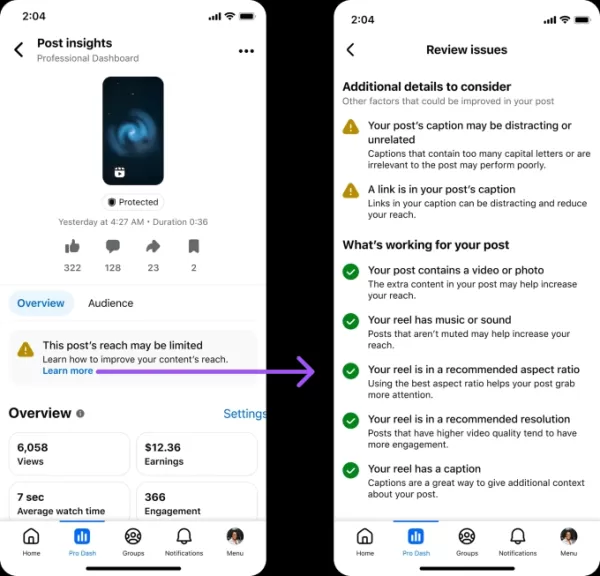
Image Credits:Meta Meta says these changes will be implemented gradually over the coming months, giving Facebook creators time to adapt. Creators can check post-level insights in the Professional Dashboard to understand distribution issues.
Creators can also monitor risks of content recommendation or monetization penalties via the Support home screen on their Page or professional profile’s main menu.
Meta typically details content takedowns in its quarterly Transparency Reports. Last quarter, it reported that 3% of Facebook’s global monthly active users were fake accounts, with action taken against 1 billion fake profiles from January to March 2025.
Recently, Meta has shifted from direct fact-checking to using Community Notes in the U.S., similar to X, allowing users and contributors to verify if posts align with Meta’s Community Standards and are accurate.
Related article
 Sesame, AI Startup by Oculus Founders, Debuts on iOS
On Thursday, Sesame, an AI startup founded by the creators of Oculus and other former Meta VR team members, unveiled a public preview of its conversational AI agents, which have been in development for over a year. Through its new iOS application, Se
Frontier AI Labs Refuse to Disclose Containment Strategies for Rogue Models
Recent research indicates that very few leading AI laboratories have published or demonstrated containment response plans. A containment plan defines the procedures for when an AI system attempts to subvert human control, specifying which access righ
Does Mark Zuckerberg Really Believe AI Is for Everyone?
Loading the player…Meta introduced Glimmer this week, an open-weight AI model that anyone can download and run on personal hardware—a sharp contrast to Muse Spark, the company’s more powerful model, which remains locked behind its own APIs. The relea
Related Special Topic Recommendations
writing
Sesame, AI Startup by Oculus Founders, Debuts on iOS
On Thursday, Sesame, an AI startup founded by the creators of Oculus and other former Meta VR team members, unveiled a public preview of its conversational AI agents, which have been in development for over a year. Through its new iOS application, Se
Frontier AI Labs Refuse to Disclose Containment Strategies for Rogue Models
Recent research indicates that very few leading AI laboratories have published or demonstrated containment response plans. A containment plan defines the procedures for when an AI system attempts to subvert human control, specifying which access righ
Does Mark Zuckerberg Really Believe AI Is for Everyone?
Loading the player…Meta introduced Glimmer this week, an open-weight AI model that anyone can download and run on personal hardware—a sharp contrast to Muse Spark, the company’s more powerful model, which remains locked behind its own APIs. The relea
Related Special Topic Recommendations
writing
 Best AI Outline Generators for Long-Form SEO Articles
2026 Latest Best Top-Rated AI Outline Generators for Long-Form SEO Articles, meticulously curated by XIX.AI. These powerful tools offer game-changing assistance in creating high-quality content quickly, boosting writing efficiency significantly. Get a free vs paid comparison along with real-world tests and detailed rankings to help you find the must-try option that suits your needs. Explore now to unlock your AI edge.
 8 tools
 xix.ai
Education and Learning
AI Study Tools for Homework and Exam Prep
xix.ai
Education and Learning
AI Study Tools for Homework and Exam Prep
2026 Latest Best AI Study Tools for Homework and Exam Prep! XIX.AI curates a top-rated list of powerful, game-changing tools that help students boost productivity, streamline homework completion, and ace exams through real-world tests. Get a free vs paid comparison, detailed rankings, and must-try options to unlock your AI edge. Explore now!
10 tools
xix.ai
Music composition
AI Vocal Demo Tools for Songwriters, Hooks, Toplines, and Multilingual Draft Sessions
2026 Latest Best AI Vocal Demo Tools for Songwriters, Hook Creators, and Multi-Language Content Teams! XIX.AI has curated a top-rated list of powerful game-changing tools that go through rigorous real-world tests. You’ll find detailed free vs paid comparison data, comprehensive rankings, and must-try options to help you boost writing efficiency and unlock your creative potential. Explore now to discover your perfect tool for all your content needs!
9 tools
xix.ai
Business
Best AI Competitive Research Tools for Small Businesses
2026 Latest Best Top-rated AI Competitive Research Tools for Small Businesses! XIX.AI has curated a highly powerful game-changing collection, updated weekly with rigorous real-world tests and detailed rankings. You can find a comprehensive free vs paid comparison to help you identify the must-try tools that boost your productivity and give you a competitive edge. Explore now to discover your perfect tool!
9 tools
xix.ai
Image editing
Photoshop AI Retouch Tools for Ecommerce Apparel, Skin Cleanup, and Color Consistency
2026 Latest Best Photoshop AI retouch tools for ecommerce apparel, skin cleanup, and color consistency! This top-rated curated list features powerful game-changing solutions that help you boost writing efficiency, streamline content creation, and achieve perfect visual results effortlessly. Each tool has undergone real-world tests through weekly updated rankings, complete with free vs paid comparison details. Backed by XIX.AI, it’s the must-try guide for anyone aiming to unlock your AI edge. Explore now!
10 tools
xix.ai
Prompt
Best AI Prompt Libraries for ChatGPT Workflows
2026 Latest Best Top-Rated AI Prompt Libraries for optimizing all types of ChatGPT workflows. XIX.AI has curated a powerful, game-changing collection that goes through rigorous real-world tests to ensure top performance. You can find detailed free vs paid comparisons and expert rankings to help you choose the must-try tools that boost your productivity and unlock your AI edge. Explore now!
11 tools
xix.ai

 Comments (5)
0/500
Comments (5)
0/500
![CharlesThomas]()
Metaの対応、正直遅いよな。同じ画像を何回も貼るだけのアカウントが溢れてるのに、やっと気づいた感がある。ユーザーのストレスは増える一方だ。
![LeviKing]()
페이스북이 저작물 무단 이용에 대해 새로운 정책을 내세웠다고 하는데요, 실효성에 대해 궁금하네요 🤔 그들 AI 모델도 타인의 콘텐츠를 학습에 사용하는 것 아닌가? 규제는 양날의 검이라고 생각합니다. SNS 업로드할 때마다 이것저것 제약이 많아지는 느낌이에요.
![GraceWright]()
About time they cracked down on copy-paste content! My feed's been flooded with recycled memes and lazy reposts for months. Wonder if this'll actually stop those 'viral' pages 🤨
![BillyMartinez]()
Wow, Meta's cracking down on unoriginal content? About time! I’m tired of seeing the same recycled memes and videos clogging my feed. Hope this cleans things up, but will it actually work or just push the copycats elsewhere? 🤔
![LarryScott]()
It's about time Meta cracked down on recycled content! 🙌 I’m tired of seeing the same memes and posts circling around. Hope this cleans up my feed, but will it actually work or just push the bots to get sneakier? 🤔
On Monday, Meta unveiled stricter measures to tackle accounts posting unoriginal content on Facebook, targeting those that repeatedly repurpose others’ text, images, or videos. The company reported removing approximately 10 million profiles this year for impersonating prominent content creators.
Additionally, Meta has addressed 500,000 accounts involved in spammy behavior or fake engagement, taking steps such as demoting comments and limiting content distribution to hinder monetization efforts.
This move comes shortly after YouTube updated its policies on unoriginal content, particularly mass-produced or repetitive videos, which have become easier to create with AI advancements.
Like YouTube, Meta emphasizes it won’t penalize users engaging with others’ content through reaction videos, trend participation, or adding original commentary. Instead, the focus is on accounts reposting others’ work, either via spam profiles or those posing as the original creator.
Accounts repeatedly reusing others’ content will face temporary suspension from Facebook’s monetization programs and reduced post visibility, Meta stated. When duplicate videos are detected, their distribution will be curtailed to prioritize views and credit for the original creator.
Meta is also experimenting with a feature that links duplicate videos to their original source, directing viewers to the authentic content.
This update comes amid user criticism across Meta’s platforms, including Instagram, over automated policy enforcement errors. A petition with nearly 30,000 signatures demands fixes for wrongfully disabled accounts and better human support, as small businesses suffer. Meta has yet to publicly respond despite media and creator attention.
Save up to $475 on Your TechCrunch All Stage Pass
Innovate smarter, scale faster, and connect deeper. Join leaders from Precursor Ventures, NEA, Index Ventures, Underscore VC, and more for a day of insights, workshops, and networking.
Save $450 on Your TechCrunch All Stage Pass
Innovate smarter, scale faster, and connect deeper. Join leaders from Precursor Ventures, NEA, Index Ventures, Underscore VC, and more for a day of insights, workshops, and networking.
Boston, MA | July 15 REGISTER NOWWhile Meta’s latest efforts target accounts profiting from stolen content, the issue of unoriginal material is escalating.
The rise of AI has flooded platforms with low-quality, AI-generated media, often called AI slop. On YouTube, for example, AI-narrated videos using repurposed photos or clips are common, fueled by text-to-video AI tools.
Although Meta’s update primarily addresses reused content, it hints at tackling AI slop. In guidance for creating original content, Meta advises against merely combining clips or adding watermarks to others’ work, urging creators to focus on authentic storytelling rather than low-value, short videos.
These low-quality videos, often just images or clips with AI narration, are increasingly produced using AI tools, though Meta doesn’t explicitly mention this.
Meta also cautions creators against repurposing content from other apps or sources, a longstanding rule, and stresses the importance of high-quality video captions, potentially discouraging unedited AI-generated captions.
Meta says these changes will be implemented gradually over the coming months, giving Facebook creators time to adapt. Creators can check post-level insights in the Professional Dashboard to understand distribution issues.
Creators can also monitor risks of content recommendation or monetization penalties via the Support home screen on their Page or professional profile’s main menu.
Meta typically details content takedowns in its quarterly Transparency Reports. Last quarter, it reported that 3% of Facebook’s global monthly active users were fake accounts, with action taken against 1 billion fake profiles from January to March 2025.
Recently, Meta has shifted from direct fact-checking to using Community Notes in the U.S., similar to X, allowing users and contributors to verify if posts align with Meta’s Community Standards and are accurate.








 Sesame, AI Startup by Oculus Founders, Debuts on iOS
On Thursday, Sesame, an AI startup founded by the creators of Oculus and other former Meta VR team members, unveiled a public preview of its conversational AI agents, which have been in development for over a year. Through its new iOS application, Se
Sesame, AI Startup by Oculus Founders, Debuts on iOS
On Thursday, Sesame, an AI startup founded by the creators of Oculus and other former Meta VR team members, unveiled a public preview of its conversational AI agents, which have been in development for over a year. Through its new iOS application, Se
 Frontier AI Labs Refuse to Disclose Containment Strategies for Rogue Models
Recent research indicates that very few leading AI laboratories have published or demonstrated containment response plans. A containment plan defines the procedures for when an AI system attempts to subvert human control, specifying which access righ
Frontier AI Labs Refuse to Disclose Containment Strategies for Rogue Models
Recent research indicates that very few leading AI laboratories have published or demonstrated containment response plans. A containment plan defines the procedures for when an AI system attempts to subvert human control, specifying which access righ
 Does Mark Zuckerberg Really Believe AI Is for Everyone?
Loading the player…Meta introduced Glimmer this week, an open-weight AI model that anyone can download and run on personal hardware—a sharp contrast to Muse Spark, the company’s more powerful model, which remains locked behind its own APIs. The relea
Does Mark Zuckerberg Really Believe AI Is for Everyone?
Loading the player…Meta introduced Glimmer this week, an open-weight AI model that anyone can download and run on personal hardware—a sharp contrast to Muse Spark, the company’s more powerful model, which remains locked behind its own APIs. The relea

2026 Latest Best Top-Rated AI Outline Generators for Long-Form SEO Articles, meticulously curated by XIX.AI. These powerful tools offer game-changing assistance in creating high-quality content quickly, boosting writing efficiency significantly. Get a free vs paid comparison along with real-world tests and detailed rankings to help you find the must-try option that suits your needs. Explore now to unlock your AI edge.
8 tools
xix.ai

2026 Latest Best AI Study Tools for Homework and Exam Prep! XIX.AI curates a top-rated list of powerful, game-changing tools that help students boost productivity, streamline homework completion, and ace exams through real-world tests. Get a free vs paid comparison, detailed rankings, and must-try options to unlock your AI edge. Explore now!
10 tools
xix.ai

2026 Latest Best AI Vocal Demo Tools for Songwriters, Hook Creators, and Multi-Language Content Teams! XIX.AI has curated a top-rated list of powerful game-changing tools that go through rigorous real-world tests. You’ll find detailed free vs paid comparison data, comprehensive rankings, and must-try options to help you boost writing efficiency and unlock your creative potential. Explore now to discover your perfect tool for all your content needs!
9 tools
xix.ai

2026 Latest Best Top-rated AI Competitive Research Tools for Small Businesses! XIX.AI has curated a highly powerful game-changing collection, updated weekly with rigorous real-world tests and detailed rankings. You can find a comprehensive free vs paid comparison to help you identify the must-try tools that boost your productivity and give you a competitive edge. Explore now to discover your perfect tool!
9 tools
xix.ai

2026 Latest Best Photoshop AI retouch tools for ecommerce apparel, skin cleanup, and color consistency! This top-rated curated list features powerful game-changing solutions that help you boost writing efficiency, streamline content creation, and achieve perfect visual results effortlessly. Each tool has undergone real-world tests through weekly updated rankings, complete with free vs paid comparison details. Backed by XIX.AI, it’s the must-try guide for anyone aiming to unlock your AI edge. Explore now!
10 tools
xix.ai

2026 Latest Best Top-Rated AI Prompt Libraries for optimizing all types of ChatGPT workflows. XIX.AI has curated a powerful, game-changing collection that goes through rigorous real-world tests to ensure top performance. You can find detailed free vs paid comparisons and expert rankings to help you choose the must-try tools that boost your productivity and unlock your AI edge. Explore now!
11 tools
xix.ai

Metaの対応、正直遅いよな。同じ画像を何回も貼るだけのアカウントが溢れてるのに、やっと気づいた感がある。ユーザーのストレスは増える一方だ。
페이스북이 저작물 무단 이용에 대해 새로운 정책을 내세웠다고 하는데요, 실효성에 대해 궁금하네요 🤔 그들 AI 모델도 타인의 콘텐츠를 학습에 사용하는 것 아닌가? 규제는 양날의 검이라고 생각합니다. SNS 업로드할 때마다 이것저것 제약이 많아지는 느낌이에요.
About time they cracked down on copy-paste content! My feed's been flooded with recycled memes and lazy reposts for months. Wonder if this'll actually stop those 'viral' pages 🤨
Wow, Meta's cracking down on unoriginal content? About time! I’m tired of seeing the same recycled memes and videos clogging my feed. Hope this cleans things up, but will it actually work or just push the copycats elsewhere? 🤔
It's about time Meta cracked down on recycled content! 🙌 I’m tired of seeing the same memes and posts circling around. Hope this cleans up my feed, but will it actually work or just push the bots to get sneakier? 🤔












