


 Home
HomexAI Unveils Grok’s Source Code: Build, Run Locally, and Inspect Every Tool Call
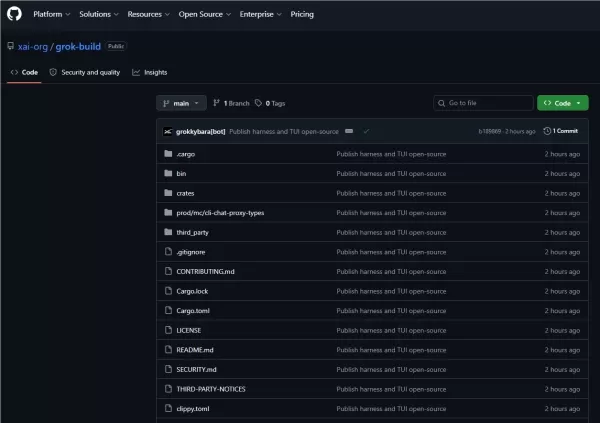
A significant development has occurred in the AI coding agent space. xAI has officially released Grok Build as open source. The complete source code for this coding agent, including its terminal user interface (TUI) developed by SpaceXAI, is now fully accessible on GitHub. This release goes beyond a symbolic gesture; it provides full transparency into the system’s architecture, exposing every layer for public review.
xAI’s rationale for open-sourcing is practical: making the code public is the most effective way to establish a robust and reliable execution framework. Previously, users had to trust a black box to generate code. Now, you can inspect the source code directly, observing how context is assembled, how model responses are parsed, and how tool calls are distributed. Every step is now transparent.
Furthermore, open sourcing enhances the framework’s explorability and extensibility. For developers working on skills, plugins, hooks, MCP servers, or subagents, this source code serves as the definitive guide. It provides precise implementation details rather than vague documentation, showing exactly how each component is loaded and invoked.
What particularly appeals to developers is Grok Build’s support for fully local-first operation. You can compile it from scratch, connect it to your own local inference service, and control all system behaviors via a config.toml file. This means you can run the agent entirely on your own machine without relying on any cloud infrastructure.
The released source code includes several critical components. First, the core agent loop logic, which details how context is assembled, responses are parsed, and tool calls are distributed—this is the system’s heartbeat. Second, the toolset implementation, demonstrating how the agent reads, edits, searches code, and executes commands. The terminal interface section covers rendering, input processing, plan review, and inline diff viewers, allowing you to track the origin and evolution of every change directly within the command line. Finally, the extension system, which explains how to integrate skills, plugins, hooks, MCP servers, and subagents—effectively providing the blueprints to customize and expand this platform.
Project repository: https://github.com/xai-org/grok-build
Related article
 Purdue Robotics Unveils PuduFM 1.0 and PuduAgent, Marking a New Era of Embodied Intelligence
In an era defined by the rapid advancement of AI and robotics, Pudu Robotics—a global leader in commercial service robots—has unveiled two groundbreaking advancements in embodied intelligence: PuduFM 1.0 and PuduAgent. These innovations highlight Pud
Baidu Kunlun Chip Set for Hong Kong Public Listing With $50 Billion Valuation Target
On June 29, the capital markets were shaken by significant news: Baidu’s AI chip subsidiary, Kunlun Tech, is fast-tracking its Hong Kong IPO, targeting a valuation of up to $50 billion. This move by Kunlun Tech—a cornerstone of Baidu’s AI hardware st
Instinct launches AI agent in group chats, including those with non-users
Instinct, the AI agent now valued at $10 billion following its latest funding round, is expanding into group chats. The startup announced on Monday that users can add the agent to conversations with friends, offering assistance in scenarios such as t
Related Special Topic Recommendations
Design & Art
Purdue Robotics Unveils PuduFM 1.0 and PuduAgent, Marking a New Era of Embodied Intelligence
In an era defined by the rapid advancement of AI and robotics, Pudu Robotics—a global leader in commercial service robots—has unveiled two groundbreaking advancements in embodied intelligence: PuduFM 1.0 and PuduAgent. These innovations highlight Pud
Baidu Kunlun Chip Set for Hong Kong Public Listing With $50 Billion Valuation Target
On June 29, the capital markets were shaken by significant news: Baidu’s AI chip subsidiary, Kunlun Tech, is fast-tracking its Hong Kong IPO, targeting a valuation of up to $50 billion. This move by Kunlun Tech—a cornerstone of Baidu’s AI hardware st
Instinct launches AI agent in group chats, including those with non-users
Instinct, the AI agent now valued at $10 billion following its latest funding round, is expanding into group chats. The startup announced on Monday that users can add the agent to conversations with friends, offering assistance in scenarios such as t
Related Special Topic Recommendations
Design & Art
 Top AI Illustration Tools: Create Editorial Scenes and Cover Art Faster
2026 Latest Top-rated AI Illustration Tools: Our curated list features the best powerfully designed tools for creating stunning editorial scenes and eye-catching cover art quickly. Each option has gone through rigorous real-world tests, offering a free vs paid comparison to help you find the perfect match for your workflow. Try these must-try solutions today to unlock your AI edge and boost your creative productivity. Explore now at XIX.AI.
 10 tools
 xix.ai
Education and Learning
Top AI Tutors for Exam Prep: Practice Math, Science, and English
xix.ai
Education and Learning
Top AI Tutors for Exam Prep: Practice Math, Science, and English
2026 Latest Top-Rated Best AI Tutors for Exam Prep are here on XIX.AI! Our curated list features powerful game-changing tools that offer free vs paid comparison, real-world tests, and weekly updated rankings. They help boost your writing efficiency, simplify complex topic learning, and unlock your academic potential. Explore now to Discover your perfect exam prep tool and Start creating today to Unlock your AI edge!
10 tools
xix.ai
Finance
AI Budget Planning Tools for Personal Money Management
2026 Latest Best Top-Rated AI Budget Planning Tools for Personal Money Management are here on XIX.AI! This curated collection features powerful, game-changing solutions that help you conduct real-world tests, understand spending habits, and create personalized plans to boost productivity. Enjoy a free vs paid comparison along with detailed rankings. Must-try tools designed to simplify money management and unlock your AI edge. Explore now!
11 tools
xix.ai
Health & Wellness
AI Sleep Tracking Assistants: Improve Recovery with Better Bedtime Habits
2026 Latest Best Top-Rated AI Sleep Tracking Assistants curated for ultimate recovery. This fully updated weekly guide features powerful tools that deliver real-world tests, free vs paid comparison, and detailed rankings to help you find the must-try solution that boosts sleep quality and supports better bedtime habits. Explore now at XIX.AI to Unlock your AI edge.
10 tools
xix.ai
Data Analysis
AI SQL Copilots for Product and Revenue Analytics
2026 Latest Best Top-Rated AI SQL Copilots for Product and Revenue Analytics! XIX.AI has curated a powerful, game-changing collection of must-try tools that undergo real-world tests through weekly updated rankings. These tools help users boost productivity significantly by accelerating data analysis, streamlining complex queries, and generating accurate insights to drive smarter business decisions. Explore now to Discover your perfect tool for unlocking your AI edge!
14 tools
xix.ai
Education and Learning
Best AI Homework Helpers That Teach: Learn Concepts, Not Just Answers
2026 Latest Best Top-Rated AI Homework Helpers That Teach Core Concepts Not Just Answers Powerful Tools for Students Must-Try Curated List Weekly Updated Free vs Paid Comparison Real-World Tests Accurate Rankings to Help You Unlock Your Full Learning Potential Explore now to Discover your perfect tool for smarter studying.
10 tools
xix.ai

 Comments (0)
0/500
Comments (0)
0/500
A significant development has occurred in the AI coding agent space. xAI has officially released Grok Build as open source. The complete source code for this coding agent, including its terminal user interface (TUI) developed by SpaceXAI, is now fully accessible on GitHub. This release goes beyond a symbolic gesture; it provides full transparency into the system’s architecture, exposing every layer for public review.
xAI’s rationale for open-sourcing is practical: making the code public is the most effective way to establish a robust and reliable execution framework. Previously, users had to trust a black box to generate code. Now, you can inspect the source code directly, observing how context is assembled, how model responses are parsed, and how tool calls are distributed. Every step is now transparent.
Furthermore, open sourcing enhances the framework’s explorability and extensibility. For developers working on skills, plugins, hooks, MCP servers, or subagents, this source code serves as the definitive guide. It provides precise implementation details rather than vague documentation, showing exactly how each component is loaded and invoked.
What particularly appeals to developers is Grok Build’s support for fully local-first operation. You can compile it from scratch, connect it to your own local inference service, and control all system behaviors via a config.toml file. This means you can run the agent entirely on your own machine without relying on any cloud infrastructure.
The released source code includes several critical components. First, the core agent loop logic, which details how context is assembled, responses are parsed, and tool calls are distributed—this is the system’s heartbeat. Second, the toolset implementation, demonstrating how the agent reads, edits, searches code, and executes commands. The terminal interface section covers rendering, input processing, plan review, and inline diff viewers, allowing you to track the origin and evolution of every change directly within the command line. Finally, the extension system, which explains how to integrate skills, plugins, hooks, MCP servers, and subagents—effectively providing the blueprints to customize and expand this platform.
Project repository: https://github.com/xai-org/grok-build








 Purdue Robotics Unveils PuduFM 1.0 and PuduAgent, Marking a New Era of Embodied Intelligence
In an era defined by the rapid advancement of AI and robotics, Pudu Robotics—a global leader in commercial service robots—has unveiled two groundbreaking advancements in embodied intelligence: PuduFM 1.0 and PuduAgent. These innovations highlight Pud
Purdue Robotics Unveils PuduFM 1.0 and PuduAgent, Marking a New Era of Embodied Intelligence
In an era defined by the rapid advancement of AI and robotics, Pudu Robotics—a global leader in commercial service robots—has unveiled two groundbreaking advancements in embodied intelligence: PuduFM 1.0 and PuduAgent. These innovations highlight Pud
 Baidu Kunlun Chip Set for Hong Kong Public Listing With $50 Billion Valuation Target
On June 29, the capital markets were shaken by significant news: Baidu’s AI chip subsidiary, Kunlun Tech, is fast-tracking its Hong Kong IPO, targeting a valuation of up to $50 billion. This move by Kunlun Tech—a cornerstone of Baidu’s AI hardware st
Baidu Kunlun Chip Set for Hong Kong Public Listing With $50 Billion Valuation Target
On June 29, the capital markets were shaken by significant news: Baidu’s AI chip subsidiary, Kunlun Tech, is fast-tracking its Hong Kong IPO, targeting a valuation of up to $50 billion. This move by Kunlun Tech—a cornerstone of Baidu’s AI hardware st
 Instinct launches AI agent in group chats, including those with non-users
Instinct, the AI agent now valued at $10 billion following its latest funding round, is expanding into group chats. The startup announced on Monday that users can add the agent to conversations with friends, offering assistance in scenarios such as t
Instinct launches AI agent in group chats, including those with non-users
Instinct, the AI agent now valued at $10 billion following its latest funding round, is expanding into group chats. The startup announced on Monday that users can add the agent to conversations with friends, offering assistance in scenarios such as t

2026 Latest Top-rated AI Illustration Tools: Our curated list features the best powerfully designed tools for creating stunning editorial scenes and eye-catching cover art quickly. Each option has gone through rigorous real-world tests, offering a free vs paid comparison to help you find the perfect match for your workflow. Try these must-try solutions today to unlock your AI edge and boost your creative productivity. Explore now at XIX.AI.
10 tools
xix.ai

2026 Latest Top-Rated Best AI Tutors for Exam Prep are here on XIX.AI! Our curated list features powerful game-changing tools that offer free vs paid comparison, real-world tests, and weekly updated rankings. They help boost your writing efficiency, simplify complex topic learning, and unlock your academic potential. Explore now to Discover your perfect exam prep tool and Start creating today to Unlock your AI edge!
10 tools
xix.ai

2026 Latest Best Top-Rated AI Budget Planning Tools for Personal Money Management are here on XIX.AI! This curated collection features powerful, game-changing solutions that help you conduct real-world tests, understand spending habits, and create personalized plans to boost productivity. Enjoy a free vs paid comparison along with detailed rankings. Must-try tools designed to simplify money management and unlock your AI edge. Explore now!
11 tools
xix.ai

2026 Latest Best Top-Rated AI Sleep Tracking Assistants curated for ultimate recovery. This fully updated weekly guide features powerful tools that deliver real-world tests, free vs paid comparison, and detailed rankings to help you find the must-try solution that boosts sleep quality and supports better bedtime habits. Explore now at XIX.AI to Unlock your AI edge.
10 tools
xix.ai

2026 Latest Best Top-Rated AI SQL Copilots for Product and Revenue Analytics! XIX.AI has curated a powerful, game-changing collection of must-try tools that undergo real-world tests through weekly updated rankings. These tools help users boost productivity significantly by accelerating data analysis, streamlining complex queries, and generating accurate insights to drive smarter business decisions. Explore now to Discover your perfect tool for unlocking your AI edge!
14 tools
xix.ai

2026 Latest Best Top-Rated AI Homework Helpers That Teach Core Concepts Not Just Answers Powerful Tools for Students Must-Try Curated List Weekly Updated Free vs Paid Comparison Real-World Tests Accurate Rankings to Help You Unlock Your Full Learning Potential Explore now to Discover your perfect tool for smarter studying.
10 tools
xix.ai












