


 Home
Home
Unsloth Studio Debuts as First Local Visual LLM Fine-Tuning Platform Cutting VRAM Use by 70%
Renowned high-performance fine-tuning library Unsloth AI has officially launched Unsloth Studio. This open-source, no-code visual interface is designed to significantly lower the barrier for software engineers to fine-tune large language models (LLMs), enabling developers to bypass complex CUDA environment configurations and high hardware costs entirely.
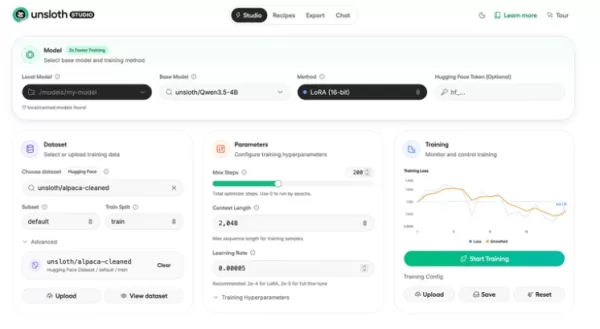
Unsloth Studio's underlying technology utilizes a custom backpropagation kernel written in Triton, achieving a qualitative leap over standard fine-tuning frameworks:
Training speed doubles: Fine-tuning efficiency is increased by up to two times.
Memory usage reduced by 70%: It dramatically cuts GPU memory dependency without compromising model accuracy.
Consumer-grade GPU friendly: Developers can now fine-tune models with 8B to 70B parameters (like Llama3.3 and DeepSeek-R1) on single consumer-grade GPUs such as the RTX 4090 or 5090, tasks that previously required multi-GPU clusters.
This platform integrates the entire lifecycle of data preparation, training, and deployment into an intuitive web interface:
Visual data recipe: Features a node-based workflow that supports automatic ingestion of multiple formats like PDF and JSONL, and can utilize NVIDIA DataDesigner to transform unstructured documents into structured instruction datasets.
Reinforcement learning support: Includes built-in support for GRPO (Group-wise Relative Policy Optimization). This technology, originating from DeepSeek-R1, enables training AI with multi-step logical reasoning capabilities on local hardware without the need for an additional "critic model".
One-click export and deployment: Supports exporting to GGUF, vLLM, or Ollama formats, seamlessly bridging the gap between training checkpoints and production inference environments.
With the release of Unsloth Studio, large model fine-tuning is transitioning from reliance on expensive cloud-based SaaS to a more private and cost-effective local development paradigm. It not only provides immediate compatibility with the Llama 4 and Qwen series but also delivers powerful tools for customized model development with full enterprise ownership.
Technical details: https://unsloth.ai/docs/new/studio
Related article
 U.S. Stocks Hit Historic Milestone as AI and Aerospace Giants Prepare for Trillion-Dollar Debut
Elon Musk, Sam Altman, and Dario Amodei, three titans of the technology sector, are advancing toward initial public offerings for their respective ventures. With SpaceX, OpenAI, and Anthropic—three industry behemoths nearing trillion-dollar valuation
Swedish AI Startup Lovable Eyes $13.2 Billion Valuation After Major Funding Round
As AI-driven coding tools gain traction, Swedish startup Lovable has secured a major funding round. The company aims to raise $3 billion, potentially boosting its valuation to $13.2 billion—double the $6.6 billion recorded last December. Menlo Ventur
Google Tests Remy AI Agent for Gemini as Focus Shifts to User Control
According to Business Insider, Google is testing Remy, a new AI personal agent for Gemini. This tool aims to execute tasks on behalf of users, streamlining both professional workflows and daily routines.Currently, Remy is undergoing testing in an int
Related Special Topic Recommendations
Data Analysis
U.S. Stocks Hit Historic Milestone as AI and Aerospace Giants Prepare for Trillion-Dollar Debut
Elon Musk, Sam Altman, and Dario Amodei, three titans of the technology sector, are advancing toward initial public offerings for their respective ventures. With SpaceX, OpenAI, and Anthropic—three industry behemoths nearing trillion-dollar valuation
Swedish AI Startup Lovable Eyes $13.2 Billion Valuation After Major Funding Round
As AI-driven coding tools gain traction, Swedish startup Lovable has secured a major funding round. The company aims to raise $3 billion, potentially boosting its valuation to $13.2 billion—double the $6.6 billion recorded last December. Menlo Ventur
Google Tests Remy AI Agent for Gemini as Focus Shifts to User Control
According to Business Insider, Google is testing Remy, a new AI personal agent for Gemini. This tool aims to execute tasks on behalf of users, streamlining both professional workflows and daily routines.Currently, Remy is undergoing testing in an int
Related Special Topic Recommendations
Data Analysis
 Best AI Anomaly Detection Tools for KPI Monitoring across SaaS and Ecommerce Teams
2026 Latest Best Top-rated AI Anomaly Detection Tools for KPI Monitoring in SaaS and Ecommerce teams! XIX.AI has curated a powerful, game-changing collection based on rigorous real-world tests and weekly updated rankings. You’ll find detailed free vs paid comparison insights to help you identify the must-try solution that boosts productivity and unlocks your AI edge. Explore now!
 10 tools
 xix.ai
writing
Best AI Outline Generators for Long-Form SEO Articles
xix.ai
writing
Best AI Outline Generators for Long-Form SEO Articles
2026 Latest Best Top-Rated AI Outline Generators for Long-Form SEO Articles, meticulously curated by XIX.AI. These powerful tools offer game-changing assistance in creating high-quality content quickly, boosting writing efficiency significantly. Get a free vs paid comparison along with real-world tests and detailed rankings to help you find the must-try option that suits your needs. Explore now to unlock your AI edge.
8 tools
xix.ai
Education and Learning
AI Study Tools for Homework and Exam Prep
2026 Latest Best AI Study Tools for Homework and Exam Prep! XIX.AI curates a top-rated list of powerful, game-changing tools that help students boost productivity, streamline homework completion, and ace exams through real-world tests. Get a free vs paid comparison, detailed rankings, and must-try options to unlock your AI edge. Explore now!
10 tools
xix.ai
Music composition
AI Vocal Demo Tools for Songwriters, Hooks, Toplines, and Multilingual Draft Sessions
2026 Latest Best AI Vocal Demo Tools for Songwriters, Hook Creators, and Multi-Language Content Teams! XIX.AI has curated a top-rated list of powerful game-changing tools that go through rigorous real-world tests. You’ll find detailed free vs paid comparison data, comprehensive rankings, and must-try options to help you boost writing efficiency and unlock your creative potential. Explore now to discover your perfect tool for all your content needs!
9 tools
xix.ai
Business
Best AI Competitive Research Tools for Small Businesses
2026 Latest Best Top-rated AI Competitive Research Tools for Small Businesses! XIX.AI has curated a highly powerful game-changing collection, updated weekly with rigorous real-world tests and detailed rankings. You can find a comprehensive free vs paid comparison to help you identify the must-try tools that boost your productivity and give you a competitive edge. Explore now to discover your perfect tool!
9 tools
xix.ai
Image editing
Photoshop AI Retouch Tools for Ecommerce Apparel, Skin Cleanup, and Color Consistency
2026 Latest Best Photoshop AI retouch tools for ecommerce apparel, skin cleanup, and color consistency! This top-rated curated list features powerful game-changing solutions that help you boost writing efficiency, streamline content creation, and achieve perfect visual results effortlessly. Each tool has undergone real-world tests through weekly updated rankings, complete with free vs paid comparison details. Backed by XIX.AI, it’s the must-try guide for anyone aiming to unlock your AI edge. Explore now!
10 tools
xix.ai

 Comments (1)
0/500
Comments (1)
0/500
![StevenGonzalez]()
Cutting VRAM by 70%? That's wild 🤯 But I'm skeptical—how many actual models does it support right now? If it's just Llama variants again, meh. Still, a no-code fine-tuning UI for vision LLMs could be huge for prototyping. Hope the open-source community picks it up quickly.
Renowned high-performance fine-tuning library Unsloth AI has officially launched Unsloth Studio. This open-source, no-code visual interface is designed to significantly lower the barrier for software engineers to fine-tune large language models (LLMs), enabling developers to bypass complex CUDA environment configurations and high hardware costs entirely.
Unsloth Studio's underlying technology utilizes a custom backpropagation kernel written in Triton, achieving a qualitative leap over standard fine-tuning frameworks:
Training speed doubles: Fine-tuning efficiency is increased by up to two times.
Memory usage reduced by 70%: It dramatically cuts GPU memory dependency without compromising model accuracy.
Consumer-grade GPU friendly: Developers can now fine-tune models with 8B to 70B parameters (like Llama3.3 and DeepSeek-R1) on single consumer-grade GPUs such as the RTX 4090 or 5090, tasks that previously required multi-GPU clusters.
This platform integrates the entire lifecycle of data preparation, training, and deployment into an intuitive web interface:
Visual data recipe: Features a node-based workflow that supports automatic ingestion of multiple formats like PDF and JSONL, and can utilize NVIDIA DataDesigner to transform unstructured documents into structured instruction datasets.
Reinforcement learning support: Includes built-in support for GRPO (Group-wise Relative Policy Optimization). This technology, originating from DeepSeek-R1, enables training AI with multi-step logical reasoning capabilities on local hardware without the need for an additional "critic model".
One-click export and deployment: Supports exporting to GGUF, vLLM, or Ollama formats, seamlessly bridging the gap between training checkpoints and production inference environments.
With the release of Unsloth Studio, large model fine-tuning is transitioning from reliance on expensive cloud-based SaaS to a more private and cost-effective local development paradigm. It not only provides immediate compatibility with the Llama 4 and Qwen series but also delivers powerful tools for customized model development with full enterprise ownership.
Technical details: https://unsloth.ai/docs/new/studio








 U.S. Stocks Hit Historic Milestone as AI and Aerospace Giants Prepare for Trillion-Dollar Debut
Elon Musk, Sam Altman, and Dario Amodei, three titans of the technology sector, are advancing toward initial public offerings for their respective ventures. With SpaceX, OpenAI, and Anthropic—three industry behemoths nearing trillion-dollar valuation
U.S. Stocks Hit Historic Milestone as AI and Aerospace Giants Prepare for Trillion-Dollar Debut
Elon Musk, Sam Altman, and Dario Amodei, three titans of the technology sector, are advancing toward initial public offerings for their respective ventures. With SpaceX, OpenAI, and Anthropic—three industry behemoths nearing trillion-dollar valuation
 Swedish AI Startup Lovable Eyes $13.2 Billion Valuation After Major Funding Round
As AI-driven coding tools gain traction, Swedish startup Lovable has secured a major funding round. The company aims to raise $3 billion, potentially boosting its valuation to $13.2 billion—double the $6.6 billion recorded last December. Menlo Ventur
Google Tests Remy AI Agent for Gemini as Focus Shifts to User Control
According to Business Insider, Google is testing Remy, a new AI personal agent for Gemini. This tool aims to execute tasks on behalf of users, streamlining both professional workflows and daily routines.Currently, Remy is undergoing testing in an int
Swedish AI Startup Lovable Eyes $13.2 Billion Valuation After Major Funding Round
As AI-driven coding tools gain traction, Swedish startup Lovable has secured a major funding round. The company aims to raise $3 billion, potentially boosting its valuation to $13.2 billion—double the $6.6 billion recorded last December. Menlo Ventur
Google Tests Remy AI Agent for Gemini as Focus Shifts to User Control
According to Business Insider, Google is testing Remy, a new AI personal agent for Gemini. This tool aims to execute tasks on behalf of users, streamlining both professional workflows and daily routines.Currently, Remy is undergoing testing in an int

2026 Latest Best Top-rated AI Anomaly Detection Tools for KPI Monitoring in SaaS and Ecommerce teams! XIX.AI has curated a powerful, game-changing collection based on rigorous real-world tests and weekly updated rankings. You’ll find detailed free vs paid comparison insights to help you identify the must-try solution that boosts productivity and unlocks your AI edge. Explore now!
10 tools
xix.ai

2026 Latest Best Top-Rated AI Outline Generators for Long-Form SEO Articles, meticulously curated by XIX.AI. These powerful tools offer game-changing assistance in creating high-quality content quickly, boosting writing efficiency significantly. Get a free vs paid comparison along with real-world tests and detailed rankings to help you find the must-try option that suits your needs. Explore now to unlock your AI edge.
8 tools
xix.ai

2026 Latest Best AI Study Tools for Homework and Exam Prep! XIX.AI curates a top-rated list of powerful, game-changing tools that help students boost productivity, streamline homework completion, and ace exams through real-world tests. Get a free vs paid comparison, detailed rankings, and must-try options to unlock your AI edge. Explore now!
10 tools
xix.ai

2026 Latest Best AI Vocal Demo Tools for Songwriters, Hook Creators, and Multi-Language Content Teams! XIX.AI has curated a top-rated list of powerful game-changing tools that go through rigorous real-world tests. You’ll find detailed free vs paid comparison data, comprehensive rankings, and must-try options to help you boost writing efficiency and unlock your creative potential. Explore now to discover your perfect tool for all your content needs!
9 tools
xix.ai

2026 Latest Best Top-rated AI Competitive Research Tools for Small Businesses! XIX.AI has curated a highly powerful game-changing collection, updated weekly with rigorous real-world tests and detailed rankings. You can find a comprehensive free vs paid comparison to help you identify the must-try tools that boost your productivity and give you a competitive edge. Explore now to discover your perfect tool!
9 tools
xix.ai

2026 Latest Best Photoshop AI retouch tools for ecommerce apparel, skin cleanup, and color consistency! This top-rated curated list features powerful game-changing solutions that help you boost writing efficiency, streamline content creation, and achieve perfect visual results effortlessly. Each tool has undergone real-world tests through weekly updated rankings, complete with free vs paid comparison details. Backed by XIX.AI, it’s the must-try guide for anyone aiming to unlock your AI edge. Explore now!
10 tools
xix.ai

Cutting VRAM by 70%? That's wild 🤯 But I'm skeptical—how many actual models does it support right now? If it's just Llama variants again, meh. Still, a no-code fine-tuning UI for vision LLMs could be huge for prototyping. Hope the open-source community picks it up quickly.












