


 Home
HomeTongyi Lab Introduces Qwen3.6-Plus, Marking a Leap Forward in Reliable AI Programming
In February of this year, Tongyi Lab launched the Qwen3.5 series. Today, they have officially introduced Qwen3.6-Plus, designed to tackle a key challenge for developers: the "unstable execution" of tasks in agent-based programming. The model is now accessible via the Aliyun BaiLian API.
Key Improvements: Enhanced Focus on Coding Agents and Long-Context Handling
Qwen3.6-Plus is engineered to seamlessly blend deep logical reasoning, extensive memory, and precise execution. Its primary strengths are:
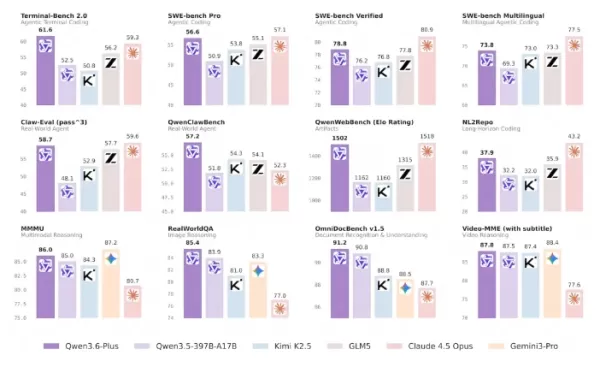
A Leap Forward in Coding Proficiency: The model excels in areas like front-end page generation, code debugging, and terminal automation. As the first domestic model in its class to achieve comprehensive leadership in agent programming, it delivers a more reliable agent experience at a reduced cost.
Million-Token Context Window: It natively supports a context of up to 1 million tokens, greatly enhancing the accuracy of parsing long documents and extracting information from multi-turn conversations.
Superior Cost Efficiency: With a model size less than half that of competitors like K2.5 or GLM5, its engineering and implementation capabilities remain highly competitive with industry leaders.
Ecosystem Compatibility: Smooth Integration with Popular Development Tools
To help developers get productive quickly, Qwen3.6-Plus offers deep compatibility with several third-party coding assistants:
OpenClaw (formerly Moltbot): An open-source, self-hostable AI coding agent. With minimal setup, it provides a full-featured agent coding experience directly in the terminal.
Qwen Code: A terminal agent specifically fine-tuned for the Qwen model family, capable of understanding complex codebases and performing automated tasks.
Claude Code: The Qwen API now supports the Anthropic protocol, enabling developers to call the Qwen3.6-Plus model directly within their existing Claude Code workflows.
Visual Agent: From "Understanding" to "Acting"
In multimodal applications, Qwen3.6-Plus has achieved a complete loop from visual perception to agent execution. The model can perform complex tasks like financial calculations (e.g., automatically tallying winnings from multiple scratch cards) based on visual input. It can also generate functional front-end code directly from design mockups. This "visual agent" capability allows it to comprehend graphical user interfaces and take subsequent actions, evolving toward a native multimodal system capable of continuous real-world perception.
Furthermore, Tongyi Lab has introduced a preserve_thinking feature in its API, which retains the chain-of-thought content from previous interactions. This is especially useful for complex agent tasks that require long-term planning. Reports indicate that additional variants of the Qwen3.6 series, including high-performance and lightweight open-source models, will be released in the near future.
Related article
 Swedish AI Startup Lovable Eyes $13.2 Billion Valuation After Major Funding Round
As AI-driven coding tools gain traction, Swedish startup Lovable has secured a major funding round. The company aims to raise $3 billion, potentially boosting its valuation to $13.2 billion—double the $6.6 billion recorded last December. Menlo Ventur
Google Tests Remy AI Agent for Gemini as Focus Shifts to User Control
According to Business Insider, Google is testing Remy, a new AI personal agent for Gemini. This tool aims to execute tasks on behalf of users, streamlining both professional workflows and daily routines.Currently, Remy is undergoing testing in an int
How to fix Core Web Vitals for better SEO rankings
Streamline Report Card Comments with AI ToolsIntroductionAI Tools for Generating Report Card CommentsMagic SchoolAlmanac AIChat GPTUsing Magic School to Generate Report Card CommentsLogging into Magic SchoolSelecting the Report Card Comments ToolCust
Related Special Topic Recommendations
writing
Swedish AI Startup Lovable Eyes $13.2 Billion Valuation After Major Funding Round
As AI-driven coding tools gain traction, Swedish startup Lovable has secured a major funding round. The company aims to raise $3 billion, potentially boosting its valuation to $13.2 billion—double the $6.6 billion recorded last December. Menlo Ventur
Google Tests Remy AI Agent for Gemini as Focus Shifts to User Control
According to Business Insider, Google is testing Remy, a new AI personal agent for Gemini. This tool aims to execute tasks on behalf of users, streamlining both professional workflows and daily routines.Currently, Remy is undergoing testing in an int
How to fix Core Web Vitals for better SEO rankings
Streamline Report Card Comments with AI ToolsIntroductionAI Tools for Generating Report Card CommentsMagic SchoolAlmanac AIChat GPTUsing Magic School to Generate Report Card CommentsLogging into Magic SchoolSelecting the Report Card Comments ToolCust
Related Special Topic Recommendations
writing
 Best AI Outline Generators for Long-Form SEO Articles
2026 Latest Best Top-Rated AI Outline Generators for Long-Form SEO Articles, meticulously curated by XIX.AI. These powerful tools offer game-changing assistance in creating high-quality content quickly, boosting writing efficiency significantly. Get a free vs paid comparison along with real-world tests and detailed rankings to help you find the must-try option that suits your needs. Explore now to unlock your AI edge.
 8 tools
 xix.ai
Education and Learning
AI Study Tools for Homework and Exam Prep
xix.ai
Education and Learning
AI Study Tools for Homework and Exam Prep
2026 Latest Best AI Study Tools for Homework and Exam Prep! XIX.AI curates a top-rated list of powerful, game-changing tools that help students boost productivity, streamline homework completion, and ace exams through real-world tests. Get a free vs paid comparison, detailed rankings, and must-try options to unlock your AI edge. Explore now!
10 tools
xix.ai
Music composition
AI Vocal Demo Tools for Songwriters, Hooks, Toplines, and Multilingual Draft Sessions
2026 Latest Best AI Vocal Demo Tools for Songwriters, Hook Creators, and Multi-Language Content Teams! XIX.AI has curated a top-rated list of powerful game-changing tools that go through rigorous real-world tests. You’ll find detailed free vs paid comparison data, comprehensive rankings, and must-try options to help you boost writing efficiency and unlock your creative potential. Explore now to discover your perfect tool for all your content needs!
9 tools
xix.ai
Business
Best AI Competitive Research Tools for Small Businesses
2026 Latest Best Top-rated AI Competitive Research Tools for Small Businesses! XIX.AI has curated a highly powerful game-changing collection, updated weekly with rigorous real-world tests and detailed rankings. You can find a comprehensive free vs paid comparison to help you identify the must-try tools that boost your productivity and give you a competitive edge. Explore now to discover your perfect tool!
9 tools
xix.ai
Image editing
Photoshop AI Retouch Tools for Ecommerce Apparel, Skin Cleanup, and Color Consistency
2026 Latest Best Photoshop AI retouch tools for ecommerce apparel, skin cleanup, and color consistency! This top-rated curated list features powerful game-changing solutions that help you boost writing efficiency, streamline content creation, and achieve perfect visual results effortlessly. Each tool has undergone real-world tests through weekly updated rankings, complete with free vs paid comparison details. Backed by XIX.AI, it’s the must-try guide for anyone aiming to unlock your AI edge. Explore now!
10 tools
xix.ai
Prompt
Best AI Prompt Libraries for ChatGPT Workflows
2026 Latest Best Top-Rated AI Prompt Libraries for optimizing all types of ChatGPT workflows. XIX.AI has curated a powerful, game-changing collection that goes through rigorous real-world tests to ensure top performance. You can find detailed free vs paid comparisons and expert rankings to help you choose the must-try tools that boost your productivity and unlock your AI edge. Explore now!
11 tools
xix.ai

 Comments (0)
0/500
Comments (0)
0/500
In February of this year, Tongyi Lab launched the Qwen3.5 series. Today, they have officially introduced Qwen3.6-Plus, designed to tackle a key challenge for developers: the "unstable execution" of tasks in agent-based programming. The model is now accessible via the Aliyun BaiLian API.
Key Improvements: Enhanced Focus on Coding Agents and Long-Context Handling
Qwen3.6-Plus is engineered to seamlessly blend deep logical reasoning, extensive memory, and precise execution. Its primary strengths are:
A Leap Forward in Coding Proficiency: The model excels in areas like front-end page generation, code debugging, and terminal automation. As the first domestic model in its class to achieve comprehensive leadership in agent programming, it delivers a more reliable agent experience at a reduced cost.
Million-Token Context Window: It natively supports a context of up to 1 million tokens, greatly enhancing the accuracy of parsing long documents and extracting information from multi-turn conversations.
Superior Cost Efficiency: With a model size less than half that of competitors like K2.5 or GLM5, its engineering and implementation capabilities remain highly competitive with industry leaders.
Ecosystem Compatibility: Smooth Integration with Popular Development Tools
To help developers get productive quickly, Qwen3.6-Plus offers deep compatibility with several third-party coding assistants:
OpenClaw (formerly Moltbot): An open-source, self-hostable AI coding agent. With minimal setup, it provides a full-featured agent coding experience directly in the terminal.
Qwen Code: A terminal agent specifically fine-tuned for the Qwen model family, capable of understanding complex codebases and performing automated tasks.
Claude Code: The Qwen API now supports the Anthropic protocol, enabling developers to call the Qwen3.6-Plus model directly within their existing Claude Code workflows.
Visual Agent: From "Understanding" to "Acting"
In multimodal applications, Qwen3.6-Plus has achieved a complete loop from visual perception to agent execution. The model can perform complex tasks like financial calculations (e.g., automatically tallying winnings from multiple scratch cards) based on visual input. It can also generate functional front-end code directly from design mockups. This "visual agent" capability allows it to comprehend graphical user interfaces and take subsequent actions, evolving toward a native multimodal system capable of continuous real-world perception.
Furthermore, Tongyi Lab has introduced a preserve_thinking feature in its API, which retains the chain-of-thought content from previous interactions. This is especially useful for complex agent tasks that require long-term planning. Reports indicate that additional variants of the Qwen3.6 series, including high-performance and lightweight open-source models, will be released in the near future.








 Swedish AI Startup Lovable Eyes $13.2 Billion Valuation After Major Funding Round
As AI-driven coding tools gain traction, Swedish startup Lovable has secured a major funding round. The company aims to raise $3 billion, potentially boosting its valuation to $13.2 billion—double the $6.6 billion recorded last December. Menlo Ventur
Google Tests Remy AI Agent for Gemini as Focus Shifts to User Control
According to Business Insider, Google is testing Remy, a new AI personal agent for Gemini. This tool aims to execute tasks on behalf of users, streamlining both professional workflows and daily routines.Currently, Remy is undergoing testing in an int
Swedish AI Startup Lovable Eyes $13.2 Billion Valuation After Major Funding Round
As AI-driven coding tools gain traction, Swedish startup Lovable has secured a major funding round. The company aims to raise $3 billion, potentially boosting its valuation to $13.2 billion—double the $6.6 billion recorded last December. Menlo Ventur
Google Tests Remy AI Agent for Gemini as Focus Shifts to User Control
According to Business Insider, Google is testing Remy, a new AI personal agent for Gemini. This tool aims to execute tasks on behalf of users, streamlining both professional workflows and daily routines.Currently, Remy is undergoing testing in an int
 How to fix Core Web Vitals for better SEO rankings
Streamline Report Card Comments with AI ToolsIntroductionAI Tools for Generating Report Card CommentsMagic SchoolAlmanac AIChat GPTUsing Magic School to Generate Report Card CommentsLogging into Magic SchoolSelecting the Report Card Comments ToolCust
How to fix Core Web Vitals for better SEO rankings
Streamline Report Card Comments with AI ToolsIntroductionAI Tools for Generating Report Card CommentsMagic SchoolAlmanac AIChat GPTUsing Magic School to Generate Report Card CommentsLogging into Magic SchoolSelecting the Report Card Comments ToolCust

2026 Latest Best Top-Rated AI Outline Generators for Long-Form SEO Articles, meticulously curated by XIX.AI. These powerful tools offer game-changing assistance in creating high-quality content quickly, boosting writing efficiency significantly. Get a free vs paid comparison along with real-world tests and detailed rankings to help you find the must-try option that suits your needs. Explore now to unlock your AI edge.
8 tools
xix.ai

2026 Latest Best AI Study Tools for Homework and Exam Prep! XIX.AI curates a top-rated list of powerful, game-changing tools that help students boost productivity, streamline homework completion, and ace exams through real-world tests. Get a free vs paid comparison, detailed rankings, and must-try options to unlock your AI edge. Explore now!
10 tools
xix.ai

2026 Latest Best AI Vocal Demo Tools for Songwriters, Hook Creators, and Multi-Language Content Teams! XIX.AI has curated a top-rated list of powerful game-changing tools that go through rigorous real-world tests. You’ll find detailed free vs paid comparison data, comprehensive rankings, and must-try options to help you boost writing efficiency and unlock your creative potential. Explore now to discover your perfect tool for all your content needs!
9 tools
xix.ai

2026 Latest Best Top-rated AI Competitive Research Tools for Small Businesses! XIX.AI has curated a highly powerful game-changing collection, updated weekly with rigorous real-world tests and detailed rankings. You can find a comprehensive free vs paid comparison to help you identify the must-try tools that boost your productivity and give you a competitive edge. Explore now to discover your perfect tool!
9 tools
xix.ai

2026 Latest Best Photoshop AI retouch tools for ecommerce apparel, skin cleanup, and color consistency! This top-rated curated list features powerful game-changing solutions that help you boost writing efficiency, streamline content creation, and achieve perfect visual results effortlessly. Each tool has undergone real-world tests through weekly updated rankings, complete with free vs paid comparison details. Backed by XIX.AI, it’s the must-try guide for anyone aiming to unlock your AI edge. Explore now!
10 tools
xix.ai
2026 Latest Best Top-Rated AI Prompt Libraries for optimizing all types of ChatGPT workflows. XIX.AI has curated a powerful, game-changing collection that goes through rigorous real-world tests to ensure top performance. You can find detailed free vs paid comparisons and expert rankings to help you choose the must-try tools that boost your productivity and unlock your AI edge. Explore now!
11 tools
xix.ai












