


 Home
Home
Tencent Unveils Internal Test for QClaw, Offering One-Click OpenClaw Setup via Integrated WeChat and QQ Functions
In today’s world where artificial intelligence advances by the day, have you ever encountered obstacles when trying to access powerful AI tools due to complex coding requirements and intricate environment setups?
Recently, an open-source AI Agent named OpenClaw—commonly referred to as “Little Crabs”—has gained widespread attention around the globe. Even Ma Huateng shared it on his social media, expressing surprise at its popularity by saying, “I didn’t expect it to become so popular.”
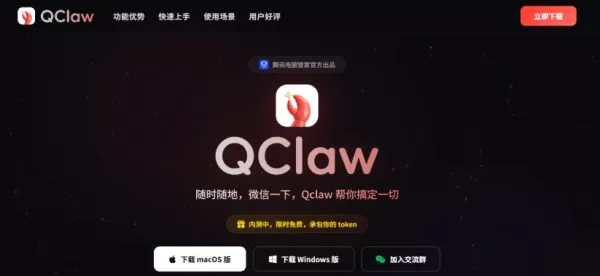
Just today, Tencent took action by officially unveiling a mysterious internal testing product called QClaw. This tool not only breaks down the technical hurdles associated with AI but also brings AI capabilities directly into WeChat.
1. What exactly is QClaw?
In simple terms, QClaw is a “one-click startup package” specifically developed by Tencent for the open-source OpenClaw project.
What is OpenClaw? It is an AI assistant that can perform real-world tasks rather than just conducting conversations. Unlike traditional chatbots, it can help users organize files, fill out forms automatically, and even control a computer remotely.
What does QClaw offer? Instead of reinventing the underlying technology, Tencent transformed this technically complex tool into a ready-to-use software solution. Users don’t need to have programming skills or set up complicated environments—just a few clicks are sufficient to utilize this advanced AI Agent.
2. Why is everyone paying attention to QClaw?
This product has drawn significant interest because it effectively addresses three major pain points in current AI deployment:
1. “Zero-Barrier” Deployment
Previously, using OpenClaw often required extensive time spent troubleshooting error messages. With QClaw, users can deploy the tool locally with just one click:
Automatic environment detection: it scans the system automatically after installation.
One-click connection: if the tool has already been installed, it can take over instantly.
Isolated operation: it runs independently without interfering with other applications, ensuring stability and security.
2. “Full Compatibility” of Models
QClaw is pre-configured to integrate the most advanced large language models available in China, including Kimi, DeepSeek, Zhipu GLM, MiniMax, and others. Users simply need to enter their API Key, and the desired model will become the core of the AI system.
3. Direct Connection with WeChat/QQ (The standout feature!)
This is perhaps the most exciting aspect for users: they can chat directly with “Little Crabs” within WeChat or QQ.
Consider these practical scenarios: while on the subway, send a message to your AI to organize documents for tomorrow’s meeting; while dining out, ask it to automatically respond to work emails; while at home, use simple gestures to have the AI generate and send a daily report. This turns WeChat into a powerful remote control for managing your computer. Tencent’s strategy here is strategic, as WeChat boasts nearly 1.3 billion active users.
Through QClaw, Tencent aims to create a complete AI ecosystem: WeChat/QQ serves as the entry point, QClaw acts as the connecting link, and OpenClaw handles the actual execution tasks. When using AI becomes as simple as sending a message rather than dealing with complex code, we will truly enter an era where AI Agents are widely accessible to everyone.
3. How can you get access to “QClaw”?
Although QClaw is still in the internal testing stage, early signs suggest it will be rolled out soon:
Stay tuned: It is currently being tested first in cities known for their strong AI development, such as Shenzhen and Hangzhou.
Get prepared in advance: If you are a developer, you can immediately start using OpenClaw on Tencent Cloud through the Lighthouse platform.
2026 may well become the year when AI Agents truly take off. When technical barriers disappear and AI becomes a “friend” in your contacts list, anyone will be able to have their own 24/7 digital assistant. The emergence of QClaw shows that this transformation is progressing faster than anticipated.
Related article
 U.S. Stocks Hit Historic Milestone as AI and Aerospace Giants Prepare for Trillion-Dollar Debut
Elon Musk, Sam Altman, and Dario Amodei, three titans of the technology sector, are advancing toward initial public offerings for their respective ventures. With SpaceX, OpenAI, and Anthropic—three industry behemoths nearing trillion-dollar valuation
Swedish AI Startup Lovable Eyes $13.2 Billion Valuation After Major Funding Round
As AI-driven coding tools gain traction, Swedish startup Lovable has secured a major funding round. The company aims to raise $3 billion, potentially boosting its valuation to $13.2 billion—double the $6.6 billion recorded last December. Menlo Ventur
Google Tests Remy AI Agent for Gemini as Focus Shifts to User Control
According to Business Insider, Google is testing Remy, a new AI personal agent for Gemini. This tool aims to execute tasks on behalf of users, streamlining both professional workflows and daily routines.Currently, Remy is undergoing testing in an int
Related Special Topic Recommendations
Data Analysis
U.S. Stocks Hit Historic Milestone as AI and Aerospace Giants Prepare for Trillion-Dollar Debut
Elon Musk, Sam Altman, and Dario Amodei, three titans of the technology sector, are advancing toward initial public offerings for their respective ventures. With SpaceX, OpenAI, and Anthropic—three industry behemoths nearing trillion-dollar valuation
Swedish AI Startup Lovable Eyes $13.2 Billion Valuation After Major Funding Round
As AI-driven coding tools gain traction, Swedish startup Lovable has secured a major funding round. The company aims to raise $3 billion, potentially boosting its valuation to $13.2 billion—double the $6.6 billion recorded last December. Menlo Ventur
Google Tests Remy AI Agent for Gemini as Focus Shifts to User Control
According to Business Insider, Google is testing Remy, a new AI personal agent for Gemini. This tool aims to execute tasks on behalf of users, streamlining both professional workflows and daily routines.Currently, Remy is undergoing testing in an int
Related Special Topic Recommendations
Data Analysis
 Best AI Anomaly Detection Tools for KPI Monitoring across SaaS and Ecommerce Teams
2026 Latest Best Top-rated AI Anomaly Detection Tools for KPI Monitoring in SaaS and Ecommerce teams! XIX.AI has curated a powerful, game-changing collection based on rigorous real-world tests and weekly updated rankings. You’ll find detailed free vs paid comparison insights to help you identify the must-try solution that boosts productivity and unlocks your AI edge. Explore now!
 10 tools
 xix.ai
writing
Best AI Outline Generators for Long-Form SEO Articles
xix.ai
writing
Best AI Outline Generators for Long-Form SEO Articles
2026 Latest Best Top-Rated AI Outline Generators for Long-Form SEO Articles, meticulously curated by XIX.AI. These powerful tools offer game-changing assistance in creating high-quality content quickly, boosting writing efficiency significantly. Get a free vs paid comparison along with real-world tests and detailed rankings to help you find the must-try option that suits your needs. Explore now to unlock your AI edge.
8 tools
xix.ai
Education and Learning
AI Study Tools for Homework and Exam Prep
2026 Latest Best AI Study Tools for Homework and Exam Prep! XIX.AI curates a top-rated list of powerful, game-changing tools that help students boost productivity, streamline homework completion, and ace exams through real-world tests. Get a free vs paid comparison, detailed rankings, and must-try options to unlock your AI edge. Explore now!
10 tools
xix.ai
Music composition
AI Vocal Demo Tools for Songwriters, Hooks, Toplines, and Multilingual Draft Sessions
2026 Latest Best AI Vocal Demo Tools for Songwriters, Hook Creators, and Multi-Language Content Teams! XIX.AI has curated a top-rated list of powerful game-changing tools that go through rigorous real-world tests. You’ll find detailed free vs paid comparison data, comprehensive rankings, and must-try options to help you boost writing efficiency and unlock your creative potential. Explore now to discover your perfect tool for all your content needs!
9 tools
xix.ai
Business
Best AI Competitive Research Tools for Small Businesses
2026 Latest Best Top-rated AI Competitive Research Tools for Small Businesses! XIX.AI has curated a highly powerful game-changing collection, updated weekly with rigorous real-world tests and detailed rankings. You can find a comprehensive free vs paid comparison to help you identify the must-try tools that boost your productivity and give you a competitive edge. Explore now to discover your perfect tool!
9 tools
xix.ai
Image editing
Photoshop AI Retouch Tools for Ecommerce Apparel, Skin Cleanup, and Color Consistency
2026 Latest Best Photoshop AI retouch tools for ecommerce apparel, skin cleanup, and color consistency! This top-rated curated list features powerful game-changing solutions that help you boost writing efficiency, streamline content creation, and achieve perfect visual results effortlessly. Each tool has undergone real-world tests through weekly updated rankings, complete with free vs paid comparison details. Backed by XIX.AI, it’s the must-try guide for anyone aiming to unlock your AI edge. Explore now!
10 tools
xix.ai

 Comments (0)
0/500
Comments (0)
0/500
In today’s world where artificial intelligence advances by the day, have you ever encountered obstacles when trying to access powerful AI tools due to complex coding requirements and intricate environment setups?
Recently, an open-source AI Agent named OpenClaw—commonly referred to as “Little Crabs”—has gained widespread attention around the globe. Even Ma Huateng shared it on his social media, expressing surprise at its popularity by saying, “I didn’t expect it to become so popular.”
Just today, Tencent took action by officially unveiling a mysterious internal testing product called QClaw. This tool not only breaks down the technical hurdles associated with AI but also brings AI capabilities directly into WeChat.
1. What exactly is QClaw?
In simple terms, QClaw is a “one-click startup package” specifically developed by Tencent for the open-source OpenClaw project.
What is OpenClaw? It is an AI assistant that can perform real-world tasks rather than just conducting conversations. Unlike traditional chatbots, it can help users organize files, fill out forms automatically, and even control a computer remotely.
What does QClaw offer? Instead of reinventing the underlying technology, Tencent transformed this technically complex tool into a ready-to-use software solution. Users don’t need to have programming skills or set up complicated environments—just a few clicks are sufficient to utilize this advanced AI Agent.
2. Why is everyone paying attention to QClaw?
This product has drawn significant interest because it effectively addresses three major pain points in current AI deployment:
1. “Zero-Barrier” Deployment
Previously, using OpenClaw often required extensive time spent troubleshooting error messages. With QClaw, users can deploy the tool locally with just one click:
Automatic environment detection: it scans the system automatically after installation.
One-click connection: if the tool has already been installed, it can take over instantly.
Isolated operation: it runs independently without interfering with other applications, ensuring stability and security.
2. “Full Compatibility” of Models
QClaw is pre-configured to integrate the most advanced large language models available in China, including Kimi, DeepSeek, Zhipu GLM, MiniMax, and others. Users simply need to enter their API Key, and the desired model will become the core of the AI system.
3. Direct Connection with WeChat/QQ (The standout feature!)
This is perhaps the most exciting aspect for users: they can chat directly with “Little Crabs” within WeChat or QQ.
Consider these practical scenarios: while on the subway, send a message to your AI to organize documents for tomorrow’s meeting; while dining out, ask it to automatically respond to work emails; while at home, use simple gestures to have the AI generate and send a daily report. This turns WeChat into a powerful remote control for managing your computer. Tencent’s strategy here is strategic, as WeChat boasts nearly 1.3 billion active users.
Through QClaw, Tencent aims to create a complete AI ecosystem: WeChat/QQ serves as the entry point, QClaw acts as the connecting link, and OpenClaw handles the actual execution tasks. When using AI becomes as simple as sending a message rather than dealing with complex code, we will truly enter an era where AI Agents are widely accessible to everyone.
3. How can you get access to “QClaw”?
Although QClaw is still in the internal testing stage, early signs suggest it will be rolled out soon:
Stay tuned: It is currently being tested first in cities known for their strong AI development, such as Shenzhen and Hangzhou.
Get prepared in advance: If you are a developer, you can immediately start using OpenClaw on Tencent Cloud through the Lighthouse platform.
2026 may well become the year when AI Agents truly take off. When technical barriers disappear and AI becomes a “friend” in your contacts list, anyone will be able to have their own 24/7 digital assistant. The emergence of QClaw shows that this transformation is progressing faster than anticipated.








 U.S. Stocks Hit Historic Milestone as AI and Aerospace Giants Prepare for Trillion-Dollar Debut
Elon Musk, Sam Altman, and Dario Amodei, three titans of the technology sector, are advancing toward initial public offerings for their respective ventures. With SpaceX, OpenAI, and Anthropic—three industry behemoths nearing trillion-dollar valuation
U.S. Stocks Hit Historic Milestone as AI and Aerospace Giants Prepare for Trillion-Dollar Debut
Elon Musk, Sam Altman, and Dario Amodei, three titans of the technology sector, are advancing toward initial public offerings for their respective ventures. With SpaceX, OpenAI, and Anthropic—three industry behemoths nearing trillion-dollar valuation
 Swedish AI Startup Lovable Eyes $13.2 Billion Valuation After Major Funding Round
As AI-driven coding tools gain traction, Swedish startup Lovable has secured a major funding round. The company aims to raise $3 billion, potentially boosting its valuation to $13.2 billion—double the $6.6 billion recorded last December. Menlo Ventur
Google Tests Remy AI Agent for Gemini as Focus Shifts to User Control
According to Business Insider, Google is testing Remy, a new AI personal agent for Gemini. This tool aims to execute tasks on behalf of users, streamlining both professional workflows and daily routines.Currently, Remy is undergoing testing in an int
Swedish AI Startup Lovable Eyes $13.2 Billion Valuation After Major Funding Round
As AI-driven coding tools gain traction, Swedish startup Lovable has secured a major funding round. The company aims to raise $3 billion, potentially boosting its valuation to $13.2 billion—double the $6.6 billion recorded last December. Menlo Ventur
Google Tests Remy AI Agent for Gemini as Focus Shifts to User Control
According to Business Insider, Google is testing Remy, a new AI personal agent for Gemini. This tool aims to execute tasks on behalf of users, streamlining both professional workflows and daily routines.Currently, Remy is undergoing testing in an int

2026 Latest Best Top-rated AI Anomaly Detection Tools for KPI Monitoring in SaaS and Ecommerce teams! XIX.AI has curated a powerful, game-changing collection based on rigorous real-world tests and weekly updated rankings. You’ll find detailed free vs paid comparison insights to help you identify the must-try solution that boosts productivity and unlocks your AI edge. Explore now!
10 tools
xix.ai

2026 Latest Best Top-Rated AI Outline Generators for Long-Form SEO Articles, meticulously curated by XIX.AI. These powerful tools offer game-changing assistance in creating high-quality content quickly, boosting writing efficiency significantly. Get a free vs paid comparison along with real-world tests and detailed rankings to help you find the must-try option that suits your needs. Explore now to unlock your AI edge.
8 tools
xix.ai

2026 Latest Best AI Study Tools for Homework and Exam Prep! XIX.AI curates a top-rated list of powerful, game-changing tools that help students boost productivity, streamline homework completion, and ace exams through real-world tests. Get a free vs paid comparison, detailed rankings, and must-try options to unlock your AI edge. Explore now!
10 tools
xix.ai

2026 Latest Best AI Vocal Demo Tools for Songwriters, Hook Creators, and Multi-Language Content Teams! XIX.AI has curated a top-rated list of powerful game-changing tools that go through rigorous real-world tests. You’ll find detailed free vs paid comparison data, comprehensive rankings, and must-try options to help you boost writing efficiency and unlock your creative potential. Explore now to discover your perfect tool for all your content needs!
9 tools
xix.ai

2026 Latest Best Top-rated AI Competitive Research Tools for Small Businesses! XIX.AI has curated a highly powerful game-changing collection, updated weekly with rigorous real-world tests and detailed rankings. You can find a comprehensive free vs paid comparison to help you identify the must-try tools that boost your productivity and give you a competitive edge. Explore now to discover your perfect tool!
9 tools
xix.ai

2026 Latest Best Photoshop AI retouch tools for ecommerce apparel, skin cleanup, and color consistency! This top-rated curated list features powerful game-changing solutions that help you boost writing efficiency, streamline content creation, and achieve perfect visual results effortlessly. Each tool has undergone real-world tests through weekly updated rankings, complete with free vs paid comparison details. Backed by XIX.AI, it’s the must-try guide for anyone aiming to unlock your AI edge. Explore now!
10 tools
xix.ai












