


 Home
HomeAI-Powered Software Simplifies Document Comparison
Modern enterprises and legal practices demand efficient, error-free document comparison capabilities. Where manual review processes prove time-intensive and unreliable, AI-powered document comparison solutions deliver unprecedented speed and precision. This in-depth exploration reveals how intelligent document analysis technology optimizes workflow efficiency, enhances accuracy, and supports data-driven decision making across sectors. Discover how artificial intelligence is redefining best practices for document-intensive operations.
Key Points
AI document comparison technology dramatically accelerates analysis timelines
Precision algorithms eliminate costly human oversight in document review
Multilingual processing enables cross-border document collaboration
Advanced pattern recognition identifies critical variations in complex documents
Natural language processing allows direct document interrogation
Seamless integration with existing document management ecosystems
Comprehensive output formats including Excel-compatible reports
Automated highlighting of material differences and key provisions
Introduction to AI-Driven Document Comparison
The Evolution of Document Comparison
Conventional document review methods involving side-by-side manual examination consistently demonstrated inefficiency and susceptibility to oversight. AI-powered document analysis platforms now automate these processes through sophisticated algorithms capable of parsing documents with machine-level precision and speed. This technological advancement proves particularly valuable in precision-critical industries including legal services, regulatory compliance, and financial operations.
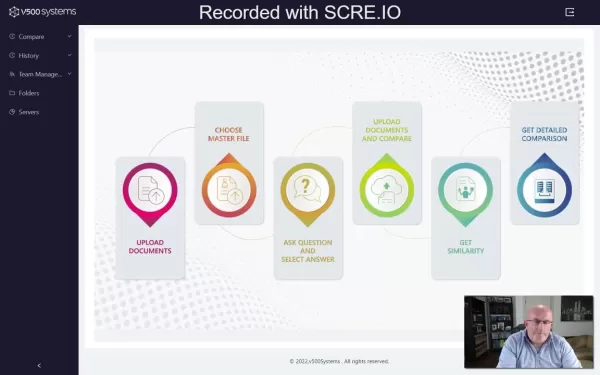
The system's contextual comprehension capabilities extend beyond superficial text matching to understand semantic meaning, uncovering substantive discrepancies that human reviewers might overlook. Furthermore, enterprise-grade solutions maintain consistent performance when processing large document volumes, making them scalable for organizational needs.
How AI Enhances Document Analysis
Artificial intelligence replicates sophisticated human cognition to interpret complex textual information. When applied to document comparison, AI examines content structure, identifies linguistic patterns, and extracts substantive elements - detecting not only explicit modifications but also nuanced contextual variations. AI-powered solutions offer distinct advantages over manual methods:
- Processing Speed: Analyzes document sets in minutes versus hours
- Accuracy Rates: Minimizes oversight through systematic examination
- Volume Capacity: Handles large document repositories with consistent performance
- Comprehensive Review: Identifies both textual and conceptual differences
- Contextual Intelligence: Interprets meaning and intent behind terminology
These capabilities collectively transform organizational approaches to document verification and analysis.
Pricing Structure for V500 Systems' AI Document Comparison
Understanding the Subscription Models
V500 Systems offers flexible commercial options designed for diverse operational requirements. The following outlines standard pricing structures common to enterprise document comparison solutions:
Subscription Plans: Tiered monthly/annual licensing based on user count, processing volume, and feature access
Transaction-Based: Per-document or per-feature pricing model ideal for intermittent usage
Enterprise Customization: Bespoke solutions for large organizations with specialized requirements
Organizations should conduct thorough requirements analysis to identify optimal cost structures aligned with their document processing volumes and use case complexity.
Step-by-Step Guide to Using V500 Systems' Document Comparison Software
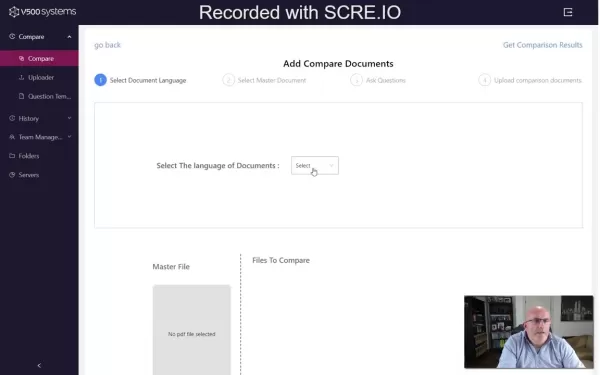
Step 1: Selecting the Document Language
The analysis process begins with language specification to ensure accurate semantic processing. The platform currently supports comprehensive analysis of English, Polish, and Arabic content.
Language selection protocol:
- Navigate to the comparison module interface
- Access the language selection dropdown
- Specify primary document language
This foundational step ensures subsequent analysis maintains contextual accuracy.
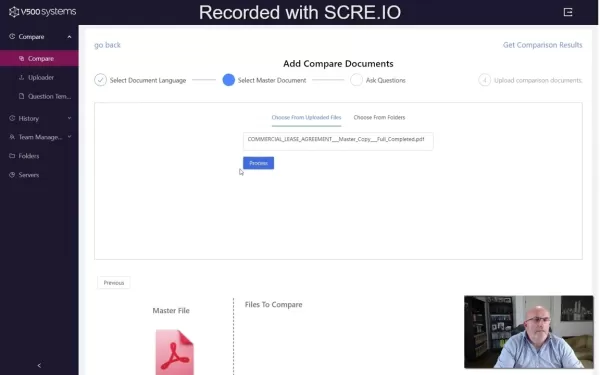
Step 2: Choosing the Master File
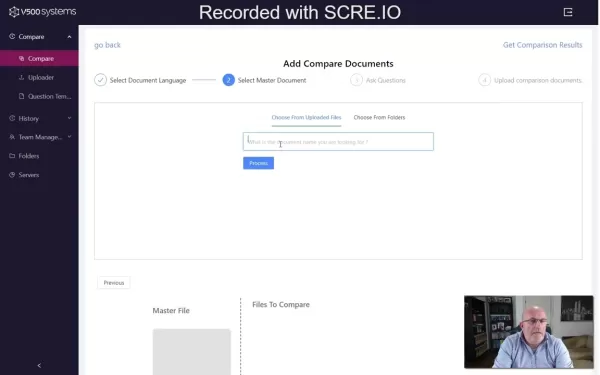
Designating the base reference document establishes the comparison framework. This authoritative version serves as the benchmark against which subsequent documents will be evaluated.
Master file selection process:
- Activate master file selection interface
- Identify source document from organizational repositories
- Confirm baseline document designation
The system intelligently parses the master document content in preparation for comparative analysis.
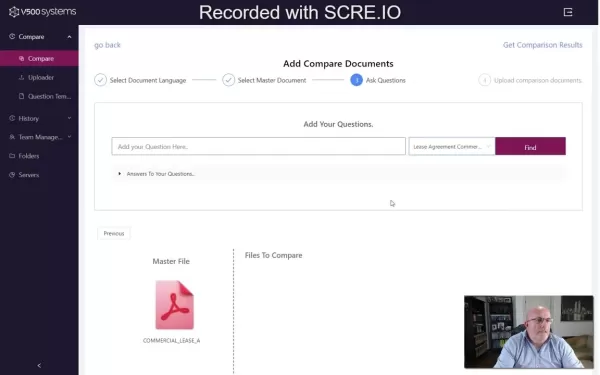
Step 3: Asking Questions for Targeted Analysis
The platform's advanced query functionality allows direct document interrogation through natural language processing. This targeted approach enables focused extraction of specific contractual provisions or data points.
Question submission workflow:
- Access the semantic query interface
- Formulate precise question or select template
- Initiate AI-powered content analysis
The system generates contextually relevant responses by synthesizing document content.
Step 4: Uploading and Comparing Documents
The final analysis phase involves comparative document submission and automated discrepancy reporting. The system generates comprehensive difference analysis with prioritized material findings.
Comparison execution protocol:
- Upload comparator documents via secure interface
- Initiate automated analysis process
- Review generated discrepancy reports
Output includes annotated versions highlighting modifications and Excel-compatible data exports for further examination.
Advantages and Disadvantages of Using AI for Document Comparison
Pros
Time Optimization: Reduces document review timelines from days to hours
Precision Enhancement: Machine-level consistency in discrepancy detection
Global Collaboration: Eliminates language barriers in international operations
Intelligent Interrogation: Natural language query capabilities
Comprehensive Reporting: Detailed variation analysis with version tracking
Cons
Implementation Period: Requires initial configuration and user familiarization
Model Dependency: Output quality correlates with algorithmic sophistication
Specialization Limits: Highly technical documents may require system customization
Connectivity Requirements: Cloud-based solutions need stable network access
Key Features of V500 Systems' AI Document Comparison
Comprehensive Language Support
The platform's multilingual processing capabilities currently extend to English (all major variants), Polish, and Arabic document analysis, with additional language support in active development. This linguistic versatility supports global enterprise operations requiring cross-border document analysis.
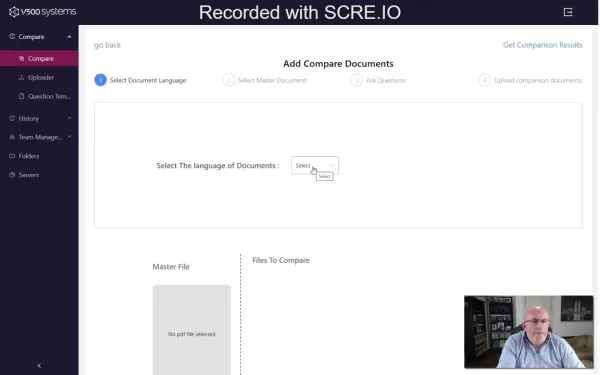
Language-specific capabilities include:
- English: Full semantic analysis with legal/technical terminology recognition
- Polish: Comprehensive Eastern European language processing
- Arabic: Right-to-left script analysis with dialect comprehension
This breadth of language support ensures accurate document examination regardless of geographic origin or subject matter complexity.
Intelligent Question Answering
The platform's natural language processing engine allows direct document interrogation through conversational queries. Users receive synthesized responses drawn from document content analysis, significantly accelerating information retrieval.
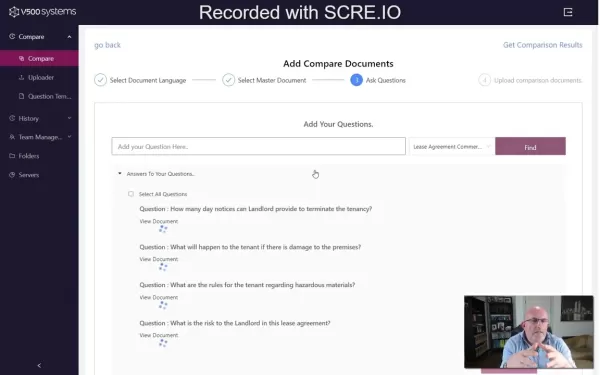
Question processing sequence:
- Natural language query input
- Contextual document analysis
- Relevant content identification
- Concise answer generation
Particularly valuable for legal practitioners requiring rapid contract clause analysis or compliance professionals verifying regulatory adherence.
Highlighting and Detailed Comparison Reporting
The system automatically identifies and emphasizes material document variations through visual indicators while generating comprehensive difference reports in multiple output formats. This functionality streamlines review processes and ensures thorough discrepancy documentation.
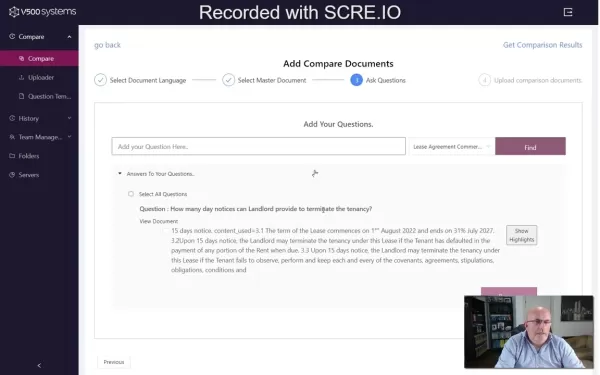
Reporting capabilities include:
- Visual document differencing with change tracking
- Automated material term highlighting
- Exportable analysis in Excel, PDF, and native formats
These features collectively enhance review efficiency while maintaining rigorous documentation standards.
Real-World Applications of AI Document Comparison
Legal Document Review
Legal professionals leverage AI document analysis for contract due diligence, version control, and litigation preparation. The technology identifies nuanced wording changes and clause modifications that carry significant legal implications while accelerating traditionally time-intensive review processes.
Legal sector benefits:
- Contract lifecycle management
- Mergers & acquisitions document analysis
- Regulatory compliance verification
- Discovery process optimization
By automating mechanical review tasks, legal teams redirect focus toward strategic case assessment and client counsel.
Compliance and Regulatory Analysis
Organizations navigate increasingly complex regulatory environments requiring constant policy monitoring and documentation. AI-assisted document comparison ensures continuous compliance by automatically detecting necessary policy updates against evolving regulatory frameworks.
Compliance applications:
- Policy/regulation gap analysis
- Audit preparation automation
- Regulatory change tracking
- Cross-border compliance verification
This proactive approach minimizes regulatory risk while streamlining compliance operations.
Business Contract Management
Enterprise contract administration benefits from automated version control, risk clause identification, and obligation tracking. AI-powered analysis reduces contractual risk exposure while maintaining organizational compliance with agreed terms.
Contract management advantages:
- Automated redlining and version comparison
- Standard clause compliance verification
- Obligation and deadline tracking
- Renewal term analysis
These capabilities transform contracts from static documents into dynamic, manageable business assets.
Frequently Asked Questions About AI Document Comparison
What types of documents can AI document comparison software analyze?
The platform processes diverse document formats including legal contracts (NDAs, MSAs, SOWs), financial statements, policy documents, and technical specifications across PDF, DOCX, and plain text formats. Advanced optical character recognition extends capabilities to scanned documents.
How accurate is AI document comparison software?
Modern solutions achieve >99% accuracy in text discrepancy identification, with performance continually improving through machine learning. Accuracy remains dependent on input document quality and complexity - clean digital documents yield optimal results versus poor-quality scans or handwritten materials.
Does the software support multiple languages?
Current multilingual capabilities include comprehensive processing of English, Polish, and Arabic content, with additional languages roadmap for future releases. The system maintains consistent analytical rigor across supported languages while accommodating regional terminology variations.
Can the software integrate with existing document management systems?
Enterprise-grade solutions offer REST API and native integration with leading document management platforms including SharePoint, iManage, and NetDocuments. This ensures seamless workflow incorporation without disrupting existing content ecosystems.
Is training required to use the software effectively?
While designed for intuitive operation, maximizing value typically requires initial user orientation. Vendors generally provide comprehensive onboarding programs including interactive tutorials, use case scenarios, and ongoing support channels to ensure rapid user proficiency.
Related Questions
How does AI document comparison software handle complex legal documents?
Specialized legal analysis capabilities include clause-level comparison, defined term tracking, and conditional logic evaluation. The software parses legal structures including recitals, definitions, operative provisions, and signature blocks while maintaining contextual relationships between provisions.
What are the benefits of using AI for compliance and regulatory analysis?
AI-driven compliance monitoring provides continuous regulatory alignment scanning, automated audit trail generation, and change impact assessment. This proactive approach reduces regulatory risk exposure while optimizing compliance resource allocation through intelligent automation of routine monitoring tasks.
Related article
 Anthropic Opens Doors to EU Cybersecurity Agency as Mythos5 Model Faces Compliance Exam
Artificial intelligence compliance regulations are advancing significantly. Leading AI firm Anthropic has officially granted the European Union's cybersecurity authority access to its Mythos AI model, a pivotal move for this advanced large language m
Lenovo Unveils AI Cutie at MWC 2026: Desktop Robotic Arm Becomes Your New Workplace Assistant
If AI in 2025 is still confined to screen-based chats, 2026 marks the shift toward tangible, desk-integrated intelligence. At MWC 2026 in Barcelona, Lenovo unveiled two groundbreaking AI hardware concepts: AI Workmate (an AI Office Partner) and AI Wo
TikTok Launches Voice Copyright Report Channel as AI Clone Voice Complaints Double
TikTok has introduced a dedicated reporting channel for voice-related intellectual property infringement, alongside enhanced rights protection mechanisms. The platform notes that as AI voice synthesis and imitation technologies become more accessible
Related Special Topic Recommendations
code
Anthropic Opens Doors to EU Cybersecurity Agency as Mythos5 Model Faces Compliance Exam
Artificial intelligence compliance regulations are advancing significantly. Leading AI firm Anthropic has officially granted the European Union's cybersecurity authority access to its Mythos AI model, a pivotal move for this advanced large language m
Lenovo Unveils AI Cutie at MWC 2026: Desktop Robotic Arm Becomes Your New Workplace Assistant
If AI in 2025 is still confined to screen-based chats, 2026 marks the shift toward tangible, desk-integrated intelligence. At MWC 2026 in Barcelona, Lenovo unveiled two groundbreaking AI hardware concepts: AI Workmate (an AI Office Partner) and AI Wo
TikTok Launches Voice Copyright Report Channel as AI Clone Voice Complaints Double
TikTok has introduced a dedicated reporting channel for voice-related intellectual property infringement, alongside enhanced rights protection mechanisms. The platform notes that as AI voice synthesis and imitation technologies become more accessible
Related Special Topic Recommendations
code
 AI Pull Request Review Tools for GitHub Teams Handling Refactors, Bugs, and Security Gaps
2026 Latest Best AI Pull Request Review Tools for GitHub Teams are here on XIX.AI! This top-rated curated list showcases powerful game-changing solutions that streamline refactoring, bug fixing, and security gap detection across all team workflows. Enjoy a free vs paid comparison along with real-world tests and detailed rankings to help you find the perfect tool that boosts productivity significantly. Explore now to unlock your AI edge!
 12 tools
 xix.ai
Text-to-speech
Best AI Text to Speech Tools for Natural Voiceovers
xix.ai
Text-to-speech
Best AI Text to Speech Tools for Natural Voiceovers
2026 Latest Best Top-rated AI Text to Speech Tools for Natural Voiceovers are here on XIX.AI! This curated list features powerful, game-changing options that deliver crystal-clear voices for every use case, backed by real-world tests and weekly updated rankings. Get a free vs paid comparison to find the must-try solution that boosts your productivity instantly. Explore now to Unlock your AI edge!
11 tools
xix.ai
Comic Creation
Manga AI Background Generators for Serialized Chapters, Covers, and Promo Art
2026 Latest Best Manga AI Background Generators Ranked Top-Rated! This curated collection showcases powerful game-changing tools perfect for creating high-quality chapter backgrounds, book covers, and promotional art. Every option has undergone rigorous real-world tests to ensure reliability. Get a free vs paid comparison along with detailed insights. Explore now to discover your perfect tool and unlock your AI edge in manga creation.
6 tools
xix.ai
Image editing
AI Object Removal Editors: Clean Up Portraits, Travel, and Product Shots
2026 Latest Best Top-rated AI Object Removal Editors for portraits travel product shots! XIX.AI curates a powerful game-changing collection regularly updated with weekly rankings. These tools offer real-world tests to help you quickly remove unwanted elements, boost content quality, and save tons of time without compromising results. Must-try for anyone aiming to unlock their AI creation edge. Explore now!
10 tools
xix.ai
Text-to-speech
Best AI Text to Speech Tools for Online Courses
2026 Latest Best Top-rated AI Text to Speech Tools for Online Courses are curated by XIX.AI based on rigorous real-world tests and weekly updated rankings. These powerful tools help creators deliver crystal-clear audio content effortlessly, boosting writing efficiency and streamlining course production. Check out the free vs paid comparison to find your perfect fit. Explore now to unlock your AI edge in online education.
10 tools
xix.ai
writing
AI Blog Title Tools for Higher Click Through Rates
2026 Latest Best Top-Rated AI Blog Title Tools for Higher Click Through Rates! XIX.AI has carefully curated a powerful, game-changing collection of top tools that go through rigorous real-world tests. You’ll find a free vs paid comparison, weekly updated rankings, and detailed insights to help you boost your blog’s traffic efficiently. Must-try options are highlighted to help you unlock your AI edge. Explore now!
10 tools
xix.ai

 Comments (1)
0/500
Comments (1)
0/500
![GeorgeMiller]()
¿Habéis probado alguna de estas herramientas? Tengo que comparar contratos cada semana y la verdad que sería un alivio si funcionan tan bien como dicen. Aunque me da un poco de miedo fiarse 100% del algoritmo en temas legales, ¿seguro que no se le escapan matices importantes? 😅 Si alguien tiene experiencia real, ¡que cuente!
Modern enterprises and legal practices demand efficient, error-free document comparison capabilities. Where manual review processes prove time-intensive and unreliable, AI-powered document comparison solutions deliver unprecedented speed and precision. This in-depth exploration reveals how intelligent document analysis technology optimizes workflow efficiency, enhances accuracy, and supports data-driven decision making across sectors. Discover how artificial intelligence is redefining best practices for document-intensive operations.
Key Points
AI document comparison technology dramatically accelerates analysis timelines
Precision algorithms eliminate costly human oversight in document review
Multilingual processing enables cross-border document collaboration
Advanced pattern recognition identifies critical variations in complex documents
Natural language processing allows direct document interrogation
Seamless integration with existing document management ecosystems
Comprehensive output formats including Excel-compatible reports
Automated highlighting of material differences and key provisions
Introduction to AI-Driven Document Comparison
The Evolution of Document Comparison
Conventional document review methods involving side-by-side manual examination consistently demonstrated inefficiency and susceptibility to oversight. AI-powered document analysis platforms now automate these processes through sophisticated algorithms capable of parsing documents with machine-level precision and speed. This technological advancement proves particularly valuable in precision-critical industries including legal services, regulatory compliance, and financial operations.
The system's contextual comprehension capabilities extend beyond superficial text matching to understand semantic meaning, uncovering substantive discrepancies that human reviewers might overlook. Furthermore, enterprise-grade solutions maintain consistent performance when processing large document volumes, making them scalable for organizational needs.
How AI Enhances Document Analysis
Artificial intelligence replicates sophisticated human cognition to interpret complex textual information. When applied to document comparison, AI examines content structure, identifies linguistic patterns, and extracts substantive elements - detecting not only explicit modifications but also nuanced contextual variations. AI-powered solutions offer distinct advantages over manual methods:
- Processing Speed: Analyzes document sets in minutes versus hours
- Accuracy Rates: Minimizes oversight through systematic examination
- Volume Capacity: Handles large document repositories with consistent performance
- Comprehensive Review: Identifies both textual and conceptual differences
- Contextual Intelligence: Interprets meaning and intent behind terminology
These capabilities collectively transform organizational approaches to document verification and analysis.
Pricing Structure for V500 Systems' AI Document Comparison
Understanding the Subscription Models
V500 Systems offers flexible commercial options designed for diverse operational requirements. The following outlines standard pricing structures common to enterprise document comparison solutions:
Subscription Plans: Tiered monthly/annual licensing based on user count, processing volume, and feature access
Transaction-Based: Per-document or per-feature pricing model ideal for intermittent usage
Enterprise Customization: Bespoke solutions for large organizations with specialized requirements
Organizations should conduct thorough requirements analysis to identify optimal cost structures aligned with their document processing volumes and use case complexity.
Step-by-Step Guide to Using V500 Systems' Document Comparison Software
Step 1: Selecting the Document Language
The analysis process begins with language specification to ensure accurate semantic processing. The platform currently supports comprehensive analysis of English, Polish, and Arabic content.
Language selection protocol:
- Navigate to the comparison module interface
- Access the language selection dropdown
- Specify primary document language
This foundational step ensures subsequent analysis maintains contextual accuracy.
Step 2: Choosing the Master File
Designating the base reference document establishes the comparison framework. This authoritative version serves as the benchmark against which subsequent documents will be evaluated.
Master file selection process:
- Activate master file selection interface
- Identify source document from organizational repositories
- Confirm baseline document designation
The system intelligently parses the master document content in preparation for comparative analysis.
Step 3: Asking Questions for Targeted Analysis
The platform's advanced query functionality allows direct document interrogation through natural language processing. This targeted approach enables focused extraction of specific contractual provisions or data points.
Question submission workflow:
- Access the semantic query interface
- Formulate precise question or select template
- Initiate AI-powered content analysis
The system generates contextually relevant responses by synthesizing document content.
Step 4: Uploading and Comparing Documents
The final analysis phase involves comparative document submission and automated discrepancy reporting. The system generates comprehensive difference analysis with prioritized material findings.
Comparison execution protocol:
- Upload comparator documents via secure interface
- Initiate automated analysis process
- Review generated discrepancy reports
Output includes annotated versions highlighting modifications and Excel-compatible data exports for further examination.
Advantages and Disadvantages of Using AI for Document Comparison
Pros
Time Optimization: Reduces document review timelines from days to hours
Precision Enhancement: Machine-level consistency in discrepancy detection
Global Collaboration: Eliminates language barriers in international operations
Intelligent Interrogation: Natural language query capabilities
Comprehensive Reporting: Detailed variation analysis with version tracking
Cons
Implementation Period: Requires initial configuration and user familiarization
Model Dependency: Output quality correlates with algorithmic sophistication
Specialization Limits: Highly technical documents may require system customization
Connectivity Requirements: Cloud-based solutions need stable network access
Key Features of V500 Systems' AI Document Comparison
Comprehensive Language Support
The platform's multilingual processing capabilities currently extend to English (all major variants), Polish, and Arabic document analysis, with additional language support in active development. This linguistic versatility supports global enterprise operations requiring cross-border document analysis.
Language-specific capabilities include:
- English: Full semantic analysis with legal/technical terminology recognition
- Polish: Comprehensive Eastern European language processing
- Arabic: Right-to-left script analysis with dialect comprehension
This breadth of language support ensures accurate document examination regardless of geographic origin or subject matter complexity.
Intelligent Question Answering
The platform's natural language processing engine allows direct document interrogation through conversational queries. Users receive synthesized responses drawn from document content analysis, significantly accelerating information retrieval.
Question processing sequence:
- Natural language query input
- Contextual document analysis
- Relevant content identification
- Concise answer generation
Particularly valuable for legal practitioners requiring rapid contract clause analysis or compliance professionals verifying regulatory adherence.
Highlighting and Detailed Comparison Reporting
The system automatically identifies and emphasizes material document variations through visual indicators while generating comprehensive difference reports in multiple output formats. This functionality streamlines review processes and ensures thorough discrepancy documentation.
Reporting capabilities include:
- Visual document differencing with change tracking
- Automated material term highlighting
- Exportable analysis in Excel, PDF, and native formats
These features collectively enhance review efficiency while maintaining rigorous documentation standards.
Real-World Applications of AI Document Comparison
Legal Document Review
Legal professionals leverage AI document analysis for contract due diligence, version control, and litigation preparation. The technology identifies nuanced wording changes and clause modifications that carry significant legal implications while accelerating traditionally time-intensive review processes.
Legal sector benefits:
- Contract lifecycle management
- Mergers & acquisitions document analysis
- Regulatory compliance verification
- Discovery process optimization
By automating mechanical review tasks, legal teams redirect focus toward strategic case assessment and client counsel.
Compliance and Regulatory Analysis
Organizations navigate increasingly complex regulatory environments requiring constant policy monitoring and documentation. AI-assisted document comparison ensures continuous compliance by automatically detecting necessary policy updates against evolving regulatory frameworks.
Compliance applications:
- Policy/regulation gap analysis
- Audit preparation automation
- Regulatory change tracking
- Cross-border compliance verification
This proactive approach minimizes regulatory risk while streamlining compliance operations.
Business Contract Management
Enterprise contract administration benefits from automated version control, risk clause identification, and obligation tracking. AI-powered analysis reduces contractual risk exposure while maintaining organizational compliance with agreed terms.
Contract management advantages:
- Automated redlining and version comparison
- Standard clause compliance verification
- Obligation and deadline tracking
- Renewal term analysis
These capabilities transform contracts from static documents into dynamic, manageable business assets.
Frequently Asked Questions About AI Document Comparison
What types of documents can AI document comparison software analyze?
The platform processes diverse document formats including legal contracts (NDAs, MSAs, SOWs), financial statements, policy documents, and technical specifications across PDF, DOCX, and plain text formats. Advanced optical character recognition extends capabilities to scanned documents.
How accurate is AI document comparison software?
Modern solutions achieve >99% accuracy in text discrepancy identification, with performance continually improving through machine learning. Accuracy remains dependent on input document quality and complexity - clean digital documents yield optimal results versus poor-quality scans or handwritten materials.
Does the software support multiple languages?
Current multilingual capabilities include comprehensive processing of English, Polish, and Arabic content, with additional languages roadmap for future releases. The system maintains consistent analytical rigor across supported languages while accommodating regional terminology variations.
Can the software integrate with existing document management systems?
Enterprise-grade solutions offer REST API and native integration with leading document management platforms including SharePoint, iManage, and NetDocuments. This ensures seamless workflow incorporation without disrupting existing content ecosystems.
Is training required to use the software effectively?
While designed for intuitive operation, maximizing value typically requires initial user orientation. Vendors generally provide comprehensive onboarding programs including interactive tutorials, use case scenarios, and ongoing support channels to ensure rapid user proficiency.
Related Questions
How does AI document comparison software handle complex legal documents?
Specialized legal analysis capabilities include clause-level comparison, defined term tracking, and conditional logic evaluation. The software parses legal structures including recitals, definitions, operative provisions, and signature blocks while maintaining contextual relationships between provisions.
What are the benefits of using AI for compliance and regulatory analysis?
AI-driven compliance monitoring provides continuous regulatory alignment scanning, automated audit trail generation, and change impact assessment. This proactive approach reduces regulatory risk exposure while optimizing compliance resource allocation through intelligent automation of routine monitoring tasks.








 Anthropic Opens Doors to EU Cybersecurity Agency as Mythos5 Model Faces Compliance Exam
Artificial intelligence compliance regulations are advancing significantly. Leading AI firm Anthropic has officially granted the European Union's cybersecurity authority access to its Mythos AI model, a pivotal move for this advanced large language m
Anthropic Opens Doors to EU Cybersecurity Agency as Mythos5 Model Faces Compliance Exam
Artificial intelligence compliance regulations are advancing significantly. Leading AI firm Anthropic has officially granted the European Union's cybersecurity authority access to its Mythos AI model, a pivotal move for this advanced large language m
 Lenovo Unveils AI Cutie at MWC 2026: Desktop Robotic Arm Becomes Your New Workplace Assistant
If AI in 2025 is still confined to screen-based chats, 2026 marks the shift toward tangible, desk-integrated intelligence. At MWC 2026 in Barcelona, Lenovo unveiled two groundbreaking AI hardware concepts: AI Workmate (an AI Office Partner) and AI Wo
Lenovo Unveils AI Cutie at MWC 2026: Desktop Robotic Arm Becomes Your New Workplace Assistant
If AI in 2025 is still confined to screen-based chats, 2026 marks the shift toward tangible, desk-integrated intelligence. At MWC 2026 in Barcelona, Lenovo unveiled two groundbreaking AI hardware concepts: AI Workmate (an AI Office Partner) and AI Wo
 TikTok Launches Voice Copyright Report Channel as AI Clone Voice Complaints Double
TikTok has introduced a dedicated reporting channel for voice-related intellectual property infringement, alongside enhanced rights protection mechanisms. The platform notes that as AI voice synthesis and imitation technologies become more accessible
TikTok Launches Voice Copyright Report Channel as AI Clone Voice Complaints Double
TikTok has introduced a dedicated reporting channel for voice-related intellectual property infringement, alongside enhanced rights protection mechanisms. The platform notes that as AI voice synthesis and imitation technologies become more accessible

2026 Latest Best AI Pull Request Review Tools for GitHub Teams are here on XIX.AI! This top-rated curated list showcases powerful game-changing solutions that streamline refactoring, bug fixing, and security gap detection across all team workflows. Enjoy a free vs paid comparison along with real-world tests and detailed rankings to help you find the perfect tool that boosts productivity significantly. Explore now to unlock your AI edge!
12 tools
xix.ai

2026 Latest Best Top-rated AI Text to Speech Tools for Natural Voiceovers are here on XIX.AI! This curated list features powerful, game-changing options that deliver crystal-clear voices for every use case, backed by real-world tests and weekly updated rankings. Get a free vs paid comparison to find the must-try solution that boosts your productivity instantly. Explore now to Unlock your AI edge!
11 tools
xix.ai

2026 Latest Best Manga AI Background Generators Ranked Top-Rated! This curated collection showcases powerful game-changing tools perfect for creating high-quality chapter backgrounds, book covers, and promotional art. Every option has undergone rigorous real-world tests to ensure reliability. Get a free vs paid comparison along with detailed insights. Explore now to discover your perfect tool and unlock your AI edge in manga creation.
6 tools
xix.ai

2026 Latest Best Top-rated AI Object Removal Editors for portraits travel product shots! XIX.AI curates a powerful game-changing collection regularly updated with weekly rankings. These tools offer real-world tests to help you quickly remove unwanted elements, boost content quality, and save tons of time without compromising results. Must-try for anyone aiming to unlock their AI creation edge. Explore now!
10 tools
xix.ai

2026 Latest Best Top-rated AI Text to Speech Tools for Online Courses are curated by XIX.AI based on rigorous real-world tests and weekly updated rankings. These powerful tools help creators deliver crystal-clear audio content effortlessly, boosting writing efficiency and streamlining course production. Check out the free vs paid comparison to find your perfect fit. Explore now to unlock your AI edge in online education.
10 tools
xix.ai

2026 Latest Best Top-Rated AI Blog Title Tools for Higher Click Through Rates! XIX.AI has carefully curated a powerful, game-changing collection of top tools that go through rigorous real-world tests. You’ll find a free vs paid comparison, weekly updated rankings, and detailed insights to help you boost your blog’s traffic efficiently. Must-try options are highlighted to help you unlock your AI edge. Explore now!
10 tools
xix.ai

¿Habéis probado alguna de estas herramientas? Tengo que comparar contratos cada semana y la verdad que sería un alivio si funcionan tan bien como dicen. Aunque me da un poco de miedo fiarse 100% del algoritmo en temas legales, ¿seguro que no se le escapan matices importantes? 😅 Si alguien tiene experiencia real, ¡que cuente!












