


 Home
Home
Samsung Launches New Galaxy Glasses Featuring Gemini AI: Lightweight 50g Model Without Display but Powered by Continuous AI Assistance
Samsung has finally taken concrete steps to integrate a powerful large language model into wearable eyewear. On the evening of July 22, the company officially introduced its first line of AI smart glasses, the Galaxy Glasses, marking its initial entry into the realm of AI-powered facial hardware.
The development of these glasses was not a Samsung-led effort alone. They were created through collaboration between Samsung, Google, Gentle Monster, and Warby Parker. Powered by the Android XR operating system, they feature native integration of Google’s Gemini multimodal large language model, with the primary goal of delivering a hands-free visual assistance solution that can operate throughout the day.
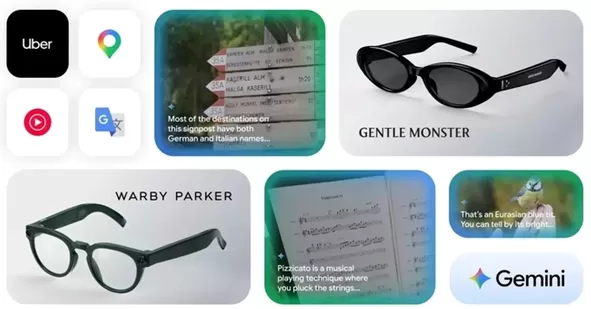
The most striking feature of the Galaxy Glasses is the absence of a traditional display screen. Thanks to its lightweight design, it resembles standard optical glasses and weighs only about 50 grams. Instead of using an AR display, it relies on high-definition cameras positioned on both sides of the frame to capture real-world images, which are then sent to Gemini for recognition and analysis. The processed results are conveyed to the user via audio output from the lens. This design choice helps reduce weight and power consumption, enabling comfortable long-term daily wear.
To support this functionality, the glasses are equipped with a dedicated processing chip. The Galaxy Glasses utilize the Qualcomm Snapdragon AR1Gen1 chipset, which includes four Arm cores operating at up to 1.9GHz along with a 12-megapixel image sensor. It supports full HD video recording at 30 frames per second. The frame also includes dual privacy indicator lights that illuminate simultaneously when recording, clearly signaling to others that recording is in progress.
Gemini’s multimodal capabilities are applied in three real-world scenarios: office work, travel, and communication. During meetings, it can automatically capture text from whiteboards and promptly organize it into Samsung Notes. When on the go, it offers real-time voice navigation and instant language translation for multiple languages. It can also read messages aloud without the need to pick up a phone. During calls, it allows users to share a live first-person video view hands-free. Additionally, it has context memory features that retain information from previous interactions to minimize repetitive actions.
There are two ways to interact with the glasses. Basic functions are controlled through the touch-sensitive area on the right temple — sliding there adjusts volume, tapping answers calls, and holding down triggers recording. When paired with a Galaxy Watch9 series watch, air gesture control becomes available, freeing both hands entirely. In terms of battery life, the glasses can operate for up to 9 hours on a single charge, while the accompanying charging and storage case provides an additional 7 full charges, ensuring sufficient power for an entire day of use.
Related article
 U.S. Stocks Hit Historic Milestone as AI and Aerospace Giants Prepare for Trillion-Dollar Debut
Elon Musk, Sam Altman, and Dario Amodei, three titans of the technology sector, are advancing toward initial public offerings for their respective ventures. With SpaceX, OpenAI, and Anthropic—three industry behemoths nearing trillion-dollar valuation
Swedish AI Startup Lovable Eyes $13.2 Billion Valuation After Major Funding Round
As AI-driven coding tools gain traction, Swedish startup Lovable has secured a major funding round. The company aims to raise $3 billion, potentially boosting its valuation to $13.2 billion—double the $6.6 billion recorded last December. Menlo Ventur
Google Tests Remy AI Agent for Gemini as Focus Shifts to User Control
According to Business Insider, Google is testing Remy, a new AI personal agent for Gemini. This tool aims to execute tasks on behalf of users, streamlining both professional workflows and daily routines.Currently, Remy is undergoing testing in an int
Related Special Topic Recommendations
Data Analysis
U.S. Stocks Hit Historic Milestone as AI and Aerospace Giants Prepare for Trillion-Dollar Debut
Elon Musk, Sam Altman, and Dario Amodei, three titans of the technology sector, are advancing toward initial public offerings for their respective ventures. With SpaceX, OpenAI, and Anthropic—three industry behemoths nearing trillion-dollar valuation
Swedish AI Startup Lovable Eyes $13.2 Billion Valuation After Major Funding Round
As AI-driven coding tools gain traction, Swedish startup Lovable has secured a major funding round. The company aims to raise $3 billion, potentially boosting its valuation to $13.2 billion—double the $6.6 billion recorded last December. Menlo Ventur
Google Tests Remy AI Agent for Gemini as Focus Shifts to User Control
According to Business Insider, Google is testing Remy, a new AI personal agent for Gemini. This tool aims to execute tasks on behalf of users, streamlining both professional workflows and daily routines.Currently, Remy is undergoing testing in an int
Related Special Topic Recommendations
Data Analysis
 Best AI Anomaly Detection Tools for KPI Monitoring across SaaS and Ecommerce Teams
2026 Latest Best Top-rated AI Anomaly Detection Tools for KPI Monitoring in SaaS and Ecommerce teams! XIX.AI has curated a powerful, game-changing collection based on rigorous real-world tests and weekly updated rankings. You’ll find detailed free vs paid comparison insights to help you identify the must-try solution that boosts productivity and unlocks your AI edge. Explore now!
 10 tools
 xix.ai
writing
Best AI Outline Generators for Long-Form SEO Articles
xix.ai
writing
Best AI Outline Generators for Long-Form SEO Articles
2026 Latest Best Top-Rated AI Outline Generators for Long-Form SEO Articles, meticulously curated by XIX.AI. These powerful tools offer game-changing assistance in creating high-quality content quickly, boosting writing efficiency significantly. Get a free vs paid comparison along with real-world tests and detailed rankings to help you find the must-try option that suits your needs. Explore now to unlock your AI edge.
8 tools
xix.ai
Education and Learning
AI Study Tools for Homework and Exam Prep
2026 Latest Best AI Study Tools for Homework and Exam Prep! XIX.AI curates a top-rated list of powerful, game-changing tools that help students boost productivity, streamline homework completion, and ace exams through real-world tests. Get a free vs paid comparison, detailed rankings, and must-try options to unlock your AI edge. Explore now!
10 tools
xix.ai
Music composition
AI Vocal Demo Tools for Songwriters, Hooks, Toplines, and Multilingual Draft Sessions
2026 Latest Best AI Vocal Demo Tools for Songwriters, Hook Creators, and Multi-Language Content Teams! XIX.AI has curated a top-rated list of powerful game-changing tools that go through rigorous real-world tests. You’ll find detailed free vs paid comparison data, comprehensive rankings, and must-try options to help you boost writing efficiency and unlock your creative potential. Explore now to discover your perfect tool for all your content needs!
9 tools
xix.ai
Business
Best AI Competitive Research Tools for Small Businesses
2026 Latest Best Top-rated AI Competitive Research Tools for Small Businesses! XIX.AI has curated a highly powerful game-changing collection, updated weekly with rigorous real-world tests and detailed rankings. You can find a comprehensive free vs paid comparison to help you identify the must-try tools that boost your productivity and give you a competitive edge. Explore now to discover your perfect tool!
9 tools
xix.ai
Image editing
Photoshop AI Retouch Tools for Ecommerce Apparel, Skin Cleanup, and Color Consistency
2026 Latest Best Photoshop AI retouch tools for ecommerce apparel, skin cleanup, and color consistency! This top-rated curated list features powerful game-changing solutions that help you boost writing efficiency, streamline content creation, and achieve perfect visual results effortlessly. Each tool has undergone real-world tests through weekly updated rankings, complete with free vs paid comparison details. Backed by XIX.AI, it’s the must-try guide for anyone aiming to unlock your AI edge. Explore now!
10 tools
xix.ai

 Comments (0)
0/500
Comments (0)
0/500
Samsung has finally taken concrete steps to integrate a powerful large language model into wearable eyewear. On the evening of July 22, the company officially introduced its first line of AI smart glasses, the Galaxy Glasses, marking its initial entry into the realm of AI-powered facial hardware.
The development of these glasses was not a Samsung-led effort alone. They were created through collaboration between Samsung, Google, Gentle Monster, and Warby Parker. Powered by the Android XR operating system, they feature native integration of Google’s Gemini multimodal large language model, with the primary goal of delivering a hands-free visual assistance solution that can operate throughout the day.
The most striking feature of the Galaxy Glasses is the absence of a traditional display screen. Thanks to its lightweight design, it resembles standard optical glasses and weighs only about 50 grams. Instead of using an AR display, it relies on high-definition cameras positioned on both sides of the frame to capture real-world images, which are then sent to Gemini for recognition and analysis. The processed results are conveyed to the user via audio output from the lens. This design choice helps reduce weight and power consumption, enabling comfortable long-term daily wear.
To support this functionality, the glasses are equipped with a dedicated processing chip. The Galaxy Glasses utilize the Qualcomm Snapdragon AR1Gen1 chipset, which includes four Arm cores operating at up to 1.9GHz along with a 12-megapixel image sensor. It supports full HD video recording at 30 frames per second. The frame also includes dual privacy indicator lights that illuminate simultaneously when recording, clearly signaling to others that recording is in progress.
Gemini’s multimodal capabilities are applied in three real-world scenarios: office work, travel, and communication. During meetings, it can automatically capture text from whiteboards and promptly organize it into Samsung Notes. When on the go, it offers real-time voice navigation and instant language translation for multiple languages. It can also read messages aloud without the need to pick up a phone. During calls, it allows users to share a live first-person video view hands-free. Additionally, it has context memory features that retain information from previous interactions to minimize repetitive actions.
There are two ways to interact with the glasses. Basic functions are controlled through the touch-sensitive area on the right temple — sliding there adjusts volume, tapping answers calls, and holding down triggers recording. When paired with a Galaxy Watch9 series watch, air gesture control becomes available, freeing both hands entirely. In terms of battery life, the glasses can operate for up to 9 hours on a single charge, while the accompanying charging and storage case provides an additional 7 full charges, ensuring sufficient power for an entire day of use.








 U.S. Stocks Hit Historic Milestone as AI and Aerospace Giants Prepare for Trillion-Dollar Debut
Elon Musk, Sam Altman, and Dario Amodei, three titans of the technology sector, are advancing toward initial public offerings for their respective ventures. With SpaceX, OpenAI, and Anthropic—three industry behemoths nearing trillion-dollar valuation
U.S. Stocks Hit Historic Milestone as AI and Aerospace Giants Prepare for Trillion-Dollar Debut
Elon Musk, Sam Altman, and Dario Amodei, three titans of the technology sector, are advancing toward initial public offerings for their respective ventures. With SpaceX, OpenAI, and Anthropic—three industry behemoths nearing trillion-dollar valuation
 Swedish AI Startup Lovable Eyes $13.2 Billion Valuation After Major Funding Round
As AI-driven coding tools gain traction, Swedish startup Lovable has secured a major funding round. The company aims to raise $3 billion, potentially boosting its valuation to $13.2 billion—double the $6.6 billion recorded last December. Menlo Ventur
Google Tests Remy AI Agent for Gemini as Focus Shifts to User Control
According to Business Insider, Google is testing Remy, a new AI personal agent for Gemini. This tool aims to execute tasks on behalf of users, streamlining both professional workflows and daily routines.Currently, Remy is undergoing testing in an int
Swedish AI Startup Lovable Eyes $13.2 Billion Valuation After Major Funding Round
As AI-driven coding tools gain traction, Swedish startup Lovable has secured a major funding round. The company aims to raise $3 billion, potentially boosting its valuation to $13.2 billion—double the $6.6 billion recorded last December. Menlo Ventur
Google Tests Remy AI Agent for Gemini as Focus Shifts to User Control
According to Business Insider, Google is testing Remy, a new AI personal agent for Gemini. This tool aims to execute tasks on behalf of users, streamlining both professional workflows and daily routines.Currently, Remy is undergoing testing in an int

2026 Latest Best Top-rated AI Anomaly Detection Tools for KPI Monitoring in SaaS and Ecommerce teams! XIX.AI has curated a powerful, game-changing collection based on rigorous real-world tests and weekly updated rankings. You’ll find detailed free vs paid comparison insights to help you identify the must-try solution that boosts productivity and unlocks your AI edge. Explore now!
10 tools
xix.ai

2026 Latest Best Top-Rated AI Outline Generators for Long-Form SEO Articles, meticulously curated by XIX.AI. These powerful tools offer game-changing assistance in creating high-quality content quickly, boosting writing efficiency significantly. Get a free vs paid comparison along with real-world tests and detailed rankings to help you find the must-try option that suits your needs. Explore now to unlock your AI edge.
8 tools
xix.ai

2026 Latest Best AI Study Tools for Homework and Exam Prep! XIX.AI curates a top-rated list of powerful, game-changing tools that help students boost productivity, streamline homework completion, and ace exams through real-world tests. Get a free vs paid comparison, detailed rankings, and must-try options to unlock your AI edge. Explore now!
10 tools
xix.ai

2026 Latest Best AI Vocal Demo Tools for Songwriters, Hook Creators, and Multi-Language Content Teams! XIX.AI has curated a top-rated list of powerful game-changing tools that go through rigorous real-world tests. You’ll find detailed free vs paid comparison data, comprehensive rankings, and must-try options to help you boost writing efficiency and unlock your creative potential. Explore now to discover your perfect tool for all your content needs!
9 tools
xix.ai

2026 Latest Best Top-rated AI Competitive Research Tools for Small Businesses! XIX.AI has curated a highly powerful game-changing collection, updated weekly with rigorous real-world tests and detailed rankings. You can find a comprehensive free vs paid comparison to help you identify the must-try tools that boost your productivity and give you a competitive edge. Explore now to discover your perfect tool!
9 tools
xix.ai

2026 Latest Best Photoshop AI retouch tools for ecommerce apparel, skin cleanup, and color consistency! This top-rated curated list features powerful game-changing solutions that help you boost writing efficiency, streamline content creation, and achieve perfect visual results effortlessly. Each tool has undergone real-world tests through weekly updated rankings, complete with free vs paid comparison details. Backed by XIX.AI, it’s the must-try guide for anyone aiming to unlock your AI edge. Explore now!
10 tools
xix.ai












