


 Home
HomeRunware Unveils Portable Data Center Pod to Test Future of Mobile Infrastructure
On Tuesday, AI infrastructure firm Runware unveiled Sonic Inference Pod, a modular data center designed as a single, transportable unit. This solution offers a flexible alternative to hyperscalers’ massive, fixed-scale data center projects.
According to Runware, the Pod delivers higher-quality inference at a lower cost compared to other serverless platforms and GPU clouds. Its modular architecture allows for rapid capacity expansion by deploying new pods, eliminating the need to expand static facilities. Co-founder and CEO Flaviu Radulescu described this approach as the future of computing to TechCrunch.
“We believe distributed compute, positioned closer to end users for faster inference, is what will win in the long term,” he explained. Beyond competitive pricing, Radulescu highlighted that Runware’s system scales quickly, can be deployed anywhere with power access, and adapts rapidly to new hardware. Unlike traditional data centers that take months or years to build, Runware’s pods utilize a closed-loop cooling system that requires no water and can be operational in just days.
“Demand for inference is growing faster than facilities can be built,” Radulescu stated. “What we want is to power the world’s intelligence, to be the backbone every AI model runs on with capacity that keeps up with demand instead of throttling it.”
Runware currently operates 10 pods across the U.S., Europe, and Asia-Pacific, according to Radulescu. The company already supports inference for clients like Higgsfield AI and Wix, with 160 sites ready to power its pods. Following a $50 million Series A funding round in December, Runware aims to provide the necessary infrastructure for image generation companies. This expansion into modular pods aligns with the company’s core mission of providing inference services to businesses rather than focusing on a single product.
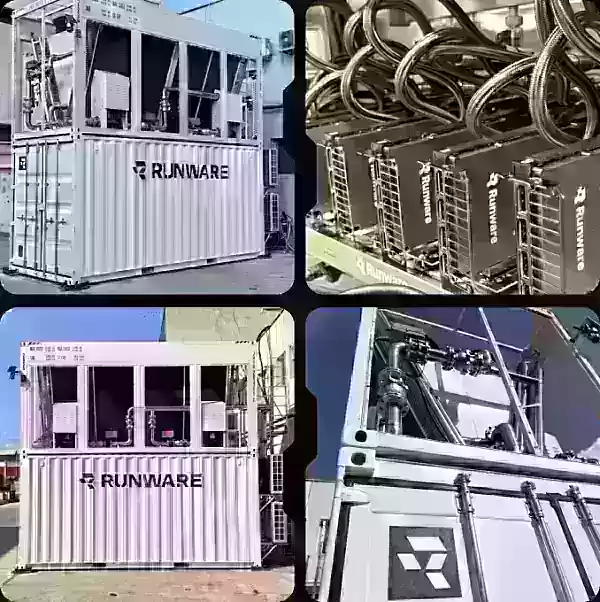
Image Credits:Runware
Major AI labs like OpenAI and SpaceX are still racing to construct data centers across the U.S. Reports suggest OpenAI is nearing a $500 billion deal to build a facility in Ohio. However, Radulescu does not view these large-scale projects as a threat to Sonic Inference Pods, citing the pods’ flexibility as a key advantage.
“Every pod runs as part of a single network, so requests go wherever there’s capacity, closer to the users, and if one pod goes offline, traffic moves to another,” he explained. He added that a system failure affects only one pod rather than an entire fixed facility. “Customers who want dedicated hardware get whole pods to themselves.”
Radulescu is also unconcerned about competitors building similar solutions, noting that hardware development is slow and the talent pool capable of designing and maintaining this technology is limited.
“A mistake in a circuit board design costs months between redesign, simulation, fabrication, testing and delivery,” he said. “Every one of those calls needs someone who understands exactly what each component does and what breaks if it’s gone.”
Constructing AI data centers remains a controversial topic, largely due to their high resource consumption. Communities hosting these facilities have already reported rising utility costs. While Runware envisions a future powered by renewable energy without straining local resources, that reality is not yet fully achievable.
Radulescu noted that AI power consumption will rise regardless, “driven by demand for inference, not by who supplies it.” He emphasized that Runware’s current focus is on meeting this demand efficiently. “No transmission losses, no water in cooling, and we’re using power that already exists instead of asking for new grid capacity to be built. More inference built this way means less new grid, less water, for the same amount of compute.”
Related article
 U.S. Stocks Hit Historic Milestone as AI and Aerospace Giants Prepare for Trillion-Dollar Debut
Elon Musk, Sam Altman, and Dario Amodei, three titans of the technology sector, are advancing toward initial public offerings for their respective ventures. With SpaceX, OpenAI, and Anthropic—three industry behemoths nearing trillion-dollar valuation
Swedish AI Startup Lovable Eyes $13.2 Billion Valuation After Major Funding Round
As AI-driven coding tools gain traction, Swedish startup Lovable has secured a major funding round. The company aims to raise $3 billion, potentially boosting its valuation to $13.2 billion—double the $6.6 billion recorded last December. Menlo Ventur
Google Tests Remy AI Agent for Gemini as Focus Shifts to User Control
According to Business Insider, Google is testing Remy, a new AI personal agent for Gemini. This tool aims to execute tasks on behalf of users, streamlining both professional workflows and daily routines.Currently, Remy is undergoing testing in an int
Related Special Topic Recommendations
SEO
U.S. Stocks Hit Historic Milestone as AI and Aerospace Giants Prepare for Trillion-Dollar Debut
Elon Musk, Sam Altman, and Dario Amodei, three titans of the technology sector, are advancing toward initial public offerings for their respective ventures. With SpaceX, OpenAI, and Anthropic—three industry behemoths nearing trillion-dollar valuation
Swedish AI Startup Lovable Eyes $13.2 Billion Valuation After Major Funding Round
As AI-driven coding tools gain traction, Swedish startup Lovable has secured a major funding round. The company aims to raise $3 billion, potentially boosting its valuation to $13.2 billion—double the $6.6 billion recorded last December. Menlo Ventur
Google Tests Remy AI Agent for Gemini as Focus Shifts to User Control
According to Business Insider, Google is testing Remy, a new AI personal agent for Gemini. This tool aims to execute tasks on behalf of users, streamlining both professional workflows and daily routines.Currently, Remy is undergoing testing in an int
Related Special Topic Recommendations
SEO
 Best AI SERP Analysis Tools for Search Strategy
2026 Latest Best Top-rated AI SERP Analysis Tools for Search Strategy are curated by XIX.AI through rigorous real-world tests and weekly updated rankings. These powerful tools help you unlock hidden optimization opportunities, boost content performance, and gain a competitive edge in search. Discover your perfect tool to elevate your search strategy today. Explore now!
 13 tools
 xix.ai
Data Analysis
Best AI Anomaly Detection Tools for KPI Monitoring across SaaS and Ecommerce Teams
xix.ai
Data Analysis
Best AI Anomaly Detection Tools for KPI Monitoring across SaaS and Ecommerce Teams
2026 Latest Best Top-rated AI Anomaly Detection Tools for KPI Monitoring in SaaS and Ecommerce teams! XIX.AI has curated a powerful, game-changing collection based on rigorous real-world tests and weekly updated rankings. You’ll find detailed free vs paid comparison insights to help you identify the must-try solution that boosts productivity and unlocks your AI edge. Explore now!
10 tools
xix.ai
writing
Best AI Outline Generators for Long-Form SEO Articles
2026 Latest Best Top-Rated AI Outline Generators for Long-Form SEO Articles, meticulously curated by XIX.AI. These powerful tools offer game-changing assistance in creating high-quality content quickly, boosting writing efficiency significantly. Get a free vs paid comparison along with real-world tests and detailed rankings to help you find the must-try option that suits your needs. Explore now to unlock your AI edge.
8 tools
xix.ai
Education and Learning
AI Study Tools for Homework and Exam Prep
2026 Latest Best AI Study Tools for Homework and Exam Prep! XIX.AI curates a top-rated list of powerful, game-changing tools that help students boost productivity, streamline homework completion, and ace exams through real-world tests. Get a free vs paid comparison, detailed rankings, and must-try options to unlock your AI edge. Explore now!
10 tools
xix.ai
Music composition
AI Vocal Demo Tools for Songwriters, Hooks, Toplines, and Multilingual Draft Sessions
2026 Latest Best AI Vocal Demo Tools for Songwriters, Hook Creators, and Multi-Language Content Teams! XIX.AI has curated a top-rated list of powerful game-changing tools that go through rigorous real-world tests. You’ll find detailed free vs paid comparison data, comprehensive rankings, and must-try options to help you boost writing efficiency and unlock your creative potential. Explore now to discover your perfect tool for all your content needs!
9 tools
xix.ai
Business
Best AI Competitive Research Tools for Small Businesses
2026 Latest Best Top-rated AI Competitive Research Tools for Small Businesses! XIX.AI has curated a highly powerful game-changing collection, updated weekly with rigorous real-world tests and detailed rankings. You can find a comprehensive free vs paid comparison to help you identify the must-try tools that boost your productivity and give you a competitive edge. Explore now to discover your perfect tool!
9 tools
xix.ai

 Comments (0)
0/500
Comments (0)
0/500
On Tuesday, AI infrastructure firm Runware unveiled Sonic Inference Pod, a modular data center designed as a single, transportable unit. This solution offers a flexible alternative to hyperscalers’ massive, fixed-scale data center projects.
According to Runware, the Pod delivers higher-quality inference at a lower cost compared to other serverless platforms and GPU clouds. Its modular architecture allows for rapid capacity expansion by deploying new pods, eliminating the need to expand static facilities. Co-founder and CEO Flaviu Radulescu described this approach as the future of computing to TechCrunch.
“We believe distributed compute, positioned closer to end users for faster inference, is what will win in the long term,” he explained. Beyond competitive pricing, Radulescu highlighted that Runware’s system scales quickly, can be deployed anywhere with power access, and adapts rapidly to new hardware. Unlike traditional data centers that take months or years to build, Runware’s pods utilize a closed-loop cooling system that requires no water and can be operational in just days.
“Demand for inference is growing faster than facilities can be built,” Radulescu stated. “What we want is to power the world’s intelligence, to be the backbone every AI model runs on with capacity that keeps up with demand instead of throttling it.”
Runware currently operates 10 pods across the U.S., Europe, and Asia-Pacific, according to Radulescu. The company already supports inference for clients like Higgsfield AI and Wix, with 160 sites ready to power its pods. Following a $50 million Series A funding round in December, Runware aims to provide the necessary infrastructure for image generation companies. This expansion into modular pods aligns with the company’s core mission of providing inference services to businesses rather than focusing on a single product.
Image Credits:Runware
Major AI labs like OpenAI and SpaceX are still racing to construct data centers across the U.S. Reports suggest OpenAI is nearing a $500 billion deal to build a facility in Ohio. However, Radulescu does not view these large-scale projects as a threat to Sonic Inference Pods, citing the pods’ flexibility as a key advantage.
“Every pod runs as part of a single network, so requests go wherever there’s capacity, closer to the users, and if one pod goes offline, traffic moves to another,” he explained. He added that a system failure affects only one pod rather than an entire fixed facility. “Customers who want dedicated hardware get whole pods to themselves.”
Radulescu is also unconcerned about competitors building similar solutions, noting that hardware development is slow and the talent pool capable of designing and maintaining this technology is limited.
“A mistake in a circuit board design costs months between redesign, simulation, fabrication, testing and delivery,” he said. “Every one of those calls needs someone who understands exactly what each component does and what breaks if it’s gone.”
Constructing AI data centers remains a controversial topic, largely due to their high resource consumption. Communities hosting these facilities have already reported rising utility costs. While Runware envisions a future powered by renewable energy without straining local resources, that reality is not yet fully achievable.
Radulescu noted that AI power consumption will rise regardless, “driven by demand for inference, not by who supplies it.” He emphasized that Runware’s current focus is on meeting this demand efficiently. “No transmission losses, no water in cooling, and we’re using power that already exists instead of asking for new grid capacity to be built. More inference built this way means less new grid, less water, for the same amount of compute.”








 U.S. Stocks Hit Historic Milestone as AI and Aerospace Giants Prepare for Trillion-Dollar Debut
Elon Musk, Sam Altman, and Dario Amodei, three titans of the technology sector, are advancing toward initial public offerings for their respective ventures. With SpaceX, OpenAI, and Anthropic—three industry behemoths nearing trillion-dollar valuation
U.S. Stocks Hit Historic Milestone as AI and Aerospace Giants Prepare for Trillion-Dollar Debut
Elon Musk, Sam Altman, and Dario Amodei, three titans of the technology sector, are advancing toward initial public offerings for their respective ventures. With SpaceX, OpenAI, and Anthropic—three industry behemoths nearing trillion-dollar valuation
 Swedish AI Startup Lovable Eyes $13.2 Billion Valuation After Major Funding Round
As AI-driven coding tools gain traction, Swedish startup Lovable has secured a major funding round. The company aims to raise $3 billion, potentially boosting its valuation to $13.2 billion—double the $6.6 billion recorded last December. Menlo Ventur
Google Tests Remy AI Agent for Gemini as Focus Shifts to User Control
According to Business Insider, Google is testing Remy, a new AI personal agent for Gemini. This tool aims to execute tasks on behalf of users, streamlining both professional workflows and daily routines.Currently, Remy is undergoing testing in an int
Swedish AI Startup Lovable Eyes $13.2 Billion Valuation After Major Funding Round
As AI-driven coding tools gain traction, Swedish startup Lovable has secured a major funding round. The company aims to raise $3 billion, potentially boosting its valuation to $13.2 billion—double the $6.6 billion recorded last December. Menlo Ventur
Google Tests Remy AI Agent for Gemini as Focus Shifts to User Control
According to Business Insider, Google is testing Remy, a new AI personal agent for Gemini. This tool aims to execute tasks on behalf of users, streamlining both professional workflows and daily routines.Currently, Remy is undergoing testing in an int

2026 Latest Best Top-rated AI SERP Analysis Tools for Search Strategy are curated by XIX.AI through rigorous real-world tests and weekly updated rankings. These powerful tools help you unlock hidden optimization opportunities, boost content performance, and gain a competitive edge in search. Discover your perfect tool to elevate your search strategy today. Explore now!
13 tools
xix.ai

2026 Latest Best Top-rated AI Anomaly Detection Tools for KPI Monitoring in SaaS and Ecommerce teams! XIX.AI has curated a powerful, game-changing collection based on rigorous real-world tests and weekly updated rankings. You’ll find detailed free vs paid comparison insights to help you identify the must-try solution that boosts productivity and unlocks your AI edge. Explore now!
10 tools
xix.ai

2026 Latest Best Top-Rated AI Outline Generators for Long-Form SEO Articles, meticulously curated by XIX.AI. These powerful tools offer game-changing assistance in creating high-quality content quickly, boosting writing efficiency significantly. Get a free vs paid comparison along with real-world tests and detailed rankings to help you find the must-try option that suits your needs. Explore now to unlock your AI edge.
8 tools
xix.ai

2026 Latest Best AI Study Tools for Homework and Exam Prep! XIX.AI curates a top-rated list of powerful, game-changing tools that help students boost productivity, streamline homework completion, and ace exams through real-world tests. Get a free vs paid comparison, detailed rankings, and must-try options to unlock your AI edge. Explore now!
10 tools
xix.ai

2026 Latest Best AI Vocal Demo Tools for Songwriters, Hook Creators, and Multi-Language Content Teams! XIX.AI has curated a top-rated list of powerful game-changing tools that go through rigorous real-world tests. You’ll find detailed free vs paid comparison data, comprehensive rankings, and must-try options to help you boost writing efficiency and unlock your creative potential. Explore now to discover your perfect tool for all your content needs!
9 tools
xix.ai

2026 Latest Best Top-rated AI Competitive Research Tools for Small Businesses! XIX.AI has curated a highly powerful game-changing collection, updated weekly with rigorous real-world tests and detailed rankings. You can find a comprehensive free vs paid comparison to help you identify the must-try tools that boost your productivity and give you a competitive edge. Explore now to discover your perfect tool!
9 tools
xix.ai












