


 Home
HomeRebel Audio Launches AI Podcast Tool for New Creators
You've probably experienced that moment with a friend: the conversation is flowing, you're making each other laugh, maybe even sharing surprisingly insightful thoughts. Then someone says it: "We should start a podcast."
Most of the time, that idea fades as quickly as it appeared. Not because it's a bad idea, but because actually creating a podcast has traditionally been quite difficult. Between recording setups, editing software, and promotion, many argue the barrier to entry is higher than people expect.
This is the gap a new platform, Rebel Audio, aims to bridge.
Rebel Audio positions itself as an all-in-one podcasting platform designed for first-time and early-stage creators. The concept is straightforward: instead of managing multiple tools, subscriptions, and workflows, podcasters can create their show, record it, edit it, upload cover artwork, generate transcripts, create clips for social media, and publish—all without leaving the platform.
Rebel Audio launched a private beta with a waitlist earlier this month and recently secured $3.8 million in an oversubscribed seed round, indicating that investors see significant potential in simplifying the podcast creation process. An official public rollout begins on May 30.
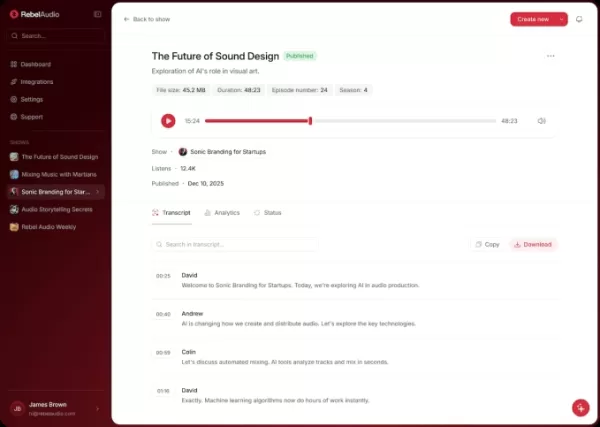
Image Credits:Rebel Audio
The timing of the launch is strategic. Podcasting is experiencing rapid growth, with the industry projected to reach $114.5 billion by 2030. According to Riverside, over 584 million people listened to podcasts in 2025, with predictions that this number will rise to 619 million by 2026.
Competitors like Spotify for Creators (formerly Spotify for Podcasters) have already adopted a similar all-in-one approach, offering tools such as unlimited hosting, video podcast uploads, audience engagement features, analytics, and monetization through ads and subscriptions. However, Rebel Audio contends that none of these solutions provide a truly comprehensive "360-degree" creation suite in the way its platform intends to. Other notable rivals include Riverside, Adobe Audition, and Descript.
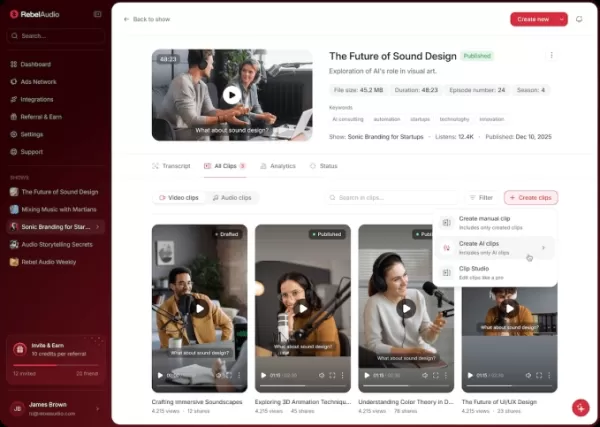
Image Credits:Rebel Audio
Unsurprisingly, Rebel Audio's platform is also heavily powered by AI.
The platform includes an AI assistant that helps with everything from generating show names and descriptions to suggesting content ideas and producing cover art based on a concept. It also offers AI-powered transcription, dubbing, and translation capabilities, as well as voice cloning for advertisement reads.
However, building a podcasting platform centered around AI could attract criticism.
The use of AI-generated images and voice cloning remains a sensitive topic across the creative industries. Concerns regarding training data, originality, and ownership continue to arise, and some creators are cautious of tools that blur these lines. Streaming platforms like Spotify and Deezer have already had to address issues related to low-quality, mass-produced AI content, sometimes referred to as "AI slop."
Rebel Audio told TechCrunch that it has implemented guardrails to address these concerns. Voice cloning is an opt-in feature that requires users to confirm they have the rights to use a given voice, and the platform includes safeguards aimed at preventing deepfake content. Similarly, the company states its AI-generated cover art tools are designed with moderation systems to block inappropriate or non-compliant imagery, particularly anything that could violate distribution platform guidelines.
Rebel Audio was developed in partnership with AI consulting firm Lattice Partners.
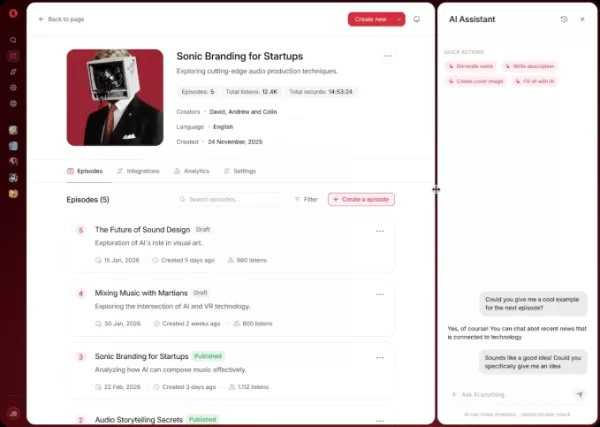
Image Credits:Rebel Audio
Behind the scenes, the company's leadership brings considerable industry experience. Founder Jared Gutstadt previously launched the production company Audio Up in 2020. Rebel Audio plans to migrate Audio Up's catalog onto its platform, including shows involving notable names like Machine Gun Kelly, Anthony Anderson, Dennis Quaid, Jason Alexander, and Luke Wilson.
The broader team includes veterans from companies like MGM and DreamWorks, and even Mark Burnett has joined as an advisor. Burnett is the producer behind hit shows like "Survivor," "The Voice," and "Shark Tank."
Regarding pricing, the platform is structured in tiers. It starts with a basic plan ($15/month) that offers AI-assisted production, hosting, and distribution to all major platforms. A Plus plan ($35/month) includes video hosting and voice cloning for ad reads, scaling up to a full Pro package ($70/month) that encompasses dynamic ad insertion, listener subscriptions, translation, and dubbing.
Related article
 Spotify challenges Google’s NotebookLM with new app
Many companies now build AI-powered features that connect email, calendar, documents, and notes to produce a daily briefing in text or audio. Spotify is following suit with a new standalone desktop app called Studio by Spotify Labs.Today, Spotify lau
ByteDance’s Seed launches global campus drive, offering virtual shares to win top large model talent
In the competitive landscape of large language models, securing top-tier talent remains the most critical strategic asset.On April 1st, ByteDance announced the launch of its Seed global campus recruitment initiative, part of its large model talent de
Suno to Watermark Songs Amid Legal Battles
Suno, the platform enabling users to generate AI-created music, has unveiled new features to label platform-produced tracks, restrict downloads, and update community standards to curb unauthorized replicas. These updates arrive as Suno confronts mult
Related Special Topic Recommendations
Design & Art
Spotify challenges Google’s NotebookLM with new app
Many companies now build AI-powered features that connect email, calendar, documents, and notes to produce a daily briefing in text or audio. Spotify is following suit with a new standalone desktop app called Studio by Spotify Labs.Today, Spotify lau
ByteDance’s Seed launches global campus drive, offering virtual shares to win top large model talent
In the competitive landscape of large language models, securing top-tier talent remains the most critical strategic asset.On April 1st, ByteDance announced the launch of its Seed global campus recruitment initiative, part of its large model talent de
Suno to Watermark Songs Amid Legal Battles
Suno, the platform enabling users to generate AI-created music, has unveiled new features to label platform-produced tracks, restrict downloads, and update community standards to curb unauthorized replicas. These updates arrive as Suno confronts mult
Related Special Topic Recommendations
Design & Art
 AI Visual Style Reference Tools for Character Sheets, Moodboards, and Pitch Decks
2026 Latest Best AI Visual Style Reference Tools for Character Sheets, Moodboards, and Pitch Decks are here on XIX.AI! This curated top-rated list features powerful game-changing tools that go through rigorous real-world tests. You’ll find a free vs paid comparison, detailed rankings, and must-try options to help you boost creativity and streamline your workflow. Explore now to discover your perfect tool for boosting productivity!
 11 tools
 xix.ai
SEO
Best AI SERP Analysis Tools for Search Strategy
xix.ai
SEO
Best AI SERP Analysis Tools for Search Strategy
2026 Latest Best Top-rated AI SERP Analysis Tools for Search Strategy are curated by XIX.AI through rigorous real-world tests and weekly updated rankings. These powerful tools help you unlock hidden optimization opportunities, boost content performance, and gain a competitive edge in search. Discover your perfect tool to elevate your search strategy today. Explore now!
13 tools
xix.ai
Data Analysis
Best AI Anomaly Detection Tools for KPI Monitoring across SaaS and Ecommerce Teams
2026 Latest Best Top-rated AI Anomaly Detection Tools for KPI Monitoring in SaaS and Ecommerce teams! XIX.AI has curated a powerful, game-changing collection based on rigorous real-world tests and weekly updated rankings. You’ll find detailed free vs paid comparison insights to help you identify the must-try solution that boosts productivity and unlocks your AI edge. Explore now!
10 tools
xix.ai
writing
Best AI Outline Generators for Long-Form SEO Articles
2026 Latest Best Top-Rated AI Outline Generators for Long-Form SEO Articles, meticulously curated by XIX.AI. These powerful tools offer game-changing assistance in creating high-quality content quickly, boosting writing efficiency significantly. Get a free vs paid comparison along with real-world tests and detailed rankings to help you find the must-try option that suits your needs. Explore now to unlock your AI edge.
8 tools
xix.ai
Education and Learning
AI Study Tools for Homework and Exam Prep
2026 Latest Best AI Study Tools for Homework and Exam Prep! XIX.AI curates a top-rated list of powerful, game-changing tools that help students boost productivity, streamline homework completion, and ace exams through real-world tests. Get a free vs paid comparison, detailed rankings, and must-try options to unlock your AI edge. Explore now!
10 tools
xix.ai
Music composition
AI Vocal Demo Tools for Songwriters, Hooks, Toplines, and Multilingual Draft Sessions
2026 Latest Best AI Vocal Demo Tools for Songwriters, Hook Creators, and Multi-Language Content Teams! XIX.AI has curated a top-rated list of powerful game-changing tools that go through rigorous real-world tests. You’ll find detailed free vs paid comparison data, comprehensive rankings, and must-try options to help you boost writing efficiency and unlock your creative potential. Explore now to discover your perfect tool for all your content needs!
9 tools
xix.ai

 Comments (1)
0/500
Comments (1)
0/500
![JackRoberts]()
Finally, a tool that understands the 'we should start a podcast' delusion! 😂 As someone who’s recorded 50+ hours of 'conversations' with zero editing skills, this looks like a lifesaver. The AI handles the boring parts so I can just focus on being weirdly enthusiastic. Can’t wait to see if it filters out the 'umms' and 'ahhs' without making us sound like robots. #PodcastLife #AI
You've probably experienced that moment with a friend: the conversation is flowing, you're making each other laugh, maybe even sharing surprisingly insightful thoughts. Then someone says it: "We should start a podcast."
Most of the time, that idea fades as quickly as it appeared. Not because it's a bad idea, but because actually creating a podcast has traditionally been quite difficult. Between recording setups, editing software, and promotion, many argue the barrier to entry is higher than people expect.
This is the gap a new platform, Rebel Audio, aims to bridge.
Rebel Audio positions itself as an all-in-one podcasting platform designed for first-time and early-stage creators. The concept is straightforward: instead of managing multiple tools, subscriptions, and workflows, podcasters can create their show, record it, edit it, upload cover artwork, generate transcripts, create clips for social media, and publish—all without leaving the platform.
Rebel Audio launched a private beta with a waitlist earlier this month and recently secured $3.8 million in an oversubscribed seed round, indicating that investors see significant potential in simplifying the podcast creation process. An official public rollout begins on May 30.
Image Credits:Rebel Audio
The timing of the launch is strategic. Podcasting is experiencing rapid growth, with the industry projected to reach $114.5 billion by 2030. According to Riverside, over 584 million people listened to podcasts in 2025, with predictions that this number will rise to 619 million by 2026.
Competitors like Spotify for Creators (formerly Spotify for Podcasters) have already adopted a similar all-in-one approach, offering tools such as unlimited hosting, video podcast uploads, audience engagement features, analytics, and monetization through ads and subscriptions. However, Rebel Audio contends that none of these solutions provide a truly comprehensive "360-degree" creation suite in the way its platform intends to. Other notable rivals include Riverside, Adobe Audition, and Descript.
Image Credits:Rebel Audio
Unsurprisingly, Rebel Audio's platform is also heavily powered by AI.
The platform includes an AI assistant that helps with everything from generating show names and descriptions to suggesting content ideas and producing cover art based on a concept. It also offers AI-powered transcription, dubbing, and translation capabilities, as well as voice cloning for advertisement reads.
However, building a podcasting platform centered around AI could attract criticism.
The use of AI-generated images and voice cloning remains a sensitive topic across the creative industries. Concerns regarding training data, originality, and ownership continue to arise, and some creators are cautious of tools that blur these lines. Streaming platforms like Spotify and Deezer have already had to address issues related to low-quality, mass-produced AI content, sometimes referred to as "AI slop."
Rebel Audio told TechCrunch that it has implemented guardrails to address these concerns. Voice cloning is an opt-in feature that requires users to confirm they have the rights to use a given voice, and the platform includes safeguards aimed at preventing deepfake content. Similarly, the company states its AI-generated cover art tools are designed with moderation systems to block inappropriate or non-compliant imagery, particularly anything that could violate distribution platform guidelines.
Rebel Audio was developed in partnership with AI consulting firm Lattice Partners.
Image Credits:Rebel Audio
Behind the scenes, the company's leadership brings considerable industry experience. Founder Jared Gutstadt previously launched the production company Audio Up in 2020. Rebel Audio plans to migrate Audio Up's catalog onto its platform, including shows involving notable names like Machine Gun Kelly, Anthony Anderson, Dennis Quaid, Jason Alexander, and Luke Wilson.
The broader team includes veterans from companies like MGM and DreamWorks, and even Mark Burnett has joined as an advisor. Burnett is the producer behind hit shows like "Survivor," "The Voice," and "Shark Tank."
Regarding pricing, the platform is structured in tiers. It starts with a basic plan ($15/month) that offers AI-assisted production, hosting, and distribution to all major platforms. A Plus plan ($35/month) includes video hosting and voice cloning for ad reads, scaling up to a full Pro package ($70/month) that encompasses dynamic ad insertion, listener subscriptions, translation, and dubbing.








 Spotify challenges Google’s NotebookLM with new app
Many companies now build AI-powered features that connect email, calendar, documents, and notes to produce a daily briefing in text or audio. Spotify is following suit with a new standalone desktop app called Studio by Spotify Labs.Today, Spotify lau
Spotify challenges Google’s NotebookLM with new app
Many companies now build AI-powered features that connect email, calendar, documents, and notes to produce a daily briefing in text or audio. Spotify is following suit with a new standalone desktop app called Studio by Spotify Labs.Today, Spotify lau
 ByteDance’s Seed launches global campus drive, offering virtual shares to win top large model talent
In the competitive landscape of large language models, securing top-tier talent remains the most critical strategic asset.On April 1st, ByteDance announced the launch of its Seed global campus recruitment initiative, part of its large model talent de
ByteDance’s Seed launches global campus drive, offering virtual shares to win top large model talent
In the competitive landscape of large language models, securing top-tier talent remains the most critical strategic asset.On April 1st, ByteDance announced the launch of its Seed global campus recruitment initiative, part of its large model talent de
 Suno to Watermark Songs Amid Legal Battles
Suno, the platform enabling users to generate AI-created music, has unveiled new features to label platform-produced tracks, restrict downloads, and update community standards to curb unauthorized replicas. These updates arrive as Suno confronts mult
Suno to Watermark Songs Amid Legal Battles
Suno, the platform enabling users to generate AI-created music, has unveiled new features to label platform-produced tracks, restrict downloads, and update community standards to curb unauthorized replicas. These updates arrive as Suno confronts mult
2026 Latest Best AI Visual Style Reference Tools for Character Sheets, Moodboards, and Pitch Decks are here on XIX.AI! This curated top-rated list features powerful game-changing tools that go through rigorous real-world tests. You’ll find a free vs paid comparison, detailed rankings, and must-try options to help you boost creativity and streamline your workflow. Explore now to discover your perfect tool for boosting productivity!
11 tools
xix.ai

2026 Latest Best Top-rated AI SERP Analysis Tools for Search Strategy are curated by XIX.AI through rigorous real-world tests and weekly updated rankings. These powerful tools help you unlock hidden optimization opportunities, boost content performance, and gain a competitive edge in search. Discover your perfect tool to elevate your search strategy today. Explore now!
13 tools
xix.ai

2026 Latest Best Top-rated AI Anomaly Detection Tools for KPI Monitoring in SaaS and Ecommerce teams! XIX.AI has curated a powerful, game-changing collection based on rigorous real-world tests and weekly updated rankings. You’ll find detailed free vs paid comparison insights to help you identify the must-try solution that boosts productivity and unlocks your AI edge. Explore now!
10 tools
xix.ai

2026 Latest Best Top-Rated AI Outline Generators for Long-Form SEO Articles, meticulously curated by XIX.AI. These powerful tools offer game-changing assistance in creating high-quality content quickly, boosting writing efficiency significantly. Get a free vs paid comparison along with real-world tests and detailed rankings to help you find the must-try option that suits your needs. Explore now to unlock your AI edge.
8 tools
xix.ai

2026 Latest Best AI Study Tools for Homework and Exam Prep! XIX.AI curates a top-rated list of powerful, game-changing tools that help students boost productivity, streamline homework completion, and ace exams through real-world tests. Get a free vs paid comparison, detailed rankings, and must-try options to unlock your AI edge. Explore now!
10 tools
xix.ai

2026 Latest Best AI Vocal Demo Tools for Songwriters, Hook Creators, and Multi-Language Content Teams! XIX.AI has curated a top-rated list of powerful game-changing tools that go through rigorous real-world tests. You’ll find detailed free vs paid comparison data, comprehensive rankings, and must-try options to help you boost writing efficiency and unlock your creative potential. Explore now to discover your perfect tool for all your content needs!
9 tools
xix.ai

Finally, a tool that understands the 'we should start a podcast' delusion! 😂 As someone who’s recorded 50+ hours of 'conversations' with zero editing skills, this looks like a lifesaver. The AI handles the boring parts so I can just focus on being weirdly enthusiastic. Can’t wait to see if it filters out the 'umms' and 'ahhs' without making us sound like robots. #PodcastLife #AI












