


 Home
HomeAI Voice Cloning & Deepfake Scams: How to Stay Safe from Fraud
As digital technologies advance, cybercriminals are deploying increasingly sophisticated methods - including AI-powered voice cloning and deepfake technology. Law enforcement agencies warn these tools are being weaponized to create highly personalized scams that can convincingly impersonate trusted contacts. This comprehensive guide examines these emerging threats, provides detection strategies, and outlines protective measures to safeguard against financial and personal harm.
Key Points
FBI alerts indicate rising AI-enabled cybercrimes targeting individuals and organizations.
Fraudsters now utilize voice cloning and deepfake video technology in sophisticated schemes.
Personal information harvesting enables highly targeted social engineering attacks.
Identifying audio/visual anomalies remains critical for scam detection.
Multi-layered verification systems and security protocols provide essential protection.
Comprehensive awareness training significantly reduces vulnerability to these scams.
The Rising Threat of AI-Powered Scams
Understanding the FBI Warning
The digital arms race between security professionals and cybercriminals has entered a dangerous new phase with the advent of accessible AI tools. What began as niche research technologies have become powerful weapons in the hands of fraudsters.

Security experts have documented an alarming trend where criminals combine traditional social engineering with AI-generated media to bypass human instincts for trust. The FBI's warnings highlight how these techniques create fraudulent scenarios of unprecedented believability, capable of overcoming even cautious skepticism.
How AI Voice Cloning and Deepfakes Work
Modern fraud schemes employ a disturbing combination of machine learning and psychological manipulation. Attackers follow a meticulous process to maximize their success rates.
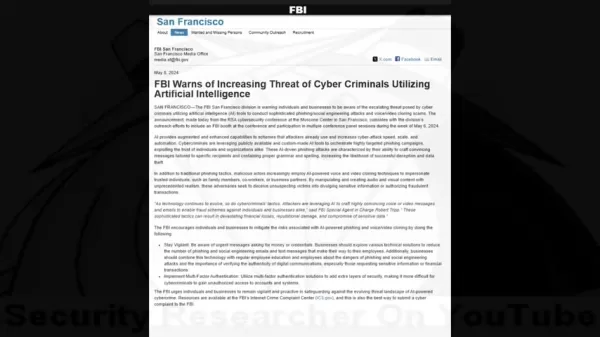
The attack lifecycle typically involves three stages:
- Data Collection: Scammers harvest voice samples from social media, public speeches, or video calls
- Voice Synthesis: AI models analyze speech patterns to generate synthetic replicas
- Multimedia Forgery: Advanced tools synchronize fake audio with manipulated video elements
Financial Impact Statistics
The monetary consequences of these AI-enabled scams demonstrate their devastating effectiveness:
- $100M+ lost by Americans in 2023 to voice cloning scams
- $14,000 average loss per incident
- $1.03 trillion global fraud losses annually
Spotting AI Scams: Detection Strategies
The Attack Methodology
Understanding criminal tactics helps potential targets recognize red flags:
- Establish Trust: Use cloned voices of known contacts
- Gather Intelligence: Research targets through social engineering
- Execute Attack: Deploy personalized deception scenarios
Identifying AI Manipulation
Warning signs of synthetic media include:
- Inconsistent vocal characteristics and pacing
- Unnatural speech patterns or phrasing

- Mechanical artifacts in audio quality
- Emotional responses that seem scripted
- Factual errors in personal references
Protective Countermeasures
Verification Best Practices
Defensive strategies should incorporate:
- Independent verification through established contact channels
- Prearranged authentication codes with frequent contacts
- In-person confirmation for unusual requests
Security Enhancements
Technical safeguards include:
- Mandatory multi-factor authentication
- Regular credential rotation policies
- Fraud monitoring systems
Awareness Training
Education initiatives should cover:
- Current scam tactics and case studies
- Psychological manipulation techniques
- Response protocols for suspicious communications
Data Privacy Management
Reduce attack surfaces by:
- Auditing social media exposure
- Restricting personal information sharing
- Implementing strict data handling policies
Advantages and Challenges
Pros
Creates highly realistic impersonations
Triggers instinctive trust responses
Produces convincing multimedia content
Cons
Potential for significant financial loss
Psychological and reputational harm
Erosion of digital trust ecosystems
Frequently Asked Questions
How does AI voice cloning work?
The technology analyzes voice samples to create synthetic replicas that mimic speech patterns, tone, and cadence, enabling convincing impersonations.
What are indicators of deepfake videos?
Look for unnatural facial movements, inconsistent lighting/skin tones, and artifacts around edges or during motion.
How should I respond to suspicious distress calls?
Verify through multiple independent channels before taking any action or providing information.
Related Questions
Are AI deepfakes illegal?
Legal status varies by jurisdiction and usage context. Most countries prohibit deepfakes used for fraud, harassment, or non-consensual content.
What protects businesses from AI fraud?
Key protections include employee training, technical safeguards, verification protocols, and incident response planning.
Related article
 Swedish AI Startup Lovable Eyes $13.2 Billion Valuation After Major Funding Round
As AI-driven coding tools gain traction, Swedish startup Lovable has secured a major funding round. The company aims to raise $3 billion, potentially boosting its valuation to $13.2 billion—double the $6.6 billion recorded last December. Menlo Ventur
Google Tests Remy AI Agent for Gemini as Focus Shifts to User Control
According to Business Insider, Google is testing Remy, a new AI personal agent for Gemini. This tool aims to execute tasks on behalf of users, streamlining both professional workflows and daily routines.Currently, Remy is undergoing testing in an int
How to fix Core Web Vitals for better SEO rankings
Streamline Report Card Comments with AI ToolsIntroductionAI Tools for Generating Report Card CommentsMagic SchoolAlmanac AIChat GPTUsing Magic School to Generate Report Card CommentsLogging into Magic SchoolSelecting the Report Card Comments ToolCust
Related Special Topic Recommendations
writing
Swedish AI Startup Lovable Eyes $13.2 Billion Valuation After Major Funding Round
As AI-driven coding tools gain traction, Swedish startup Lovable has secured a major funding round. The company aims to raise $3 billion, potentially boosting its valuation to $13.2 billion—double the $6.6 billion recorded last December. Menlo Ventur
Google Tests Remy AI Agent for Gemini as Focus Shifts to User Control
According to Business Insider, Google is testing Remy, a new AI personal agent for Gemini. This tool aims to execute tasks on behalf of users, streamlining both professional workflows and daily routines.Currently, Remy is undergoing testing in an int
How to fix Core Web Vitals for better SEO rankings
Streamline Report Card Comments with AI ToolsIntroductionAI Tools for Generating Report Card CommentsMagic SchoolAlmanac AIChat GPTUsing Magic School to Generate Report Card CommentsLogging into Magic SchoolSelecting the Report Card Comments ToolCust
Related Special Topic Recommendations
writing
 Best AI Outline Generators for Long-Form SEO Articles
2026 Latest Best Top-Rated AI Outline Generators for Long-Form SEO Articles, meticulously curated by XIX.AI. These powerful tools offer game-changing assistance in creating high-quality content quickly, boosting writing efficiency significantly. Get a free vs paid comparison along with real-world tests and detailed rankings to help you find the must-try option that suits your needs. Explore now to unlock your AI edge.
 8 tools
 xix.ai
Education and Learning
AI Study Tools for Homework and Exam Prep
xix.ai
Education and Learning
AI Study Tools for Homework and Exam Prep
2026 Latest Best AI Study Tools for Homework and Exam Prep! XIX.AI curates a top-rated list of powerful, game-changing tools that help students boost productivity, streamline homework completion, and ace exams through real-world tests. Get a free vs paid comparison, detailed rankings, and must-try options to unlock your AI edge. Explore now!
10 tools
xix.ai
Music composition
AI Vocal Demo Tools for Songwriters, Hooks, Toplines, and Multilingual Draft Sessions
2026 Latest Best AI Vocal Demo Tools for Songwriters, Hook Creators, and Multi-Language Content Teams! XIX.AI has curated a top-rated list of powerful game-changing tools that go through rigorous real-world tests. You’ll find detailed free vs paid comparison data, comprehensive rankings, and must-try options to help you boost writing efficiency and unlock your creative potential. Explore now to discover your perfect tool for all your content needs!
9 tools
xix.ai
Business
Best AI Competitive Research Tools for Small Businesses
2026 Latest Best Top-rated AI Competitive Research Tools for Small Businesses! XIX.AI has curated a highly powerful game-changing collection, updated weekly with rigorous real-world tests and detailed rankings. You can find a comprehensive free vs paid comparison to help you identify the must-try tools that boost your productivity and give you a competitive edge. Explore now to discover your perfect tool!
9 tools
xix.ai
Image editing
Photoshop AI Retouch Tools for Ecommerce Apparel, Skin Cleanup, and Color Consistency
2026 Latest Best Photoshop AI retouch tools for ecommerce apparel, skin cleanup, and color consistency! This top-rated curated list features powerful game-changing solutions that help you boost writing efficiency, streamline content creation, and achieve perfect visual results effortlessly. Each tool has undergone real-world tests through weekly updated rankings, complete with free vs paid comparison details. Backed by XIX.AI, it’s the must-try guide for anyone aiming to unlock your AI edge. Explore now!
10 tools
xix.ai
Prompt
Best AI Prompt Libraries for ChatGPT Workflows
2026 Latest Best Top-Rated AI Prompt Libraries for optimizing all types of ChatGPT workflows. XIX.AI has curated a powerful, game-changing collection that goes through rigorous real-world tests to ensure top performance. You can find detailed free vs paid comparisons and expert rankings to help you choose the must-try tools that boost your productivity and unlock your AI edge. Explore now!
11 tools
xix.ai

 Comments (3)
0/500
Comments (3)
0/500
![ArthurJones]()
This is terrifying! 😱 I never thought voice cloning could be used for scams so easily. Thanks for the tips on how to stay safe - definitely gonna be more careful with unknown calls.
![LarryEvans]()
La technologie de synthèse vocale devient vraiment flippante... J'ai déjà reçu un appel suspect imitant la voix de mon frère. Heureusement que j'ai raccroché à temps 😰 Est-ce qu'on devrait légaliser des mots-code secrets en famille ?
![EricAllen]()
Ces deepfakes vocaux commencent à faire vraiment peur 😨 Hier ma grand-mère a failli se faire avoir par un faux appel 'de moi' qui demandait de l'argent... Comment font les autorités pour suivre cette technologie qui évolue si vite?
As digital technologies advance, cybercriminals are deploying increasingly sophisticated methods - including AI-powered voice cloning and deepfake technology. Law enforcement agencies warn these tools are being weaponized to create highly personalized scams that can convincingly impersonate trusted contacts. This comprehensive guide examines these emerging threats, provides detection strategies, and outlines protective measures to safeguard against financial and personal harm.
Key Points
FBI alerts indicate rising AI-enabled cybercrimes targeting individuals and organizations.
Fraudsters now utilize voice cloning and deepfake video technology in sophisticated schemes.
Personal information harvesting enables highly targeted social engineering attacks.
Identifying audio/visual anomalies remains critical for scam detection.
Multi-layered verification systems and security protocols provide essential protection.
Comprehensive awareness training significantly reduces vulnerability to these scams.
The Rising Threat of AI-Powered Scams
Understanding the FBI Warning
The digital arms race between security professionals and cybercriminals has entered a dangerous new phase with the advent of accessible AI tools. What began as niche research technologies have become powerful weapons in the hands of fraudsters.
Security experts have documented an alarming trend where criminals combine traditional social engineering with AI-generated media to bypass human instincts for trust. The FBI's warnings highlight how these techniques create fraudulent scenarios of unprecedented believability, capable of overcoming even cautious skepticism.
How AI Voice Cloning and Deepfakes Work
Modern fraud schemes employ a disturbing combination of machine learning and psychological manipulation. Attackers follow a meticulous process to maximize their success rates.
The attack lifecycle typically involves three stages:
- Data Collection: Scammers harvest voice samples from social media, public speeches, or video calls
- Voice Synthesis: AI models analyze speech patterns to generate synthetic replicas
- Multimedia Forgery: Advanced tools synchronize fake audio with manipulated video elements
Financial Impact Statistics
The monetary consequences of these AI-enabled scams demonstrate their devastating effectiveness:
- $100M+ lost by Americans in 2023 to voice cloning scams
- $14,000 average loss per incident
- $1.03 trillion global fraud losses annually
Spotting AI Scams: Detection Strategies
The Attack Methodology
Understanding criminal tactics helps potential targets recognize red flags:
- Establish Trust: Use cloned voices of known contacts
- Gather Intelligence: Research targets through social engineering
- Execute Attack: Deploy personalized deception scenarios
Identifying AI Manipulation
Warning signs of synthetic media include:
- Inconsistent vocal characteristics and pacing
- Unnatural speech patterns or phrasing
- Mechanical artifacts in audio quality
- Emotional responses that seem scripted
- Factual errors in personal references
Protective Countermeasures
Verification Best Practices
Defensive strategies should incorporate:
- Independent verification through established contact channels
- Prearranged authentication codes with frequent contacts
- In-person confirmation for unusual requests
Security Enhancements
Technical safeguards include:
- Mandatory multi-factor authentication
- Regular credential rotation policies
- Fraud monitoring systems
Awareness Training
Education initiatives should cover:
- Current scam tactics and case studies
- Psychological manipulation techniques
- Response protocols for suspicious communications
Data Privacy Management
Reduce attack surfaces by:
- Auditing social media exposure
- Restricting personal information sharing
- Implementing strict data handling policies
Advantages and Challenges
Pros
Creates highly realistic impersonations
Triggers instinctive trust responses
Produces convincing multimedia content
Cons
Potential for significant financial loss
Psychological and reputational harm
Erosion of digital trust ecosystems
Frequently Asked Questions
How does AI voice cloning work?
The technology analyzes voice samples to create synthetic replicas that mimic speech patterns, tone, and cadence, enabling convincing impersonations.
What are indicators of deepfake videos?
Look for unnatural facial movements, inconsistent lighting/skin tones, and artifacts around edges or during motion.
How should I respond to suspicious distress calls?
Verify through multiple independent channels before taking any action or providing information.
Related Questions
Are AI deepfakes illegal?
Legal status varies by jurisdiction and usage context. Most countries prohibit deepfakes used for fraud, harassment, or non-consensual content.
What protects businesses from AI fraud?
Key protections include employee training, technical safeguards, verification protocols, and incident response planning.








 Swedish AI Startup Lovable Eyes $13.2 Billion Valuation After Major Funding Round
As AI-driven coding tools gain traction, Swedish startup Lovable has secured a major funding round. The company aims to raise $3 billion, potentially boosting its valuation to $13.2 billion—double the $6.6 billion recorded last December. Menlo Ventur
Google Tests Remy AI Agent for Gemini as Focus Shifts to User Control
According to Business Insider, Google is testing Remy, a new AI personal agent for Gemini. This tool aims to execute tasks on behalf of users, streamlining both professional workflows and daily routines.Currently, Remy is undergoing testing in an int
Swedish AI Startup Lovable Eyes $13.2 Billion Valuation After Major Funding Round
As AI-driven coding tools gain traction, Swedish startup Lovable has secured a major funding round. The company aims to raise $3 billion, potentially boosting its valuation to $13.2 billion—double the $6.6 billion recorded last December. Menlo Ventur
Google Tests Remy AI Agent for Gemini as Focus Shifts to User Control
According to Business Insider, Google is testing Remy, a new AI personal agent for Gemini. This tool aims to execute tasks on behalf of users, streamlining both professional workflows and daily routines.Currently, Remy is undergoing testing in an int
 How to fix Core Web Vitals for better SEO rankings
Streamline Report Card Comments with AI ToolsIntroductionAI Tools for Generating Report Card CommentsMagic SchoolAlmanac AIChat GPTUsing Magic School to Generate Report Card CommentsLogging into Magic SchoolSelecting the Report Card Comments ToolCust
How to fix Core Web Vitals for better SEO rankings
Streamline Report Card Comments with AI ToolsIntroductionAI Tools for Generating Report Card CommentsMagic SchoolAlmanac AIChat GPTUsing Magic School to Generate Report Card CommentsLogging into Magic SchoolSelecting the Report Card Comments ToolCust

2026 Latest Best Top-Rated AI Outline Generators for Long-Form SEO Articles, meticulously curated by XIX.AI. These powerful tools offer game-changing assistance in creating high-quality content quickly, boosting writing efficiency significantly. Get a free vs paid comparison along with real-world tests and detailed rankings to help you find the must-try option that suits your needs. Explore now to unlock your AI edge.
8 tools
xix.ai

2026 Latest Best AI Study Tools for Homework and Exam Prep! XIX.AI curates a top-rated list of powerful, game-changing tools that help students boost productivity, streamline homework completion, and ace exams through real-world tests. Get a free vs paid comparison, detailed rankings, and must-try options to unlock your AI edge. Explore now!
10 tools
xix.ai

2026 Latest Best AI Vocal Demo Tools for Songwriters, Hook Creators, and Multi-Language Content Teams! XIX.AI has curated a top-rated list of powerful game-changing tools that go through rigorous real-world tests. You’ll find detailed free vs paid comparison data, comprehensive rankings, and must-try options to help you boost writing efficiency and unlock your creative potential. Explore now to discover your perfect tool for all your content needs!
9 tools
xix.ai

2026 Latest Best Top-rated AI Competitive Research Tools for Small Businesses! XIX.AI has curated a highly powerful game-changing collection, updated weekly with rigorous real-world tests and detailed rankings. You can find a comprehensive free vs paid comparison to help you identify the must-try tools that boost your productivity and give you a competitive edge. Explore now to discover your perfect tool!
9 tools
xix.ai

2026 Latest Best Photoshop AI retouch tools for ecommerce apparel, skin cleanup, and color consistency! This top-rated curated list features powerful game-changing solutions that help you boost writing efficiency, streamline content creation, and achieve perfect visual results effortlessly. Each tool has undergone real-world tests through weekly updated rankings, complete with free vs paid comparison details. Backed by XIX.AI, it’s the must-try guide for anyone aiming to unlock your AI edge. Explore now!
10 tools
xix.ai

2026 Latest Best Top-Rated AI Prompt Libraries for optimizing all types of ChatGPT workflows. XIX.AI has curated a powerful, game-changing collection that goes through rigorous real-world tests to ensure top performance. You can find detailed free vs paid comparisons and expert rankings to help you choose the must-try tools that boost your productivity and unlock your AI edge. Explore now!
11 tools
xix.ai

This is terrifying! 😱 I never thought voice cloning could be used for scams so easily. Thanks for the tips on how to stay safe - definitely gonna be more careful with unknown calls.
La technologie de synthèse vocale devient vraiment flippante... J'ai déjà reçu un appel suspect imitant la voix de mon frère. Heureusement que j'ai raccroché à temps 😰 Est-ce qu'on devrait légaliser des mots-code secrets en famille ?
Ces deepfakes vocaux commencent à faire vraiment peur 😨 Hier ma grand-mère a failli se faire avoir par un faux appel 'de moi' qui demandait de l'argent... Comment font les autorités pour suivre cette technologie qui évolue si vite?












