


 Home
HomePolyAI Unveils Wren, a Coding Agent for Dialogue Systems
![]()
PolyAI aims to make agentic voice AI more human-like than ever. Credit: Getty
Matt Henderson, VP of Research at PolyAI, explains how Wren, an autonomous coding agent, optimises enterprise dialogue agents for better customer service
For years, enterprise contact centres have relied on legacy Interactive Voice Response (IVR) systems.
These platforms force customers through rigid, nested menus which frequently fail to match actual customer intent, resulting in high abandonment rates and profound consumer frustration.
While the initial wave of AI offered a marginal improvement through text-based chatbots and cascaded voice models, these solutions fundamentally lacked the acoustic awareness to handle the natural flow of human conversation, including interruptions, hesitation and background noise.
The solution is PolyAI, an AI company born from the University of Cambridge’s Machine Intelligence Lab in 2017.
Backed by more than US$120m in funding from huge investors, the company has pioneered audio-native conversational systems designed to handle complex, high-stakes enterprise interactions.
Yet the company’s ambition does not stop there. Where most would envision humans as the one improving agentic AI, PolyAI is thinking outside the box with Wren, a coding agent which analyses every agent conversation and proactively improves them, translating into massive enterprise gains.
PolyAI: Growth in numbers
- Estimated valuation of US$500m
- Raised more than US$200m in total funding
- Founded in 2017 in London
- US$86m raised in Series D funding
Hearing the conversation: The audio-native shift
Before an AI can autonomously improve a customer service platform, it must first be capable of actually understanding the caller.
The industry standard for voice AI has historically been a cascaded architecture: an automatic speech recognition (ASR) engine transcribes speech to text, an LLM generates a text reply and a text-to-speech (TTS) engine synthesises the audio.
Yet this method strips the emotional and acoustic context from the call, dropping vital cues before the LLM even processes the input.
To overcome this soulless synthesised audio, PolyAI created Dialog-RSN-1, a frontier dialogue model that perceives and reasons directly over raw audio inputs.
Dialog-RSN-1 combines turn-taking, speech recognition and response generation into a single audio-aware LLM, and can actually catch a caller's hesitation, detect frustration and manage interruptions just as a human agent would.
Matt Henderson, VP of Research at PolyAI, says in a blog: “For the enterprises that build on PolyAI, that means dialogue agents that hear and handle a call the way a great human agent would: catching hesitation, hearing frustration before it escalates and knowing exactly when to speak.”
What sets this model apart is its limit of audio awareness to the input side. Instead, it uses a separate TTS system for generation, allowing enterprises to maintain strict control over brand voice and compliance guardrails while achieving a sub-300-millisecond response latency.
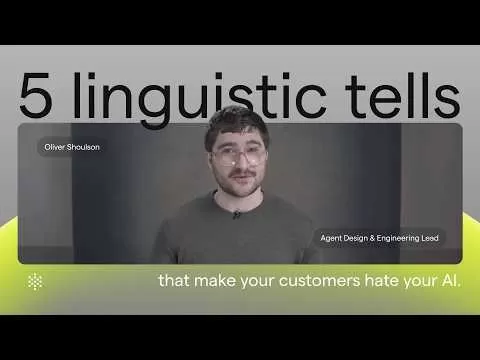
Matt Henderson, VP of Research at PolyAI, says the dialogue agents hear and handle a call the way a great human agent would. Credit: matthen.com
Wren: The agent behind the agents
While deploying a highly capable, audio-native voice agent resolves the immediate friction of customer interaction, the agent cannot just be deployed and forgotten about. Indeed, the long-term challenge for enterprises lies in maintenance and optimisation.
Historically, refining an AI agent required dedicated human engineering teams to manually review a small sample of call logs, identify edge cases and code new conversational pathways. Yet this is time-consuming and costly for the modern company.
Enter Wren, PolyAI’s coding agent built natively into its Agentic Dialog Platform. Functioning as what PolyAI describes as “the agent behind your agents”, Wren autonomously and continuously monitors, refines and optimises customer-facing dialogue agents.
Unlike traditional analytics tools that rely on high-level summaries or small sample sets, Wren analyses 100% of live customer interactions across all channels.
Wren operates through two parallel optimisation motions: self-healing, and self-improving, chiefly.
Arkadiusz Kwapiszewski, Head of Agent OS for PolyAI, explains self-healing and self-improving. Credit: LinkedIn
Arkadiusz Kwapiszewski, Head of Agent OS for PolyAI, explains: “Self-healing catches what's broken in your agent and repairs it, and self-improving finds where something already works but could work better, measured against whatever metrics matter most to you.”
“You decide on the metrics, and Wren will hunt for opportunities to move them. And the impact can be validated through the Agentic Dialog Platform’s A/B testing capabilities.
“First, it engages in “self-healing”, automatically identifying bugs, broken integrations or customer frustrations and generating the code required to repair them.
“Second, it pursues KPI-driven “self-improvement.” Wren proactively searches for opportunities to optimise interactions against North Star business metrics, such as customer satisfaction (CSAT), call containment rates and booking conversions.”
Self-healing catches what's broken in your agent and repairs it, and self-improving finds where something already works but could work better
Arkadiusz Kwapiszewski, Head of Agent OS for PolyAI
Key funding backers of PolyAI
- NVIDIA: NVIDIA provides more than just financial support. It also supplies the crucial hardware infrastructure that enables PolyAI to process speech-to-text, intent understanding and text-to-speech generation in mere milliseconds.
- Khosla Ventures: This venture capital firm has been a steadfast supporter of PolyAI since its earlier funding rounds. Khosla Ventures focuses on early-stage technology companies that have the potential for massive societal and economic impact.
- Hedosophia: Operating as a global investment firm, Hedosophia led PolyAI's US$50m Series C funding round and co-led the subsequent US$86m Series D round. Hedosophia's continued financial support has enabled PolyAI to expand its deployment across hospitality, retail and financial services sectors.
Related article
 Rime Secures $24M Series A to Enhance Enterprise Customer Support
Voice AI startups have primarily unlocked value by managing enterprise calls across sales, marketing, and customer support. Large organizations are delegating call handling to voice model developers such as ElevenLabs and Deepgram, infrastructure pro
Iceland’s Treble Secures $18 Million for Voice Simulation Platform
Voice AI has become one of the most dynamic sectors in artificial intelligence, attracting billions in investment to power applications ranging from automated customer support and sales calls to meeting assistants and voice-first smart glasses.As AI
How Cloudflare Tools Secure Autonomous AI Payments
Cloudflare Tools secure autonomous AI payments to tackle what PSE Consulting’s Andrew O’Connor calls one of the biggest barriers to market adoptionSafeguarding web infrastructure is transforming as organisations search for reliable frameworks to depl
Related Special Topic Recommendations
Design & Art
Rime Secures $24M Series A to Enhance Enterprise Customer Support
Voice AI startups have primarily unlocked value by managing enterprise calls across sales, marketing, and customer support. Large organizations are delegating call handling to voice model developers such as ElevenLabs and Deepgram, infrastructure pro
Iceland’s Treble Secures $18 Million for Voice Simulation Platform
Voice AI has become one of the most dynamic sectors in artificial intelligence, attracting billions in investment to power applications ranging from automated customer support and sales calls to meeting assistants and voice-first smart glasses.As AI
How Cloudflare Tools Secure Autonomous AI Payments
Cloudflare Tools secure autonomous AI payments to tackle what PSE Consulting’s Andrew O’Connor calls one of the biggest barriers to market adoptionSafeguarding web infrastructure is transforming as organisations search for reliable frameworks to depl
Related Special Topic Recommendations
Design & Art
 Top AI Illustration Tools: Create Editorial Scenes and Cover Art Faster
2026 Latest Top-rated AI Illustration Tools: Our curated list features the best powerfully designed tools for creating stunning editorial scenes and eye-catching cover art quickly. Each option has gone through rigorous real-world tests, offering a free vs paid comparison to help you find the perfect match for your workflow. Try these must-try solutions today to unlock your AI edge and boost your creative productivity. Explore now at XIX.AI.
 10 tools
 xix.ai
Education and Learning
Top AI Tutors for Exam Prep: Practice Math, Science, and English
xix.ai
Education and Learning
Top AI Tutors for Exam Prep: Practice Math, Science, and English
2026 Latest Top-Rated Best AI Tutors for Exam Prep are here on XIX.AI! Our curated list features powerful game-changing tools that offer free vs paid comparison, real-world tests, and weekly updated rankings. They help boost your writing efficiency, simplify complex topic learning, and unlock your academic potential. Explore now to Discover your perfect exam prep tool and Start creating today to Unlock your AI edge!
10 tools
xix.ai
Finance
AI Budget Planning Tools for Personal Money Management
2026 Latest Best Top-Rated AI Budget Planning Tools for Personal Money Management are here on XIX.AI! This curated collection features powerful, game-changing solutions that help you conduct real-world tests, understand spending habits, and create personalized plans to boost productivity. Enjoy a free vs paid comparison along with detailed rankings. Must-try tools designed to simplify money management and unlock your AI edge. Explore now!
11 tools
xix.ai
Health & Wellness
AI Sleep Tracking Assistants: Improve Recovery with Better Bedtime Habits
2026 Latest Best Top-Rated AI Sleep Tracking Assistants curated for ultimate recovery. This fully updated weekly guide features powerful tools that deliver real-world tests, free vs paid comparison, and detailed rankings to help you find the must-try solution that boosts sleep quality and supports better bedtime habits. Explore now at XIX.AI to Unlock your AI edge.
10 tools
xix.ai
Data Analysis
AI SQL Copilots for Product and Revenue Analytics
2026 Latest Best Top-Rated AI SQL Copilots for Product and Revenue Analytics! XIX.AI has curated a powerful, game-changing collection of must-try tools that undergo real-world tests through weekly updated rankings. These tools help users boost productivity significantly by accelerating data analysis, streamlining complex queries, and generating accurate insights to drive smarter business decisions. Explore now to Discover your perfect tool for unlocking your AI edge!
14 tools
xix.ai
Education and Learning
Best AI Homework Helpers That Teach: Learn Concepts, Not Just Answers
2026 Latest Best Top-Rated AI Homework Helpers That Teach Core Concepts Not Just Answers Powerful Tools for Students Must-Try Curated List Weekly Updated Free vs Paid Comparison Real-World Tests Accurate Rankings to Help You Unlock Your Full Learning Potential Explore now to Discover your perfect tool for smarter studying.
10 tools
xix.ai

 Comments (0)
0/500
Comments (0)
0/500
PolyAI aims to make agentic voice AI more human-like than ever. Credit: Getty
Matt Henderson, VP of Research at PolyAI, explains how Wren, an autonomous coding agent, optimises enterprise dialogue agents for better customer service
For years, enterprise contact centres have relied on legacy Interactive Voice Response (IVR) systems.
These platforms force customers through rigid, nested menus which frequently fail to match actual customer intent, resulting in high abandonment rates and profound consumer frustration.
While the initial wave of AI offered a marginal improvement through text-based chatbots and cascaded voice models, these solutions fundamentally lacked the acoustic awareness to handle the natural flow of human conversation, including interruptions, hesitation and background noise.
The solution is PolyAI, an AI company born from the University of Cambridge’s Machine Intelligence Lab in 2017.
Backed by more than US$120m in funding from huge investors, the company has pioneered audio-native conversational systems designed to handle complex, high-stakes enterprise interactions.
Yet the company’s ambition does not stop there. Where most would envision humans as the one improving agentic AI, PolyAI is thinking outside the box with Wren, a coding agent which analyses every agent conversation and proactively improves them, translating into massive enterprise gains.
PolyAI: Growth in numbers
- Estimated valuation of US$500m
- Raised more than US$200m in total funding
- Founded in 2017 in London
- US$86m raised in Series D funding
Hearing the conversation: The audio-native shift
Before an AI can autonomously improve a customer service platform, it must first be capable of actually understanding the caller.
The industry standard for voice AI has historically been a cascaded architecture: an automatic speech recognition (ASR) engine transcribes speech to text, an LLM generates a text reply and a text-to-speech (TTS) engine synthesises the audio.
Yet this method strips the emotional and acoustic context from the call, dropping vital cues before the LLM even processes the input.
To overcome this soulless synthesised audio, PolyAI created Dialog-RSN-1, a frontier dialogue model that perceives and reasons directly over raw audio inputs.
Dialog-RSN-1 combines turn-taking, speech recognition and response generation into a single audio-aware LLM, and can actually catch a caller's hesitation, detect frustration and manage interruptions just as a human agent would.
Matt Henderson, VP of Research at PolyAI, says in a blog: “For the enterprises that build on PolyAI, that means dialogue agents that hear and handle a call the way a great human agent would: catching hesitation, hearing frustration before it escalates and knowing exactly when to speak.”
What sets this model apart is its limit of audio awareness to the input side. Instead, it uses a separate TTS system for generation, allowing enterprises to maintain strict control over brand voice and compliance guardrails while achieving a sub-300-millisecond response latency.
Matt Henderson, VP of Research at PolyAI, says the dialogue agents hear and handle a call the way a great human agent would. Credit: matthen.com
Wren: The agent behind the agents
While deploying a highly capable, audio-native voice agent resolves the immediate friction of customer interaction, the agent cannot just be deployed and forgotten about. Indeed, the long-term challenge for enterprises lies in maintenance and optimisation.
Historically, refining an AI agent required dedicated human engineering teams to manually review a small sample of call logs, identify edge cases and code new conversational pathways. Yet this is time-consuming and costly for the modern company.
Enter Wren, PolyAI’s coding agent built natively into its Agentic Dialog Platform. Functioning as what PolyAI describes as “the agent behind your agents”, Wren autonomously and continuously monitors, refines and optimises customer-facing dialogue agents.
Unlike traditional analytics tools that rely on high-level summaries or small sample sets, Wren analyses 100% of live customer interactions across all channels.
Wren operates through two parallel optimisation motions: self-healing, and self-improving, chiefly.
Arkadiusz Kwapiszewski, Head of Agent OS for PolyAI, explains self-healing and self-improving. Credit: LinkedIn
Arkadiusz Kwapiszewski, Head of Agent OS for PolyAI, explains: “Self-healing catches what's broken in your agent and repairs it, and self-improving finds where something already works but could work better, measured against whatever metrics matter most to you.”
“You decide on the metrics, and Wren will hunt for opportunities to move them. And the impact can be validated through the Agentic Dialog Platform’s A/B testing capabilities.
“First, it engages in “self-healing”, automatically identifying bugs, broken integrations or customer frustrations and generating the code required to repair them.
“Second, it pursues KPI-driven “self-improvement.” Wren proactively searches for opportunities to optimise interactions against North Star business metrics, such as customer satisfaction (CSAT), call containment rates and booking conversions.”
Self-healing catches what's broken in your agent and repairs it, and self-improving finds where something already works but could work better
Arkadiusz Kwapiszewski, Head of Agent OS for PolyAI
Key funding backers of PolyAI
- NVIDIA: NVIDIA provides more than just financial support. It also supplies the crucial hardware infrastructure that enables PolyAI to process speech-to-text, intent understanding and text-to-speech generation in mere milliseconds.
- Khosla Ventures: This venture capital firm has been a steadfast supporter of PolyAI since its earlier funding rounds. Khosla Ventures focuses on early-stage technology companies that have the potential for massive societal and economic impact.
- Hedosophia: Operating as a global investment firm, Hedosophia led PolyAI's US$50m Series C funding round and co-led the subsequent US$86m Series D round. Hedosophia's continued financial support has enabled PolyAI to expand its deployment across hospitality, retail and financial services sectors.








 Rime Secures $24M Series A to Enhance Enterprise Customer Support
Voice AI startups have primarily unlocked value by managing enterprise calls across sales, marketing, and customer support. Large organizations are delegating call handling to voice model developers such as ElevenLabs and Deepgram, infrastructure pro
Rime Secures $24M Series A to Enhance Enterprise Customer Support
Voice AI startups have primarily unlocked value by managing enterprise calls across sales, marketing, and customer support. Large organizations are delegating call handling to voice model developers such as ElevenLabs and Deepgram, infrastructure pro
 Iceland’s Treble Secures $18 Million for Voice Simulation Platform
Voice AI has become one of the most dynamic sectors in artificial intelligence, attracting billions in investment to power applications ranging from automated customer support and sales calls to meeting assistants and voice-first smart glasses.As AI
Iceland’s Treble Secures $18 Million for Voice Simulation Platform
Voice AI has become one of the most dynamic sectors in artificial intelligence, attracting billions in investment to power applications ranging from automated customer support and sales calls to meeting assistants and voice-first smart glasses.As AI
 How Cloudflare Tools Secure Autonomous AI Payments
Cloudflare Tools secure autonomous AI payments to tackle what PSE Consulting’s Andrew O’Connor calls one of the biggest barriers to market adoptionSafeguarding web infrastructure is transforming as organisations search for reliable frameworks to depl
How Cloudflare Tools Secure Autonomous AI Payments
Cloudflare Tools secure autonomous AI payments to tackle what PSE Consulting’s Andrew O’Connor calls one of the biggest barriers to market adoptionSafeguarding web infrastructure is transforming as organisations search for reliable frameworks to depl

2026 Latest Top-rated AI Illustration Tools: Our curated list features the best powerfully designed tools for creating stunning editorial scenes and eye-catching cover art quickly. Each option has gone through rigorous real-world tests, offering a free vs paid comparison to help you find the perfect match for your workflow. Try these must-try solutions today to unlock your AI edge and boost your creative productivity. Explore now at XIX.AI.
10 tools
xix.ai

2026 Latest Top-Rated Best AI Tutors for Exam Prep are here on XIX.AI! Our curated list features powerful game-changing tools that offer free vs paid comparison, real-world tests, and weekly updated rankings. They help boost your writing efficiency, simplify complex topic learning, and unlock your academic potential. Explore now to Discover your perfect exam prep tool and Start creating today to Unlock your AI edge!
10 tools
xix.ai

2026 Latest Best Top-Rated AI Budget Planning Tools for Personal Money Management are here on XIX.AI! This curated collection features powerful, game-changing solutions that help you conduct real-world tests, understand spending habits, and create personalized plans to boost productivity. Enjoy a free vs paid comparison along with detailed rankings. Must-try tools designed to simplify money management and unlock your AI edge. Explore now!
11 tools
xix.ai

2026 Latest Best Top-Rated AI Sleep Tracking Assistants curated for ultimate recovery. This fully updated weekly guide features powerful tools that deliver real-world tests, free vs paid comparison, and detailed rankings to help you find the must-try solution that boosts sleep quality and supports better bedtime habits. Explore now at XIX.AI to Unlock your AI edge.
10 tools
xix.ai

2026 Latest Best Top-Rated AI SQL Copilots for Product and Revenue Analytics! XIX.AI has curated a powerful, game-changing collection of must-try tools that undergo real-world tests through weekly updated rankings. These tools help users boost productivity significantly by accelerating data analysis, streamlining complex queries, and generating accurate insights to drive smarter business decisions. Explore now to Discover your perfect tool for unlocking your AI edge!
14 tools
xix.ai

2026 Latest Best Top-Rated AI Homework Helpers That Teach Core Concepts Not Just Answers Powerful Tools for Students Must-Try Curated List Weekly Updated Free vs Paid Comparison Real-World Tests Accurate Rankings to Help You Unlock Your Full Learning Potential Explore now to Discover your perfect tool for smarter studying.
10 tools
xix.ai












