


 Home
HomeOpenClaw Update Integrates GPT-5.4, Unifying Fragmented Smart Agents
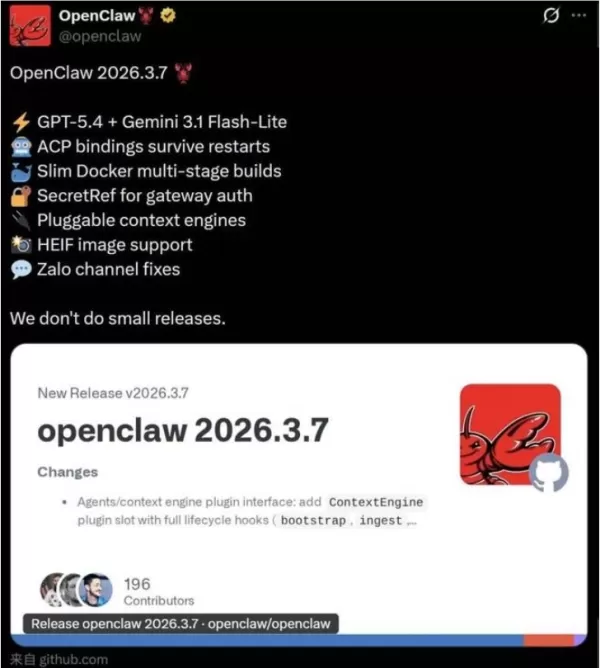
This Sunday, the hottest open-source AI agent project, OpenClaw, dropped another bombshell in the AI community. As its GitHub stars surpassed 280,000, the team unveiled a major update: version 2026.3.7. This isn't just a routine patch; it's a pivotal step in OpenClaw's evolution from an experimental framework toward an "Agent Operating System."
First to Support GPT-5.4, Outperforming Claude Code
The most notable feature of this update is native support for GPT-5.4. In the OOLONG benchmark, the new OpenClaw equipped with the lossless-claw plugin scored 74.8, significantly ahead of Claude Code (70.3). OpenClaw demonstrated exceptional stability and accuracy, especially as context length increased. On-site testing engineers were impressed, noting that describing its performance as "running well" would be an understatement.
"Memory Hot-Swapping": Enabling Persistent Agent Operations
AI agents have long struggled with limited context windows. This update introduces a revolutionary "Context Engine Plugin Interface" that supports "memory hot-swapping." Developers can now integrate RAG (Retrieval-Augmented Generation) or knowledge graph folding technologies seamlessly. Even after a service restart, agents can resume work uninterrupted using ACP persistent channel binding. This highly persistent design removes the final barrier to long-term autonomous agent operation.
Attention to Detail: Eliminating "Internal Reasoning," Boosting Productivity
For local model users, the new version has overhauled the web search tool and offers perfect compatibility with the "thinking/reasoning" stream isolation found in models like Ollama. In practical terms, the AI's internal deliberations and hesitations are now accurately filtered out. Users receive the final, actionable answer directly, eliminating the awkward experience of watching the model reason in real-time while you wait.
From Geek Toy to Virtual Employee
The application scenarios for OpenClaw are expanding rapidly. From professional coding and report writing to daily tasks like stock analysis and PPT creation, this "red lobster" is making inroads across industries. Thanks to 196 contributors, it now includes production-grade security features such as prompt injection resistance and credential protection.
If you're still manually handling repetitive work, it might be time to onboard your own "virtual employee." In 2026, the standard for professionals is an AI assistant that self-improves and never clocks out.
Related article
 ByteDance’s Seed launches global campus drive, offering virtual shares to win top large model talent
In the competitive landscape of large language models, securing top-tier talent remains the most critical strategic asset.On April 1st, ByteDance announced the launch of its Seed global campus recruitment initiative, part of its large model talent de
Suno to Watermark Songs Amid Legal Battles
Suno, the platform enabling users to generate AI-created music, has unveiled new features to label platform-produced tracks, restrict downloads, and update community standards to curb unauthorized replicas. These updates arrive as Suno confronts mult
Musk Admits Grok Build Leaked User Code, Promises to Erase All Historical Data
Elon Musk directly addressed the privacy controversy surrounding Grok Build, beginning with a simple "True" to confirm the incident's validity. He pledged that all user data previously uploaded to SpaceXAI would be permanently erased, stating, "not a
Related Special Topic Recommendations
Design & Art
ByteDance’s Seed launches global campus drive, offering virtual shares to win top large model talent
In the competitive landscape of large language models, securing top-tier talent remains the most critical strategic asset.On April 1st, ByteDance announced the launch of its Seed global campus recruitment initiative, part of its large model talent de
Suno to Watermark Songs Amid Legal Battles
Suno, the platform enabling users to generate AI-created music, has unveiled new features to label platform-produced tracks, restrict downloads, and update community standards to curb unauthorized replicas. These updates arrive as Suno confronts mult
Musk Admits Grok Build Leaked User Code, Promises to Erase All Historical Data
Elon Musk directly addressed the privacy controversy surrounding Grok Build, beginning with a simple "True" to confirm the incident's validity. He pledged that all user data previously uploaded to SpaceXAI would be permanently erased, stating, "not a
Related Special Topic Recommendations
Design & Art
 AI Visual Style Reference Tools for Character Sheets, Moodboards, and Pitch Decks
2026 Latest Best AI Visual Style Reference Tools for Character Sheets, Moodboards, and Pitch Decks are here on XIX.AI! This curated top-rated list features powerful game-changing tools that go through rigorous real-world tests. You’ll find a free vs paid comparison, detailed rankings, and must-try options to help you boost creativity and streamline your workflow. Explore now to discover your perfect tool for boosting productivity!
 11 tools
 xix.ai
SEO
Best AI SERP Analysis Tools for Search Strategy
xix.ai
SEO
Best AI SERP Analysis Tools for Search Strategy
2026 Latest Best Top-rated AI SERP Analysis Tools for Search Strategy are curated by XIX.AI through rigorous real-world tests and weekly updated rankings. These powerful tools help you unlock hidden optimization opportunities, boost content performance, and gain a competitive edge in search. Discover your perfect tool to elevate your search strategy today. Explore now!
13 tools
xix.ai
Data Analysis
Best AI Anomaly Detection Tools for KPI Monitoring across SaaS and Ecommerce Teams
2026 Latest Best Top-rated AI Anomaly Detection Tools for KPI Monitoring in SaaS and Ecommerce teams! XIX.AI has curated a powerful, game-changing collection based on rigorous real-world tests and weekly updated rankings. You’ll find detailed free vs paid comparison insights to help you identify the must-try solution that boosts productivity and unlocks your AI edge. Explore now!
10 tools
xix.ai
writing
Best AI Outline Generators for Long-Form SEO Articles
2026 Latest Best Top-Rated AI Outline Generators for Long-Form SEO Articles, meticulously curated by XIX.AI. These powerful tools offer game-changing assistance in creating high-quality content quickly, boosting writing efficiency significantly. Get a free vs paid comparison along with real-world tests and detailed rankings to help you find the must-try option that suits your needs. Explore now to unlock your AI edge.
8 tools
xix.ai
Education and Learning
AI Study Tools for Homework and Exam Prep
2026 Latest Best AI Study Tools for Homework and Exam Prep! XIX.AI curates a top-rated list of powerful, game-changing tools that help students boost productivity, streamline homework completion, and ace exams through real-world tests. Get a free vs paid comparison, detailed rankings, and must-try options to unlock your AI edge. Explore now!
10 tools
xix.ai
Music composition
AI Vocal Demo Tools for Songwriters, Hooks, Toplines, and Multilingual Draft Sessions
2026 Latest Best AI Vocal Demo Tools for Songwriters, Hook Creators, and Multi-Language Content Teams! XIX.AI has curated a top-rated list of powerful game-changing tools that go through rigorous real-world tests. You’ll find detailed free vs paid comparison data, comprehensive rankings, and must-try options to help you boost writing efficiency and unlock your creative potential. Explore now to discover your perfect tool for all your content needs!
9 tools
xix.ai

 Comments (2)
0/500
Comments (2)
0/500
![KevinJohnson]()
So OpenClaw just integrated GPT-5.4 to unify fragmented smart agents... sounds like they're trying to build a single brain for all those little bots. 280k stars is impressive, but I can't help wondering: when all those agents start talking to each other through one central model, who's actually in control? 🤔 Hope the update includes some serious fail-safe logic, otherwise we might end up with a very confused super-agent.
![SamuelJackson]()
Wait, so OpenClaw just casually integrated GPT-5.4? That's wild. But unifying fragmented agents sounds like a nightmare in practice. 🤔
This Sunday, the hottest open-source AI agent project, OpenClaw, dropped another bombshell in the AI community. As its GitHub stars surpassed 280,000, the team unveiled a major update: version 2026.3.7. This isn't just a routine patch; it's a pivotal step in OpenClaw's evolution from an experimental framework toward an "Agent Operating System."
First to Support GPT-5.4, Outperforming Claude Code
The most notable feature of this update is native support for GPT-5.4. In the OOLONG benchmark, the new OpenClaw equipped with the lossless-claw plugin scored 74.8, significantly ahead of Claude Code (70.3). OpenClaw demonstrated exceptional stability and accuracy, especially as context length increased. On-site testing engineers were impressed, noting that describing its performance as "running well" would be an understatement.
"Memory Hot-Swapping": Enabling Persistent Agent Operations
AI agents have long struggled with limited context windows. This update introduces a revolutionary "Context Engine Plugin Interface" that supports "memory hot-swapping." Developers can now integrate RAG (Retrieval-Augmented Generation) or knowledge graph folding technologies seamlessly. Even after a service restart, agents can resume work uninterrupted using ACP persistent channel binding. This highly persistent design removes the final barrier to long-term autonomous agent operation.
Attention to Detail: Eliminating "Internal Reasoning," Boosting Productivity
For local model users, the new version has overhauled the web search tool and offers perfect compatibility with the "thinking/reasoning" stream isolation found in models like Ollama. In practical terms, the AI's internal deliberations and hesitations are now accurately filtered out. Users receive the final, actionable answer directly, eliminating the awkward experience of watching the model reason in real-time while you wait.
From Geek Toy to Virtual Employee
The application scenarios for OpenClaw are expanding rapidly. From professional coding and report writing to daily tasks like stock analysis and PPT creation, this "red lobster" is making inroads across industries. Thanks to 196 contributors, it now includes production-grade security features such as prompt injection resistance and credential protection.
If you're still manually handling repetitive work, it might be time to onboard your own "virtual employee." In 2026, the standard for professionals is an AI assistant that self-improves and never clocks out.








 ByteDance’s Seed launches global campus drive, offering virtual shares to win top large model talent
In the competitive landscape of large language models, securing top-tier talent remains the most critical strategic asset.On April 1st, ByteDance announced the launch of its Seed global campus recruitment initiative, part of its large model talent de
ByteDance’s Seed launches global campus drive, offering virtual shares to win top large model talent
In the competitive landscape of large language models, securing top-tier talent remains the most critical strategic asset.On April 1st, ByteDance announced the launch of its Seed global campus recruitment initiative, part of its large model talent de
 Suno to Watermark Songs Amid Legal Battles
Suno, the platform enabling users to generate AI-created music, has unveiled new features to label platform-produced tracks, restrict downloads, and update community standards to curb unauthorized replicas. These updates arrive as Suno confronts mult
Suno to Watermark Songs Amid Legal Battles
Suno, the platform enabling users to generate AI-created music, has unveiled new features to label platform-produced tracks, restrict downloads, and update community standards to curb unauthorized replicas. These updates arrive as Suno confronts mult
 Musk Admits Grok Build Leaked User Code, Promises to Erase All Historical Data
Elon Musk directly addressed the privacy controversy surrounding Grok Build, beginning with a simple "True" to confirm the incident's validity. He pledged that all user data previously uploaded to SpaceXAI would be permanently erased, stating, "not a
Musk Admits Grok Build Leaked User Code, Promises to Erase All Historical Data
Elon Musk directly addressed the privacy controversy surrounding Grok Build, beginning with a simple "True" to confirm the incident's validity. He pledged that all user data previously uploaded to SpaceXAI would be permanently erased, stating, "not a

2026 Latest Best AI Visual Style Reference Tools for Character Sheets, Moodboards, and Pitch Decks are here on XIX.AI! This curated top-rated list features powerful game-changing tools that go through rigorous real-world tests. You’ll find a free vs paid comparison, detailed rankings, and must-try options to help you boost creativity and streamline your workflow. Explore now to discover your perfect tool for boosting productivity!
11 tools
xix.ai

2026 Latest Best Top-rated AI SERP Analysis Tools for Search Strategy are curated by XIX.AI through rigorous real-world tests and weekly updated rankings. These powerful tools help you unlock hidden optimization opportunities, boost content performance, and gain a competitive edge in search. Discover your perfect tool to elevate your search strategy today. Explore now!
13 tools
xix.ai

2026 Latest Best Top-rated AI Anomaly Detection Tools for KPI Monitoring in SaaS and Ecommerce teams! XIX.AI has curated a powerful, game-changing collection based on rigorous real-world tests and weekly updated rankings. You’ll find detailed free vs paid comparison insights to help you identify the must-try solution that boosts productivity and unlocks your AI edge. Explore now!
10 tools
xix.ai

2026 Latest Best Top-Rated AI Outline Generators for Long-Form SEO Articles, meticulously curated by XIX.AI. These powerful tools offer game-changing assistance in creating high-quality content quickly, boosting writing efficiency significantly. Get a free vs paid comparison along with real-world tests and detailed rankings to help you find the must-try option that suits your needs. Explore now to unlock your AI edge.
8 tools
xix.ai

2026 Latest Best AI Study Tools for Homework and Exam Prep! XIX.AI curates a top-rated list of powerful, game-changing tools that help students boost productivity, streamline homework completion, and ace exams through real-world tests. Get a free vs paid comparison, detailed rankings, and must-try options to unlock your AI edge. Explore now!
10 tools
xix.ai

2026 Latest Best AI Vocal Demo Tools for Songwriters, Hook Creators, and Multi-Language Content Teams! XIX.AI has curated a top-rated list of powerful game-changing tools that go through rigorous real-world tests. You’ll find detailed free vs paid comparison data, comprehensive rankings, and must-try options to help you boost writing efficiency and unlock your creative potential. Explore now to discover your perfect tool for all your content needs!
9 tools
xix.ai

So OpenClaw just integrated GPT-5.4 to unify fragmented smart agents... sounds like they're trying to build a single brain for all those little bots. 280k stars is impressive, but I can't help wondering: when all those agents start talking to each other through one central model, who's actually in control? 🤔 Hope the update includes some serious fail-safe logic, otherwise we might end up with a very confused super-agent.
Wait, so OpenClaw just casually integrated GPT-5.4? That's wild. But unifying fragmented agents sounds like a nightmare in practice. 🤔












