


 Home
HomeOpenClaw Lobster: Navigating Product Selection and Common Pitfalls
The year 2026 marks the official dawn of the "fully autonomous agent" era in AI. The "Crab War," ignited by the open-source framework OpenClaw, has reached a fever pitch, with over 20 distinct intelligent agent products now on the market, sporting monthly fees ranging from 19 to 899 yuan.
These so-called "crab" AI agents represent a core breakthrough, moving beyond simple chat to directly access system permissions and execute tasks. Whether automating document workflows, enabling remote computer control, or deeply integrating into enterprise office ecosystems, AI is evolving from a mere "recommender" into a true "executor."
Three Camps Divide the Market: From Geek Open Source to Big Tech Ecosystems
The current landscape is split among three major forces. The open-source camp, led by OpenClaw, is a favorite among developers, boasting over 26,000 functional plugins. Internet giants like Tencent and ByteDance pursue an "ecosystem integration" strategy. Tencent's QClaw connects directly to WeChat, while ByteDance's ArkClaw is deeply embedded within Feishu, focusing on enterprise-grade stability under high concurrency.
The third major force comes from hardware manufacturers. Both Huawei and Xiaomi have launched system-level "crabs." Huawei's Xiaoyi Claw leverages the underlying security enhancements of the HarmonyOS, emphasizing seamless multi-device collaboration. Xiaomi, meanwhile, uses its MiMo large model to control its ecosystem of smart home devices, pushing AI agents into the domestic sphere.
Buyer's Guide: Privacy Red Lines and Token Traps
While enjoying automated convenience, users must not overlook security and cost risks. The Ministry of Industry and Information Technology has issued warnings regarding some open-source versions, noting that locally deployed AI agents may carry remote code execution risks. It is recommended that critical tasks always involve manual verification, and for financial or high-privacy operations, products with hardware-level isolation should be prioritized.
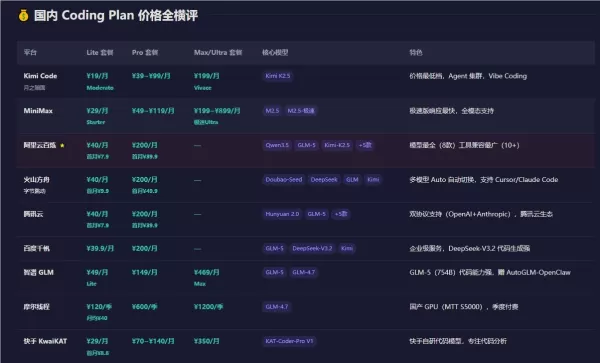
Furthermore, billing models vary significantly between products, and users should be wary of the "Token Bomb." On some pay-as-you-go platforms, a single complex command can trigger numerous API calls. When trialing products like KimiClaw or AutoClaw, it's advisable to set a spending limit upfront to avoid unexpected charges.
For a more detailed guide, visit: https://clawpk.net/
Related article
 U.S. Stocks Hit Historic Milestone as AI and Aerospace Giants Prepare for Trillion-Dollar Debut
Elon Musk, Sam Altman, and Dario Amodei, three titans of the technology sector, are advancing toward initial public offerings for their respective ventures. With SpaceX, OpenAI, and Anthropic—three industry behemoths nearing trillion-dollar valuation
Swedish AI Startup Lovable Eyes $13.2 Billion Valuation After Major Funding Round
As AI-driven coding tools gain traction, Swedish startup Lovable has secured a major funding round. The company aims to raise $3 billion, potentially boosting its valuation to $13.2 billion—double the $6.6 billion recorded last December. Menlo Ventur
Google Tests Remy AI Agent for Gemini as Focus Shifts to User Control
According to Business Insider, Google is testing Remy, a new AI personal agent for Gemini. This tool aims to execute tasks on behalf of users, streamlining both professional workflows and daily routines.Currently, Remy is undergoing testing in an int
Related Special Topic Recommendations
writing
U.S. Stocks Hit Historic Milestone as AI and Aerospace Giants Prepare for Trillion-Dollar Debut
Elon Musk, Sam Altman, and Dario Amodei, three titans of the technology sector, are advancing toward initial public offerings for their respective ventures. With SpaceX, OpenAI, and Anthropic—three industry behemoths nearing trillion-dollar valuation
Swedish AI Startup Lovable Eyes $13.2 Billion Valuation After Major Funding Round
As AI-driven coding tools gain traction, Swedish startup Lovable has secured a major funding round. The company aims to raise $3 billion, potentially boosting its valuation to $13.2 billion—double the $6.6 billion recorded last December. Menlo Ventur
Google Tests Remy AI Agent for Gemini as Focus Shifts to User Control
According to Business Insider, Google is testing Remy, a new AI personal agent for Gemini. This tool aims to execute tasks on behalf of users, streamlining both professional workflows and daily routines.Currently, Remy is undergoing testing in an int
Related Special Topic Recommendations
writing
 Best AI Outline Generators for Long-Form SEO Articles
2026 Latest Best Top-Rated AI Outline Generators for Long-Form SEO Articles, meticulously curated by XIX.AI. These powerful tools offer game-changing assistance in creating high-quality content quickly, boosting writing efficiency significantly. Get a free vs paid comparison along with real-world tests and detailed rankings to help you find the must-try option that suits your needs. Explore now to unlock your AI edge.
 8 tools
 xix.ai
Education and Learning
AI Study Tools for Homework and Exam Prep
xix.ai
Education and Learning
AI Study Tools for Homework and Exam Prep
2026 Latest Best AI Study Tools for Homework and Exam Prep! XIX.AI curates a top-rated list of powerful, game-changing tools that help students boost productivity, streamline homework completion, and ace exams through real-world tests. Get a free vs paid comparison, detailed rankings, and must-try options to unlock your AI edge. Explore now!
10 tools
xix.ai
Music composition
AI Vocal Demo Tools for Songwriters, Hooks, Toplines, and Multilingual Draft Sessions
2026 Latest Best AI Vocal Demo Tools for Songwriters, Hook Creators, and Multi-Language Content Teams! XIX.AI has curated a top-rated list of powerful game-changing tools that go through rigorous real-world tests. You’ll find detailed free vs paid comparison data, comprehensive rankings, and must-try options to help you boost writing efficiency and unlock your creative potential. Explore now to discover your perfect tool for all your content needs!
9 tools
xix.ai
Business
Best AI Competitive Research Tools for Small Businesses
2026 Latest Best Top-rated AI Competitive Research Tools for Small Businesses! XIX.AI has curated a highly powerful game-changing collection, updated weekly with rigorous real-world tests and detailed rankings. You can find a comprehensive free vs paid comparison to help you identify the must-try tools that boost your productivity and give you a competitive edge. Explore now to discover your perfect tool!
9 tools
xix.ai
Image editing
Photoshop AI Retouch Tools for Ecommerce Apparel, Skin Cleanup, and Color Consistency
2026 Latest Best Photoshop AI retouch tools for ecommerce apparel, skin cleanup, and color consistency! This top-rated curated list features powerful game-changing solutions that help you boost writing efficiency, streamline content creation, and achieve perfect visual results effortlessly. Each tool has undergone real-world tests through weekly updated rankings, complete with free vs paid comparison details. Backed by XIX.AI, it’s the must-try guide for anyone aiming to unlock your AI edge. Explore now!
10 tools
xix.ai
Prompt
Best AI Prompt Libraries for ChatGPT Workflows
2026 Latest Best Top-Rated AI Prompt Libraries for optimizing all types of ChatGPT workflows. XIX.AI has curated a powerful, game-changing collection that goes through rigorous real-world tests to ensure top performance. You can find detailed free vs paid comparisons and expert rankings to help you choose the must-try tools that boost your productivity and unlock your AI edge. Explore now!
11 tools
xix.ai

 Comments (0)
0/500
Comments (0)
0/500
The year 2026 marks the official dawn of the "fully autonomous agent" era in AI. The "Crab War," ignited by the open-source framework OpenClaw, has reached a fever pitch, with over 20 distinct intelligent agent products now on the market, sporting monthly fees ranging from 19 to 899 yuan.
These so-called "crab" AI agents represent a core breakthrough, moving beyond simple chat to directly access system permissions and execute tasks. Whether automating document workflows, enabling remote computer control, or deeply integrating into enterprise office ecosystems, AI is evolving from a mere "recommender" into a true "executor."
Three Camps Divide the Market: From Geek Open Source to Big Tech Ecosystems
The current landscape is split among three major forces. The open-source camp, led by OpenClaw, is a favorite among developers, boasting over 26,000 functional plugins. Internet giants like Tencent and ByteDance pursue an "ecosystem integration" strategy. Tencent's QClaw connects directly to WeChat, while ByteDance's ArkClaw is deeply embedded within Feishu, focusing on enterprise-grade stability under high concurrency.
The third major force comes from hardware manufacturers. Both Huawei and Xiaomi have launched system-level "crabs." Huawei's Xiaoyi Claw leverages the underlying security enhancements of the HarmonyOS, emphasizing seamless multi-device collaboration. Xiaomi, meanwhile, uses its MiMo large model to control its ecosystem of smart home devices, pushing AI agents into the domestic sphere.
Buyer's Guide: Privacy Red Lines and Token Traps
While enjoying automated convenience, users must not overlook security and cost risks. The Ministry of Industry and Information Technology has issued warnings regarding some open-source versions, noting that locally deployed AI agents may carry remote code execution risks. It is recommended that critical tasks always involve manual verification, and for financial or high-privacy operations, products with hardware-level isolation should be prioritized.
Furthermore, billing models vary significantly between products, and users should be wary of the "Token Bomb." On some pay-as-you-go platforms, a single complex command can trigger numerous API calls. When trialing products like KimiClaw or AutoClaw, it's advisable to set a spending limit upfront to avoid unexpected charges.
For a more detailed guide, visit: https://clawpk.net/








 U.S. Stocks Hit Historic Milestone as AI and Aerospace Giants Prepare for Trillion-Dollar Debut
Elon Musk, Sam Altman, and Dario Amodei, three titans of the technology sector, are advancing toward initial public offerings for their respective ventures. With SpaceX, OpenAI, and Anthropic—three industry behemoths nearing trillion-dollar valuation
U.S. Stocks Hit Historic Milestone as AI and Aerospace Giants Prepare for Trillion-Dollar Debut
Elon Musk, Sam Altman, and Dario Amodei, three titans of the technology sector, are advancing toward initial public offerings for their respective ventures. With SpaceX, OpenAI, and Anthropic—three industry behemoths nearing trillion-dollar valuation
 Swedish AI Startup Lovable Eyes $13.2 Billion Valuation After Major Funding Round
As AI-driven coding tools gain traction, Swedish startup Lovable has secured a major funding round. The company aims to raise $3 billion, potentially boosting its valuation to $13.2 billion—double the $6.6 billion recorded last December. Menlo Ventur
Google Tests Remy AI Agent for Gemini as Focus Shifts to User Control
According to Business Insider, Google is testing Remy, a new AI personal agent for Gemini. This tool aims to execute tasks on behalf of users, streamlining both professional workflows and daily routines.Currently, Remy is undergoing testing in an int
Swedish AI Startup Lovable Eyes $13.2 Billion Valuation After Major Funding Round
As AI-driven coding tools gain traction, Swedish startup Lovable has secured a major funding round. The company aims to raise $3 billion, potentially boosting its valuation to $13.2 billion—double the $6.6 billion recorded last December. Menlo Ventur
Google Tests Remy AI Agent for Gemini as Focus Shifts to User Control
According to Business Insider, Google is testing Remy, a new AI personal agent for Gemini. This tool aims to execute tasks on behalf of users, streamlining both professional workflows and daily routines.Currently, Remy is undergoing testing in an int

2026 Latest Best Top-Rated AI Outline Generators for Long-Form SEO Articles, meticulously curated by XIX.AI. These powerful tools offer game-changing assistance in creating high-quality content quickly, boosting writing efficiency significantly. Get a free vs paid comparison along with real-world tests and detailed rankings to help you find the must-try option that suits your needs. Explore now to unlock your AI edge.
8 tools
xix.ai

2026 Latest Best AI Study Tools for Homework and Exam Prep! XIX.AI curates a top-rated list of powerful, game-changing tools that help students boost productivity, streamline homework completion, and ace exams through real-world tests. Get a free vs paid comparison, detailed rankings, and must-try options to unlock your AI edge. Explore now!
10 tools
xix.ai

2026 Latest Best AI Vocal Demo Tools for Songwriters, Hook Creators, and Multi-Language Content Teams! XIX.AI has curated a top-rated list of powerful game-changing tools that go through rigorous real-world tests. You’ll find detailed free vs paid comparison data, comprehensive rankings, and must-try options to help you boost writing efficiency and unlock your creative potential. Explore now to discover your perfect tool for all your content needs!
9 tools
xix.ai

2026 Latest Best Top-rated AI Competitive Research Tools for Small Businesses! XIX.AI has curated a highly powerful game-changing collection, updated weekly with rigorous real-world tests and detailed rankings. You can find a comprehensive free vs paid comparison to help you identify the must-try tools that boost your productivity and give you a competitive edge. Explore now to discover your perfect tool!
9 tools
xix.ai

2026 Latest Best Photoshop AI retouch tools for ecommerce apparel, skin cleanup, and color consistency! This top-rated curated list features powerful game-changing solutions that help you boost writing efficiency, streamline content creation, and achieve perfect visual results effortlessly. Each tool has undergone real-world tests through weekly updated rankings, complete with free vs paid comparison details. Backed by XIX.AI, it’s the must-try guide for anyone aiming to unlock your AI edge. Explore now!
10 tools
xix.ai

2026 Latest Best Top-Rated AI Prompt Libraries for optimizing all types of ChatGPT workflows. XIX.AI has curated a powerful, game-changing collection that goes through rigorous real-world tests to ensure top performance. You can find detailed free vs paid comparisons and expert rankings to help you choose the must-try tools that boost your productivity and unlock your AI edge. Explore now!
11 tools
xix.ai












