


 Home
HomeOpenAI upgrades Codex AI assistant with six new role plugins
Artificial intelligence applications worldwide are accelerating their expansion from software development into nearly every industry. OpenAI, the AI leader, has officially announced a major update to its core AI agent assistant, Codex, introducing six new job-specific plugins at once. This upgrade encompasses 62 commonly used applications and 110 professional skills in depth, marking a disruptive broadening of the tool's use cases.
As OpenAI's most representative agent product, Codex originally focused mainly on helping programmers with coding tasks. Now, its ecosystem has experienced explosive growth, with weekly active users surpassing 5 million. Notably, non-developer users now account for roughly 20% of the total user base, and their growth rate is more than three times faster than that of traditional developers. These rapidly emerging new users come from diverse fields such as data analysis, marketing, operations, design, research, investment banking, and investing. To meet this trend, OpenAI has precisely launched exclusive plugin packs tailored to six mainstream job roles: data analysis, creative production, sales, product design, public stock investment, and investment banking. These packs bundle job-specific applications, skills, and workflows into one-click solutions.
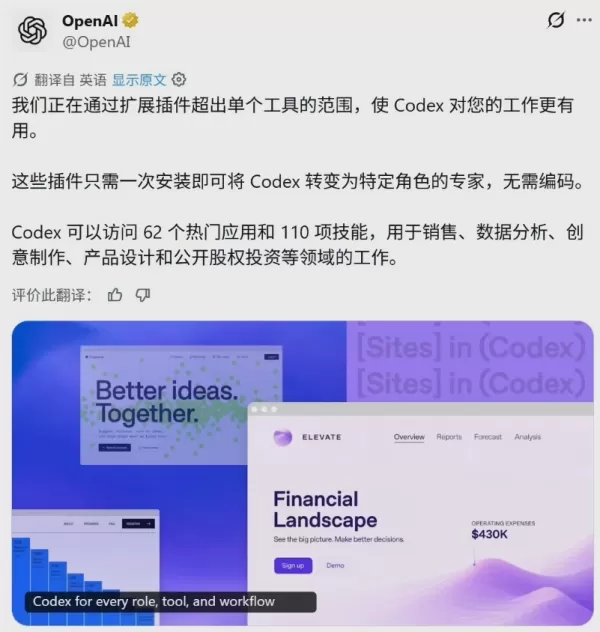
In terms of specific features, the new plugins deliver productivity-level improvements for different job roles. For example, the data analysis plugin integrates seamlessly with mainstream databases and industry tools like Snowflake, Databricks Genie, Hex, and Tableau, enabling teams to query business data directly, interpret metric changes, and generate visual dashboards with one click. The creative production plugin is designed specifically for marketing teams, quickly turning dry briefs into diverse ad variations, campaign boards, product promotional images, or lifestyle illustrations. Additionally, the system offers preview capabilities for building interactive websites and applications aimed at commercial and enterprise users. Team members can simply access a unique URL to view project boards or lightweight tool progress in a shared virtual workspace, provide real-time feedback, and make decisions.
To make AI intervention more precise, Codex has also expanded its refined "annotation editing" feature for documents, spreadsheets, and presentations. Whether in navigation bars of interactive websites, core statements in investment arguments, or complex chart labels in slides, users can directly select specific text, allowing Codex to "edit where it points." This enables micro-adjustments only at designated spots, completely eliminating the inefficient mode of large-scale rewriting. These underlying restructures will undoubtedly further accelerate the widespread adoption of enterprise-level AI productivity tools.
Related article
 Swedish AI Startup Lovable Eyes $13.2 Billion Valuation After Major Funding Round
As AI-driven coding tools gain traction, Swedish startup Lovable has secured a major funding round. The company aims to raise $3 billion, potentially boosting its valuation to $13.2 billion—double the $6.6 billion recorded last December. Menlo Ventur
Google Tests Remy AI Agent for Gemini as Focus Shifts to User Control
According to Business Insider, Google is testing Remy, a new AI personal agent for Gemini. This tool aims to execute tasks on behalf of users, streamlining both professional workflows and daily routines.Currently, Remy is undergoing testing in an int
How to fix Core Web Vitals for better SEO rankings
Streamline Report Card Comments with AI ToolsIntroductionAI Tools for Generating Report Card CommentsMagic SchoolAlmanac AIChat GPTUsing Magic School to Generate Report Card CommentsLogging into Magic SchoolSelecting the Report Card Comments ToolCust
Related Special Topic Recommendations
writing
Swedish AI Startup Lovable Eyes $13.2 Billion Valuation After Major Funding Round
As AI-driven coding tools gain traction, Swedish startup Lovable has secured a major funding round. The company aims to raise $3 billion, potentially boosting its valuation to $13.2 billion—double the $6.6 billion recorded last December. Menlo Ventur
Google Tests Remy AI Agent for Gemini as Focus Shifts to User Control
According to Business Insider, Google is testing Remy, a new AI personal agent for Gemini. This tool aims to execute tasks on behalf of users, streamlining both professional workflows and daily routines.Currently, Remy is undergoing testing in an int
How to fix Core Web Vitals for better SEO rankings
Streamline Report Card Comments with AI ToolsIntroductionAI Tools for Generating Report Card CommentsMagic SchoolAlmanac AIChat GPTUsing Magic School to Generate Report Card CommentsLogging into Magic SchoolSelecting the Report Card Comments ToolCust
Related Special Topic Recommendations
writing
 Best AI Outline Generators for Long-Form SEO Articles
2026 Latest Best Top-Rated AI Outline Generators for Long-Form SEO Articles, meticulously curated by XIX.AI. These powerful tools offer game-changing assistance in creating high-quality content quickly, boosting writing efficiency significantly. Get a free vs paid comparison along with real-world tests and detailed rankings to help you find the must-try option that suits your needs. Explore now to unlock your AI edge.
 8 tools
 xix.ai
Education and Learning
AI Study Tools for Homework and Exam Prep
xix.ai
Education and Learning
AI Study Tools for Homework and Exam Prep
2026 Latest Best AI Study Tools for Homework and Exam Prep! XIX.AI curates a top-rated list of powerful, game-changing tools that help students boost productivity, streamline homework completion, and ace exams through real-world tests. Get a free vs paid comparison, detailed rankings, and must-try options to unlock your AI edge. Explore now!
10 tools
xix.ai
Music composition
AI Vocal Demo Tools for Songwriters, Hooks, Toplines, and Multilingual Draft Sessions
2026 Latest Best AI Vocal Demo Tools for Songwriters, Hook Creators, and Multi-Language Content Teams! XIX.AI has curated a top-rated list of powerful game-changing tools that go through rigorous real-world tests. You’ll find detailed free vs paid comparison data, comprehensive rankings, and must-try options to help you boost writing efficiency and unlock your creative potential. Explore now to discover your perfect tool for all your content needs!
9 tools
xix.ai
Business
Best AI Competitive Research Tools for Small Businesses
2026 Latest Best Top-rated AI Competitive Research Tools for Small Businesses! XIX.AI has curated a highly powerful game-changing collection, updated weekly with rigorous real-world tests and detailed rankings. You can find a comprehensive free vs paid comparison to help you identify the must-try tools that boost your productivity and give you a competitive edge. Explore now to discover your perfect tool!
9 tools
xix.ai
Image editing
Photoshop AI Retouch Tools for Ecommerce Apparel, Skin Cleanup, and Color Consistency
2026 Latest Best Photoshop AI retouch tools for ecommerce apparel, skin cleanup, and color consistency! This top-rated curated list features powerful game-changing solutions that help you boost writing efficiency, streamline content creation, and achieve perfect visual results effortlessly. Each tool has undergone real-world tests through weekly updated rankings, complete with free vs paid comparison details. Backed by XIX.AI, it’s the must-try guide for anyone aiming to unlock your AI edge. Explore now!
10 tools
xix.ai
Prompt
Best AI Prompt Libraries for ChatGPT Workflows
2026 Latest Best Top-Rated AI Prompt Libraries for optimizing all types of ChatGPT workflows. XIX.AI has curated a powerful, game-changing collection that goes through rigorous real-world tests to ensure top performance. You can find detailed free vs paid comparisons and expert rankings to help you choose the must-try tools that boost your productivity and unlock your AI edge. Explore now!
11 tools
xix.ai

 Comments (0)
0/500
Comments (0)
0/500
Artificial intelligence applications worldwide are accelerating their expansion from software development into nearly every industry. OpenAI, the AI leader, has officially announced a major update to its core AI agent assistant, Codex, introducing six new job-specific plugins at once. This upgrade encompasses 62 commonly used applications and 110 professional skills in depth, marking a disruptive broadening of the tool's use cases.
As OpenAI's most representative agent product, Codex originally focused mainly on helping programmers with coding tasks. Now, its ecosystem has experienced explosive growth, with weekly active users surpassing 5 million. Notably, non-developer users now account for roughly 20% of the total user base, and their growth rate is more than three times faster than that of traditional developers. These rapidly emerging new users come from diverse fields such as data analysis, marketing, operations, design, research, investment banking, and investing. To meet this trend, OpenAI has precisely launched exclusive plugin packs tailored to six mainstream job roles: data analysis, creative production, sales, product design, public stock investment, and investment banking. These packs bundle job-specific applications, skills, and workflows into one-click solutions.
In terms of specific features, the new plugins deliver productivity-level improvements for different job roles. For example, the data analysis plugin integrates seamlessly with mainstream databases and industry tools like Snowflake, Databricks Genie, Hex, and Tableau, enabling teams to query business data directly, interpret metric changes, and generate visual dashboards with one click. The creative production plugin is designed specifically for marketing teams, quickly turning dry briefs into diverse ad variations, campaign boards, product promotional images, or lifestyle illustrations. Additionally, the system offers preview capabilities for building interactive websites and applications aimed at commercial and enterprise users. Team members can simply access a unique URL to view project boards or lightweight tool progress in a shared virtual workspace, provide real-time feedback, and make decisions.
To make AI intervention more precise, Codex has also expanded its refined "annotation editing" feature for documents, spreadsheets, and presentations. Whether in navigation bars of interactive websites, core statements in investment arguments, or complex chart labels in slides, users can directly select specific text, allowing Codex to "edit where it points." This enables micro-adjustments only at designated spots, completely eliminating the inefficient mode of large-scale rewriting. These underlying restructures will undoubtedly further accelerate the widespread adoption of enterprise-level AI productivity tools.








 Swedish AI Startup Lovable Eyes $13.2 Billion Valuation After Major Funding Round
As AI-driven coding tools gain traction, Swedish startup Lovable has secured a major funding round. The company aims to raise $3 billion, potentially boosting its valuation to $13.2 billion—double the $6.6 billion recorded last December. Menlo Ventur
Google Tests Remy AI Agent for Gemini as Focus Shifts to User Control
According to Business Insider, Google is testing Remy, a new AI personal agent for Gemini. This tool aims to execute tasks on behalf of users, streamlining both professional workflows and daily routines.Currently, Remy is undergoing testing in an int
Swedish AI Startup Lovable Eyes $13.2 Billion Valuation After Major Funding Round
As AI-driven coding tools gain traction, Swedish startup Lovable has secured a major funding round. The company aims to raise $3 billion, potentially boosting its valuation to $13.2 billion—double the $6.6 billion recorded last December. Menlo Ventur
Google Tests Remy AI Agent for Gemini as Focus Shifts to User Control
According to Business Insider, Google is testing Remy, a new AI personal agent for Gemini. This tool aims to execute tasks on behalf of users, streamlining both professional workflows and daily routines.Currently, Remy is undergoing testing in an int
 How to fix Core Web Vitals for better SEO rankings
Streamline Report Card Comments with AI ToolsIntroductionAI Tools for Generating Report Card CommentsMagic SchoolAlmanac AIChat GPTUsing Magic School to Generate Report Card CommentsLogging into Magic SchoolSelecting the Report Card Comments ToolCust
How to fix Core Web Vitals for better SEO rankings
Streamline Report Card Comments with AI ToolsIntroductionAI Tools for Generating Report Card CommentsMagic SchoolAlmanac AIChat GPTUsing Magic School to Generate Report Card CommentsLogging into Magic SchoolSelecting the Report Card Comments ToolCust

2026 Latest Best Top-Rated AI Outline Generators for Long-Form SEO Articles, meticulously curated by XIX.AI. These powerful tools offer game-changing assistance in creating high-quality content quickly, boosting writing efficiency significantly. Get a free vs paid comparison along with real-world tests and detailed rankings to help you find the must-try option that suits your needs. Explore now to unlock your AI edge.
8 tools
xix.ai

2026 Latest Best AI Study Tools for Homework and Exam Prep! XIX.AI curates a top-rated list of powerful, game-changing tools that help students boost productivity, streamline homework completion, and ace exams through real-world tests. Get a free vs paid comparison, detailed rankings, and must-try options to unlock your AI edge. Explore now!
10 tools
xix.ai

2026 Latest Best AI Vocal Demo Tools for Songwriters, Hook Creators, and Multi-Language Content Teams! XIX.AI has curated a top-rated list of powerful game-changing tools that go through rigorous real-world tests. You’ll find detailed free vs paid comparison data, comprehensive rankings, and must-try options to help you boost writing efficiency and unlock your creative potential. Explore now to discover your perfect tool for all your content needs!
9 tools
xix.ai

2026 Latest Best Top-rated AI Competitive Research Tools for Small Businesses! XIX.AI has curated a highly powerful game-changing collection, updated weekly with rigorous real-world tests and detailed rankings. You can find a comprehensive free vs paid comparison to help you identify the must-try tools that boost your productivity and give you a competitive edge. Explore now to discover your perfect tool!
9 tools
xix.ai

2026 Latest Best Photoshop AI retouch tools for ecommerce apparel, skin cleanup, and color consistency! This top-rated curated list features powerful game-changing solutions that help you boost writing efficiency, streamline content creation, and achieve perfect visual results effortlessly. Each tool has undergone real-world tests through weekly updated rankings, complete with free vs paid comparison details. Backed by XIX.AI, it’s the must-try guide for anyone aiming to unlock your AI edge. Explore now!
10 tools
xix.ai
2026 Latest Best Top-Rated AI Prompt Libraries for optimizing all types of ChatGPT workflows. XIX.AI has curated a powerful, game-changing collection that goes through rigorous real-world tests to ensure top performance. You can find detailed free vs paid comparisons and expert rankings to help you choose the must-try tools that boost your productivity and unlock your AI edge. Explore now!
11 tools
xix.ai












