


 Home
HomeOpenAI unveils $230 Codex keyboard amid hardware legal battle
OpenAI is officially entering the hardware market with the release of a $230 illuminated keyboard designed for its AI coding assistant, Codex.
The Codex Micro, created in collaboration with keyboard specialist Work Louder, is marketed as a stylish new way for ChatGPT users to oversee their fleets of AI coding agents — semi-autonomous bots that can write and execute code with minimal human intervention.
The device features illuminated "Agent Keys" that display agent status, customizable Command Keys that serve as shortcuts for frequent Codex actions, and a joystick for initiating typical workflows. It also includes a dial that controls how much "reasoning" — essentially, the time and computing power — an agent applies to a specific task (agent reasoning level).
The concept is that, rather than managing your agents through a phone or desktop app, you can now use the Micro as a "command center for agentic work," according to OpenAI. It will also likely look impressive on your desk. The device can be controlled and customized through the ChatGPT desktop app.
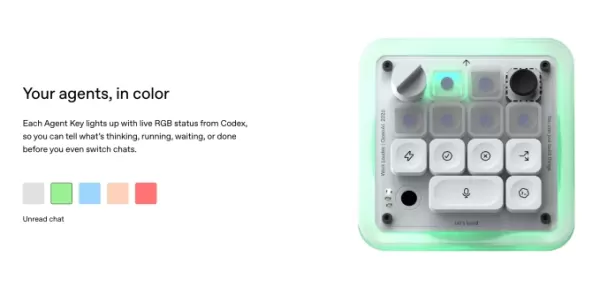
Image credit:OpenAI
OpenAI told TechCrunch in an email that the Micro is a limited-edition collaboration, indicating it is more of a novelty item than a product for mass consumption. It appears to be a flashy gadget intended to mark the company's entry into the hardware market.
More significant hardware news came on Tuesday. A yet-to-be-released OpenAI device, as revealed by Bloomberg, appears to be designed for the long term. It is described as a portable, screenless smart speaker that integrates with ChatGPT and features "mechanical elements that can move on their own."
At this point, it's hard to envision how all those disparate details — screenless, portable, moving parts — will combine into a coherent product (OpenAI isn't commenting). However, it presents an intriguing picture, at the very least. It also seems far from finished. The Bloomberg report notes that the item is still in development and could change.
This new device is reportedly being designed by former Apple engineers — a company that is currently suing OpenAI for trade secret theft.
That connection has not gone unnoticed, especially by Apple. Apple sued OpenAI last week, accusing the company's senior leadership of a deliberate strategy to extract its confidential information; it alleges that OpenAI used that information in developing its own hardware device. OpenAI has denied any wrongdoing.
Related article
 Sam Altman Sparks Debate Over AI's Deceleration
Listen onApple PodcastsListen onSpotifyOpenAI CEO Sam Altman recently suggested that it may be time to “pace the rate of AI development” to allow society to “harden around some of these new capability levels.”On the latest episode of TechCrunch’s Equ
OpenAI fights Apple trade secret lawsuit
OpenAI rebutted Apple’s trade secret allegations on Tuesday, arguing the lawsuit is unfounded.“We take these claims seriously but see no evidence supporting them,” OpenAI stated, as reported by Bloomberg’s Ed Ludlow on X. “We support fair competition
OpenAI robotics head Caitlin Kalinowski resigns over Pentagon partnership
OpenAI robotics leader Caitlin Kalinowski has stepped down following the company’s controversial partnership with the Department of Defense.“This wasn’t an easy call,” Kalinowski explained in a social media statement. “While AI plays a vital role in
Related Special Topic Recommendations
SEO
Sam Altman Sparks Debate Over AI's Deceleration
Listen onApple PodcastsListen onSpotifyOpenAI CEO Sam Altman recently suggested that it may be time to “pace the rate of AI development” to allow society to “harden around some of these new capability levels.”On the latest episode of TechCrunch’s Equ
OpenAI fights Apple trade secret lawsuit
OpenAI rebutted Apple’s trade secret allegations on Tuesday, arguing the lawsuit is unfounded.“We take these claims seriously but see no evidence supporting them,” OpenAI stated, as reported by Bloomberg’s Ed Ludlow on X. “We support fair competition
OpenAI robotics head Caitlin Kalinowski resigns over Pentagon partnership
OpenAI robotics leader Caitlin Kalinowski has stepped down following the company’s controversial partnership with the Department of Defense.“This wasn’t an easy call,” Kalinowski explained in a social media statement. “While AI plays a vital role in
Related Special Topic Recommendations
SEO
 Best AI SERP Analysis Tools for Search Strategy
2026 Latest Best Top-rated AI SERP Analysis Tools for Search Strategy are curated by XIX.AI through rigorous real-world tests and weekly updated rankings. These powerful tools help you unlock hidden optimization opportunities, boost content performance, and gain a competitive edge in search. Discover your perfect tool to elevate your search strategy today. Explore now!
 13 tools
 xix.ai
Data Analysis
Best AI Anomaly Detection Tools for KPI Monitoring across SaaS and Ecommerce Teams
xix.ai
Data Analysis
Best AI Anomaly Detection Tools for KPI Monitoring across SaaS and Ecommerce Teams
2026 Latest Best Top-rated AI Anomaly Detection Tools for KPI Monitoring in SaaS and Ecommerce teams! XIX.AI has curated a powerful, game-changing collection based on rigorous real-world tests and weekly updated rankings. You’ll find detailed free vs paid comparison insights to help you identify the must-try solution that boosts productivity and unlocks your AI edge. Explore now!
10 tools
xix.ai
writing
Best AI Outline Generators for Long-Form SEO Articles
2026 Latest Best Top-Rated AI Outline Generators for Long-Form SEO Articles, meticulously curated by XIX.AI. These powerful tools offer game-changing assistance in creating high-quality content quickly, boosting writing efficiency significantly. Get a free vs paid comparison along with real-world tests and detailed rankings to help you find the must-try option that suits your needs. Explore now to unlock your AI edge.
8 tools
xix.ai
Education and Learning
AI Study Tools for Homework and Exam Prep
2026 Latest Best AI Study Tools for Homework and Exam Prep! XIX.AI curates a top-rated list of powerful, game-changing tools that help students boost productivity, streamline homework completion, and ace exams through real-world tests. Get a free vs paid comparison, detailed rankings, and must-try options to unlock your AI edge. Explore now!
10 tools
xix.ai
Music composition
AI Vocal Demo Tools for Songwriters, Hooks, Toplines, and Multilingual Draft Sessions
2026 Latest Best AI Vocal Demo Tools for Songwriters, Hook Creators, and Multi-Language Content Teams! XIX.AI has curated a top-rated list of powerful game-changing tools that go through rigorous real-world tests. You’ll find detailed free vs paid comparison data, comprehensive rankings, and must-try options to help you boost writing efficiency and unlock your creative potential. Explore now to discover your perfect tool for all your content needs!
9 tools
xix.ai
Business
Best AI Competitive Research Tools for Small Businesses
2026 Latest Best Top-rated AI Competitive Research Tools for Small Businesses! XIX.AI has curated a highly powerful game-changing collection, updated weekly with rigorous real-world tests and detailed rankings. You can find a comprehensive free vs paid comparison to help you identify the must-try tools that boost your productivity and give you a competitive edge. Explore now to discover your perfect tool!
9 tools
xix.ai

 Comments (0)
0/500
Comments (0)
0/500
OpenAI is officially entering the hardware market with the release of a $230 illuminated keyboard designed for its AI coding assistant, Codex.
The Codex Micro, created in collaboration with keyboard specialist Work Louder, is marketed as a stylish new way for ChatGPT users to oversee their fleets of AI coding agents — semi-autonomous bots that can write and execute code with minimal human intervention.
The device features illuminated "Agent Keys" that display agent status, customizable Command Keys that serve as shortcuts for frequent Codex actions, and a joystick for initiating typical workflows. It also includes a dial that controls how much "reasoning" — essentially, the time and computing power — an agent applies to a specific task (agent reasoning level).
The concept is that, rather than managing your agents through a phone or desktop app, you can now use the Micro as a "command center for agentic work," according to OpenAI. It will also likely look impressive on your desk. The device can be controlled and customized through the ChatGPT desktop app.
Image credit:OpenAI
OpenAI told TechCrunch in an email that the Micro is a limited-edition collaboration, indicating it is more of a novelty item than a product for mass consumption. It appears to be a flashy gadget intended to mark the company's entry into the hardware market.
More significant hardware news came on Tuesday. A yet-to-be-released OpenAI device, as revealed by Bloomberg, appears to be designed for the long term. It is described as a portable, screenless smart speaker that integrates with ChatGPT and features "mechanical elements that can move on their own."
At this point, it's hard to envision how all those disparate details — screenless, portable, moving parts — will combine into a coherent product (OpenAI isn't commenting). However, it presents an intriguing picture, at the very least. It also seems far from finished. The Bloomberg report notes that the item is still in development and could change.
This new device is reportedly being designed by former Apple engineers — a company that is currently suing OpenAI for trade secret theft.
That connection has not gone unnoticed, especially by Apple. Apple sued OpenAI last week, accusing the company's senior leadership of a deliberate strategy to extract its confidential information; it alleges that OpenAI used that information in developing its own hardware device. OpenAI has denied any wrongdoing.








 Sam Altman Sparks Debate Over AI's Deceleration
Listen onApple PodcastsListen onSpotifyOpenAI CEO Sam Altman recently suggested that it may be time to “pace the rate of AI development” to allow society to “harden around some of these new capability levels.”On the latest episode of TechCrunch’s Equ
Sam Altman Sparks Debate Over AI's Deceleration
Listen onApple PodcastsListen onSpotifyOpenAI CEO Sam Altman recently suggested that it may be time to “pace the rate of AI development” to allow society to “harden around some of these new capability levels.”On the latest episode of TechCrunch’s Equ
 OpenAI fights Apple trade secret lawsuit
OpenAI rebutted Apple’s trade secret allegations on Tuesday, arguing the lawsuit is unfounded.“We take these claims seriously but see no evidence supporting them,” OpenAI stated, as reported by Bloomberg’s Ed Ludlow on X. “We support fair competition
OpenAI fights Apple trade secret lawsuit
OpenAI rebutted Apple’s trade secret allegations on Tuesday, arguing the lawsuit is unfounded.“We take these claims seriously but see no evidence supporting them,” OpenAI stated, as reported by Bloomberg’s Ed Ludlow on X. “We support fair competition
 OpenAI robotics head Caitlin Kalinowski resigns over Pentagon partnership
OpenAI robotics leader Caitlin Kalinowski has stepped down following the company’s controversial partnership with the Department of Defense.“This wasn’t an easy call,” Kalinowski explained in a social media statement. “While AI plays a vital role in
OpenAI robotics head Caitlin Kalinowski resigns over Pentagon partnership
OpenAI robotics leader Caitlin Kalinowski has stepped down following the company’s controversial partnership with the Department of Defense.“This wasn’t an easy call,” Kalinowski explained in a social media statement. “While AI plays a vital role in

2026 Latest Best Top-rated AI SERP Analysis Tools for Search Strategy are curated by XIX.AI through rigorous real-world tests and weekly updated rankings. These powerful tools help you unlock hidden optimization opportunities, boost content performance, and gain a competitive edge in search. Discover your perfect tool to elevate your search strategy today. Explore now!
13 tools
xix.ai

2026 Latest Best Top-rated AI Anomaly Detection Tools for KPI Monitoring in SaaS and Ecommerce teams! XIX.AI has curated a powerful, game-changing collection based on rigorous real-world tests and weekly updated rankings. You’ll find detailed free vs paid comparison insights to help you identify the must-try solution that boosts productivity and unlocks your AI edge. Explore now!
10 tools
xix.ai

2026 Latest Best Top-Rated AI Outline Generators for Long-Form SEO Articles, meticulously curated by XIX.AI. These powerful tools offer game-changing assistance in creating high-quality content quickly, boosting writing efficiency significantly. Get a free vs paid comparison along with real-world tests and detailed rankings to help you find the must-try option that suits your needs. Explore now to unlock your AI edge.
8 tools
xix.ai

2026 Latest Best AI Study Tools for Homework and Exam Prep! XIX.AI curates a top-rated list of powerful, game-changing tools that help students boost productivity, streamline homework completion, and ace exams through real-world tests. Get a free vs paid comparison, detailed rankings, and must-try options to unlock your AI edge. Explore now!
10 tools
xix.ai

2026 Latest Best AI Vocal Demo Tools for Songwriters, Hook Creators, and Multi-Language Content Teams! XIX.AI has curated a top-rated list of powerful game-changing tools that go through rigorous real-world tests. You’ll find detailed free vs paid comparison data, comprehensive rankings, and must-try options to help you boost writing efficiency and unlock your creative potential. Explore now to discover your perfect tool for all your content needs!
9 tools
xix.ai

2026 Latest Best Top-rated AI Competitive Research Tools for Small Businesses! XIX.AI has curated a highly powerful game-changing collection, updated weekly with rigorous real-world tests and detailed rankings. You can find a comprehensive free vs paid comparison to help you identify the must-try tools that boost your productivity and give you a competitive edge. Explore now to discover your perfect tool!
9 tools
xix.ai












