


 Home
HomeOpenAI Revamps ChatGPT Memory, Cuts Computing to One-Fifth to Fix Obsolescence and Errors
OpenAI, the leading AI company, has announced a major architectural upgrade to ChatGPT's memory function, introducing a new system powered by the revolutionary Dreaming V3 mechanism. The core goal of this upgrade is to eliminate two longstanding issues that have plagued users: outdated memory and insufficient accuracy. It also significantly boosts scalability for serving hundreds of millions of users.
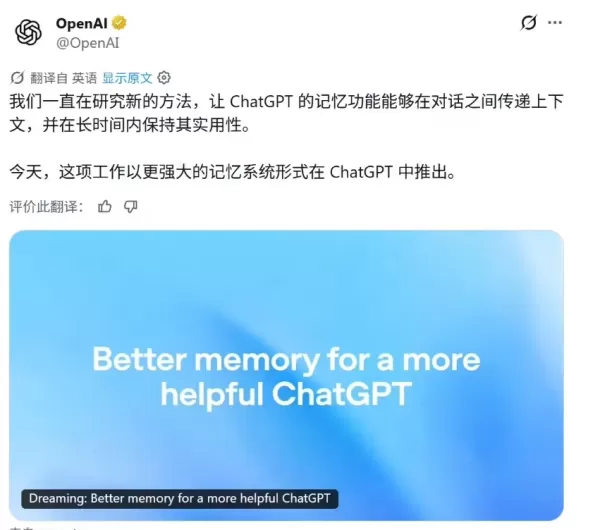
Intelligent Evolution Without Explicit Prompts
Looking back at the evolution of ChatGPT's memory system: when it first launched in 2024, it relied entirely on explicit user prompts like "remember something." The system could only mechanically store a limited amount of background information. With the introduction of the Dreaming mechanism in 2025, the system began to autonomously reference chat history and select relevant content through background processes. However, it wasn't until the release of this V3 version that the mechanism truly matured and became the core architecture of the entire memory system.
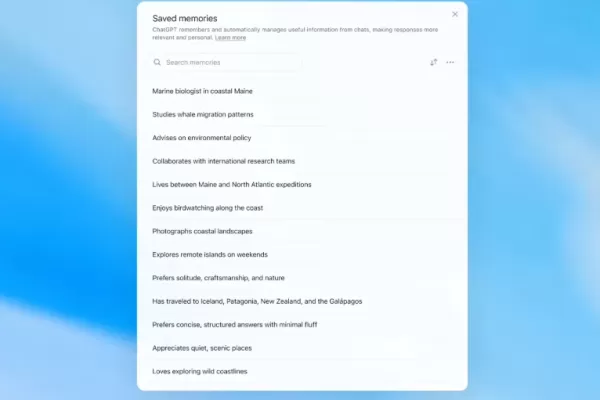
In the new architecture, ChatGPT has made significant strides in personalization, automatically updating user profiles over time. The system summarizes important life details and preferences, displaying them on a dedicated page. Users can intuitively view, modify, or add this information, and can also ask about the source and details of a specific memory through conversation.
Reduced Compute Power Empowers Free Users
In addition to user experience improvements, OpenAI has also achieved breakthroughs in operational mechanisms and resource optimization. Official data shows that after recent deep technical improvements, the computing resources required by the new Dreaming V3 mechanism for serving free users have been reduced to just one-fifth of the original amount.
Thanks to this sharp reduction in compute consumption, OpenAI has finally been able to extend this advanced memory feature to free users while maintaining service quality. Currently, the system has been initially rolled out to Plus and Pro paid users in the United States and has simultaneously doubled their memory capacity limit.
Related article
 ByteDance’s Seed launches global campus drive, offering virtual shares to win top large model talent
In the competitive landscape of large language models, securing top-tier talent remains the most critical strategic asset.On April 1st, ByteDance announced the launch of its Seed global campus recruitment initiative, part of its large model talent de
Suno to Watermark Songs Amid Legal Battles
Suno, the platform enabling users to generate AI-created music, has unveiled new features to label platform-produced tracks, restrict downloads, and update community standards to curb unauthorized replicas. These updates arrive as Suno confronts mult
Musk Admits Grok Build Leaked User Code, Promises to Erase All Historical Data
Elon Musk directly addressed the privacy controversy surrounding Grok Build, beginning with a simple "True" to confirm the incident's validity. He pledged that all user data previously uploaded to SpaceXAI would be permanently erased, stating, "not a
Related Special Topic Recommendations
Design & Art
ByteDance’s Seed launches global campus drive, offering virtual shares to win top large model talent
In the competitive landscape of large language models, securing top-tier talent remains the most critical strategic asset.On April 1st, ByteDance announced the launch of its Seed global campus recruitment initiative, part of its large model talent de
Suno to Watermark Songs Amid Legal Battles
Suno, the platform enabling users to generate AI-created music, has unveiled new features to label platform-produced tracks, restrict downloads, and update community standards to curb unauthorized replicas. These updates arrive as Suno confronts mult
Musk Admits Grok Build Leaked User Code, Promises to Erase All Historical Data
Elon Musk directly addressed the privacy controversy surrounding Grok Build, beginning with a simple "True" to confirm the incident's validity. He pledged that all user data previously uploaded to SpaceXAI would be permanently erased, stating, "not a
Related Special Topic Recommendations
Design & Art
 AI Visual Style Reference Tools for Character Sheets, Moodboards, and Pitch Decks
2026 Latest Best AI Visual Style Reference Tools for Character Sheets, Moodboards, and Pitch Decks are here on XIX.AI! This curated top-rated list features powerful game-changing tools that go through rigorous real-world tests. You’ll find a free vs paid comparison, detailed rankings, and must-try options to help you boost creativity and streamline your workflow. Explore now to discover your perfect tool for boosting productivity!
 11 tools
 xix.ai
SEO
Best AI SERP Analysis Tools for Search Strategy
xix.ai
SEO
Best AI SERP Analysis Tools for Search Strategy
2026 Latest Best Top-rated AI SERP Analysis Tools for Search Strategy are curated by XIX.AI through rigorous real-world tests and weekly updated rankings. These powerful tools help you unlock hidden optimization opportunities, boost content performance, and gain a competitive edge in search. Discover your perfect tool to elevate your search strategy today. Explore now!
13 tools
xix.ai
Data Analysis
Best AI Anomaly Detection Tools for KPI Monitoring across SaaS and Ecommerce Teams
2026 Latest Best Top-rated AI Anomaly Detection Tools for KPI Monitoring in SaaS and Ecommerce teams! XIX.AI has curated a powerful, game-changing collection based on rigorous real-world tests and weekly updated rankings. You’ll find detailed free vs paid comparison insights to help you identify the must-try solution that boosts productivity and unlocks your AI edge. Explore now!
10 tools
xix.ai
writing
Best AI Outline Generators for Long-Form SEO Articles
2026 Latest Best Top-Rated AI Outline Generators for Long-Form SEO Articles, meticulously curated by XIX.AI. These powerful tools offer game-changing assistance in creating high-quality content quickly, boosting writing efficiency significantly. Get a free vs paid comparison along with real-world tests and detailed rankings to help you find the must-try option that suits your needs. Explore now to unlock your AI edge.
8 tools
xix.ai
Education and Learning
AI Study Tools for Homework and Exam Prep
2026 Latest Best AI Study Tools for Homework and Exam Prep! XIX.AI curates a top-rated list of powerful, game-changing tools that help students boost productivity, streamline homework completion, and ace exams through real-world tests. Get a free vs paid comparison, detailed rankings, and must-try options to unlock your AI edge. Explore now!
10 tools
xix.ai
Music composition
AI Vocal Demo Tools for Songwriters, Hooks, Toplines, and Multilingual Draft Sessions
2026 Latest Best AI Vocal Demo Tools for Songwriters, Hook Creators, and Multi-Language Content Teams! XIX.AI has curated a top-rated list of powerful game-changing tools that go through rigorous real-world tests. You’ll find detailed free vs paid comparison data, comprehensive rankings, and must-try options to help you boost writing efficiency and unlock your creative potential. Explore now to discover your perfect tool for all your content needs!
9 tools
xix.ai

 Comments (1)
0/500
Comments (1)
0/500
![GaryLewis]()
I was totally shocked to hear ChatGPT’s memory capacity is now just one-fifth of what it used to be! It makes me wonder if this change will actually solve the obsolescence problem or just make things worse. Do you think smaller memory will slow down its response speed even more?
OpenAI, the leading AI company, has announced a major architectural upgrade to ChatGPT's memory function, introducing a new system powered by the revolutionary Dreaming V3 mechanism. The core goal of this upgrade is to eliminate two longstanding issues that have plagued users: outdated memory and insufficient accuracy. It also significantly boosts scalability for serving hundreds of millions of users.
Intelligent Evolution Without Explicit Prompts
Looking back at the evolution of ChatGPT's memory system: when it first launched in 2024, it relied entirely on explicit user prompts like "remember something." The system could only mechanically store a limited amount of background information. With the introduction of the Dreaming mechanism in 2025, the system began to autonomously reference chat history and select relevant content through background processes. However, it wasn't until the release of this V3 version that the mechanism truly matured and became the core architecture of the entire memory system.
In the new architecture, ChatGPT has made significant strides in personalization, automatically updating user profiles over time. The system summarizes important life details and preferences, displaying them on a dedicated page. Users can intuitively view, modify, or add this information, and can also ask about the source and details of a specific memory through conversation.
Reduced Compute Power Empowers Free Users
In addition to user experience improvements, OpenAI has also achieved breakthroughs in operational mechanisms and resource optimization. Official data shows that after recent deep technical improvements, the computing resources required by the new Dreaming V3 mechanism for serving free users have been reduced to just one-fifth of the original amount.
Thanks to this sharp reduction in compute consumption, OpenAI has finally been able to extend this advanced memory feature to free users while maintaining service quality. Currently, the system has been initially rolled out to Plus and Pro paid users in the United States and has simultaneously doubled their memory capacity limit.








 ByteDance’s Seed launches global campus drive, offering virtual shares to win top large model talent
In the competitive landscape of large language models, securing top-tier talent remains the most critical strategic asset.On April 1st, ByteDance announced the launch of its Seed global campus recruitment initiative, part of its large model talent de
ByteDance’s Seed launches global campus drive, offering virtual shares to win top large model talent
In the competitive landscape of large language models, securing top-tier talent remains the most critical strategic asset.On April 1st, ByteDance announced the launch of its Seed global campus recruitment initiative, part of its large model talent de
 Suno to Watermark Songs Amid Legal Battles
Suno, the platform enabling users to generate AI-created music, has unveiled new features to label platform-produced tracks, restrict downloads, and update community standards to curb unauthorized replicas. These updates arrive as Suno confronts mult
Suno to Watermark Songs Amid Legal Battles
Suno, the platform enabling users to generate AI-created music, has unveiled new features to label platform-produced tracks, restrict downloads, and update community standards to curb unauthorized replicas. These updates arrive as Suno confronts mult
 Musk Admits Grok Build Leaked User Code, Promises to Erase All Historical Data
Elon Musk directly addressed the privacy controversy surrounding Grok Build, beginning with a simple "True" to confirm the incident's validity. He pledged that all user data previously uploaded to SpaceXAI would be permanently erased, stating, "not a
Musk Admits Grok Build Leaked User Code, Promises to Erase All Historical Data
Elon Musk directly addressed the privacy controversy surrounding Grok Build, beginning with a simple "True" to confirm the incident's validity. He pledged that all user data previously uploaded to SpaceXAI would be permanently erased, stating, "not a

2026 Latest Best AI Visual Style Reference Tools for Character Sheets, Moodboards, and Pitch Decks are here on XIX.AI! This curated top-rated list features powerful game-changing tools that go through rigorous real-world tests. You’ll find a free vs paid comparison, detailed rankings, and must-try options to help you boost creativity and streamline your workflow. Explore now to discover your perfect tool for boosting productivity!
11 tools
xix.ai

2026 Latest Best Top-rated AI SERP Analysis Tools for Search Strategy are curated by XIX.AI through rigorous real-world tests and weekly updated rankings. These powerful tools help you unlock hidden optimization opportunities, boost content performance, and gain a competitive edge in search. Discover your perfect tool to elevate your search strategy today. Explore now!
13 tools
xix.ai

2026 Latest Best Top-rated AI Anomaly Detection Tools for KPI Monitoring in SaaS and Ecommerce teams! XIX.AI has curated a powerful, game-changing collection based on rigorous real-world tests and weekly updated rankings. You’ll find detailed free vs paid comparison insights to help you identify the must-try solution that boosts productivity and unlocks your AI edge. Explore now!
10 tools
xix.ai

2026 Latest Best Top-Rated AI Outline Generators for Long-Form SEO Articles, meticulously curated by XIX.AI. These powerful tools offer game-changing assistance in creating high-quality content quickly, boosting writing efficiency significantly. Get a free vs paid comparison along with real-world tests and detailed rankings to help you find the must-try option that suits your needs. Explore now to unlock your AI edge.
8 tools
xix.ai

2026 Latest Best AI Study Tools for Homework and Exam Prep! XIX.AI curates a top-rated list of powerful, game-changing tools that help students boost productivity, streamline homework completion, and ace exams through real-world tests. Get a free vs paid comparison, detailed rankings, and must-try options to unlock your AI edge. Explore now!
10 tools
xix.ai

2026 Latest Best AI Vocal Demo Tools for Songwriters, Hook Creators, and Multi-Language Content Teams! XIX.AI has curated a top-rated list of powerful game-changing tools that go through rigorous real-world tests. You’ll find detailed free vs paid comparison data, comprehensive rankings, and must-try options to help you boost writing efficiency and unlock your creative potential. Explore now to discover your perfect tool for all your content needs!
9 tools
xix.ai

I was totally shocked to hear ChatGPT’s memory capacity is now just one-fifth of what it used to be! It makes me wonder if this change will actually solve the obsolescence problem or just make things worse. Do you think smaller memory will slow down its response speed even more?












