


 Home
HomeOpenAI Integrates Codex AI Coding Assistant Into ChatGPT
OpenAI announced on Friday the research preview launch of Codex, its most advanced AI coding agent to date.
Codex is driven by codex-1, a specialized version of the company's o3 AI reasoning model engineered for software development. According to OpenAI, codex-1 generates more refined code than o3, follows instructions with greater accuracy, and iteratively tests its code until all checks pass.
The Codex agent operates within a secure, cloud-based virtual computer. By integrating with GitHub, it can access your code repositories directly. OpenAI states this AI coding agent can complete tasks—such as writing simple features, fixing bugs, answering code-related questions, and executing tests—in anywhere from one minute to half an hour.
OpenAI notes that Codex can manage several software engineering tasks at once and doesn’t restrict users from using their computer or browser during operation.
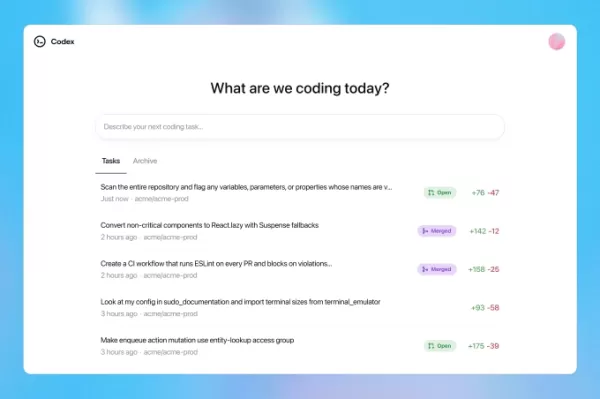
What users see when launching CodexImage Credits:OpenAI Codex is available starting today for ChatGPT Pro, Enterprise, and Team subscribers. OpenAI indicates users will initially receive generous usage limits, but rate restrictions will be introduced in the coming weeks. After that, users can buy additional credits for Codex, an OpenAI representative confirmed to TechCrunch.
OpenAI also intends to extend Codex access to ChatGPT Plus and Edu users soon.
AI-assisted coding tools, sometimes referred to as "vibe coders," have gained significant traction recently. Executives at Google and Microsoft report that approximately 30% of their companies’ code is now AI-generated. In February, Anthropic released its Claude Code tool, and Google enhanced its Gemini Code Assist in April with more autonomous features.
Techcrunch event Join us at TechCrunch Sessions: AI
Reserve your place at our premier AI industry event featuring experts from OpenAI, Anthropic, and Cohere. For a limited time, tickets are only $292 for a full day of talks, workshops, and high-impact networking.
Exhibit at TechCrunch Sessions: AI
Secure your space at TC Sessions: AI and present your technology to 1,200+ key decision-makers—without a large budget. Offer valid through May 9 or while tables remain.
Berkeley, CA | June 5 REGISTER NOW The rise of AI-assisted coding has fueled rapid growth for the companies behind these platforms. Cursor, one of the most widely-used AI coding tools, achieved roughly $300 million in annualized revenue by April and is said to be raising new funding at a $9 billion valuation.
Now, OpenAI is entering the arena. The ChatGPT creator reportedly closed a $3 billion deal to acquire Windsurf, the team behind another leading AI coding platform. The introduction of Codex further demonstrates OpenAI's commitment to expanding its own AI coding capabilities.
Eligible users can find Codex in the ChatGPT sidebar. To assign a new coding task, type a prompt and select the “Code” button. Users may also ask questions about their code and click “Ask.” Below the prompt bar, users can track assigned tasks and monitor their status.
Before Codex's debut, OpenAI’s Agents Research Lead, Josh Tobin, explained to TechCrunch that the long-term goal is for these AI coding agents to serve as "virtual teammates," autonomously handling work that typically takes engineers hours or days. The company already uses Codex internally to automate repetitive jobs, build new feature scaffolds, and draft documentation.
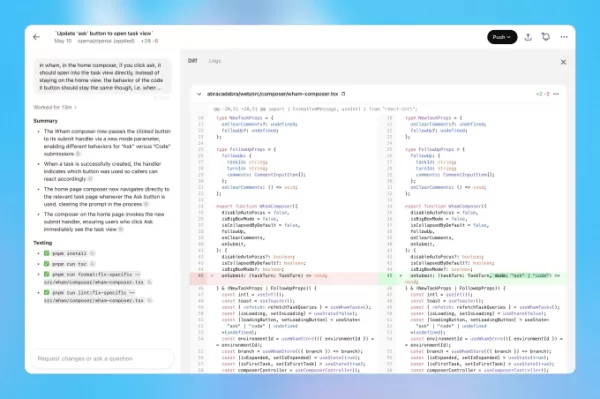
OpenAI’s new coding agent, CodexImage Credits:OpenAI OpenAI Product Lead Alexander Embiricos noted that many safety measures developed for the o3 model also apply to Codex. In a blog post, OpenAI confirms Codex will consistently deny requests to create harmful software. It also runs in an isolated environment without internet or external API access, reducing potential misuse—though this may also limit some functionality.
It's important to recognize that AI coding agents, like other generative AI systems, can make errors. A recent Microsoft study showed that top coding models like Claude 3.7 Sonnet and o3-mini had difficulty debugging reliably. Still, investor enthusiasm for these tools remains strong.
OpenAI is also upgrading Codex CLI, its open source coding agent for the terminal, with a version of the o4-mini model tailored for software engineering. This model is now the default in Codex CLI and accessible via OpenAI’s API at $1.50 per million input tokens (approximately 750,000 words) and $6 per million output tokens.
The introduction of Codex underscores OpenAI's strategy to enhance ChatGPT with specialized tools beyond its core chatbot. Over the past year, OpenAI has rolled out perks like priority access to Sora (its AI video generator), the Deep Research agent, and the web browsing agent Operator for subscribers.
These additions may attract new users to ChatGPT subscriptions and, in the case of Codex, encourage current subscribers to pay for higher usage limits.
Related article
 Sam Altman Sparks Debate Over AI's Deceleration
Listen onApple PodcastsListen onSpotifyOpenAI CEO Sam Altman recently suggested that it may be time to “pace the rate of AI development” to allow society to “harden around some of these new capability levels.”On the latest episode of TechCrunch’s Equ
OpenAI fights Apple trade secret lawsuit
OpenAI rebutted Apple’s trade secret allegations on Tuesday, arguing the lawsuit is unfounded.“We take these claims seriously but see no evidence supporting them,” OpenAI stated, as reported by Bloomberg’s Ed Ludlow on X. “We support fair competition
OpenAI robotics head Caitlin Kalinowski resigns over Pentagon partnership
OpenAI robotics leader Caitlin Kalinowski has stepped down following the company’s controversial partnership with the Department of Defense.“This wasn’t an easy call,” Kalinowski explained in a social media statement. “While AI plays a vital role in
Related Special Topic Recommendations
Business
Sam Altman Sparks Debate Over AI's Deceleration
Listen onApple PodcastsListen onSpotifyOpenAI CEO Sam Altman recently suggested that it may be time to “pace the rate of AI development” to allow society to “harden around some of these new capability levels.”On the latest episode of TechCrunch’s Equ
OpenAI fights Apple trade secret lawsuit
OpenAI rebutted Apple’s trade secret allegations on Tuesday, arguing the lawsuit is unfounded.“We take these claims seriously but see no evidence supporting them,” OpenAI stated, as reported by Bloomberg’s Ed Ludlow on X. “We support fair competition
OpenAI robotics head Caitlin Kalinowski resigns over Pentagon partnership
OpenAI robotics leader Caitlin Kalinowski has stepped down following the company’s controversial partnership with the Department of Defense.“This wasn’t an easy call,” Kalinowski explained in a social media statement. “While AI plays a vital role in
Related Special Topic Recommendations
Business
 Best AI Competitive Research Tools for Small Businesses
2026 Latest Best Top-rated AI Competitive Research Tools for Small Businesses! XIX.AI has curated a highly powerful game-changing collection, updated weekly with rigorous real-world tests and detailed rankings. You can find a comprehensive free vs paid comparison to help you identify the must-try tools that boost your productivity and give you a competitive edge. Explore now to discover your perfect tool!
 9 tools
 xix.ai
Image editing
Photoshop AI Retouch Tools for Ecommerce Apparel, Skin Cleanup, and Color Consistency
xix.ai
Image editing
Photoshop AI Retouch Tools for Ecommerce Apparel, Skin Cleanup, and Color Consistency
2026 Latest Best Photoshop AI retouch tools for ecommerce apparel, skin cleanup, and color consistency! This top-rated curated list features powerful game-changing solutions that help you boost writing efficiency, streamline content creation, and achieve perfect visual results effortlessly. Each tool has undergone real-world tests through weekly updated rankings, complete with free vs paid comparison details. Backed by XIX.AI, it’s the must-try guide for anyone aiming to unlock your AI edge. Explore now!
10 tools
xix.ai
Prompt
Best AI Prompt Libraries for ChatGPT Workflows
2026 Latest Best Top-Rated AI Prompt Libraries for optimizing all types of ChatGPT workflows. XIX.AI has curated a powerful, game-changing collection that goes through rigorous real-world tests to ensure top performance. You can find detailed free vs paid comparisons and expert rankings to help you choose the must-try tools that boost your productivity and unlock your AI edge. Explore now!
11 tools
xix.ai
Education and Learning
AI Quiz Builder Platforms for Teachers, Tutors, and Cohort-Based Learning Programs
2026 Latest Best AI Quiz Builder Platforms for Teachers, Tutors, and Cohort-Based Learning Programs! XIX.AI has curated a top-rated list of powerful game-changing tools that go through real-world tests to deliver accurate rankings. These must-try platforms help boost writing efficiency, streamline content creation, and simplify quiz design across all learning scenarios. Explore now to discover your perfect tool for unlocking your AI edge in teaching!
13 tools
xix.ai
code
AI Pull Request Review Tools for GitHub Teams Handling Refactors, Bugs, and Security Gaps
2026 Latest Best AI Pull Request Review Tools for GitHub Teams are here on XIX.AI! This top-rated curated list showcases powerful game-changing solutions that streamline refactoring, bug fixing, and security gap detection across all team workflows. Enjoy a free vs paid comparison along with real-world tests and detailed rankings to help you find the perfect tool that boosts productivity significantly. Explore now to unlock your AI edge!
12 tools
xix.ai
Text-to-speech
Best AI Text to Speech Tools for Natural Voiceovers
2026 Latest Best Top-rated AI Text to Speech Tools for Natural Voiceovers are here on XIX.AI! This curated list features powerful, game-changing options that deliver crystal-clear voices for every use case, backed by real-world tests and weekly updated rankings. Get a free vs paid comparison to find the must-try solution that boosts your productivity instantly. Explore now to Unlock your AI edge!
11 tools
xix.ai

 Comments (0)
0/500
Comments (0)
0/500
OpenAI announced on Friday the research preview launch of Codex, its most advanced AI coding agent to date.
Codex is driven by codex-1, a specialized version of the company's o3 AI reasoning model engineered for software development. According to OpenAI, codex-1 generates more refined code than o3, follows instructions with greater accuracy, and iteratively tests its code until all checks pass.
The Codex agent operates within a secure, cloud-based virtual computer. By integrating with GitHub, it can access your code repositories directly. OpenAI states this AI coding agent can complete tasks—such as writing simple features, fixing bugs, answering code-related questions, and executing tests—in anywhere from one minute to half an hour.
OpenAI notes that Codex can manage several software engineering tasks at once and doesn’t restrict users from using their computer or browser during operation.
Codex is available starting today for ChatGPT Pro, Enterprise, and Team subscribers. OpenAI indicates users will initially receive generous usage limits, but rate restrictions will be introduced in the coming weeks. After that, users can buy additional credits for Codex, an OpenAI representative confirmed to TechCrunch.
OpenAI also intends to extend Codex access to ChatGPT Plus and Edu users soon.
AI-assisted coding tools, sometimes referred to as "vibe coders," have gained significant traction recently. Executives at Google and Microsoft report that approximately 30% of their companies’ code is now AI-generated. In February, Anthropic released its Claude Code tool, and Google enhanced its Gemini Code Assist in April with more autonomous features.
Techcrunch eventJoin us at TechCrunch Sessions: AI
Reserve your place at our premier AI industry event featuring experts from OpenAI, Anthropic, and Cohere. For a limited time, tickets are only $292 for a full day of talks, workshops, and high-impact networking.
Exhibit at TechCrunch Sessions: AI
Secure your space at TC Sessions: AI and present your technology to 1,200+ key decision-makers—without a large budget. Offer valid through May 9 or while tables remain.
Berkeley, CA | June 5 REGISTER NOWThe rise of AI-assisted coding has fueled rapid growth for the companies behind these platforms. Cursor, one of the most widely-used AI coding tools, achieved roughly $300 million in annualized revenue by April and is said to be raising new funding at a $9 billion valuation.
Now, OpenAI is entering the arena. The ChatGPT creator reportedly closed a $3 billion deal to acquire Windsurf, the team behind another leading AI coding platform. The introduction of Codex further demonstrates OpenAI's commitment to expanding its own AI coding capabilities.
Eligible users can find Codex in the ChatGPT sidebar. To assign a new coding task, type a prompt and select the “Code” button. Users may also ask questions about their code and click “Ask.” Below the prompt bar, users can track assigned tasks and monitor their status.
Before Codex's debut, OpenAI’s Agents Research Lead, Josh Tobin, explained to TechCrunch that the long-term goal is for these AI coding agents to serve as "virtual teammates," autonomously handling work that typically takes engineers hours or days. The company already uses Codex internally to automate repetitive jobs, build new feature scaffolds, and draft documentation.
OpenAI Product Lead Alexander Embiricos noted that many safety measures developed for the o3 model also apply to Codex. In a blog post, OpenAI confirms Codex will consistently deny requests to create harmful software. It also runs in an isolated environment without internet or external API access, reducing potential misuse—though this may also limit some functionality.
It's important to recognize that AI coding agents, like other generative AI systems, can make errors. A recent Microsoft study showed that top coding models like Claude 3.7 Sonnet and o3-mini had difficulty debugging reliably. Still, investor enthusiasm for these tools remains strong.
OpenAI is also upgrading Codex CLI, its open source coding agent for the terminal, with a version of the o4-mini model tailored for software engineering. This model is now the default in Codex CLI and accessible via OpenAI’s API at $1.50 per million input tokens (approximately 750,000 words) and $6 per million output tokens.
The introduction of Codex underscores OpenAI's strategy to enhance ChatGPT with specialized tools beyond its core chatbot. Over the past year, OpenAI has rolled out perks like priority access to Sora (its AI video generator), the Deep Research agent, and the web browsing agent Operator for subscribers.
These additions may attract new users to ChatGPT subscriptions and, in the case of Codex, encourage current subscribers to pay for higher usage limits.








 Sam Altman Sparks Debate Over AI's Deceleration
Listen onApple PodcastsListen onSpotifyOpenAI CEO Sam Altman recently suggested that it may be time to “pace the rate of AI development” to allow society to “harden around some of these new capability levels.”On the latest episode of TechCrunch’s Equ
Sam Altman Sparks Debate Over AI's Deceleration
Listen onApple PodcastsListen onSpotifyOpenAI CEO Sam Altman recently suggested that it may be time to “pace the rate of AI development” to allow society to “harden around some of these new capability levels.”On the latest episode of TechCrunch’s Equ
 OpenAI fights Apple trade secret lawsuit
OpenAI rebutted Apple’s trade secret allegations on Tuesday, arguing the lawsuit is unfounded.“We take these claims seriously but see no evidence supporting them,” OpenAI stated, as reported by Bloomberg’s Ed Ludlow on X. “We support fair competition
OpenAI fights Apple trade secret lawsuit
OpenAI rebutted Apple’s trade secret allegations on Tuesday, arguing the lawsuit is unfounded.“We take these claims seriously but see no evidence supporting them,” OpenAI stated, as reported by Bloomberg’s Ed Ludlow on X. “We support fair competition
 OpenAI robotics head Caitlin Kalinowski resigns over Pentagon partnership
OpenAI robotics leader Caitlin Kalinowski has stepped down following the company’s controversial partnership with the Department of Defense.“This wasn’t an easy call,” Kalinowski explained in a social media statement. “While AI plays a vital role in
OpenAI robotics head Caitlin Kalinowski resigns over Pentagon partnership
OpenAI robotics leader Caitlin Kalinowski has stepped down following the company’s controversial partnership with the Department of Defense.“This wasn’t an easy call,” Kalinowski explained in a social media statement. “While AI plays a vital role in

2026 Latest Best Top-rated AI Competitive Research Tools for Small Businesses! XIX.AI has curated a highly powerful game-changing collection, updated weekly with rigorous real-world tests and detailed rankings. You can find a comprehensive free vs paid comparison to help you identify the must-try tools that boost your productivity and give you a competitive edge. Explore now to discover your perfect tool!
9 tools
xix.ai

2026 Latest Best Photoshop AI retouch tools for ecommerce apparel, skin cleanup, and color consistency! This top-rated curated list features powerful game-changing solutions that help you boost writing efficiency, streamline content creation, and achieve perfect visual results effortlessly. Each tool has undergone real-world tests through weekly updated rankings, complete with free vs paid comparison details. Backed by XIX.AI, it’s the must-try guide for anyone aiming to unlock your AI edge. Explore now!
10 tools
xix.ai

2026 Latest Best Top-Rated AI Prompt Libraries for optimizing all types of ChatGPT workflows. XIX.AI has curated a powerful, game-changing collection that goes through rigorous real-world tests to ensure top performance. You can find detailed free vs paid comparisons and expert rankings to help you choose the must-try tools that boost your productivity and unlock your AI edge. Explore now!
11 tools
xix.ai

2026 Latest Best AI Quiz Builder Platforms for Teachers, Tutors, and Cohort-Based Learning Programs! XIX.AI has curated a top-rated list of powerful game-changing tools that go through real-world tests to deliver accurate rankings. These must-try platforms help boost writing efficiency, streamline content creation, and simplify quiz design across all learning scenarios. Explore now to discover your perfect tool for unlocking your AI edge in teaching!
13 tools
xix.ai
2026 Latest Best AI Pull Request Review Tools for GitHub Teams are here on XIX.AI! This top-rated curated list showcases powerful game-changing solutions that streamline refactoring, bug fixing, and security gap detection across all team workflows. Enjoy a free vs paid comparison along with real-world tests and detailed rankings to help you find the perfect tool that boosts productivity significantly. Explore now to unlock your AI edge!
12 tools
xix.ai

2026 Latest Best Top-rated AI Text to Speech Tools for Natural Voiceovers are here on XIX.AI! This curated list features powerful, game-changing options that deliver crystal-clear voices for every use case, backed by real-world tests and weekly updated rankings. Get a free vs paid comparison to find the must-try solution that boosts your productivity instantly. Explore now to Unlock your AI edge!
11 tools
xix.ai












