


 Home
HomeOpenAI Files IPO Draft; Altman Reiterates AGI Popularization Vision
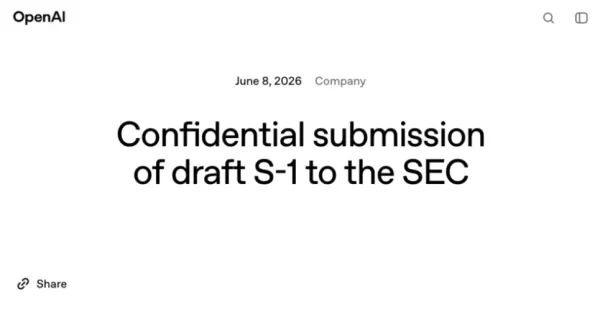
The competitive dynamics in artificial intelligence are shifting rapidly. After Anthropic, the parent company of Claude, confidentially filed its S-1 draft, OpenAI has now submitted its own IPO application to the U.S. Securities and Exchange Commission, marking a significant move toward public markets.
While OpenAI's announcement acknowledged the benefits of remaining private, the company ultimately decided to proceed with the IPO after weighing the trade-offs. In contrast to its competitor's restrained tone, OpenAI CEO Sam Altman published an article titled "Built to Benefit Everyone: Our Plan," reaffirming the company's founding mission to build AI for all of humanity and outlining a core goal of providing personal AGI to every person on Earth.
Reflecting on OpenAI's journey, it represents a complex evolution from a nonprofit origin to a commercial powerhouse. Starting as a purely nonprofit organization in 2015, introducing a capped-profit model in 2019, and undergoing a full restructuring by the end of 2025—the for-profit arm was reorganized into OpenAI Group, a public benefit corporation (PBC), while the original nonprofit parent became the OpenAI Foundation, holding roughly 26% of shares. These structural changes were both compromises to secure the enormous capital needed for computing power and a balancing act between commercial ambitions and social responsibility.
Public data shows OpenAI's commercial growth has been exceptionally fast, with annualized revenue surpassing $20 billion as of January this year. But behind this success lies an equally staggering pace of spending. Multiple estimates suggest OpenAI's potential loss could range from $14 billion to $25 billion in 2026. Given the enormous costs of computing power, turning to the capital market has become a necessary step to sustain ongoing R&D investment.
In his article, Altman outlined three core goals for OpenAI's future: first, building an "automated AI researcher" that collaborates with human researchers to iterate and accelerate breakthroughs in alignment technology; second, driving economic growth and scientific progress to ensure AI-driven prosperity is broadly distributed; and third, turning advanced AI into personalized products that are accessible to everyone.
Industry analysts predict that as both OpenAI and Anthropic pursue IPOs, these two leading AI unicorns could reach trillion-dollar valuations after going public. This wave of listings not only represents a head-to-head competition between the two front-runners but also serves as a large-scale "vote" by global capital markets on the future prospects of artificial general intelligence (AGI).
Related article
 U.S. Stocks Hit Historic Milestone as AI and Aerospace Giants Prepare for Trillion-Dollar Debut
Elon Musk, Sam Altman, and Dario Amodei, three titans of the technology sector, are advancing toward initial public offerings for their respective ventures. With SpaceX, OpenAI, and Anthropic—three industry behemoths nearing trillion-dollar valuation
Swedish AI Startup Lovable Eyes $13.2 Billion Valuation After Major Funding Round
As AI-driven coding tools gain traction, Swedish startup Lovable has secured a major funding round. The company aims to raise $3 billion, potentially boosting its valuation to $13.2 billion—double the $6.6 billion recorded last December. Menlo Ventur
Google Tests Remy AI Agent for Gemini as Focus Shifts to User Control
According to Business Insider, Google is testing Remy, a new AI personal agent for Gemini. This tool aims to execute tasks on behalf of users, streamlining both professional workflows and daily routines.Currently, Remy is undergoing testing in an int
Related Special Topic Recommendations
SEO
U.S. Stocks Hit Historic Milestone as AI and Aerospace Giants Prepare for Trillion-Dollar Debut
Elon Musk, Sam Altman, and Dario Amodei, three titans of the technology sector, are advancing toward initial public offerings for their respective ventures. With SpaceX, OpenAI, and Anthropic—three industry behemoths nearing trillion-dollar valuation
Swedish AI Startup Lovable Eyes $13.2 Billion Valuation After Major Funding Round
As AI-driven coding tools gain traction, Swedish startup Lovable has secured a major funding round. The company aims to raise $3 billion, potentially boosting its valuation to $13.2 billion—double the $6.6 billion recorded last December. Menlo Ventur
Google Tests Remy AI Agent for Gemini as Focus Shifts to User Control
According to Business Insider, Google is testing Remy, a new AI personal agent for Gemini. This tool aims to execute tasks on behalf of users, streamlining both professional workflows and daily routines.Currently, Remy is undergoing testing in an int
Related Special Topic Recommendations
SEO
 Best AI SERP Analysis Tools for Search Strategy
2026 Latest Best Top-rated AI SERP Analysis Tools for Search Strategy are curated by XIX.AI through rigorous real-world tests and weekly updated rankings. These powerful tools help you unlock hidden optimization opportunities, boost content performance, and gain a competitive edge in search. Discover your perfect tool to elevate your search strategy today. Explore now!
 13 tools
 xix.ai
Data Analysis
Best AI Anomaly Detection Tools for KPI Monitoring across SaaS and Ecommerce Teams
xix.ai
Data Analysis
Best AI Anomaly Detection Tools for KPI Monitoring across SaaS and Ecommerce Teams
2026 Latest Best Top-rated AI Anomaly Detection Tools for KPI Monitoring in SaaS and Ecommerce teams! XIX.AI has curated a powerful, game-changing collection based on rigorous real-world tests and weekly updated rankings. You’ll find detailed free vs paid comparison insights to help you identify the must-try solution that boosts productivity and unlocks your AI edge. Explore now!
10 tools
xix.ai
writing
Best AI Outline Generators for Long-Form SEO Articles
2026 Latest Best Top-Rated AI Outline Generators for Long-Form SEO Articles, meticulously curated by XIX.AI. These powerful tools offer game-changing assistance in creating high-quality content quickly, boosting writing efficiency significantly. Get a free vs paid comparison along with real-world tests and detailed rankings to help you find the must-try option that suits your needs. Explore now to unlock your AI edge.
8 tools
xix.ai
Education and Learning
AI Study Tools for Homework and Exam Prep
2026 Latest Best AI Study Tools for Homework and Exam Prep! XIX.AI curates a top-rated list of powerful, game-changing tools that help students boost productivity, streamline homework completion, and ace exams through real-world tests. Get a free vs paid comparison, detailed rankings, and must-try options to unlock your AI edge. Explore now!
10 tools
xix.ai
Music composition
AI Vocal Demo Tools for Songwriters, Hooks, Toplines, and Multilingual Draft Sessions
2026 Latest Best AI Vocal Demo Tools for Songwriters, Hook Creators, and Multi-Language Content Teams! XIX.AI has curated a top-rated list of powerful game-changing tools that go through rigorous real-world tests. You’ll find detailed free vs paid comparison data, comprehensive rankings, and must-try options to help you boost writing efficiency and unlock your creative potential. Explore now to discover your perfect tool for all your content needs!
9 tools
xix.ai
Business
Best AI Competitive Research Tools for Small Businesses
2026 Latest Best Top-rated AI Competitive Research Tools for Small Businesses! XIX.AI has curated a highly powerful game-changing collection, updated weekly with rigorous real-world tests and detailed rankings. You can find a comprehensive free vs paid comparison to help you identify the must-try tools that boost your productivity and give you a competitive edge. Explore now to discover your perfect tool!
9 tools
xix.ai

 Comments (0)
0/500
Comments (0)
0/500
The competitive dynamics in artificial intelligence are shifting rapidly. After Anthropic, the parent company of Claude, confidentially filed its S-1 draft, OpenAI has now submitted its own IPO application to the U.S. Securities and Exchange Commission, marking a significant move toward public markets.
While OpenAI's announcement acknowledged the benefits of remaining private, the company ultimately decided to proceed with the IPO after weighing the trade-offs. In contrast to its competitor's restrained tone, OpenAI CEO Sam Altman published an article titled "Built to Benefit Everyone: Our Plan," reaffirming the company's founding mission to build AI for all of humanity and outlining a core goal of providing personal AGI to every person on Earth.
Reflecting on OpenAI's journey, it represents a complex evolution from a nonprofit origin to a commercial powerhouse. Starting as a purely nonprofit organization in 2015, introducing a capped-profit model in 2019, and undergoing a full restructuring by the end of 2025—the for-profit arm was reorganized into OpenAI Group, a public benefit corporation (PBC), while the original nonprofit parent became the OpenAI Foundation, holding roughly 26% of shares. These structural changes were both compromises to secure the enormous capital needed for computing power and a balancing act between commercial ambitions and social responsibility.
Public data shows OpenAI's commercial growth has been exceptionally fast, with annualized revenue surpassing $20 billion as of January this year. But behind this success lies an equally staggering pace of spending. Multiple estimates suggest OpenAI's potential loss could range from $14 billion to $25 billion in 2026. Given the enormous costs of computing power, turning to the capital market has become a necessary step to sustain ongoing R&D investment.
In his article, Altman outlined three core goals for OpenAI's future: first, building an "automated AI researcher" that collaborates with human researchers to iterate and accelerate breakthroughs in alignment technology; second, driving economic growth and scientific progress to ensure AI-driven prosperity is broadly distributed; and third, turning advanced AI into personalized products that are accessible to everyone.
Industry analysts predict that as both OpenAI and Anthropic pursue IPOs, these two leading AI unicorns could reach trillion-dollar valuations after going public. This wave of listings not only represents a head-to-head competition between the two front-runners but also serves as a large-scale "vote" by global capital markets on the future prospects of artificial general intelligence (AGI).








 U.S. Stocks Hit Historic Milestone as AI and Aerospace Giants Prepare for Trillion-Dollar Debut
Elon Musk, Sam Altman, and Dario Amodei, three titans of the technology sector, are advancing toward initial public offerings for their respective ventures. With SpaceX, OpenAI, and Anthropic—three industry behemoths nearing trillion-dollar valuation
U.S. Stocks Hit Historic Milestone as AI and Aerospace Giants Prepare for Trillion-Dollar Debut
Elon Musk, Sam Altman, and Dario Amodei, three titans of the technology sector, are advancing toward initial public offerings for their respective ventures. With SpaceX, OpenAI, and Anthropic—three industry behemoths nearing trillion-dollar valuation
 Swedish AI Startup Lovable Eyes $13.2 Billion Valuation After Major Funding Round
As AI-driven coding tools gain traction, Swedish startup Lovable has secured a major funding round. The company aims to raise $3 billion, potentially boosting its valuation to $13.2 billion—double the $6.6 billion recorded last December. Menlo Ventur
Google Tests Remy AI Agent for Gemini as Focus Shifts to User Control
According to Business Insider, Google is testing Remy, a new AI personal agent for Gemini. This tool aims to execute tasks on behalf of users, streamlining both professional workflows and daily routines.Currently, Remy is undergoing testing in an int
Swedish AI Startup Lovable Eyes $13.2 Billion Valuation After Major Funding Round
As AI-driven coding tools gain traction, Swedish startup Lovable has secured a major funding round. The company aims to raise $3 billion, potentially boosting its valuation to $13.2 billion—double the $6.6 billion recorded last December. Menlo Ventur
Google Tests Remy AI Agent for Gemini as Focus Shifts to User Control
According to Business Insider, Google is testing Remy, a new AI personal agent for Gemini. This tool aims to execute tasks on behalf of users, streamlining both professional workflows and daily routines.Currently, Remy is undergoing testing in an int

2026 Latest Best Top-rated AI SERP Analysis Tools for Search Strategy are curated by XIX.AI through rigorous real-world tests and weekly updated rankings. These powerful tools help you unlock hidden optimization opportunities, boost content performance, and gain a competitive edge in search. Discover your perfect tool to elevate your search strategy today. Explore now!
13 tools
xix.ai

2026 Latest Best Top-rated AI Anomaly Detection Tools for KPI Monitoring in SaaS and Ecommerce teams! XIX.AI has curated a powerful, game-changing collection based on rigorous real-world tests and weekly updated rankings. You’ll find detailed free vs paid comparison insights to help you identify the must-try solution that boosts productivity and unlocks your AI edge. Explore now!
10 tools
xix.ai

2026 Latest Best Top-Rated AI Outline Generators for Long-Form SEO Articles, meticulously curated by XIX.AI. These powerful tools offer game-changing assistance in creating high-quality content quickly, boosting writing efficiency significantly. Get a free vs paid comparison along with real-world tests and detailed rankings to help you find the must-try option that suits your needs. Explore now to unlock your AI edge.
8 tools
xix.ai

2026 Latest Best AI Study Tools for Homework and Exam Prep! XIX.AI curates a top-rated list of powerful, game-changing tools that help students boost productivity, streamline homework completion, and ace exams through real-world tests. Get a free vs paid comparison, detailed rankings, and must-try options to unlock your AI edge. Explore now!
10 tools
xix.ai

2026 Latest Best AI Vocal Demo Tools for Songwriters, Hook Creators, and Multi-Language Content Teams! XIX.AI has curated a top-rated list of powerful game-changing tools that go through rigorous real-world tests. You’ll find detailed free vs paid comparison data, comprehensive rankings, and must-try options to help you boost writing efficiency and unlock your creative potential. Explore now to discover your perfect tool for all your content needs!
9 tools
xix.ai

2026 Latest Best Top-rated AI Competitive Research Tools for Small Businesses! XIX.AI has curated a highly powerful game-changing collection, updated weekly with rigorous real-world tests and detailed rankings. You can find a comprehensive free vs paid comparison to help you identify the must-try tools that boost your productivity and give you a competitive edge. Explore now to discover your perfect tool!
9 tools
xix.ai












