


 Home
Home
GPT-4o Returns as Default Model for All Paying ChatGPT Users; Altman Vows Advance Notice for Any Future Changes
OpenAI has reinstated GPT-4o as a default option for all paying users, including subscribers to ChatGPT Plus, Pro, Team, Enterprise, and Edu tiers. Previously accessible only by enabling a "show legacy models" setting, the language model that powered ChatGPT prior to last week's GPT-5 launch is now readily available once again.
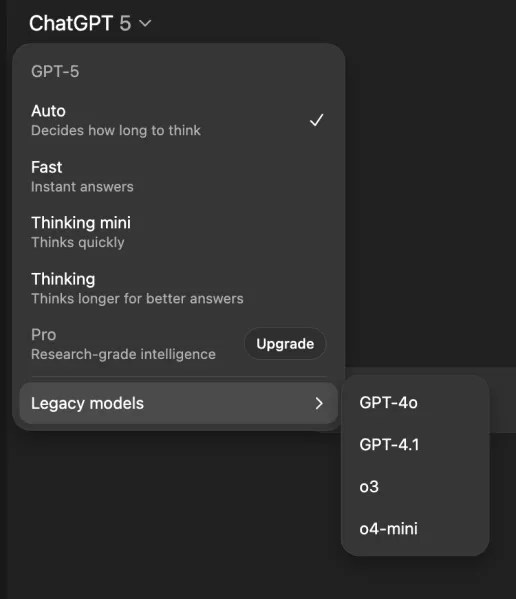
At the same time, paying subscribers will also see a new “Show additional models” setting enabled by default, restoring access to GPT-4.1, o3, and o4-mini—the latter two being reasoning-focused models.
OpenAI CEO and co-founder Sam Altman announced the shift on X just minutes ago, promising that if GPT-4o is ever removed in the future, the company will provide "plenty of notice."
Updates to ChatGPT:
You can now choose between “Auto”, “Fast”, and “Thinking” for GPT-5. Most users will want Auto, but the additional control will be useful for some people.
Rate limits are now 3,000 messages/week with GPT-5 Thinking, and then extra capacity on GPT-5 Thinking…
— Sam Altman (@sama) August 13, 2025
These models appear in the model selection menu at the top of the ChatGPT session screen, both on the web and across mobile and other applications.
This move comes after a rocky first week for GPT-5, which launched on August 7 in four variants—regular, mini, nano, and pro—some of which included optional “thinking” modes tailored for longer, reasoning-heavy tasks.
As VentureBeat previously reported, GPT-5’s debut received mixed feedback and encountered technical issues, including a malfunctioning “autoswitcher” that misdirected user prompts, inconsistent performance relative to GPT-4o, and user frustration over the abrupt removal of older models.
Altman's recent update introduces additional controls to the ChatGPT interface, giving users the ability to select between “Auto,” “Fast,” and “Thinking” modes when using GPT-5.
The “Thinking” mode, which supports a 196,000-token context window, is now subject to a 3,000-message weekly limit for paying users. Once this cap is reached, subscribers may continue using the scaled-back “GPT-5 Thinking mini” mode. Altman indicated these limits could be adjusted based on usage patterns.
Notably, GPT-4.5 remains available exclusively to Pro users, reflecting its high GPU cost.
Altman also suggested a forthcoming personality adjustment for GPT-5, aiming for a tone that feels “warmer” than the current default while avoiding the polarizing nature of GPT-4o.
The company is exploring per-user customization as a long-term approach—a potential solution to the strong emotional bonds some users have developed with earlier models.
These updates are expected to ease frustration among users who were unsettled by the sudden switch to GPT-5 and the removal of older OpenAI models, though they may also sustain the intense attachments some individuals have formed with specific AI personalities.
Related article
 Sam Altman Sparks Debate Over AI's Deceleration
Listen onApple PodcastsListen onSpotifyOpenAI CEO Sam Altman recently suggested that it may be time to “pace the rate of AI development” to allow society to “harden around some of these new capability levels.”On the latest episode of TechCrunch’s Equ
OpenAI fights Apple trade secret lawsuit
OpenAI rebutted Apple’s trade secret allegations on Tuesday, arguing the lawsuit is unfounded.“We take these claims seriously but see no evidence supporting them,” OpenAI stated, as reported by Bloomberg’s Ed Ludlow on X. “We support fair competition
OpenAI robotics head Caitlin Kalinowski resigns over Pentagon partnership
OpenAI robotics leader Caitlin Kalinowski has stepped down following the company’s controversial partnership with the Department of Defense.“This wasn’t an easy call,” Kalinowski explained in a social media statement. “While AI plays a vital role in
Related Special Topic Recommendations
writing
Sam Altman Sparks Debate Over AI's Deceleration
Listen onApple PodcastsListen onSpotifyOpenAI CEO Sam Altman recently suggested that it may be time to “pace the rate of AI development” to allow society to “harden around some of these new capability levels.”On the latest episode of TechCrunch’s Equ
OpenAI fights Apple trade secret lawsuit
OpenAI rebutted Apple’s trade secret allegations on Tuesday, arguing the lawsuit is unfounded.“We take these claims seriously but see no evidence supporting them,” OpenAI stated, as reported by Bloomberg’s Ed Ludlow on X. “We support fair competition
OpenAI robotics head Caitlin Kalinowski resigns over Pentagon partnership
OpenAI robotics leader Caitlin Kalinowski has stepped down following the company’s controversial partnership with the Department of Defense.“This wasn’t an easy call,” Kalinowski explained in a social media statement. “While AI plays a vital role in
Related Special Topic Recommendations
writing
 Best AI Outline Generators for Long-Form SEO Articles
2026 Latest Best Top-Rated AI Outline Generators for Long-Form SEO Articles, meticulously curated by XIX.AI. These powerful tools offer game-changing assistance in creating high-quality content quickly, boosting writing efficiency significantly. Get a free vs paid comparison along with real-world tests and detailed rankings to help you find the must-try option that suits your needs. Explore now to unlock your AI edge.
 8 tools
 xix.ai
Education and Learning
AI Study Tools for Homework and Exam Prep
xix.ai
Education and Learning
AI Study Tools for Homework and Exam Prep
2026 Latest Best AI Study Tools for Homework and Exam Prep! XIX.AI curates a top-rated list of powerful, game-changing tools that help students boost productivity, streamline homework completion, and ace exams through real-world tests. Get a free vs paid comparison, detailed rankings, and must-try options to unlock your AI edge. Explore now!
10 tools
xix.ai
Music composition
AI Vocal Demo Tools for Songwriters, Hooks, Toplines, and Multilingual Draft Sessions
2026 Latest Best AI Vocal Demo Tools for Songwriters, Hook Creators, and Multi-Language Content Teams! XIX.AI has curated a top-rated list of powerful game-changing tools that go through rigorous real-world tests. You’ll find detailed free vs paid comparison data, comprehensive rankings, and must-try options to help you boost writing efficiency and unlock your creative potential. Explore now to discover your perfect tool for all your content needs!
9 tools
xix.ai
Business
Best AI Competitive Research Tools for Small Businesses
2026 Latest Best Top-rated AI Competitive Research Tools for Small Businesses! XIX.AI has curated a highly powerful game-changing collection, updated weekly with rigorous real-world tests and detailed rankings. You can find a comprehensive free vs paid comparison to help you identify the must-try tools that boost your productivity and give you a competitive edge. Explore now to discover your perfect tool!
9 tools
xix.ai
Image editing
Photoshop AI Retouch Tools for Ecommerce Apparel, Skin Cleanup, and Color Consistency
2026 Latest Best Photoshop AI retouch tools for ecommerce apparel, skin cleanup, and color consistency! This top-rated curated list features powerful game-changing solutions that help you boost writing efficiency, streamline content creation, and achieve perfect visual results effortlessly. Each tool has undergone real-world tests through weekly updated rankings, complete with free vs paid comparison details. Backed by XIX.AI, it’s the must-try guide for anyone aiming to unlock your AI edge. Explore now!
10 tools
xix.ai
Prompt
Best AI Prompt Libraries for ChatGPT Workflows
2026 Latest Best Top-Rated AI Prompt Libraries for optimizing all types of ChatGPT workflows. XIX.AI has curated a powerful, game-changing collection that goes through rigorous real-world tests to ensure top performance. You can find detailed free vs paid comparisons and expert rankings to help you choose the must-try tools that boost your productivity and unlock your AI edge. Explore now!
11 tools
xix.ai

 Comments (0)
0/500
Comments (0)
0/500
OpenAI has reinstated GPT-4o as a default option for all paying users, including subscribers to ChatGPT Plus, Pro, Team, Enterprise, and Edu tiers. Previously accessible only by enabling a "show legacy models" setting, the language model that powered ChatGPT prior to last week's GPT-5 launch is now readily available once again.
At the same time, paying subscribers will also see a new “Show additional models” setting enabled by default, restoring access to GPT-4.1, o3, and o4-mini—the latter two being reasoning-focused models.
OpenAI CEO and co-founder Sam Altman announced the shift on X just minutes ago, promising that if GPT-4o is ever removed in the future, the company will provide "plenty of notice."
Updates to ChatGPT:
— Sam Altman (@sama) August 13, 2025
You can now choose between “Auto”, “Fast”, and “Thinking” for GPT-5. Most users will want Auto, but the additional control will be useful for some people.
Rate limits are now 3,000 messages/week with GPT-5 Thinking, and then extra capacity on GPT-5 Thinking…
These models appear in the model selection menu at the top of the ChatGPT session screen, both on the web and across mobile and other applications.
This move comes after a rocky first week for GPT-5, which launched on August 7 in four variants—regular, mini, nano, and pro—some of which included optional “thinking” modes tailored for longer, reasoning-heavy tasks.
As VentureBeat previously reported, GPT-5’s debut received mixed feedback and encountered technical issues, including a malfunctioning “autoswitcher” that misdirected user prompts, inconsistent performance relative to GPT-4o, and user frustration over the abrupt removal of older models.
Altman's recent update introduces additional controls to the ChatGPT interface, giving users the ability to select between “Auto,” “Fast,” and “Thinking” modes when using GPT-5.
The “Thinking” mode, which supports a 196,000-token context window, is now subject to a 3,000-message weekly limit for paying users. Once this cap is reached, subscribers may continue using the scaled-back “GPT-5 Thinking mini” mode. Altman indicated these limits could be adjusted based on usage patterns.
Notably, GPT-4.5 remains available exclusively to Pro users, reflecting its high GPU cost.
Altman also suggested a forthcoming personality adjustment for GPT-5, aiming for a tone that feels “warmer” than the current default while avoiding the polarizing nature of GPT-4o.
The company is exploring per-user customization as a long-term approach—a potential solution to the strong emotional bonds some users have developed with earlier models.
These updates are expected to ease frustration among users who were unsettled by the sudden switch to GPT-5 and the removal of older OpenAI models, though they may also sustain the intense attachments some individuals have formed with specific AI personalities.








 Sam Altman Sparks Debate Over AI's Deceleration
Listen onApple PodcastsListen onSpotifyOpenAI CEO Sam Altman recently suggested that it may be time to “pace the rate of AI development” to allow society to “harden around some of these new capability levels.”On the latest episode of TechCrunch’s Equ
Sam Altman Sparks Debate Over AI's Deceleration
Listen onApple PodcastsListen onSpotifyOpenAI CEO Sam Altman recently suggested that it may be time to “pace the rate of AI development” to allow society to “harden around some of these new capability levels.”On the latest episode of TechCrunch’s Equ
 OpenAI fights Apple trade secret lawsuit
OpenAI rebutted Apple’s trade secret allegations on Tuesday, arguing the lawsuit is unfounded.“We take these claims seriously but see no evidence supporting them,” OpenAI stated, as reported by Bloomberg’s Ed Ludlow on X. “We support fair competition
OpenAI fights Apple trade secret lawsuit
OpenAI rebutted Apple’s trade secret allegations on Tuesday, arguing the lawsuit is unfounded.“We take these claims seriously but see no evidence supporting them,” OpenAI stated, as reported by Bloomberg’s Ed Ludlow on X. “We support fair competition
 OpenAI robotics head Caitlin Kalinowski resigns over Pentagon partnership
OpenAI robotics leader Caitlin Kalinowski has stepped down following the company’s controversial partnership with the Department of Defense.“This wasn’t an easy call,” Kalinowski explained in a social media statement. “While AI plays a vital role in
OpenAI robotics head Caitlin Kalinowski resigns over Pentagon partnership
OpenAI robotics leader Caitlin Kalinowski has stepped down following the company’s controversial partnership with the Department of Defense.“This wasn’t an easy call,” Kalinowski explained in a social media statement. “While AI plays a vital role in

2026 Latest Best Top-Rated AI Outline Generators for Long-Form SEO Articles, meticulously curated by XIX.AI. These powerful tools offer game-changing assistance in creating high-quality content quickly, boosting writing efficiency significantly. Get a free vs paid comparison along with real-world tests and detailed rankings to help you find the must-try option that suits your needs. Explore now to unlock your AI edge.
8 tools
xix.ai

2026 Latest Best AI Study Tools for Homework and Exam Prep! XIX.AI curates a top-rated list of powerful, game-changing tools that help students boost productivity, streamline homework completion, and ace exams through real-world tests. Get a free vs paid comparison, detailed rankings, and must-try options to unlock your AI edge. Explore now!
10 tools
xix.ai

2026 Latest Best AI Vocal Demo Tools for Songwriters, Hook Creators, and Multi-Language Content Teams! XIX.AI has curated a top-rated list of powerful game-changing tools that go through rigorous real-world tests. You’ll find detailed free vs paid comparison data, comprehensive rankings, and must-try options to help you boost writing efficiency and unlock your creative potential. Explore now to discover your perfect tool for all your content needs!
9 tools
xix.ai

2026 Latest Best Top-rated AI Competitive Research Tools for Small Businesses! XIX.AI has curated a highly powerful game-changing collection, updated weekly with rigorous real-world tests and detailed rankings. You can find a comprehensive free vs paid comparison to help you identify the must-try tools that boost your productivity and give you a competitive edge. Explore now to discover your perfect tool!
9 tools
xix.ai

2026 Latest Best Photoshop AI retouch tools for ecommerce apparel, skin cleanup, and color consistency! This top-rated curated list features powerful game-changing solutions that help you boost writing efficiency, streamline content creation, and achieve perfect visual results effortlessly. Each tool has undergone real-world tests through weekly updated rankings, complete with free vs paid comparison details. Backed by XIX.AI, it’s the must-try guide for anyone aiming to unlock your AI edge. Explore now!
10 tools
xix.ai
2026 Latest Best Top-Rated AI Prompt Libraries for optimizing all types of ChatGPT workflows. XIX.AI has curated a powerful, game-changing collection that goes through rigorous real-world tests to ensure top performance. You can find detailed free vs paid comparisons and expert rankings to help you choose the must-try tools that boost your productivity and unlock your AI edge. Explore now!
11 tools
xix.ai












