


 Home
Home
NVIDIA's Xinzhou Wu: autonomous driving's ChatGPT moment has arrived, L4 mass production no longer a dream
In the rapidly evolving field of physical AI, autonomous driving is often viewed as the first major challenge to overcome. Recently, Wu Xinzhou, Vice President of NVIDIA, outlined the company's ambitious vision for intelligent driving at a Beijing communication event. He not only described the "five-layer cake" architecture supporting assisted driving but also provided a clear timeline for the rollout of Level 4 autonomous driving.
The 'Five-Layer Cake' Creates a Full-Stack Ecosystem
NVIDIA has moved beyond simply supplying chips, aiming instead to build a comprehensive service system through a trio of computing platforms: vehicle-side inference, cloud training, and simulation verification. Wu Xinzhou metaphorically refers to this as the "five-layer cake," spanning from the underlying Hyperion hardware platform, through the operating system, open model Alpamayo, and simulation toolchain, all the way up to the top-level cloud infrastructure.
At the heart of this system is a focus on lowering the development barrier for automakers. Particularly during the shift from modular to end-to-end architectures, NVIDIA leverages its powerful simulation capabilities to run two million scenario validations each day, significantly boosting model training efficiency. The company is now actively encouraging major car manufacturers to adopt the Hyperion platform, aiming for a major leap in standardization and scalability.
Vision-First Approach with Built-in Redundancy
On the technical front, Wu Xinzhou is a strong advocate of vision-based solutions. He argues that visual sensors offer pixel density and information limits far beyond those of LiDAR, making them more than capable of supporting high-level assisted driving. However, for more advanced L3 and L4 systems, NVIDIA still sees LiDAR as an essential safety redundancy. He revealed that the company is collaborating with suppliers in Europe and the US to secure stable hardware support for high-level intelligent driving solutions.
L4 Countdown: 30 Cities by 2028
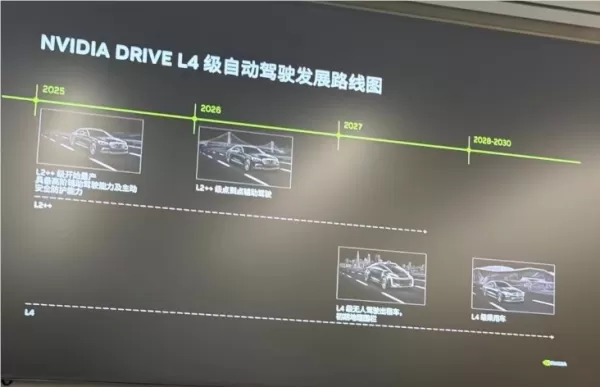
Amid ongoing industry debate about skipping L3 to jump directly to L4, Wu Xinzhou takes a pragmatic view. He believes L3 offers immediate value by freeing human drivers from certain tasks, while L4 demands substantial cloud operations. According to NVIDIA’s roadmap: a mass-production project with Mercedes-Benz is set for 2025; an L4 pilot with Google is planned for 2027; and by 2028, NVIDIA intends to partner with Uber to offer driverless services during the Los Angeles Olympics, targeting coverage in 20 to 30 cities worldwide.
Physical AI Expands: From Cars to Robots
Related article
 U.S. Stocks Hit Historic Milestone as AI and Aerospace Giants Prepare for Trillion-Dollar Debut
Elon Musk, Sam Altman, and Dario Amodei, three titans of the technology sector, are advancing toward initial public offerings for their respective ventures. With SpaceX, OpenAI, and Anthropic—three industry behemoths nearing trillion-dollar valuation
Swedish AI Startup Lovable Eyes $13.2 Billion Valuation After Major Funding Round
As AI-driven coding tools gain traction, Swedish startup Lovable has secured a major funding round. The company aims to raise $3 billion, potentially boosting its valuation to $13.2 billion—double the $6.6 billion recorded last December. Menlo Ventur
Google Tests Remy AI Agent for Gemini as Focus Shifts to User Control
According to Business Insider, Google is testing Remy, a new AI personal agent for Gemini. This tool aims to execute tasks on behalf of users, streamlining both professional workflows and daily routines.Currently, Remy is undergoing testing in an int
Related Special Topic Recommendations
SEO
U.S. Stocks Hit Historic Milestone as AI and Aerospace Giants Prepare for Trillion-Dollar Debut
Elon Musk, Sam Altman, and Dario Amodei, three titans of the technology sector, are advancing toward initial public offerings for their respective ventures. With SpaceX, OpenAI, and Anthropic—three industry behemoths nearing trillion-dollar valuation
Swedish AI Startup Lovable Eyes $13.2 Billion Valuation After Major Funding Round
As AI-driven coding tools gain traction, Swedish startup Lovable has secured a major funding round. The company aims to raise $3 billion, potentially boosting its valuation to $13.2 billion—double the $6.6 billion recorded last December. Menlo Ventur
Google Tests Remy AI Agent for Gemini as Focus Shifts to User Control
According to Business Insider, Google is testing Remy, a new AI personal agent for Gemini. This tool aims to execute tasks on behalf of users, streamlining both professional workflows and daily routines.Currently, Remy is undergoing testing in an int
Related Special Topic Recommendations
SEO
 Best AI SERP Analysis Tools for Search Strategy
2026 Latest Best Top-rated AI SERP Analysis Tools for Search Strategy are curated by XIX.AI through rigorous real-world tests and weekly updated rankings. These powerful tools help you unlock hidden optimization opportunities, boost content performance, and gain a competitive edge in search. Discover your perfect tool to elevate your search strategy today. Explore now!
 13 tools
 xix.ai
Data Analysis
Best AI Anomaly Detection Tools for KPI Monitoring across SaaS and Ecommerce Teams
xix.ai
Data Analysis
Best AI Anomaly Detection Tools for KPI Monitoring across SaaS and Ecommerce Teams
2026 Latest Best Top-rated AI Anomaly Detection Tools for KPI Monitoring in SaaS and Ecommerce teams! XIX.AI has curated a powerful, game-changing collection based on rigorous real-world tests and weekly updated rankings. You’ll find detailed free vs paid comparison insights to help you identify the must-try solution that boosts productivity and unlocks your AI edge. Explore now!
10 tools
xix.ai
writing
Best AI Outline Generators for Long-Form SEO Articles
2026 Latest Best Top-Rated AI Outline Generators for Long-Form SEO Articles, meticulously curated by XIX.AI. These powerful tools offer game-changing assistance in creating high-quality content quickly, boosting writing efficiency significantly. Get a free vs paid comparison along with real-world tests and detailed rankings to help you find the must-try option that suits your needs. Explore now to unlock your AI edge.
8 tools
xix.ai
Education and Learning
AI Study Tools for Homework and Exam Prep
2026 Latest Best AI Study Tools for Homework and Exam Prep! XIX.AI curates a top-rated list of powerful, game-changing tools that help students boost productivity, streamline homework completion, and ace exams through real-world tests. Get a free vs paid comparison, detailed rankings, and must-try options to unlock your AI edge. Explore now!
10 tools
xix.ai
Music composition
AI Vocal Demo Tools for Songwriters, Hooks, Toplines, and Multilingual Draft Sessions
2026 Latest Best AI Vocal Demo Tools for Songwriters, Hook Creators, and Multi-Language Content Teams! XIX.AI has curated a top-rated list of powerful game-changing tools that go through rigorous real-world tests. You’ll find detailed free vs paid comparison data, comprehensive rankings, and must-try options to help you boost writing efficiency and unlock your creative potential. Explore now to discover your perfect tool for all your content needs!
9 tools
xix.ai
Business
Best AI Competitive Research Tools for Small Businesses
2026 Latest Best Top-rated AI Competitive Research Tools for Small Businesses! XIX.AI has curated a highly powerful game-changing collection, updated weekly with rigorous real-world tests and detailed rankings. You can find a comprehensive free vs paid comparison to help you identify the must-try tools that boost your productivity and give you a competitive edge. Explore now to discover your perfect tool!
9 tools
xix.ai

 Comments (0)
0/500
Comments (0)
0/500
In the rapidly evolving field of physical AI, autonomous driving is often viewed as the first major challenge to overcome. Recently, Wu Xinzhou, Vice President of NVIDIA, outlined the company's ambitious vision for intelligent driving at a Beijing communication event. He not only described the "five-layer cake" architecture supporting assisted driving but also provided a clear timeline for the rollout of Level 4 autonomous driving.
The 'Five-Layer Cake' Creates a Full-Stack Ecosystem
NVIDIA has moved beyond simply supplying chips, aiming instead to build a comprehensive service system through a trio of computing platforms: vehicle-side inference, cloud training, and simulation verification. Wu Xinzhou metaphorically refers to this as the "five-layer cake," spanning from the underlying Hyperion hardware platform, through the operating system, open model Alpamayo, and simulation toolchain, all the way up to the top-level cloud infrastructure.
At the heart of this system is a focus on lowering the development barrier for automakers. Particularly during the shift from modular to end-to-end architectures, NVIDIA leverages its powerful simulation capabilities to run two million scenario validations each day, significantly boosting model training efficiency. The company is now actively encouraging major car manufacturers to adopt the Hyperion platform, aiming for a major leap in standardization and scalability.
Vision-First Approach with Built-in Redundancy
On the technical front, Wu Xinzhou is a strong advocate of vision-based solutions. He argues that visual sensors offer pixel density and information limits far beyond those of LiDAR, making them more than capable of supporting high-level assisted driving. However, for more advanced L3 and L4 systems, NVIDIA still sees LiDAR as an essential safety redundancy. He revealed that the company is collaborating with suppliers in Europe and the US to secure stable hardware support for high-level intelligent driving solutions.
L4 Countdown: 30 Cities by 2028
Amid ongoing industry debate about skipping L3 to jump directly to L4, Wu Xinzhou takes a pragmatic view. He believes L3 offers immediate value by freeing human drivers from certain tasks, while L4 demands substantial cloud operations. According to NVIDIA’s roadmap: a mass-production project with Mercedes-Benz is set for 2025; an L4 pilot with Google is planned for 2027; and by 2028, NVIDIA intends to partner with Uber to offer driverless services during the Los Angeles Olympics, targeting coverage in 20 to 30 cities worldwide.
Physical AI Expands: From Cars to Robots








 U.S. Stocks Hit Historic Milestone as AI and Aerospace Giants Prepare for Trillion-Dollar Debut
Elon Musk, Sam Altman, and Dario Amodei, three titans of the technology sector, are advancing toward initial public offerings for their respective ventures. With SpaceX, OpenAI, and Anthropic—three industry behemoths nearing trillion-dollar valuation
U.S. Stocks Hit Historic Milestone as AI and Aerospace Giants Prepare for Trillion-Dollar Debut
Elon Musk, Sam Altman, and Dario Amodei, three titans of the technology sector, are advancing toward initial public offerings for their respective ventures. With SpaceX, OpenAI, and Anthropic—three industry behemoths nearing trillion-dollar valuation
 Swedish AI Startup Lovable Eyes $13.2 Billion Valuation After Major Funding Round
As AI-driven coding tools gain traction, Swedish startup Lovable has secured a major funding round. The company aims to raise $3 billion, potentially boosting its valuation to $13.2 billion—double the $6.6 billion recorded last December. Menlo Ventur
Google Tests Remy AI Agent for Gemini as Focus Shifts to User Control
According to Business Insider, Google is testing Remy, a new AI personal agent for Gemini. This tool aims to execute tasks on behalf of users, streamlining both professional workflows and daily routines.Currently, Remy is undergoing testing in an int
Swedish AI Startup Lovable Eyes $13.2 Billion Valuation After Major Funding Round
As AI-driven coding tools gain traction, Swedish startup Lovable has secured a major funding round. The company aims to raise $3 billion, potentially boosting its valuation to $13.2 billion—double the $6.6 billion recorded last December. Menlo Ventur
Google Tests Remy AI Agent for Gemini as Focus Shifts to User Control
According to Business Insider, Google is testing Remy, a new AI personal agent for Gemini. This tool aims to execute tasks on behalf of users, streamlining both professional workflows and daily routines.Currently, Remy is undergoing testing in an int

2026 Latest Best Top-rated AI SERP Analysis Tools for Search Strategy are curated by XIX.AI through rigorous real-world tests and weekly updated rankings. These powerful tools help you unlock hidden optimization opportunities, boost content performance, and gain a competitive edge in search. Discover your perfect tool to elevate your search strategy today. Explore now!
13 tools
xix.ai

2026 Latest Best Top-rated AI Anomaly Detection Tools for KPI Monitoring in SaaS and Ecommerce teams! XIX.AI has curated a powerful, game-changing collection based on rigorous real-world tests and weekly updated rankings. You’ll find detailed free vs paid comparison insights to help you identify the must-try solution that boosts productivity and unlocks your AI edge. Explore now!
10 tools
xix.ai

2026 Latest Best Top-Rated AI Outline Generators for Long-Form SEO Articles, meticulously curated by XIX.AI. These powerful tools offer game-changing assistance in creating high-quality content quickly, boosting writing efficiency significantly. Get a free vs paid comparison along with real-world tests and detailed rankings to help you find the must-try option that suits your needs. Explore now to unlock your AI edge.
8 tools
xix.ai

2026 Latest Best AI Study Tools for Homework and Exam Prep! XIX.AI curates a top-rated list of powerful, game-changing tools that help students boost productivity, streamline homework completion, and ace exams through real-world tests. Get a free vs paid comparison, detailed rankings, and must-try options to unlock your AI edge. Explore now!
10 tools
xix.ai

2026 Latest Best AI Vocal Demo Tools for Songwriters, Hook Creators, and Multi-Language Content Teams! XIX.AI has curated a top-rated list of powerful game-changing tools that go through rigorous real-world tests. You’ll find detailed free vs paid comparison data, comprehensive rankings, and must-try options to help you boost writing efficiency and unlock your creative potential. Explore now to discover your perfect tool for all your content needs!
9 tools
xix.ai

2026 Latest Best Top-rated AI Competitive Research Tools for Small Businesses! XIX.AI has curated a highly powerful game-changing collection, updated weekly with rigorous real-world tests and detailed rankings. You can find a comprehensive free vs paid comparison to help you identify the must-try tools that boost your productivity and give you a competitive edge. Explore now to discover your perfect tool!
9 tools
xix.ai












