


 Home
Home
NVIDIA and Tsinghua University Introduce Gamma-World, Breaking Multi-Agent Simulation Limits
Video world models are shifting from a single-agent perspective toward multi-agent collaboration. Traditional models typically assume a single agent, which limits their ability to handle complex scenarios where multiple players act and observe each other in the same virtual world. To overcome this architectural bottleneck, NVIDIA, in collaboration with Tsinghua University, the University of Toronto, and the Vector Institute, has introduced Gamma-World (γ-World), a new multi-agent world model solution.
The main challenge in multi-agent world modeling is preserving three types of consistency: temporal, cross-perspective, and interactive. Earlier efforts like Solaris advanced two-agent collaboration but revealed two critical flaws: identity encoding that disrupts permutation symmetry, and a fully connected attention mechanism that drives quadratic computational growth with the number of agents, preventing effective scaling to more participants.
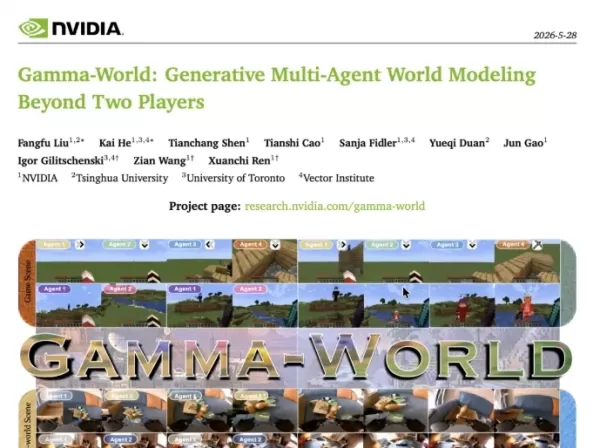
Gamma-World addresses these structural issues with a complete redesign. The team introduced Simplex Rotary Agent Encoding, which positions all players at the vertices of a geometric simplex, ensuring natural equidistance and equal status among them. This design has no learnable parameters and uses random coordinate assignment, enabling the model to train on two-agent data and directly execute four-agent scenarios without any architectural changes—a significant leap in generalization.
To tackle the computational throughput bottleneck, Gamma-World employs a Sparse Hub Attention Mechanism. This approach replaces traditional pairwise direct communication with a set of learnable hub tokens that act as compressed relays for shared world states, reducing computational cost to linear complexity. Combined with independent caching, the system achieves real-time action simulation at 24 frames per second (24 FPS).
For training, the team used a three-stage teacher-student distillation approach, where a bidirectional teacher model guides a causal student model, compressing multi-step sampling into just four steps. This maintains action controllability while significantly reducing error accumulation during autoregressive inference.
Experimental results demonstrate that across five core scenarios in a multi-player Minecraft virtual environment—including memory and construction—Gamma-World outperforms existing state-of-the-art models, achieving an average reduction of over 40% in the FVD metric for video quality. The framework has also been successfully adapted to real dual-arm robot collaboration tasks, confirming its cross-scenario applicability. This advancement not only improves multi-agent simulation but also has the potential to serve as a large-scale simulation generation infrastructure for physical AI domains such as multi-arm medical collaboration, factory multi-robot scheduling, and autonomous driving.
Related article
 U.S. Stocks Hit Historic Milestone as AI and Aerospace Giants Prepare for Trillion-Dollar Debut
Elon Musk, Sam Altman, and Dario Amodei, three titans of the technology sector, are advancing toward initial public offerings for their respective ventures. With SpaceX, OpenAI, and Anthropic—three industry behemoths nearing trillion-dollar valuation
Swedish AI Startup Lovable Eyes $13.2 Billion Valuation After Major Funding Round
As AI-driven coding tools gain traction, Swedish startup Lovable has secured a major funding round. The company aims to raise $3 billion, potentially boosting its valuation to $13.2 billion—double the $6.6 billion recorded last December. Menlo Ventur
Google Tests Remy AI Agent for Gemini as Focus Shifts to User Control
According to Business Insider, Google is testing Remy, a new AI personal agent for Gemini. This tool aims to execute tasks on behalf of users, streamlining both professional workflows and daily routines.Currently, Remy is undergoing testing in an int
Related Special Topic Recommendations
Data Analysis
U.S. Stocks Hit Historic Milestone as AI and Aerospace Giants Prepare for Trillion-Dollar Debut
Elon Musk, Sam Altman, and Dario Amodei, three titans of the technology sector, are advancing toward initial public offerings for their respective ventures. With SpaceX, OpenAI, and Anthropic—three industry behemoths nearing trillion-dollar valuation
Swedish AI Startup Lovable Eyes $13.2 Billion Valuation After Major Funding Round
As AI-driven coding tools gain traction, Swedish startup Lovable has secured a major funding round. The company aims to raise $3 billion, potentially boosting its valuation to $13.2 billion—double the $6.6 billion recorded last December. Menlo Ventur
Google Tests Remy AI Agent for Gemini as Focus Shifts to User Control
According to Business Insider, Google is testing Remy, a new AI personal agent for Gemini. This tool aims to execute tasks on behalf of users, streamlining both professional workflows and daily routines.Currently, Remy is undergoing testing in an int
Related Special Topic Recommendations
Data Analysis
 Best AI Anomaly Detection Tools for KPI Monitoring across SaaS and Ecommerce Teams
2026 Latest Best Top-rated AI Anomaly Detection Tools for KPI Monitoring in SaaS and Ecommerce teams! XIX.AI has curated a powerful, game-changing collection based on rigorous real-world tests and weekly updated rankings. You’ll find detailed free vs paid comparison insights to help you identify the must-try solution that boosts productivity and unlocks your AI edge. Explore now!
 10 tools
 xix.ai
writing
Best AI Outline Generators for Long-Form SEO Articles
xix.ai
writing
Best AI Outline Generators for Long-Form SEO Articles
2026 Latest Best Top-Rated AI Outline Generators for Long-Form SEO Articles, meticulously curated by XIX.AI. These powerful tools offer game-changing assistance in creating high-quality content quickly, boosting writing efficiency significantly. Get a free vs paid comparison along with real-world tests and detailed rankings to help you find the must-try option that suits your needs. Explore now to unlock your AI edge.
8 tools
xix.ai
Education and Learning
AI Study Tools for Homework and Exam Prep
2026 Latest Best AI Study Tools for Homework and Exam Prep! XIX.AI curates a top-rated list of powerful, game-changing tools that help students boost productivity, streamline homework completion, and ace exams through real-world tests. Get a free vs paid comparison, detailed rankings, and must-try options to unlock your AI edge. Explore now!
10 tools
xix.ai
Music composition
AI Vocal Demo Tools for Songwriters, Hooks, Toplines, and Multilingual Draft Sessions
2026 Latest Best AI Vocal Demo Tools for Songwriters, Hook Creators, and Multi-Language Content Teams! XIX.AI has curated a top-rated list of powerful game-changing tools that go through rigorous real-world tests. You’ll find detailed free vs paid comparison data, comprehensive rankings, and must-try options to help you boost writing efficiency and unlock your creative potential. Explore now to discover your perfect tool for all your content needs!
9 tools
xix.ai
Business
Best AI Competitive Research Tools for Small Businesses
2026 Latest Best Top-rated AI Competitive Research Tools for Small Businesses! XIX.AI has curated a highly powerful game-changing collection, updated weekly with rigorous real-world tests and detailed rankings. You can find a comprehensive free vs paid comparison to help you identify the must-try tools that boost your productivity and give you a competitive edge. Explore now to discover your perfect tool!
9 tools
xix.ai
Image editing
Photoshop AI Retouch Tools for Ecommerce Apparel, Skin Cleanup, and Color Consistency
2026 Latest Best Photoshop AI retouch tools for ecommerce apparel, skin cleanup, and color consistency! This top-rated curated list features powerful game-changing solutions that help you boost writing efficiency, streamline content creation, and achieve perfect visual results effortlessly. Each tool has undergone real-world tests through weekly updated rankings, complete with free vs paid comparison details. Backed by XIX.AI, it’s the must-try guide for anyone aiming to unlock your AI edge. Explore now!
10 tools
xix.ai

 Comments (0)
0/500
Comments (0)
0/500
Video world models are shifting from a single-agent perspective toward multi-agent collaboration. Traditional models typically assume a single agent, which limits their ability to handle complex scenarios where multiple players act and observe each other in the same virtual world. To overcome this architectural bottleneck, NVIDIA, in collaboration with Tsinghua University, the University of Toronto, and the Vector Institute, has introduced Gamma-World (γ-World), a new multi-agent world model solution.
The main challenge in multi-agent world modeling is preserving three types of consistency: temporal, cross-perspective, and interactive. Earlier efforts like Solaris advanced two-agent collaboration but revealed two critical flaws: identity encoding that disrupts permutation symmetry, and a fully connected attention mechanism that drives quadratic computational growth with the number of agents, preventing effective scaling to more participants.
Gamma-World addresses these structural issues with a complete redesign. The team introduced Simplex Rotary Agent Encoding, which positions all players at the vertices of a geometric simplex, ensuring natural equidistance and equal status among them. This design has no learnable parameters and uses random coordinate assignment, enabling the model to train on two-agent data and directly execute four-agent scenarios without any architectural changes—a significant leap in generalization.
To tackle the computational throughput bottleneck, Gamma-World employs a Sparse Hub Attention Mechanism. This approach replaces traditional pairwise direct communication with a set of learnable hub tokens that act as compressed relays for shared world states, reducing computational cost to linear complexity. Combined with independent caching, the system achieves real-time action simulation at 24 frames per second (24 FPS).
For training, the team used a three-stage teacher-student distillation approach, where a bidirectional teacher model guides a causal student model, compressing multi-step sampling into just four steps. This maintains action controllability while significantly reducing error accumulation during autoregressive inference.
Experimental results demonstrate that across five core scenarios in a multi-player Minecraft virtual environment—including memory and construction—Gamma-World outperforms existing state-of-the-art models, achieving an average reduction of over 40% in the FVD metric for video quality. The framework has also been successfully adapted to real dual-arm robot collaboration tasks, confirming its cross-scenario applicability. This advancement not only improves multi-agent simulation but also has the potential to serve as a large-scale simulation generation infrastructure for physical AI domains such as multi-arm medical collaboration, factory multi-robot scheduling, and autonomous driving.








 U.S. Stocks Hit Historic Milestone as AI and Aerospace Giants Prepare for Trillion-Dollar Debut
Elon Musk, Sam Altman, and Dario Amodei, three titans of the technology sector, are advancing toward initial public offerings for their respective ventures. With SpaceX, OpenAI, and Anthropic—three industry behemoths nearing trillion-dollar valuation
U.S. Stocks Hit Historic Milestone as AI and Aerospace Giants Prepare for Trillion-Dollar Debut
Elon Musk, Sam Altman, and Dario Amodei, three titans of the technology sector, are advancing toward initial public offerings for their respective ventures. With SpaceX, OpenAI, and Anthropic—three industry behemoths nearing trillion-dollar valuation
 Swedish AI Startup Lovable Eyes $13.2 Billion Valuation After Major Funding Round
As AI-driven coding tools gain traction, Swedish startup Lovable has secured a major funding round. The company aims to raise $3 billion, potentially boosting its valuation to $13.2 billion—double the $6.6 billion recorded last December. Menlo Ventur
Google Tests Remy AI Agent for Gemini as Focus Shifts to User Control
According to Business Insider, Google is testing Remy, a new AI personal agent for Gemini. This tool aims to execute tasks on behalf of users, streamlining both professional workflows and daily routines.Currently, Remy is undergoing testing in an int
Swedish AI Startup Lovable Eyes $13.2 Billion Valuation After Major Funding Round
As AI-driven coding tools gain traction, Swedish startup Lovable has secured a major funding round. The company aims to raise $3 billion, potentially boosting its valuation to $13.2 billion—double the $6.6 billion recorded last December. Menlo Ventur
Google Tests Remy AI Agent for Gemini as Focus Shifts to User Control
According to Business Insider, Google is testing Remy, a new AI personal agent for Gemini. This tool aims to execute tasks on behalf of users, streamlining both professional workflows and daily routines.Currently, Remy is undergoing testing in an int

2026 Latest Best Top-rated AI Anomaly Detection Tools for KPI Monitoring in SaaS and Ecommerce teams! XIX.AI has curated a powerful, game-changing collection based on rigorous real-world tests and weekly updated rankings. You’ll find detailed free vs paid comparison insights to help you identify the must-try solution that boosts productivity and unlocks your AI edge. Explore now!
10 tools
xix.ai

2026 Latest Best Top-Rated AI Outline Generators for Long-Form SEO Articles, meticulously curated by XIX.AI. These powerful tools offer game-changing assistance in creating high-quality content quickly, boosting writing efficiency significantly. Get a free vs paid comparison along with real-world tests and detailed rankings to help you find the must-try option that suits your needs. Explore now to unlock your AI edge.
8 tools
xix.ai

2026 Latest Best AI Study Tools for Homework and Exam Prep! XIX.AI curates a top-rated list of powerful, game-changing tools that help students boost productivity, streamline homework completion, and ace exams through real-world tests. Get a free vs paid comparison, detailed rankings, and must-try options to unlock your AI edge. Explore now!
10 tools
xix.ai

2026 Latest Best AI Vocal Demo Tools for Songwriters, Hook Creators, and Multi-Language Content Teams! XIX.AI has curated a top-rated list of powerful game-changing tools that go through rigorous real-world tests. You’ll find detailed free vs paid comparison data, comprehensive rankings, and must-try options to help you boost writing efficiency and unlock your creative potential. Explore now to discover your perfect tool for all your content needs!
9 tools
xix.ai

2026 Latest Best Top-rated AI Competitive Research Tools for Small Businesses! XIX.AI has curated a highly powerful game-changing collection, updated weekly with rigorous real-world tests and detailed rankings. You can find a comprehensive free vs paid comparison to help you identify the must-try tools that boost your productivity and give you a competitive edge. Explore now to discover your perfect tool!
9 tools
xix.ai

2026 Latest Best Photoshop AI retouch tools for ecommerce apparel, skin cleanup, and color consistency! This top-rated curated list features powerful game-changing solutions that help you boost writing efficiency, streamline content creation, and achieve perfect visual results effortlessly. Each tool has undergone real-world tests through weekly updated rankings, complete with free vs paid comparison details. Backed by XIX.AI, it’s the must-try guide for anyone aiming to unlock your AI edge. Explore now!
10 tools
xix.ai












