


 Home
Home
From MIPS to exaflops in mere decades: Compute power is exploding, and it will transform AI
At the recent Nvidia GTC conference, the tech giant unveiled a groundbreaking achievement: the first single-rack system of servers capable of reaching one exaflop. That's a mind-boggling one billion billion floating-point operations (FLOPS) per second. This feat is powered by Nvidia's latest GB200 NVL72 system, featuring the cutting-edge Blackwell graphics processing units (GPUs). To put it into perspective, this system fits into a standard computer rack that's about 6 feet tall, a bit over 3 feet deep, and less than 2 feet wide.
Shrinking an Exaflop: From Frontier to Blackwell
The announcement got me thinking about how far we've come in just a few years. The world's first exaflop-capable computer, "Frontier," was installed at Oak Ridge National Laboratory in 2022. Built by HPE and powered by AMD GPUs and CPUs, it spanned a massive 74 racks. In contrast, Nvidia's new system packs 73 times more performance into a single rack. That's like tripling performance every year for three years straight! It's a testament to the incredible strides made in computing density, energy efficiency, and architectural design.
It's also worth noting that while both systems reach the exascale milestone, they're designed for different purposes. Nvidia's exaflop rating is based on lower-precision math—4-bit and 8-bit floating-point operations—ideal for AI workloads like training and running large language models (LLMs). These calculations favor speed over precision. On the other hand, Frontier's exaflop rating comes from 64-bit double-precision math, the gold standard for scientific simulations where accuracy is paramount.
We've Come a Long Way (Very Quickly)
The pace of this progress is almost hard to believe, especially when I think back to the early days of my career in computing. My first job was as a programmer on the DEC KL 1090, part of DEC's PDP-10 series of timeshare mainframes. That machine chugged along at a modest 1.8 million instructions per second (MIPS). It connected to cathode ray tube (CRT) displays via hardwired cables, with no graphics to speak of—just text on a screen. And of course, there was no Internet. Remote users had to connect over phone lines with modems that topped out at 1,200 bits per second.
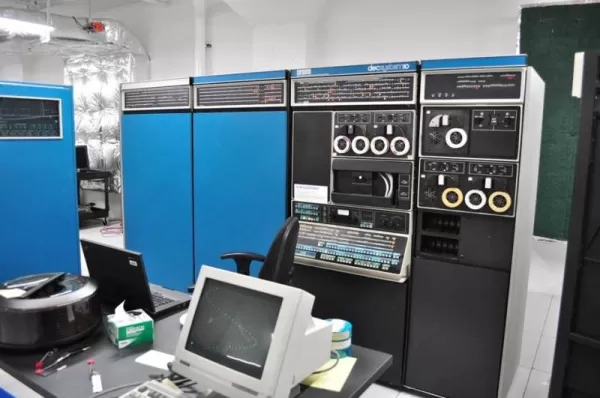
500 Billion Times More Compute
While comparing MIPS to FLOPS isn't a direct apples-to-apples comparison, it gives us a sense of the incredible leap in computing power. MIPS measures integer processing speed, great for general-purpose computing and business applications. FLOPS, on the other hand, measures floating-point performance, crucial for scientific workloads and the heavy lifting behind modern AI, like the matrix math and linear algebra needed to train and run machine learning (ML) models.
Using these as a rough guide, the new Nvidia system is roughly 500 billion times more powerful than the old DEC machine. It's a stunning example of the exponential growth in computing power over a single career. It makes you wonder: If we've achieved this much in 40 years, what could the next five years bring?
Nvidia has given us some hints. At GTC, they shared a roadmap predicting that their next-generation full-rack system, based on the "Vera Rubin" Ultra architecture, will deliver 14 times the performance of the current Blackwell Ultra rack. We're looking at somewhere between 14 and 15 exaflops in AI-optimized work within the next year or two.
It's not just about raw power, either. Squeezing this performance into a single rack means less physical space, fewer materials, and potentially lower energy use per operation. Though let's not forget, the absolute power demands of these systems are still huge.
Does AI Really Need All That Compute Power?
While these performance gains are impressive, the AI industry is now wrestling with a big question: How much computing power do we really need, and at what cost? The race to build massive new AI data centers is driven by the demands of exascale computing and increasingly capable AI models.
The most ambitious project is the $500 billion Project Stargate, planning 20 data centers across the U.S., each half a million square feet. There's a wave of other hyperscale projects underway or in the works around the world as companies and countries rush to build the infrastructure for future AI workloads.
Some analysts are worried we might be overbuilding. Concerns grew after the release of R1, a reasoning model from China's DeepSeek that uses significantly less compute than its peers. Microsoft's recent cancellation of leases with multiple data center providers has fueled speculation that they might be rethinking their AI infrastructure needs.
However, The Register suggested that this pullback might be more about the planned data centers not being able to handle the power and cooling needs of next-gen AI systems. AI models are already pushing the limits of current infrastructure. MIT Technology Review reported that many data centers in China are struggling and failing because they were built to outdated specifications.
AI Inference Demands More FLOPs
Reasoning models do most of their heavy lifting at runtime through a process called inference. These models power some of the most advanced and resource-intensive applications, like deep research assistants and the emerging wave of agentic AI systems.
While DeepSeek-R1 initially led the industry to think future AI might need less computing power, Nvidia CEO Jensen Huang pushed back hard. In a CNBC interview, he argued the opposite: "It was the exact opposite conclusion that everybody had." He added that reasoning AI consumes 100 times more computing than non-reasoning AI.
As AI evolves from reasoning models to autonomous agents and beyond, the demand for computing power is likely to surge again. The next breakthroughs might come in areas like AI agent coordination, fusion simulations, or large-scale digital twins—all made possible by the kind of computing leap we've just seen.
Seemingly right on cue, OpenAI announced $40 billion in new funding, the largest private tech funding round on record. In a blog post, they said the funding "enables us to push the frontiers of AI research even further, scale our compute infrastructure and deliver increasingly powerful tools for the 500 million people who use ChatGPT every week."
Why is so much capital flowing into AI? The reasons range from competitiveness to national security, but one factor stands out: AI could increase corporate profits by $4.4 trillion a year, according to McKinsey.
What Comes Next? It's Anybody's Guess
At their core, information systems are about simplifying complexity, whether it's an emergency vehicle routing system I once wrote in Fortran, a student achievement reporting tool built in COBOL, or modern AI systems accelerating drug discovery. The goal has always been the same: To make sense of the world.
Now, with powerful AI on the horizon, we're crossing a threshold. For the first time, we might have the computing power and intelligence to tackle problems that were once beyond human reach.
New York Times columnist Kevin Roose captured this moment well: "Every week, I meet engineers and entrepreneurs working on AI who tell me that change—big change, world-shaking change, the kind of transformation we've never seen before—is just around the corner." And that's not even counting the breakthroughs that arrive each week.
Just in the past few days, we've seen OpenAI's GPT-4o generate nearly perfect images from text, Google release what may be the most advanced reasoning model yet in Gemini 2.5 Pro, and Runway unveil a video model with shot-to-shot character and scene consistency, something VentureBeat notes has eluded most AI video generators until now.
What comes next is truly anyone's guess. We don't know whether powerful AI will be a breakthrough or breakdown, whether it will help solve fusion energy or unleash new biological risks. But with ever more FLOPS coming online over the next five years, one thing seems certain: Innovation will come fast—and with force. As FLOPS scale, so must our conversations about responsibility, regulation, and restraint.
Gary Grossman is EVP of technology practice at Edelman and global lead of the Edelman AI Center of Excellence.
Related article
![Nvidia CEO Jensen Huang tells Trump ‘we’re not going to let [an AI slowdown] happen’](data:image/gif;base64,R0lGODlhAQABAIAAAAAAAP///yH5BAEAAAAALAAAAAABAAEAAAIBRAA7) Nvidia CEO Jensen Huang tells Trump ‘we’re not going to let [an AI slowdown] happen’
During his appearance at the All-In Summit in Los Angeles on Monday, Nvidia CEO Jensen Huang received an unexpected call from President Donald Trump, one he couldn’t simply ignore.“I’m on stage with the besties,” Huang explained to Trump, referencing
Jensen Huang Reveals Nvidia’s ‘Brand New’ $200B Market Opportunity
Nvidia founder and CEO Jensen Huang stands out as one of the most compelling corporate visionaries, if not the greatest, in driving his company’s narrative. He may even eclipse Salesforce’s Marc Benioff in his unwavering optimism regarding the firm’s
OneRail Leverages Nvidia AI to Optimize Real-Time Last-Mile Delivery
OneRail has introduced an AI-driven delivery platform leveraging Nvidia technology to assist retailers, wholesalers, and distributors in determining the most efficient delivery methods for individual orders.Named OmniSTAR, the system assesses various
Related Special Topic Recommendations
Education and Learning
Nvidia CEO Jensen Huang tells Trump ‘we’re not going to let [an AI slowdown] happen’
During his appearance at the All-In Summit in Los Angeles on Monday, Nvidia CEO Jensen Huang received an unexpected call from President Donald Trump, one he couldn’t simply ignore.“I’m on stage with the besties,” Huang explained to Trump, referencing
Jensen Huang Reveals Nvidia’s ‘Brand New’ $200B Market Opportunity
Nvidia founder and CEO Jensen Huang stands out as one of the most compelling corporate visionaries, if not the greatest, in driving his company’s narrative. He may even eclipse Salesforce’s Marc Benioff in his unwavering optimism regarding the firm’s
OneRail Leverages Nvidia AI to Optimize Real-Time Last-Mile Delivery
OneRail has introduced an AI-driven delivery platform leveraging Nvidia technology to assist retailers, wholesalers, and distributors in determining the most efficient delivery methods for individual orders.Named OmniSTAR, the system assesses various
Related Special Topic Recommendations
Education and Learning
 AI Study Tools for Homework and Exam Prep
2026 Latest Best AI Study Tools for Homework and Exam Prep! XIX.AI curates a top-rated list of powerful, game-changing tools that help students boost productivity, streamline homework completion, and ace exams through real-world tests. Get a free vs paid comparison, detailed rankings, and must-try options to unlock your AI edge. Explore now!
 10 tools
 xix.ai
Music composition
AI Vocal Demo Tools for Songwriters, Hooks, Toplines, and Multilingual Draft Sessions
xix.ai
Music composition
AI Vocal Demo Tools for Songwriters, Hooks, Toplines, and Multilingual Draft Sessions
2026 Latest Best AI Vocal Demo Tools for Songwriters, Hook Creators, and Multi-Language Content Teams! XIX.AI has curated a top-rated list of powerful game-changing tools that go through rigorous real-world tests. You’ll find detailed free vs paid comparison data, comprehensive rankings, and must-try options to help you boost writing efficiency and unlock your creative potential. Explore now to discover your perfect tool for all your content needs!
9 tools
xix.ai
Business
Best AI Competitive Research Tools for Small Businesses
2026 Latest Best Top-rated AI Competitive Research Tools for Small Businesses! XIX.AI has curated a highly powerful game-changing collection, updated weekly with rigorous real-world tests and detailed rankings. You can find a comprehensive free vs paid comparison to help you identify the must-try tools that boost your productivity and give you a competitive edge. Explore now to discover your perfect tool!
9 tools
xix.ai
Image editing
Photoshop AI Retouch Tools for Ecommerce Apparel, Skin Cleanup, and Color Consistency
2026 Latest Best Photoshop AI retouch tools for ecommerce apparel, skin cleanup, and color consistency! This top-rated curated list features powerful game-changing solutions that help you boost writing efficiency, streamline content creation, and achieve perfect visual results effortlessly. Each tool has undergone real-world tests through weekly updated rankings, complete with free vs paid comparison details. Backed by XIX.AI, it’s the must-try guide for anyone aiming to unlock your AI edge. Explore now!
10 tools
xix.ai
Prompt
Best AI Prompt Libraries for ChatGPT Workflows
2026 Latest Best Top-Rated AI Prompt Libraries for optimizing all types of ChatGPT workflows. XIX.AI has curated a powerful, game-changing collection that goes through rigorous real-world tests to ensure top performance. You can find detailed free vs paid comparisons and expert rankings to help you choose the must-try tools that boost your productivity and unlock your AI edge. Explore now!
11 tools
xix.ai
Education and Learning
AI Quiz Builder Platforms for Teachers, Tutors, and Cohort-Based Learning Programs
2026 Latest Best AI Quiz Builder Platforms for Teachers, Tutors, and Cohort-Based Learning Programs! XIX.AI has curated a top-rated list of powerful game-changing tools that go through real-world tests to deliver accurate rankings. These must-try platforms help boost writing efficiency, streamline content creation, and simplify quiz design across all learning scenarios. Explore now to discover your perfect tool for unlocking your AI edge in teaching!
13 tools
xix.ai

 Comments (7)
0/500
Comments (7)
0/500
![BrianDavis]()
One exaflop in a single rack? That's insane 🤯. But honestly, I'm more worried about the power consumption—those GB200 chips must drink electricity like it's happy hour. Still, if this means better AI reasoning without hallucinations, sign me up. Just hope we don't end up with Skynet running on Nvidia hardware.
![RichardThomas]()
Uau, um exaflop em um único rack?! 🤯 Lembro que há alguns anos discutíamos petaflops como algo futurista. Agora a NVIDIA já alcançou esse marco. É incrível ver como a computação avança exponencialmente, mas também me pergunto: quem, além de grandes corporações e governos, terá acesso real a esse poder? A democratização da IA ainda parece distante quando o hardware requer investimentos astronômicos. Será que vamos ver aplicações práticas disso no dia a dia ou ficará restrito a pesquisa de ponta?
![StevenAllen]()
와, 단일 랙에서 익사플롭 성능이라니... 엔비디아는 정말 멈출 줄 모르네요. 🤯 AI 학습에 이 속도라면 곧 개인 맞춤형 AI 보조자가 현실화되겠어요. 근데 이런 연산력이 기후변화에 미치는 영향도 함께 생각해 봐야 할 것 같아요. GPU 클러스터 전력 소비량이 벌써 걱정되네요.
![JackMoore]()
Mind-blowing speed! Nvidia's exaflop system is a game-changer for AI. Can't wait to see what crazy innovations come next! 🚀
![StephenRoberts]()
Mind-blowing speed! Nvidia’s exaflop system is a game-changer for AI. Can’t wait to see what crazy applications come out of this! 🚀
![MarkGonzalez]()
Mind blown! An exaflop in a single rack? Nvidia's pushing AI into hyperspace. Can't wait to see what crazy applications come next. 🚀
At the recent Nvidia GTC conference, the tech giant unveiled a groundbreaking achievement: the first single-rack system of servers capable of reaching one exaflop. That's a mind-boggling one billion billion floating-point operations (FLOPS) per second. This feat is powered by Nvidia's latest GB200 NVL72 system, featuring the cutting-edge Blackwell graphics processing units (GPUs). To put it into perspective, this system fits into a standard computer rack that's about 6 feet tall, a bit over 3 feet deep, and less than 2 feet wide.
Shrinking an Exaflop: From Frontier to Blackwell
The announcement got me thinking about how far we've come in just a few years. The world's first exaflop-capable computer, "Frontier," was installed at Oak Ridge National Laboratory in 2022. Built by HPE and powered by AMD GPUs and CPUs, it spanned a massive 74 racks. In contrast, Nvidia's new system packs 73 times more performance into a single rack. That's like tripling performance every year for three years straight! It's a testament to the incredible strides made in computing density, energy efficiency, and architectural design.
It's also worth noting that while both systems reach the exascale milestone, they're designed for different purposes. Nvidia's exaflop rating is based on lower-precision math—4-bit and 8-bit floating-point operations—ideal for AI workloads like training and running large language models (LLMs). These calculations favor speed over precision. On the other hand, Frontier's exaflop rating comes from 64-bit double-precision math, the gold standard for scientific simulations where accuracy is paramount.
We've Come a Long Way (Very Quickly)
The pace of this progress is almost hard to believe, especially when I think back to the early days of my career in computing. My first job was as a programmer on the DEC KL 1090, part of DEC's PDP-10 series of timeshare mainframes. That machine chugged along at a modest 1.8 million instructions per second (MIPS). It connected to cathode ray tube (CRT) displays via hardwired cables, with no graphics to speak of—just text on a screen. And of course, there was no Internet. Remote users had to connect over phone lines with modems that topped out at 1,200 bits per second.
500 Billion Times More Compute
While comparing MIPS to FLOPS isn't a direct apples-to-apples comparison, it gives us a sense of the incredible leap in computing power. MIPS measures integer processing speed, great for general-purpose computing and business applications. FLOPS, on the other hand, measures floating-point performance, crucial for scientific workloads and the heavy lifting behind modern AI, like the matrix math and linear algebra needed to train and run machine learning (ML) models.
Using these as a rough guide, the new Nvidia system is roughly 500 billion times more powerful than the old DEC machine. It's a stunning example of the exponential growth in computing power over a single career. It makes you wonder: If we've achieved this much in 40 years, what could the next five years bring?
Nvidia has given us some hints. At GTC, they shared a roadmap predicting that their next-generation full-rack system, based on the "Vera Rubin" Ultra architecture, will deliver 14 times the performance of the current Blackwell Ultra rack. We're looking at somewhere between 14 and 15 exaflops in AI-optimized work within the next year or two.
It's not just about raw power, either. Squeezing this performance into a single rack means less physical space, fewer materials, and potentially lower energy use per operation. Though let's not forget, the absolute power demands of these systems are still huge.
Does AI Really Need All That Compute Power?
While these performance gains are impressive, the AI industry is now wrestling with a big question: How much computing power do we really need, and at what cost? The race to build massive new AI data centers is driven by the demands of exascale computing and increasingly capable AI models.
The most ambitious project is the $500 billion Project Stargate, planning 20 data centers across the U.S., each half a million square feet. There's a wave of other hyperscale projects underway or in the works around the world as companies and countries rush to build the infrastructure for future AI workloads.
Some analysts are worried we might be overbuilding. Concerns grew after the release of R1, a reasoning model from China's DeepSeek that uses significantly less compute than its peers. Microsoft's recent cancellation of leases with multiple data center providers has fueled speculation that they might be rethinking their AI infrastructure needs.
However, The Register suggested that this pullback might be more about the planned data centers not being able to handle the power and cooling needs of next-gen AI systems. AI models are already pushing the limits of current infrastructure. MIT Technology Review reported that many data centers in China are struggling and failing because they were built to outdated specifications.
AI Inference Demands More FLOPs
Reasoning models do most of their heavy lifting at runtime through a process called inference. These models power some of the most advanced and resource-intensive applications, like deep research assistants and the emerging wave of agentic AI systems.
While DeepSeek-R1 initially led the industry to think future AI might need less computing power, Nvidia CEO Jensen Huang pushed back hard. In a CNBC interview, he argued the opposite: "It was the exact opposite conclusion that everybody had." He added that reasoning AI consumes 100 times more computing than non-reasoning AI.
As AI evolves from reasoning models to autonomous agents and beyond, the demand for computing power is likely to surge again. The next breakthroughs might come in areas like AI agent coordination, fusion simulations, or large-scale digital twins—all made possible by the kind of computing leap we've just seen.
Seemingly right on cue, OpenAI announced $40 billion in new funding, the largest private tech funding round on record. In a blog post, they said the funding "enables us to push the frontiers of AI research even further, scale our compute infrastructure and deliver increasingly powerful tools for the 500 million people who use ChatGPT every week."
Why is so much capital flowing into AI? The reasons range from competitiveness to national security, but one factor stands out: AI could increase corporate profits by $4.4 trillion a year, according to McKinsey.
What Comes Next? It's Anybody's Guess
At their core, information systems are about simplifying complexity, whether it's an emergency vehicle routing system I once wrote in Fortran, a student achievement reporting tool built in COBOL, or modern AI systems accelerating drug discovery. The goal has always been the same: To make sense of the world.
Now, with powerful AI on the horizon, we're crossing a threshold. For the first time, we might have the computing power and intelligence to tackle problems that were once beyond human reach.
New York Times columnist Kevin Roose captured this moment well: "Every week, I meet engineers and entrepreneurs working on AI who tell me that change—big change, world-shaking change, the kind of transformation we've never seen before—is just around the corner." And that's not even counting the breakthroughs that arrive each week.
Just in the past few days, we've seen OpenAI's GPT-4o generate nearly perfect images from text, Google release what may be the most advanced reasoning model yet in Gemini 2.5 Pro, and Runway unveil a video model with shot-to-shot character and scene consistency, something VentureBeat notes has eluded most AI video generators until now.
What comes next is truly anyone's guess. We don't know whether powerful AI will be a breakthrough or breakdown, whether it will help solve fusion energy or unleash new biological risks. But with ever more FLOPS coming online over the next five years, one thing seems certain: Innovation will come fast—and with force. As FLOPS scale, so must our conversations about responsibility, regulation, and restraint.
Gary Grossman is EVP of technology practice at Edelman and global lead of the Edelman AI Center of Excellence.








![Nvidia CEO Jensen Huang tells Trump ‘we’re not going to let [an AI slowdown] happen’](https://img.xix.ai/uploads/79/6aa87327d0e12.webp) Nvidia CEO Jensen Huang tells Trump ‘we’re not going to let [an AI slowdown] happen’
During his appearance at the All-In Summit in Los Angeles on Monday, Nvidia CEO Jensen Huang received an unexpected call from President Donald Trump, one he couldn’t simply ignore.“I’m on stage with the besties,” Huang explained to Trump, referencing
Nvidia CEO Jensen Huang tells Trump ‘we’re not going to let [an AI slowdown] happen’
During his appearance at the All-In Summit in Los Angeles on Monday, Nvidia CEO Jensen Huang received an unexpected call from President Donald Trump, one he couldn’t simply ignore.“I’m on stage with the besties,” Huang explained to Trump, referencing
 Jensen Huang Reveals Nvidia’s ‘Brand New’ $200B Market Opportunity
Nvidia founder and CEO Jensen Huang stands out as one of the most compelling corporate visionaries, if not the greatest, in driving his company’s narrative. He may even eclipse Salesforce’s Marc Benioff in his unwavering optimism regarding the firm’s
Jensen Huang Reveals Nvidia’s ‘Brand New’ $200B Market Opportunity
Nvidia founder and CEO Jensen Huang stands out as one of the most compelling corporate visionaries, if not the greatest, in driving his company’s narrative. He may even eclipse Salesforce’s Marc Benioff in his unwavering optimism regarding the firm’s
 OneRail Leverages Nvidia AI to Optimize Real-Time Last-Mile Delivery
OneRail has introduced an AI-driven delivery platform leveraging Nvidia technology to assist retailers, wholesalers, and distributors in determining the most efficient delivery methods for individual orders.Named OmniSTAR, the system assesses various
OneRail Leverages Nvidia AI to Optimize Real-Time Last-Mile Delivery
OneRail has introduced an AI-driven delivery platform leveraging Nvidia technology to assist retailers, wholesalers, and distributors in determining the most efficient delivery methods for individual orders.Named OmniSTAR, the system assesses various

2026 Latest Best AI Study Tools for Homework and Exam Prep! XIX.AI curates a top-rated list of powerful, game-changing tools that help students boost productivity, streamline homework completion, and ace exams through real-world tests. Get a free vs paid comparison, detailed rankings, and must-try options to unlock your AI edge. Explore now!
10 tools
xix.ai

2026 Latest Best AI Vocal Demo Tools for Songwriters, Hook Creators, and Multi-Language Content Teams! XIX.AI has curated a top-rated list of powerful game-changing tools that go through rigorous real-world tests. You’ll find detailed free vs paid comparison data, comprehensive rankings, and must-try options to help you boost writing efficiency and unlock your creative potential. Explore now to discover your perfect tool for all your content needs!
9 tools
xix.ai

2026 Latest Best Top-rated AI Competitive Research Tools for Small Businesses! XIX.AI has curated a highly powerful game-changing collection, updated weekly with rigorous real-world tests and detailed rankings. You can find a comprehensive free vs paid comparison to help you identify the must-try tools that boost your productivity and give you a competitive edge. Explore now to discover your perfect tool!
9 tools
xix.ai

2026 Latest Best Photoshop AI retouch tools for ecommerce apparel, skin cleanup, and color consistency! This top-rated curated list features powerful game-changing solutions that help you boost writing efficiency, streamline content creation, and achieve perfect visual results effortlessly. Each tool has undergone real-world tests through weekly updated rankings, complete with free vs paid comparison details. Backed by XIX.AI, it’s the must-try guide for anyone aiming to unlock your AI edge. Explore now!
10 tools
xix.ai

2026 Latest Best Top-Rated AI Prompt Libraries for optimizing all types of ChatGPT workflows. XIX.AI has curated a powerful, game-changing collection that goes through rigorous real-world tests to ensure top performance. You can find detailed free vs paid comparisons and expert rankings to help you choose the must-try tools that boost your productivity and unlock your AI edge. Explore now!
11 tools
xix.ai

2026 Latest Best AI Quiz Builder Platforms for Teachers, Tutors, and Cohort-Based Learning Programs! XIX.AI has curated a top-rated list of powerful game-changing tools that go through real-world tests to deliver accurate rankings. These must-try platforms help boost writing efficiency, streamline content creation, and simplify quiz design across all learning scenarios. Explore now to discover your perfect tool for unlocking your AI edge in teaching!
13 tools
xix.ai

One exaflop in a single rack? That's insane 🤯. But honestly, I'm more worried about the power consumption—those GB200 chips must drink electricity like it's happy hour. Still, if this means better AI reasoning without hallucinations, sign me up. Just hope we don't end up with Skynet running on Nvidia hardware.
Uau, um exaflop em um único rack?! 🤯 Lembro que há alguns anos discutíamos petaflops como algo futurista. Agora a NVIDIA já alcançou esse marco. É incrível ver como a computação avança exponencialmente, mas também me pergunto: quem, além de grandes corporações e governos, terá acesso real a esse poder? A democratização da IA ainda parece distante quando o hardware requer investimentos astronômicos. Será que vamos ver aplicações práticas disso no dia a dia ou ficará restrito a pesquisa de ponta?
와, 단일 랙에서 익사플롭 성능이라니... 엔비디아는 정말 멈출 줄 모르네요. 🤯 AI 학습에 이 속도라면 곧 개인 맞춤형 AI 보조자가 현실화되겠어요. 근데 이런 연산력이 기후변화에 미치는 영향도 함께 생각해 봐야 할 것 같아요. GPU 클러스터 전력 소비량이 벌써 걱정되네요.
Mind-blowing speed! Nvidia's exaflop system is a game-changer for AI. Can't wait to see what crazy innovations come next! 🚀
Mind-blowing speed! Nvidia’s exaflop system is a game-changer for AI. Can’t wait to see what crazy applications come out of this! 🚀
Mind blown! An exaflop in a single rack? Nvidia's pushing AI into hyperspace. Can't wait to see what crazy applications come next. 🚀












