


 Home
HomeMiniMax's M3 Flagship Model and Its Indicator Impress but Spark Divisive Backlash
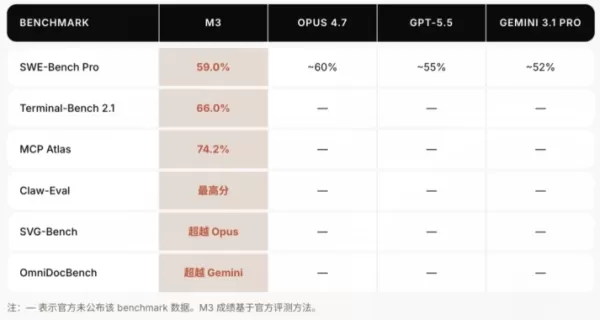
The race for large language models continues to intensify, with AI startup MiniMax recently releasing its new flagship model, M3. According to benchmark results from the technical report, the model delivers impressive performance: scoring 59% on tests that simulate real-world software engineering tasks, surpassing GPT-5.5 and approaching Opus4.7. It also offers million-token context processing and native multimodal capabilities. However, despite these strong technical achievements, the launch has triggered significant backlash from the developer community, with particularly harsh criticism surfacing in Chinese online forums.
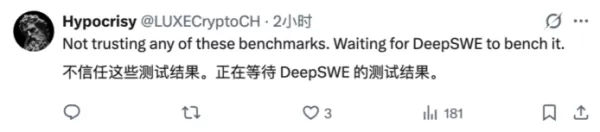
A primary source of skepticism revolves around the evaluation methodology. Technical details reveal that M3 used Claude Code—a competing model—as the evaluation framework for its coding capability tests. While it is common practice to use existing toolchains for agent evaluations, critics say that MiniMax essentially tested its own model against a competitor's framework and directly claimed high scores, comparing itself to the same competitor in public promotions. Many developers have labeled this approach disingenuous, as it makes it difficult to distinguish the model's native abilities from the enhancements provided by the framework.
Another point of contention is the sincerity of the open-source commitment. Unlike other vendors that release open-source models with full weights, MiniMax did not disclose M3's size or provide its weights. The company only stated it would open-source the model within ten days, offering only API access at launch. Since reproducibility and verifiability are core values of the open-source community, promoting open-source while withholding weights—though understandable from a commercial standpoint—has alienated a developer community that expects transparency and practicality.
What has frustrated heavy users most is the sudden change to the billing rules. Previously, MiniMax was known for its generous usage limits, restricting by request count without a monthly token cap. With the M3 release, the company introduced a new token-based plan that charges by total volume. While the official line is that the Plus plan offers strong token value, heavy users—especially those working with million-token contexts—find that each call consumes a large amount, quickly depleting package quotas. This has led to widespread complaints from long-time users.
Setting aside the operational controversies, M3 does have notable innovations at the architectural level. It introduces a self-developed sparse attention mechanism called MSA (MiniMax Sparse Attention), which mitigates the quadratic computational explosion of traditional Transformers by applying high-precision block partitioning and sparsification to key-value pairs. At the low-level operator level, the model adopts a novel aggregation computation method that improves memory access continuity, achieving speeds four times faster than the open-source Flash-Sparse-Attention. As a result, M3 boosts forward propagation and decoding speeds by 9x and 15x respectively under million-token contexts, reducing single-token computation to half that of the previous generation.
Related article
 Suno to Watermark Songs Amid Legal Battles
Suno, the platform enabling users to generate AI-created music, has unveiled new features to label platform-produced tracks, restrict downloads, and update community standards to curb unauthorized replicas. These updates arrive as Suno confronts mult
Musk Admits Grok Build Leaked User Code, Promises to Erase All Historical Data
Elon Musk directly addressed the privacy controversy surrounding Grok Build, beginning with a simple "True" to confirm the incident's validity. He pledged that all user data previously uploaded to SpaceXAI would be permanently erased, stating, "not a
U.S. Stocks Hit Historic Milestone as AI and Aerospace Giants Prepare for Trillion-Dollar Debut
Elon Musk, Sam Altman, and Dario Amodei, three titans of the technology sector, are advancing toward initial public offerings for their respective ventures. With SpaceX, OpenAI, and Anthropic—three industry behemoths nearing trillion-dollar valuation
Related Special Topic Recommendations
Design & Art
Suno to Watermark Songs Amid Legal Battles
Suno, the platform enabling users to generate AI-created music, has unveiled new features to label platform-produced tracks, restrict downloads, and update community standards to curb unauthorized replicas. These updates arrive as Suno confronts mult
Musk Admits Grok Build Leaked User Code, Promises to Erase All Historical Data
Elon Musk directly addressed the privacy controversy surrounding Grok Build, beginning with a simple "True" to confirm the incident's validity. He pledged that all user data previously uploaded to SpaceXAI would be permanently erased, stating, "not a
U.S. Stocks Hit Historic Milestone as AI and Aerospace Giants Prepare for Trillion-Dollar Debut
Elon Musk, Sam Altman, and Dario Amodei, three titans of the technology sector, are advancing toward initial public offerings for their respective ventures. With SpaceX, OpenAI, and Anthropic—three industry behemoths nearing trillion-dollar valuation
Related Special Topic Recommendations
Design & Art
 AI Visual Style Reference Tools for Character Sheets, Moodboards, and Pitch Decks
2026 Latest Best AI Visual Style Reference Tools for Character Sheets, Moodboards, and Pitch Decks are here on XIX.AI! This curated top-rated list features powerful game-changing tools that go through rigorous real-world tests. You’ll find a free vs paid comparison, detailed rankings, and must-try options to help you boost creativity and streamline your workflow. Explore now to discover your perfect tool for boosting productivity!
 11 tools
 xix.ai
SEO
Best AI SERP Analysis Tools for Search Strategy
xix.ai
SEO
Best AI SERP Analysis Tools for Search Strategy
2026 Latest Best Top-rated AI SERP Analysis Tools for Search Strategy are curated by XIX.AI through rigorous real-world tests and weekly updated rankings. These powerful tools help you unlock hidden optimization opportunities, boost content performance, and gain a competitive edge in search. Discover your perfect tool to elevate your search strategy today. Explore now!
13 tools
xix.ai
Data Analysis
Best AI Anomaly Detection Tools for KPI Monitoring across SaaS and Ecommerce Teams
2026 Latest Best Top-rated AI Anomaly Detection Tools for KPI Monitoring in SaaS and Ecommerce teams! XIX.AI has curated a powerful, game-changing collection based on rigorous real-world tests and weekly updated rankings. You’ll find detailed free vs paid comparison insights to help you identify the must-try solution that boosts productivity and unlocks your AI edge. Explore now!
10 tools
xix.ai
writing
Best AI Outline Generators for Long-Form SEO Articles
2026 Latest Best Top-Rated AI Outline Generators for Long-Form SEO Articles, meticulously curated by XIX.AI. These powerful tools offer game-changing assistance in creating high-quality content quickly, boosting writing efficiency significantly. Get a free vs paid comparison along with real-world tests and detailed rankings to help you find the must-try option that suits your needs. Explore now to unlock your AI edge.
8 tools
xix.ai
Education and Learning
AI Study Tools for Homework and Exam Prep
2026 Latest Best AI Study Tools for Homework and Exam Prep! XIX.AI curates a top-rated list of powerful, game-changing tools that help students boost productivity, streamline homework completion, and ace exams through real-world tests. Get a free vs paid comparison, detailed rankings, and must-try options to unlock your AI edge. Explore now!
10 tools
xix.ai
Music composition
AI Vocal Demo Tools for Songwriters, Hooks, Toplines, and Multilingual Draft Sessions
2026 Latest Best AI Vocal Demo Tools for Songwriters, Hook Creators, and Multi-Language Content Teams! XIX.AI has curated a top-rated list of powerful game-changing tools that go through rigorous real-world tests. You’ll find detailed free vs paid comparison data, comprehensive rankings, and must-try options to help you boost writing efficiency and unlock your creative potential. Explore now to discover your perfect tool for all your content needs!
9 tools
xix.ai

 Comments (0)
0/500
Comments (0)
0/500
The race for large language models continues to intensify, with AI startup MiniMax recently releasing its new flagship model, M3. According to benchmark results from the technical report, the model delivers impressive performance: scoring 59% on tests that simulate real-world software engineering tasks, surpassing GPT-5.5 and approaching Opus4.7. It also offers million-token context processing and native multimodal capabilities. However, despite these strong technical achievements, the launch has triggered significant backlash from the developer community, with particularly harsh criticism surfacing in Chinese online forums.
A primary source of skepticism revolves around the evaluation methodology. Technical details reveal that M3 used Claude Code—a competing model—as the evaluation framework for its coding capability tests. While it is common practice to use existing toolchains for agent evaluations, critics say that MiniMax essentially tested its own model against a competitor's framework and directly claimed high scores, comparing itself to the same competitor in public promotions. Many developers have labeled this approach disingenuous, as it makes it difficult to distinguish the model's native abilities from the enhancements provided by the framework.
Another point of contention is the sincerity of the open-source commitment. Unlike other vendors that release open-source models with full weights, MiniMax did not disclose M3's size or provide its weights. The company only stated it would open-source the model within ten days, offering only API access at launch. Since reproducibility and verifiability are core values of the open-source community, promoting open-source while withholding weights—though understandable from a commercial standpoint—has alienated a developer community that expects transparency and practicality.
What has frustrated heavy users most is the sudden change to the billing rules. Previously, MiniMax was known for its generous usage limits, restricting by request count without a monthly token cap. With the M3 release, the company introduced a new token-based plan that charges by total volume. While the official line is that the Plus plan offers strong token value, heavy users—especially those working with million-token contexts—find that each call consumes a large amount, quickly depleting package quotas. This has led to widespread complaints from long-time users.
Setting aside the operational controversies, M3 does have notable innovations at the architectural level. It introduces a self-developed sparse attention mechanism called MSA (MiniMax Sparse Attention), which mitigates the quadratic computational explosion of traditional Transformers by applying high-precision block partitioning and sparsification to key-value pairs. At the low-level operator level, the model adopts a novel aggregation computation method that improves memory access continuity, achieving speeds four times faster than the open-source Flash-Sparse-Attention. As a result, M3 boosts forward propagation and decoding speeds by 9x and 15x respectively under million-token contexts, reducing single-token computation to half that of the previous generation.








 Suno to Watermark Songs Amid Legal Battles
Suno, the platform enabling users to generate AI-created music, has unveiled new features to label platform-produced tracks, restrict downloads, and update community standards to curb unauthorized replicas. These updates arrive as Suno confronts mult
Suno to Watermark Songs Amid Legal Battles
Suno, the platform enabling users to generate AI-created music, has unveiled new features to label platform-produced tracks, restrict downloads, and update community standards to curb unauthorized replicas. These updates arrive as Suno confronts mult
 Musk Admits Grok Build Leaked User Code, Promises to Erase All Historical Data
Elon Musk directly addressed the privacy controversy surrounding Grok Build, beginning with a simple "True" to confirm the incident's validity. He pledged that all user data previously uploaded to SpaceXAI would be permanently erased, stating, "not a
Musk Admits Grok Build Leaked User Code, Promises to Erase All Historical Data
Elon Musk directly addressed the privacy controversy surrounding Grok Build, beginning with a simple "True" to confirm the incident's validity. He pledged that all user data previously uploaded to SpaceXAI would be permanently erased, stating, "not a
 U.S. Stocks Hit Historic Milestone as AI and Aerospace Giants Prepare for Trillion-Dollar Debut
Elon Musk, Sam Altman, and Dario Amodei, three titans of the technology sector, are advancing toward initial public offerings for their respective ventures. With SpaceX, OpenAI, and Anthropic—three industry behemoths nearing trillion-dollar valuation
U.S. Stocks Hit Historic Milestone as AI and Aerospace Giants Prepare for Trillion-Dollar Debut
Elon Musk, Sam Altman, and Dario Amodei, three titans of the technology sector, are advancing toward initial public offerings for their respective ventures. With SpaceX, OpenAI, and Anthropic—three industry behemoths nearing trillion-dollar valuation

2026 Latest Best AI Visual Style Reference Tools for Character Sheets, Moodboards, and Pitch Decks are here on XIX.AI! This curated top-rated list features powerful game-changing tools that go through rigorous real-world tests. You’ll find a free vs paid comparison, detailed rankings, and must-try options to help you boost creativity and streamline your workflow. Explore now to discover your perfect tool for boosting productivity!
11 tools
xix.ai

2026 Latest Best Top-rated AI SERP Analysis Tools for Search Strategy are curated by XIX.AI through rigorous real-world tests and weekly updated rankings. These powerful tools help you unlock hidden optimization opportunities, boost content performance, and gain a competitive edge in search. Discover your perfect tool to elevate your search strategy today. Explore now!
13 tools
xix.ai

2026 Latest Best Top-rated AI Anomaly Detection Tools for KPI Monitoring in SaaS and Ecommerce teams! XIX.AI has curated a powerful, game-changing collection based on rigorous real-world tests and weekly updated rankings. You’ll find detailed free vs paid comparison insights to help you identify the must-try solution that boosts productivity and unlocks your AI edge. Explore now!
10 tools
xix.ai

2026 Latest Best Top-Rated AI Outline Generators for Long-Form SEO Articles, meticulously curated by XIX.AI. These powerful tools offer game-changing assistance in creating high-quality content quickly, boosting writing efficiency significantly. Get a free vs paid comparison along with real-world tests and detailed rankings to help you find the must-try option that suits your needs. Explore now to unlock your AI edge.
8 tools
xix.ai

2026 Latest Best AI Study Tools for Homework and Exam Prep! XIX.AI curates a top-rated list of powerful, game-changing tools that help students boost productivity, streamline homework completion, and ace exams through real-world tests. Get a free vs paid comparison, detailed rankings, and must-try options to unlock your AI edge. Explore now!
10 tools
xix.ai

2026 Latest Best AI Vocal Demo Tools for Songwriters, Hook Creators, and Multi-Language Content Teams! XIX.AI has curated a top-rated list of powerful game-changing tools that go through rigorous real-world tests. You’ll find detailed free vs paid comparison data, comprehensive rankings, and must-try options to help you boost writing efficiency and unlock your creative potential. Explore now to discover your perfect tool for all your content needs!
9 tools
xix.ai












