


 Home
HomeMiniMax Unveils Office Suite AI to Streamline Document Creation
In the realm of AI-powered office tasks, many have faced similar frustrations: requesting a report from an AI, only to have formulas convert to static values; asking it to adjust a PPT template, only for the layout to become disorganized. To tackle this persistent industry challenge of "unusable generated content," the large model company MiniMax (Xiyu Technology) has recently open-sourced its production-grade office document engine, Office Skills. Released under the MIT license, this codebase aims to ensure AI-generated Word, Excel, PPT, and PDF documents truly meet a "ready-to-use" standard.
Architectural Overhaul: Moving Beyond Generic Libraries for Precise Control
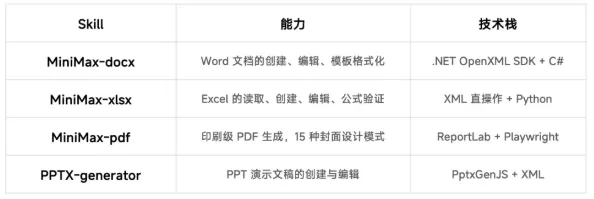
MiniMax's technical approach is notably robust. To address the "silent data loss" common in standard Python libraries when processing complex file formats, they moved beyond conventional, limited solutions:
Excel (xlsx): They bypassed openpyxl, opting instead for surgical precision at the XML level. By unzipping files, modifying specific XML nodes, and repackaging, they guarantee that existing pivot tables, VBA macros, and intricate formulas remain fully intact.
Word (docx): They abandoned the lightweight python-docx in favor of Microsoft's .NET OpenXML SDK, achieving flawless handling of nested tables, headers, footers, and revision tracking.
PDF and PPT: They implemented a "dual-engine" segmentation strategy. For instance, a PDF cover might be rendered using HTML+CSS for design fidelity, while the body content is processed by ReportLab for stability. For PPT, they predefined four visual "themes" to ensure consistent styling throughout presentations.
Self-Improving Cycle: A "Digital Employee" That Learns from Mistakes
Beyond open-sourcing the toolchain, MiniMax also introduced a self-evolution mechanism called Execute → Evaluate → Fix. This means Office Skills is not static code—it incorporates an automated evaluation framework. When the AI fails to produce a correct document, the system automatically detects errors in structure, formulas, or formatting, logging these cases for iterative improvement.
This mechanism enhances the stability of Office Skills in real-world office scenarios. Whether generating a high-end omakase menu or a complex investment banking financial report, the AI no longer delivers just a "demo," but a final product with logical coherence and compliant formatting. By open-sourcing this capability, the race for office automation agents may be leaving the "amateur era" behind and entering a stage of professional, reliable delivery.
Related article
 Swedish AI Startup Lovable Eyes $13.2 Billion Valuation After Major Funding Round
As AI-driven coding tools gain traction, Swedish startup Lovable has secured a major funding round. The company aims to raise $3 billion, potentially boosting its valuation to $13.2 billion—double the $6.6 billion recorded last December. Menlo Ventur
Google Tests Remy AI Agent for Gemini as Focus Shifts to User Control
According to Business Insider, Google is testing Remy, a new AI personal agent for Gemini. This tool aims to execute tasks on behalf of users, streamlining both professional workflows and daily routines.Currently, Remy is undergoing testing in an int
How to fix Core Web Vitals for better SEO rankings
Streamline Report Card Comments with AI ToolsIntroductionAI Tools for Generating Report Card CommentsMagic SchoolAlmanac AIChat GPTUsing Magic School to Generate Report Card CommentsLogging into Magic SchoolSelecting the Report Card Comments ToolCust
Related Special Topic Recommendations
writing
Swedish AI Startup Lovable Eyes $13.2 Billion Valuation After Major Funding Round
As AI-driven coding tools gain traction, Swedish startup Lovable has secured a major funding round. The company aims to raise $3 billion, potentially boosting its valuation to $13.2 billion—double the $6.6 billion recorded last December. Menlo Ventur
Google Tests Remy AI Agent for Gemini as Focus Shifts to User Control
According to Business Insider, Google is testing Remy, a new AI personal agent for Gemini. This tool aims to execute tasks on behalf of users, streamlining both professional workflows and daily routines.Currently, Remy is undergoing testing in an int
How to fix Core Web Vitals for better SEO rankings
Streamline Report Card Comments with AI ToolsIntroductionAI Tools for Generating Report Card CommentsMagic SchoolAlmanac AIChat GPTUsing Magic School to Generate Report Card CommentsLogging into Magic SchoolSelecting the Report Card Comments ToolCust
Related Special Topic Recommendations
writing
 Best AI Outline Generators for Long-Form SEO Articles
2026 Latest Best Top-Rated AI Outline Generators for Long-Form SEO Articles, meticulously curated by XIX.AI. These powerful tools offer game-changing assistance in creating high-quality content quickly, boosting writing efficiency significantly. Get a free vs paid comparison along with real-world tests and detailed rankings to help you find the must-try option that suits your needs. Explore now to unlock your AI edge.
 8 tools
 xix.ai
Education and Learning
AI Study Tools for Homework and Exam Prep
xix.ai
Education and Learning
AI Study Tools for Homework and Exam Prep
2026 Latest Best AI Study Tools for Homework and Exam Prep! XIX.AI curates a top-rated list of powerful, game-changing tools that help students boost productivity, streamline homework completion, and ace exams through real-world tests. Get a free vs paid comparison, detailed rankings, and must-try options to unlock your AI edge. Explore now!
10 tools
xix.ai
Music composition
AI Vocal Demo Tools for Songwriters, Hooks, Toplines, and Multilingual Draft Sessions
2026 Latest Best AI Vocal Demo Tools for Songwriters, Hook Creators, and Multi-Language Content Teams! XIX.AI has curated a top-rated list of powerful game-changing tools that go through rigorous real-world tests. You’ll find detailed free vs paid comparison data, comprehensive rankings, and must-try options to help you boost writing efficiency and unlock your creative potential. Explore now to discover your perfect tool for all your content needs!
9 tools
xix.ai
Business
Best AI Competitive Research Tools for Small Businesses
2026 Latest Best Top-rated AI Competitive Research Tools for Small Businesses! XIX.AI has curated a highly powerful game-changing collection, updated weekly with rigorous real-world tests and detailed rankings. You can find a comprehensive free vs paid comparison to help you identify the must-try tools that boost your productivity and give you a competitive edge. Explore now to discover your perfect tool!
9 tools
xix.ai
Image editing
Photoshop AI Retouch Tools for Ecommerce Apparel, Skin Cleanup, and Color Consistency
2026 Latest Best Photoshop AI retouch tools for ecommerce apparel, skin cleanup, and color consistency! This top-rated curated list features powerful game-changing solutions that help you boost writing efficiency, streamline content creation, and achieve perfect visual results effortlessly. Each tool has undergone real-world tests through weekly updated rankings, complete with free vs paid comparison details. Backed by XIX.AI, it’s the must-try guide for anyone aiming to unlock your AI edge. Explore now!
10 tools
xix.ai
Prompt
Best AI Prompt Libraries for ChatGPT Workflows
2026 Latest Best Top-Rated AI Prompt Libraries for optimizing all types of ChatGPT workflows. XIX.AI has curated a powerful, game-changing collection that goes through rigorous real-world tests to ensure top performance. You can find detailed free vs paid comparisons and expert rankings to help you choose the must-try tools that boost your productivity and unlock your AI edge. Explore now!
11 tools
xix.ai

 Comments (0)
0/500
Comments (0)
0/500
In the realm of AI-powered office tasks, many have faced similar frustrations: requesting a report from an AI, only to have formulas convert to static values; asking it to adjust a PPT template, only for the layout to become disorganized. To tackle this persistent industry challenge of "unusable generated content," the large model company MiniMax (Xiyu Technology) has recently open-sourced its production-grade office document engine, Office Skills. Released under the MIT license, this codebase aims to ensure AI-generated Word, Excel, PPT, and PDF documents truly meet a "ready-to-use" standard.
Architectural Overhaul: Moving Beyond Generic Libraries for Precise Control
MiniMax's technical approach is notably robust. To address the "silent data loss" common in standard Python libraries when processing complex file formats, they moved beyond conventional, limited solutions:
Excel (xlsx): They bypassed openpyxl, opting instead for surgical precision at the XML level. By unzipping files, modifying specific XML nodes, and repackaging, they guarantee that existing pivot tables, VBA macros, and intricate formulas remain fully intact.
Word (docx): They abandoned the lightweight python-docx in favor of Microsoft's .NET OpenXML SDK, achieving flawless handling of nested tables, headers, footers, and revision tracking.
PDF and PPT: They implemented a "dual-engine" segmentation strategy. For instance, a PDF cover might be rendered using HTML+CSS for design fidelity, while the body content is processed by ReportLab for stability. For PPT, they predefined four visual "themes" to ensure consistent styling throughout presentations.
Self-Improving Cycle: A "Digital Employee" That Learns from Mistakes
Beyond open-sourcing the toolchain, MiniMax also introduced a self-evolution mechanism called Execute → Evaluate → Fix. This means Office Skills is not static code—it incorporates an automated evaluation framework. When the AI fails to produce a correct document, the system automatically detects errors in structure, formulas, or formatting, logging these cases for iterative improvement.
This mechanism enhances the stability of Office Skills in real-world office scenarios. Whether generating a high-end omakase menu or a complex investment banking financial report, the AI no longer delivers just a "demo," but a final product with logical coherence and compliant formatting. By open-sourcing this capability, the race for office automation agents may be leaving the "amateur era" behind and entering a stage of professional, reliable delivery.








 Swedish AI Startup Lovable Eyes $13.2 Billion Valuation After Major Funding Round
As AI-driven coding tools gain traction, Swedish startup Lovable has secured a major funding round. The company aims to raise $3 billion, potentially boosting its valuation to $13.2 billion—double the $6.6 billion recorded last December. Menlo Ventur
Google Tests Remy AI Agent for Gemini as Focus Shifts to User Control
According to Business Insider, Google is testing Remy, a new AI personal agent for Gemini. This tool aims to execute tasks on behalf of users, streamlining both professional workflows and daily routines.Currently, Remy is undergoing testing in an int
Swedish AI Startup Lovable Eyes $13.2 Billion Valuation After Major Funding Round
As AI-driven coding tools gain traction, Swedish startup Lovable has secured a major funding round. The company aims to raise $3 billion, potentially boosting its valuation to $13.2 billion—double the $6.6 billion recorded last December. Menlo Ventur
Google Tests Remy AI Agent for Gemini as Focus Shifts to User Control
According to Business Insider, Google is testing Remy, a new AI personal agent for Gemini. This tool aims to execute tasks on behalf of users, streamlining both professional workflows and daily routines.Currently, Remy is undergoing testing in an int
 How to fix Core Web Vitals for better SEO rankings
Streamline Report Card Comments with AI ToolsIntroductionAI Tools for Generating Report Card CommentsMagic SchoolAlmanac AIChat GPTUsing Magic School to Generate Report Card CommentsLogging into Magic SchoolSelecting the Report Card Comments ToolCust
How to fix Core Web Vitals for better SEO rankings
Streamline Report Card Comments with AI ToolsIntroductionAI Tools for Generating Report Card CommentsMagic SchoolAlmanac AIChat GPTUsing Magic School to Generate Report Card CommentsLogging into Magic SchoolSelecting the Report Card Comments ToolCust

2026 Latest Best Top-Rated AI Outline Generators for Long-Form SEO Articles, meticulously curated by XIX.AI. These powerful tools offer game-changing assistance in creating high-quality content quickly, boosting writing efficiency significantly. Get a free vs paid comparison along with real-world tests and detailed rankings to help you find the must-try option that suits your needs. Explore now to unlock your AI edge.
8 tools
xix.ai

2026 Latest Best AI Study Tools for Homework and Exam Prep! XIX.AI curates a top-rated list of powerful, game-changing tools that help students boost productivity, streamline homework completion, and ace exams through real-world tests. Get a free vs paid comparison, detailed rankings, and must-try options to unlock your AI edge. Explore now!
10 tools
xix.ai

2026 Latest Best AI Vocal Demo Tools for Songwriters, Hook Creators, and Multi-Language Content Teams! XIX.AI has curated a top-rated list of powerful game-changing tools that go through rigorous real-world tests. You’ll find detailed free vs paid comparison data, comprehensive rankings, and must-try options to help you boost writing efficiency and unlock your creative potential. Explore now to discover your perfect tool for all your content needs!
9 tools
xix.ai
2026 Latest Best Top-rated AI Competitive Research Tools for Small Businesses! XIX.AI has curated a highly powerful game-changing collection, updated weekly with rigorous real-world tests and detailed rankings. You can find a comprehensive free vs paid comparison to help you identify the must-try tools that boost your productivity and give you a competitive edge. Explore now to discover your perfect tool!
9 tools
xix.ai

2026 Latest Best Photoshop AI retouch tools for ecommerce apparel, skin cleanup, and color consistency! This top-rated curated list features powerful game-changing solutions that help you boost writing efficiency, streamline content creation, and achieve perfect visual results effortlessly. Each tool has undergone real-world tests through weekly updated rankings, complete with free vs paid comparison details. Backed by XIX.AI, it’s the must-try guide for anyone aiming to unlock your AI edge. Explore now!
10 tools
xix.ai
2026 Latest Best Top-Rated AI Prompt Libraries for optimizing all types of ChatGPT workflows. XIX.AI has curated a powerful, game-changing collection that goes through rigorous real-world tests to ensure top performance. You can find detailed free vs paid comparisons and expert rankings to help you choose the must-try tools that boost your productivity and unlock your AI edge. Explore now!
11 tools
xix.ai












