


 Home
Home
Microsoft's VibeVoice AI Family Goes Open Source, Handles 90-Minute Dialogues, Tops 27K GitHub Stars
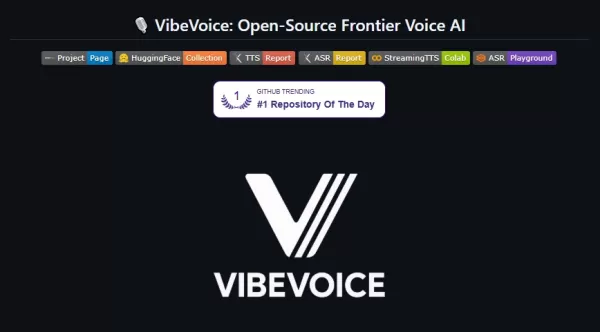
Microsoft has recently open-sourced a state-of-the-art family of voice AI models named VibeVoice, featuring capabilities like automatic speech recognition (ASR) and text-to-speech (TTS). The project has rapidly captured the developer community's interest, thanks to its robust long-audio processing, natural multi-speaker dialogue generation, and real-time, low-latency performance. It has already garnered around 27,000 Stars on GitHub.
Released as an open-source research framework under the MIT license, VibeVoice supports local deployment with no cloud subscription fees, aiming to foster collaboration and innovation in speech synthesis. The model family comprises three core members, each addressing specific challenges in traditional voice AI, such as long-sequence handling, speaker consistency, and natural fluency.
VibeVoice-ASR-7B: A Powerful Tool for Structured Speech-to-Text, Handling Up to 60 Minutes of Audio
VibeVoice-ASR-7B is a unified speech-to-text model capable of processing audio files up to 60 minutes long in a single pass, directly outputting structured transcripts. The output identifies the speaker, provides precise timestamps, and details the spoken content, while supporting custom hotwords to improve accuracy for proper nouns or technical terms. Supporting over 50 languages, it is well-suited for complex scenarios like lengthy meeting recordings and podcast transcription.
Community developers have already built practical tools on this model, such as a voice input method called Vibing for macOS and Windows. User feedback indicates strong performance in speed and accuracy, significantly boosting daily voice input efficiency.
VibeVoice-TTS-1.5B: Expressive Speech Generation for Up to 90 Minutes with Multiple Speakers
VibeVoice-TTS-1.5B is the core text-to-speech model, capable of generating continuous audio up to 90 minutes long in one go and supporting up to four distinct speakers for natural dialogue simulation. The synthesized speech is expressive, sounding natural and fluent with realistic pauses, emphasis, and emotional shifts, making it ideal for podcasts, long narratives, audiobooks, or multi-character dialogues.
Unlike many traditional TTS models limited to 1-2 speakers, VibeVoice-TTS achieves significant breakthroughs in long-form and multi-speaker consistency. Its architecture combines a continuous speech tokenizer (acoustic and semantic) with a low frame rate (7.5Hz), greatly enhancing computational efficiency for long sequences.
VibeVoice-Realtime-0.5B: Real-Time TTS with Around 300 Milliseconds of Latency
VibeVoice-Realtime-0.5B is designed for real-time applications, supporting streaming text input with a first-audio latency of approximately 300 milliseconds, while still capable of generating audio up to 10 minutes long. This model is particularly suitable for interactive applications requiring instant feedback, such as real-time voice assistants or live streaming dubbing.
Additionally, the project introduced experimental speaker support, including multilingual speech and various English style variations, offering developers greater customization options.
AIbase Review: Microsoft's open-sourcing of VibeVoice not only lowers the barrier to entry for high-performance voice AI but also provides a complete local deployment solution. The project was briefly taken down due to potential misuse risks but was relaunched after implementing security measures like audio watermarks and audible disclaimers, reflecting responsible AI development principles. Developers can now obtain model weights from GitHub and Hugging Face and quickly test them via platforms like Colab.
With ongoing contributions from the open-source community, including optimizations for Apple Silicon, VibeVoice is poised to accelerate adoption in content creation, accessibility tools, and voice interaction. Interested developers can visit Microsoft's official project page for further exploration.
Project Address: https://github.com/microsoft/VibeVoice
Related article
 Suno to Watermark Songs Amid Legal Battles
Suno, the platform enabling users to generate AI-created music, has unveiled new features to label platform-produced tracks, restrict downloads, and update community standards to curb unauthorized replicas. These updates arrive as Suno confronts mult
Musk Admits Grok Build Leaked User Code, Promises to Erase All Historical Data
Elon Musk directly addressed the privacy controversy surrounding Grok Build, beginning with a simple "True" to confirm the incident's validity. He pledged that all user data previously uploaded to SpaceXAI would be permanently erased, stating, "not a
U.S. Stocks Hit Historic Milestone as AI and Aerospace Giants Prepare for Trillion-Dollar Debut
Elon Musk, Sam Altman, and Dario Amodei, three titans of the technology sector, are advancing toward initial public offerings for their respective ventures. With SpaceX, OpenAI, and Anthropic—three industry behemoths nearing trillion-dollar valuation
Related Special Topic Recommendations
SEO
Suno to Watermark Songs Amid Legal Battles
Suno, the platform enabling users to generate AI-created music, has unveiled new features to label platform-produced tracks, restrict downloads, and update community standards to curb unauthorized replicas. These updates arrive as Suno confronts mult
Musk Admits Grok Build Leaked User Code, Promises to Erase All Historical Data
Elon Musk directly addressed the privacy controversy surrounding Grok Build, beginning with a simple "True" to confirm the incident's validity. He pledged that all user data previously uploaded to SpaceXAI would be permanently erased, stating, "not a
U.S. Stocks Hit Historic Milestone as AI and Aerospace Giants Prepare for Trillion-Dollar Debut
Elon Musk, Sam Altman, and Dario Amodei, three titans of the technology sector, are advancing toward initial public offerings for their respective ventures. With SpaceX, OpenAI, and Anthropic—three industry behemoths nearing trillion-dollar valuation
Related Special Topic Recommendations
SEO
 Best AI SERP Analysis Tools for Search Strategy
2026 Latest Best Top-rated AI SERP Analysis Tools for Search Strategy are curated by XIX.AI through rigorous real-world tests and weekly updated rankings. These powerful tools help you unlock hidden optimization opportunities, boost content performance, and gain a competitive edge in search. Discover your perfect tool to elevate your search strategy today. Explore now!
 13 tools
 xix.ai
Data Analysis
Best AI Anomaly Detection Tools for KPI Monitoring across SaaS and Ecommerce Teams
xix.ai
Data Analysis
Best AI Anomaly Detection Tools for KPI Monitoring across SaaS and Ecommerce Teams
2026 Latest Best Top-rated AI Anomaly Detection Tools for KPI Monitoring in SaaS and Ecommerce teams! XIX.AI has curated a powerful, game-changing collection based on rigorous real-world tests and weekly updated rankings. You’ll find detailed free vs paid comparison insights to help you identify the must-try solution that boosts productivity and unlocks your AI edge. Explore now!
10 tools
xix.ai
writing
Best AI Outline Generators for Long-Form SEO Articles
2026 Latest Best Top-Rated AI Outline Generators for Long-Form SEO Articles, meticulously curated by XIX.AI. These powerful tools offer game-changing assistance in creating high-quality content quickly, boosting writing efficiency significantly. Get a free vs paid comparison along with real-world tests and detailed rankings to help you find the must-try option that suits your needs. Explore now to unlock your AI edge.
8 tools
xix.ai
Education and Learning
AI Study Tools for Homework and Exam Prep
2026 Latest Best AI Study Tools for Homework and Exam Prep! XIX.AI curates a top-rated list of powerful, game-changing tools that help students boost productivity, streamline homework completion, and ace exams through real-world tests. Get a free vs paid comparison, detailed rankings, and must-try options to unlock your AI edge. Explore now!
10 tools
xix.ai
Music composition
AI Vocal Demo Tools for Songwriters, Hooks, Toplines, and Multilingual Draft Sessions
2026 Latest Best AI Vocal Demo Tools for Songwriters, Hook Creators, and Multi-Language Content Teams! XIX.AI has curated a top-rated list of powerful game-changing tools that go through rigorous real-world tests. You’ll find detailed free vs paid comparison data, comprehensive rankings, and must-try options to help you boost writing efficiency and unlock your creative potential. Explore now to discover your perfect tool for all your content needs!
9 tools
xix.ai
Business
Best AI Competitive Research Tools for Small Businesses
2026 Latest Best Top-rated AI Competitive Research Tools for Small Businesses! XIX.AI has curated a highly powerful game-changing collection, updated weekly with rigorous real-world tests and detailed rankings. You can find a comprehensive free vs paid comparison to help you identify the must-try tools that boost your productivity and give you a competitive edge. Explore now to discover your perfect tool!
9 tools
xix.ai

 Comments (0)
0/500
Comments (0)
0/500
Microsoft has recently open-sourced a state-of-the-art family of voice AI models named VibeVoice, featuring capabilities like automatic speech recognition (ASR) and text-to-speech (TTS). The project has rapidly captured the developer community's interest, thanks to its robust long-audio processing, natural multi-speaker dialogue generation, and real-time, low-latency performance. It has already garnered around 27,000 Stars on GitHub.
Released as an open-source research framework under the MIT license, VibeVoice supports local deployment with no cloud subscription fees, aiming to foster collaboration and innovation in speech synthesis. The model family comprises three core members, each addressing specific challenges in traditional voice AI, such as long-sequence handling, speaker consistency, and natural fluency.
VibeVoice-ASR-7B: A Powerful Tool for Structured Speech-to-Text, Handling Up to 60 Minutes of Audio
VibeVoice-ASR-7B is a unified speech-to-text model capable of processing audio files up to 60 minutes long in a single pass, directly outputting structured transcripts. The output identifies the speaker, provides precise timestamps, and details the spoken content, while supporting custom hotwords to improve accuracy for proper nouns or technical terms. Supporting over 50 languages, it is well-suited for complex scenarios like lengthy meeting recordings and podcast transcription.
Community developers have already built practical tools on this model, such as a voice input method called Vibing for macOS and Windows. User feedback indicates strong performance in speed and accuracy, significantly boosting daily voice input efficiency.
VibeVoice-TTS-1.5B: Expressive Speech Generation for Up to 90 Minutes with Multiple Speakers
VibeVoice-TTS-1.5B is the core text-to-speech model, capable of generating continuous audio up to 90 minutes long in one go and supporting up to four distinct speakers for natural dialogue simulation. The synthesized speech is expressive, sounding natural and fluent with realistic pauses, emphasis, and emotional shifts, making it ideal for podcasts, long narratives, audiobooks, or multi-character dialogues.
Unlike many traditional TTS models limited to 1-2 speakers, VibeVoice-TTS achieves significant breakthroughs in long-form and multi-speaker consistency. Its architecture combines a continuous speech tokenizer (acoustic and semantic) with a low frame rate (7.5Hz), greatly enhancing computational efficiency for long sequences.
VibeVoice-Realtime-0.5B: Real-Time TTS with Around 300 Milliseconds of Latency
VibeVoice-Realtime-0.5B is designed for real-time applications, supporting streaming text input with a first-audio latency of approximately 300 milliseconds, while still capable of generating audio up to 10 minutes long. This model is particularly suitable for interactive applications requiring instant feedback, such as real-time voice assistants or live streaming dubbing.
Additionally, the project introduced experimental speaker support, including multilingual speech and various English style variations, offering developers greater customization options.
AIbase Review: Microsoft's open-sourcing of VibeVoice not only lowers the barrier to entry for high-performance voice AI but also provides a complete local deployment solution. The project was briefly taken down due to potential misuse risks but was relaunched after implementing security measures like audio watermarks and audible disclaimers, reflecting responsible AI development principles. Developers can now obtain model weights from GitHub and Hugging Face and quickly test them via platforms like Colab.
With ongoing contributions from the open-source community, including optimizations for Apple Silicon, VibeVoice is poised to accelerate adoption in content creation, accessibility tools, and voice interaction. Interested developers can visit Microsoft's official project page for further exploration.
Project Address: https://github.com/microsoft/VibeVoice








 Suno to Watermark Songs Amid Legal Battles
Suno, the platform enabling users to generate AI-created music, has unveiled new features to label platform-produced tracks, restrict downloads, and update community standards to curb unauthorized replicas. These updates arrive as Suno confronts mult
Suno to Watermark Songs Amid Legal Battles
Suno, the platform enabling users to generate AI-created music, has unveiled new features to label platform-produced tracks, restrict downloads, and update community standards to curb unauthorized replicas. These updates arrive as Suno confronts mult
 Musk Admits Grok Build Leaked User Code, Promises to Erase All Historical Data
Elon Musk directly addressed the privacy controversy surrounding Grok Build, beginning with a simple "True" to confirm the incident's validity. He pledged that all user data previously uploaded to SpaceXAI would be permanently erased, stating, "not a
Musk Admits Grok Build Leaked User Code, Promises to Erase All Historical Data
Elon Musk directly addressed the privacy controversy surrounding Grok Build, beginning with a simple "True" to confirm the incident's validity. He pledged that all user data previously uploaded to SpaceXAI would be permanently erased, stating, "not a
 U.S. Stocks Hit Historic Milestone as AI and Aerospace Giants Prepare for Trillion-Dollar Debut
Elon Musk, Sam Altman, and Dario Amodei, three titans of the technology sector, are advancing toward initial public offerings for their respective ventures. With SpaceX, OpenAI, and Anthropic—three industry behemoths nearing trillion-dollar valuation
U.S. Stocks Hit Historic Milestone as AI and Aerospace Giants Prepare for Trillion-Dollar Debut
Elon Musk, Sam Altman, and Dario Amodei, three titans of the technology sector, are advancing toward initial public offerings for their respective ventures. With SpaceX, OpenAI, and Anthropic—three industry behemoths nearing trillion-dollar valuation

2026 Latest Best Top-rated AI SERP Analysis Tools for Search Strategy are curated by XIX.AI through rigorous real-world tests and weekly updated rankings. These powerful tools help you unlock hidden optimization opportunities, boost content performance, and gain a competitive edge in search. Discover your perfect tool to elevate your search strategy today. Explore now!
13 tools
xix.ai

2026 Latest Best Top-rated AI Anomaly Detection Tools for KPI Monitoring in SaaS and Ecommerce teams! XIX.AI has curated a powerful, game-changing collection based on rigorous real-world tests and weekly updated rankings. You’ll find detailed free vs paid comparison insights to help you identify the must-try solution that boosts productivity and unlocks your AI edge. Explore now!
10 tools
xix.ai

2026 Latest Best Top-Rated AI Outline Generators for Long-Form SEO Articles, meticulously curated by XIX.AI. These powerful tools offer game-changing assistance in creating high-quality content quickly, boosting writing efficiency significantly. Get a free vs paid comparison along with real-world tests and detailed rankings to help you find the must-try option that suits your needs. Explore now to unlock your AI edge.
8 tools
xix.ai

2026 Latest Best AI Study Tools for Homework and Exam Prep! XIX.AI curates a top-rated list of powerful, game-changing tools that help students boost productivity, streamline homework completion, and ace exams through real-world tests. Get a free vs paid comparison, detailed rankings, and must-try options to unlock your AI edge. Explore now!
10 tools
xix.ai

2026 Latest Best AI Vocal Demo Tools for Songwriters, Hook Creators, and Multi-Language Content Teams! XIX.AI has curated a top-rated list of powerful game-changing tools that go through rigorous real-world tests. You’ll find detailed free vs paid comparison data, comprehensive rankings, and must-try options to help you boost writing efficiency and unlock your creative potential. Explore now to discover your perfect tool for all your content needs!
9 tools
xix.ai

2026 Latest Best Top-rated AI Competitive Research Tools for Small Businesses! XIX.AI has curated a highly powerful game-changing collection, updated weekly with rigorous real-world tests and detailed rankings. You can find a comprehensive free vs paid comparison to help you identify the must-try tools that boost your productivity and give you a competitive edge. Explore now to discover your perfect tool!
9 tools
xix.ai












