


 Home
HomeMicrosoft Webwright Open-Sources Web Agent, Shifts from Click to Code
Microsoft Research recently open-sourced its new web agent framework, Webwright. Instead of relying on the mainstream "screenshot/DOM click" prediction model, this framework lets AI models directly write Playwright code and execute Bash commands in the terminal, completing complex web tasks more efficiently and logically.
I. Core Architecture: A Minimalist "Terminal-First" Approach
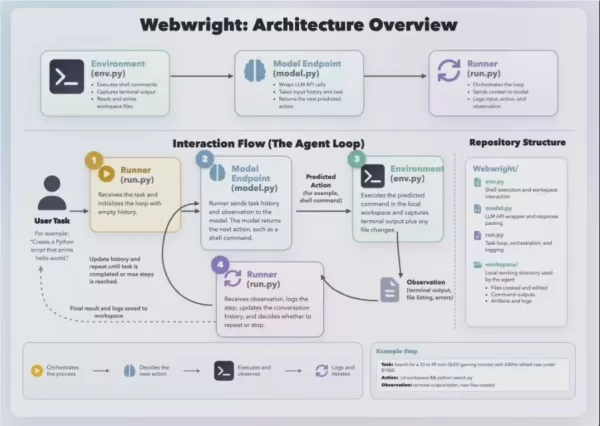
Webwright's design philosophy is straightforward: "One terminal beats thousands of abstractions." The framework consists of roughly 1,000 lines of code split into three core modules, with no complex multi-agent orchestration:
Runner (about 150 lines): Manages the agent loop's core logic, handling context and execution.
Model Endpoint (about 550 lines): A unified interface for model interaction, supporting backends like OpenAI, Anthropic, and OpenRouter.
Terminal Environment (about 300 lines): Provides an isolated terminal execution environment where the model can run Playwright scripts, view logs, analyze screenshots, and debug.
Workflow: The Runner sends the current task context to the model → the model generates a "thought process" and "Shell command" → the environment executes and returns results (output, screenshot, error stack) → the loop continues until the task is complete.
II. Why Shift from "Clicking" to "Writing Code"?
Current mainstream agents operate browsers by constantly predicting "clicks, scrolls, inputs," which leads to efficiency issues and state management challenges. Webwright's code-driven approach offers clear advantages:
Logical Reuse: Each operation generates reusable RPA (Robotic Process Automation) scripts, not one-time click records. These scripts can be reused in other tools like Claude Code or Codex.
Complex Logic Handling: Code naturally supports loops, functions, and branching. For long-chain tasks like form filling, cross-page operations, and conditional jumps, code expression far outperforms simple action stacking.
Engineering Error Correction: By analyzing stack traces after execution errors, the model can autonomously enter a "write code - run - error - fix" iterative cycle, significantly boosting task success rates.
III. Engineering Breakthroughs: Solving "False Success" and "Context Bloat"
Webwright introduces targeted solutions for two common agent pain points:
Gate Self-Check Mechanism: Prevents the model from falsely claiming task completion. The model must first generate a "self-check configuration" and run the final script in a clean environment. Only after self-reflection confirms the task is truly achieved can it output a completion marker.
History Compression: To handle context overload from long trajectories, the system compresses history into a summary every 20 steps, ensuring the context window always focuses on key progress.
IV. Test Performance: Outperforming the Benchmark
In benchmark tests from May 2026, Webwright performed exceptionally well:
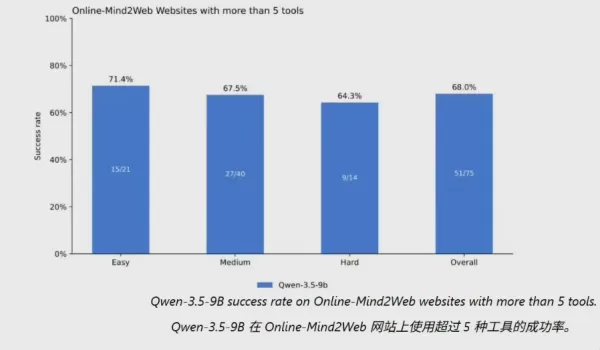
Online-Mind2Web: Webwright based on GPT-5.4 achieved an accuracy of 86.67% within a 100-step budget, ranking among the top open-source solutions.
Odysseys (Long-Chain Tasks): Facing complex instructions averaging 272 words, Webwright + GPT-5.4 scored 60.1%, an increase of about 81.5% compared to base GPT-5.4 (33.5%), surpassing the April leaderboard champion Opus4.6 (44.5%).
Industry Feedback
Webwright's emergence highlights an important trend: as model programming capabilities improve, agents are shifting toward a "developer paradigm." By treating the browser as a programmable endpoint rather than just an interactive interface, Webwright successfully elevates the efficiency and robustness of AI web task execution to a new level.
For developers, Webwright is not just an agent framework—it's a "super employee" that can automatically write, maintain, and package automation scripts. The project is now open source on GitHub.
Related article
 Slackbot Becomes an AI Agent
Slackbot, the automated assistant embedded in Salesforce’s corporate messaging platform Slack, is evolving into an AI agent. Salesforce CTO Parker Harris envisions it achieving viral status comparable to OpenAI’s ChatGPT.The cloud software giant laun
ByteDance Boosts Core AI Incentives as Doubao Surges 14.6%
ByteDance recently convened a DouBao equity briefing to unveil fresh incentive policies for staff involved in the DouBao division. The strike price for DouBao shares has been lifted from $14.85 in June 2026 to $17.02, marking an approximate 14.6% inc
MiniMax Unveils 10x Team Program to Incentivize Global AI Experts
MiniMax (Xiyu Technology), the General Artificial Intelligence Lab, has officially launched "10x Team," a global talent collaboration initiative. This program aims to recruit top experts across industries to explore the deep application of large mode
Related Special Topic Recommendations
Education and Learning
Slackbot Becomes an AI Agent
Slackbot, the automated assistant embedded in Salesforce’s corporate messaging platform Slack, is evolving into an AI agent. Salesforce CTO Parker Harris envisions it achieving viral status comparable to OpenAI’s ChatGPT.The cloud software giant laun
ByteDance Boosts Core AI Incentives as Doubao Surges 14.6%
ByteDance recently convened a DouBao equity briefing to unveil fresh incentive policies for staff involved in the DouBao division. The strike price for DouBao shares has been lifted from $14.85 in June 2026 to $17.02, marking an approximate 14.6% inc
MiniMax Unveils 10x Team Program to Incentivize Global AI Experts
MiniMax (Xiyu Technology), the General Artificial Intelligence Lab, has officially launched "10x Team," a global talent collaboration initiative. This program aims to recruit top experts across industries to explore the deep application of large mode
Related Special Topic Recommendations
Education and Learning
 AI Study Tools for Homework and Exam Prep
2026 Latest Best AI Study Tools for Homework and Exam Prep! XIX.AI curates a top-rated list of powerful, game-changing tools that help students boost productivity, streamline homework completion, and ace exams through real-world tests. Get a free vs paid comparison, detailed rankings, and must-try options to unlock your AI edge. Explore now!
 10 tools
 xix.ai
Music composition
AI Vocal Demo Tools for Songwriters, Hooks, Toplines, and Multilingual Draft Sessions
xix.ai
Music composition
AI Vocal Demo Tools for Songwriters, Hooks, Toplines, and Multilingual Draft Sessions
2026 Latest Best AI Vocal Demo Tools for Songwriters, Hook Creators, and Multi-Language Content Teams! XIX.AI has curated a top-rated list of powerful game-changing tools that go through rigorous real-world tests. You’ll find detailed free vs paid comparison data, comprehensive rankings, and must-try options to help you boost writing efficiency and unlock your creative potential. Explore now to discover your perfect tool for all your content needs!
9 tools
xix.ai
Business
Best AI Competitive Research Tools for Small Businesses
2026 Latest Best Top-rated AI Competitive Research Tools for Small Businesses! XIX.AI has curated a highly powerful game-changing collection, updated weekly with rigorous real-world tests and detailed rankings. You can find a comprehensive free vs paid comparison to help you identify the must-try tools that boost your productivity and give you a competitive edge. Explore now to discover your perfect tool!
9 tools
xix.ai
Image editing
Photoshop AI Retouch Tools for Ecommerce Apparel, Skin Cleanup, and Color Consistency
2026 Latest Best Photoshop AI retouch tools for ecommerce apparel, skin cleanup, and color consistency! This top-rated curated list features powerful game-changing solutions that help you boost writing efficiency, streamline content creation, and achieve perfect visual results effortlessly. Each tool has undergone real-world tests through weekly updated rankings, complete with free vs paid comparison details. Backed by XIX.AI, it’s the must-try guide for anyone aiming to unlock your AI edge. Explore now!
10 tools
xix.ai
Prompt
Best AI Prompt Libraries for ChatGPT Workflows
2026 Latest Best Top-Rated AI Prompt Libraries for optimizing all types of ChatGPT workflows. XIX.AI has curated a powerful, game-changing collection that goes through rigorous real-world tests to ensure top performance. You can find detailed free vs paid comparisons and expert rankings to help you choose the must-try tools that boost your productivity and unlock your AI edge. Explore now!
11 tools
xix.ai
Education and Learning
AI Quiz Builder Platforms for Teachers, Tutors, and Cohort-Based Learning Programs
2026 Latest Best AI Quiz Builder Platforms for Teachers, Tutors, and Cohort-Based Learning Programs! XIX.AI has curated a top-rated list of powerful game-changing tools that go through real-world tests to deliver accurate rankings. These must-try platforms help boost writing efficiency, streamline content creation, and simplify quiz design across all learning scenarios. Explore now to discover your perfect tool for unlocking your AI edge in teaching!
13 tools
xix.ai

 Comments (1)
0/500
Comments (1)
0/500
![WalterWalker]()
Webwrightのオープンソース化、素晴らしい!スクリーンショットやDOMクリックに頼らず、直接Playwrightコードを生成するって発想が面白いね。これならより柔軟な自動化が期待できそう。でも、生成されたコードの品質管理はどうするんだろ?バグが出た時のデバッグコストが心配だけど、技術的にはかなり興味深い試みだと思う。開発者の手腕次第で大きな影響を与えそう。
Microsoft Research recently open-sourced its new web agent framework, Webwright. Instead of relying on the mainstream "screenshot/DOM click" prediction model, this framework lets AI models directly write Playwright code and execute Bash commands in the terminal, completing complex web tasks more efficiently and logically.
I. Core Architecture: A Minimalist "Terminal-First" Approach
Webwright's design philosophy is straightforward: "One terminal beats thousands of abstractions." The framework consists of roughly 1,000 lines of code split into three core modules, with no complex multi-agent orchestration:
Runner (about 150 lines): Manages the agent loop's core logic, handling context and execution.
Model Endpoint (about 550 lines): A unified interface for model interaction, supporting backends like OpenAI, Anthropic, and OpenRouter.
Terminal Environment (about 300 lines): Provides an isolated terminal execution environment where the model can run Playwright scripts, view logs, analyze screenshots, and debug.
Workflow: The Runner sends the current task context to the model → the model generates a "thought process" and "Shell command" → the environment executes and returns results (output, screenshot, error stack) → the loop continues until the task is complete.
II. Why Shift from "Clicking" to "Writing Code"?
Current mainstream agents operate browsers by constantly predicting "clicks, scrolls, inputs," which leads to efficiency issues and state management challenges. Webwright's code-driven approach offers clear advantages:
Logical Reuse: Each operation generates reusable RPA (Robotic Process Automation) scripts, not one-time click records. These scripts can be reused in other tools like Claude Code or Codex.
Complex Logic Handling: Code naturally supports loops, functions, and branching. For long-chain tasks like form filling, cross-page operations, and conditional jumps, code expression far outperforms simple action stacking.
Engineering Error Correction: By analyzing stack traces after execution errors, the model can autonomously enter a "write code - run - error - fix" iterative cycle, significantly boosting task success rates.
III. Engineering Breakthroughs: Solving "False Success" and "Context Bloat"
Webwright introduces targeted solutions for two common agent pain points:
Gate Self-Check Mechanism: Prevents the model from falsely claiming task completion. The model must first generate a "self-check configuration" and run the final script in a clean environment. Only after self-reflection confirms the task is truly achieved can it output a completion marker.
History Compression: To handle context overload from long trajectories, the system compresses history into a summary every 20 steps, ensuring the context window always focuses on key progress.
IV. Test Performance: Outperforming the Benchmark
In benchmark tests from May 2026, Webwright performed exceptionally well:
Online-Mind2Web: Webwright based on GPT-5.4 achieved an accuracy of 86.67% within a 100-step budget, ranking among the top open-source solutions.
Odysseys (Long-Chain Tasks): Facing complex instructions averaging 272 words, Webwright + GPT-5.4 scored 60.1%, an increase of about 81.5% compared to base GPT-5.4 (33.5%), surpassing the April leaderboard champion Opus4.6 (44.5%).
Industry Feedback
Webwright's emergence highlights an important trend: as model programming capabilities improve, agents are shifting toward a "developer paradigm." By treating the browser as a programmable endpoint rather than just an interactive interface, Webwright successfully elevates the efficiency and robustness of AI web task execution to a new level.
For developers, Webwright is not just an agent framework—it's a "super employee" that can automatically write, maintain, and package automation scripts. The project is now open source on GitHub.








 Slackbot Becomes an AI Agent
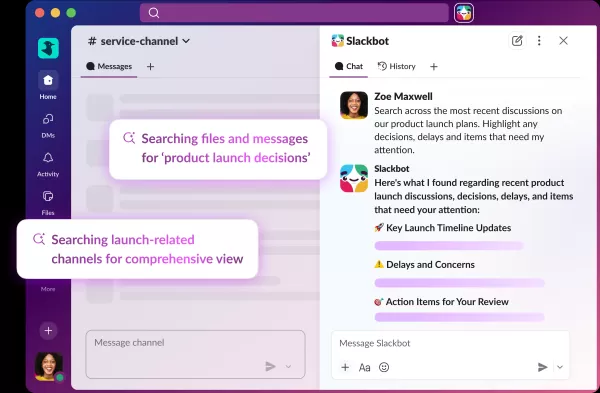
Slackbot, the automated assistant embedded in Salesforce’s corporate messaging platform Slack, is evolving into an AI agent. Salesforce CTO Parker Harris envisions it achieving viral status comparable to OpenAI’s ChatGPT.The cloud software giant laun
Slackbot Becomes an AI Agent
Slackbot, the automated assistant embedded in Salesforce’s corporate messaging platform Slack, is evolving into an AI agent. Salesforce CTO Parker Harris envisions it achieving viral status comparable to OpenAI’s ChatGPT.The cloud software giant laun
 ByteDance Boosts Core AI Incentives as Doubao Surges 14.6%
ByteDance recently convened a DouBao equity briefing to unveil fresh incentive policies for staff involved in the DouBao division. The strike price for DouBao shares has been lifted from $14.85 in June 2026 to $17.02, marking an approximate 14.6% inc
ByteDance Boosts Core AI Incentives as Doubao Surges 14.6%
ByteDance recently convened a DouBao equity briefing to unveil fresh incentive policies for staff involved in the DouBao division. The strike price for DouBao shares has been lifted from $14.85 in June 2026 to $17.02, marking an approximate 14.6% inc
 MiniMax Unveils 10x Team Program to Incentivize Global AI Experts
MiniMax (Xiyu Technology), the General Artificial Intelligence Lab, has officially launched "10x Team," a global talent collaboration initiative. This program aims to recruit top experts across industries to explore the deep application of large mode
MiniMax Unveils 10x Team Program to Incentivize Global AI Experts
MiniMax (Xiyu Technology), the General Artificial Intelligence Lab, has officially launched "10x Team," a global talent collaboration initiative. This program aims to recruit top experts across industries to explore the deep application of large mode

2026 Latest Best AI Study Tools for Homework and Exam Prep! XIX.AI curates a top-rated list of powerful, game-changing tools that help students boost productivity, streamline homework completion, and ace exams through real-world tests. Get a free vs paid comparison, detailed rankings, and must-try options to unlock your AI edge. Explore now!
10 tools
xix.ai

2026 Latest Best AI Vocal Demo Tools for Songwriters, Hook Creators, and Multi-Language Content Teams! XIX.AI has curated a top-rated list of powerful game-changing tools that go through rigorous real-world tests. You’ll find detailed free vs paid comparison data, comprehensive rankings, and must-try options to help you boost writing efficiency and unlock your creative potential. Explore now to discover your perfect tool for all your content needs!
9 tools
xix.ai

2026 Latest Best Top-rated AI Competitive Research Tools for Small Businesses! XIX.AI has curated a highly powerful game-changing collection, updated weekly with rigorous real-world tests and detailed rankings. You can find a comprehensive free vs paid comparison to help you identify the must-try tools that boost your productivity and give you a competitive edge. Explore now to discover your perfect tool!
9 tools
xix.ai

2026 Latest Best Photoshop AI retouch tools for ecommerce apparel, skin cleanup, and color consistency! This top-rated curated list features powerful game-changing solutions that help you boost writing efficiency, streamline content creation, and achieve perfect visual results effortlessly. Each tool has undergone real-world tests through weekly updated rankings, complete with free vs paid comparison details. Backed by XIX.AI, it’s the must-try guide for anyone aiming to unlock your AI edge. Explore now!
10 tools
xix.ai
2026 Latest Best Top-Rated AI Prompt Libraries for optimizing all types of ChatGPT workflows. XIX.AI has curated a powerful, game-changing collection that goes through rigorous real-world tests to ensure top performance. You can find detailed free vs paid comparisons and expert rankings to help you choose the must-try tools that boost your productivity and unlock your AI edge. Explore now!
11 tools
xix.ai

2026 Latest Best AI Quiz Builder Platforms for Teachers, Tutors, and Cohort-Based Learning Programs! XIX.AI has curated a top-rated list of powerful game-changing tools that go through real-world tests to deliver accurate rankings. These must-try platforms help boost writing efficiency, streamline content creation, and simplify quiz design across all learning scenarios. Explore now to discover your perfect tool for unlocking your AI edge in teaching!
13 tools
xix.ai

Webwrightのオープンソース化、素晴らしい!スクリーンショットやDOMクリックに頼らず、直接Playwrightコードを生成するって発想が面白いね。これならより柔軟な自動化が期待できそう。でも、生成されたコードの品質管理はどうするんだろ?バグが出た時のデバッグコストが心配だけど、技術的にはかなり興味深い試みだと思う。開発者の手腕次第で大きな影響を与えそう。












