


 Home
HomeMicrosoft Open-Sources Phi-4-Vision, a Lightweight Multimodal AI Model
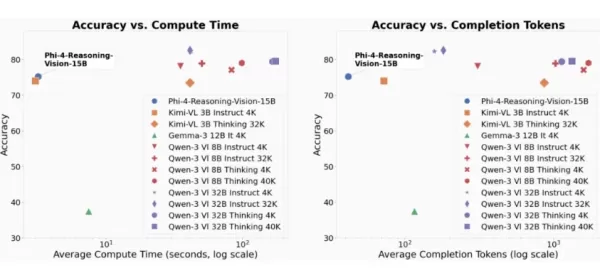
Microsoft has officially open-sourced its latest multi-modal reasoning model, Phi-4-reasoning-vision-15B. With 15 billion parameters, this model strikes an ideal balance between high performance and low cost. Its lightweight architecture makes it a compelling new option for tackling complex visual tasks in resource-limited environments.
A "Compact Powerhouse" Fueled by Refined Data
Unlike typical industry models trained on trillions of tokens, Phi-4-reasoning-vision was developed using only 200 billion multi-modal tokens. The team prioritized data quality through rigorous cleaning of open-source data, generating targeted synthetic data, and carefully calibrating domain-specific data ratios—such as increasing mathematical content to boost computational reasoning. This approach enables excellent performance in scientific reasoning and on-screen element localization tasks.
Innovative Hybrid Reasoning Strategy
A key innovation of this model is its "hybrid reasoning pathway" design:
Perception Tasks: For straightforward tasks like image captioning or OCR, the model defaults to a direct answer mode, optimizing for speed and lower latency.
Reasoning Tasks: When confronted with complex logic, such as interpreting mathematical formulas or scientific charts, it automatically engages a structured chain-of-thought (CoT) process to ensure answer accuracy.
Users can also manually switch between these two modes using specific trigger phrases, adapting the model's behavior to different application needs.
By integrating the SigLIP-2 dynamic resolution encoder, the model excels at perceiving fine details within high-resolution screenshots. This capability positions it as an ideal foundation for developing Computer Usage Agents (CUAs), which can accurately identify and interact with buttons, fields, and other elements on digital interfaces.
Phi-4-reasoning-vision-15B is now available on major open-source platforms. Microsoft envisions that this compact model will demonstrate how "smaller and faster" can also mean "more capable" in the multi-modal domain, helping to advance the adoption of spatial intelligence and real-time interactive technologies.
Related article
 Swedish AI Startup Lovable Eyes $13.2 Billion Valuation After Major Funding Round
As AI-driven coding tools gain traction, Swedish startup Lovable has secured a major funding round. The company aims to raise $3 billion, potentially boosting its valuation to $13.2 billion—double the $6.6 billion recorded last December. Menlo Ventur
Google Tests Remy AI Agent for Gemini as Focus Shifts to User Control
According to Business Insider, Google is testing Remy, a new AI personal agent for Gemini. This tool aims to execute tasks on behalf of users, streamlining both professional workflows and daily routines.Currently, Remy is undergoing testing in an int
How to fix Core Web Vitals for better SEO rankings
Streamline Report Card Comments with AI ToolsIntroductionAI Tools for Generating Report Card CommentsMagic SchoolAlmanac AIChat GPTUsing Magic School to Generate Report Card CommentsLogging into Magic SchoolSelecting the Report Card Comments ToolCust
Related Special Topic Recommendations
writing
Swedish AI Startup Lovable Eyes $13.2 Billion Valuation After Major Funding Round
As AI-driven coding tools gain traction, Swedish startup Lovable has secured a major funding round. The company aims to raise $3 billion, potentially boosting its valuation to $13.2 billion—double the $6.6 billion recorded last December. Menlo Ventur
Google Tests Remy AI Agent for Gemini as Focus Shifts to User Control
According to Business Insider, Google is testing Remy, a new AI personal agent for Gemini. This tool aims to execute tasks on behalf of users, streamlining both professional workflows and daily routines.Currently, Remy is undergoing testing in an int
How to fix Core Web Vitals for better SEO rankings
Streamline Report Card Comments with AI ToolsIntroductionAI Tools for Generating Report Card CommentsMagic SchoolAlmanac AIChat GPTUsing Magic School to Generate Report Card CommentsLogging into Magic SchoolSelecting the Report Card Comments ToolCust
Related Special Topic Recommendations
writing
 Best AI Outline Generators for Long-Form SEO Articles
2026 Latest Best Top-Rated AI Outline Generators for Long-Form SEO Articles, meticulously curated by XIX.AI. These powerful tools offer game-changing assistance in creating high-quality content quickly, boosting writing efficiency significantly. Get a free vs paid comparison along with real-world tests and detailed rankings to help you find the must-try option that suits your needs. Explore now to unlock your AI edge.
 8 tools
 xix.ai
Education and Learning
AI Study Tools for Homework and Exam Prep
xix.ai
Education and Learning
AI Study Tools for Homework and Exam Prep
2026 Latest Best AI Study Tools for Homework and Exam Prep! XIX.AI curates a top-rated list of powerful, game-changing tools that help students boost productivity, streamline homework completion, and ace exams through real-world tests. Get a free vs paid comparison, detailed rankings, and must-try options to unlock your AI edge. Explore now!
10 tools
xix.ai
Music composition
AI Vocal Demo Tools for Songwriters, Hooks, Toplines, and Multilingual Draft Sessions
2026 Latest Best AI Vocal Demo Tools for Songwriters, Hook Creators, and Multi-Language Content Teams! XIX.AI has curated a top-rated list of powerful game-changing tools that go through rigorous real-world tests. You’ll find detailed free vs paid comparison data, comprehensive rankings, and must-try options to help you boost writing efficiency and unlock your creative potential. Explore now to discover your perfect tool for all your content needs!
9 tools
xix.ai
Business
Best AI Competitive Research Tools for Small Businesses
2026 Latest Best Top-rated AI Competitive Research Tools for Small Businesses! XIX.AI has curated a highly powerful game-changing collection, updated weekly with rigorous real-world tests and detailed rankings. You can find a comprehensive free vs paid comparison to help you identify the must-try tools that boost your productivity and give you a competitive edge. Explore now to discover your perfect tool!
9 tools
xix.ai
Image editing
Photoshop AI Retouch Tools for Ecommerce Apparel, Skin Cleanup, and Color Consistency
2026 Latest Best Photoshop AI retouch tools for ecommerce apparel, skin cleanup, and color consistency! This top-rated curated list features powerful game-changing solutions that help you boost writing efficiency, streamline content creation, and achieve perfect visual results effortlessly. Each tool has undergone real-world tests through weekly updated rankings, complete with free vs paid comparison details. Backed by XIX.AI, it’s the must-try guide for anyone aiming to unlock your AI edge. Explore now!
10 tools
xix.ai
Prompt
Best AI Prompt Libraries for ChatGPT Workflows
2026 Latest Best Top-Rated AI Prompt Libraries for optimizing all types of ChatGPT workflows. XIX.AI has curated a powerful, game-changing collection that goes through rigorous real-world tests to ensure top performance. You can find detailed free vs paid comparisons and expert rankings to help you choose the must-try tools that boost your productivity and unlock your AI edge. Explore now!
11 tools
xix.ai

 Comments (1)
0/500
Comments (1)
0/500
![StevenSanchez]()
So Microsoft just dropped Phi-4-Vision as open source? That's a bold move — 15B params and low cost sounds like a sweet spot for startups who can't afford GPT-4. But I wonder: will this actually drive real multimodal apps or just end up as another benchmark-chasing experiment?
Microsoft has officially open-sourced its latest multi-modal reasoning model, Phi-4-reasoning-vision-15B. With 15 billion parameters, this model strikes an ideal balance between high performance and low cost. Its lightweight architecture makes it a compelling new option for tackling complex visual tasks in resource-limited environments.
A "Compact Powerhouse" Fueled by Refined Data
Unlike typical industry models trained on trillions of tokens, Phi-4-reasoning-vision was developed using only 200 billion multi-modal tokens. The team prioritized data quality through rigorous cleaning of open-source data, generating targeted synthetic data, and carefully calibrating domain-specific data ratios—such as increasing mathematical content to boost computational reasoning. This approach enables excellent performance in scientific reasoning and on-screen element localization tasks.
Innovative Hybrid Reasoning Strategy
A key innovation of this model is its "hybrid reasoning pathway" design:
Perception Tasks: For straightforward tasks like image captioning or OCR, the model defaults to a direct answer mode, optimizing for speed and lower latency.
Reasoning Tasks: When confronted with complex logic, such as interpreting mathematical formulas or scientific charts, it automatically engages a structured chain-of-thought (CoT) process to ensure answer accuracy.
Users can also manually switch between these two modes using specific trigger phrases, adapting the model's behavior to different application needs.
By integrating the SigLIP-2 dynamic resolution encoder, the model excels at perceiving fine details within high-resolution screenshots. This capability positions it as an ideal foundation for developing Computer Usage Agents (CUAs), which can accurately identify and interact with buttons, fields, and other elements on digital interfaces.
Phi-4-reasoning-vision-15B is now available on major open-source platforms. Microsoft envisions that this compact model will demonstrate how "smaller and faster" can also mean "more capable" in the multi-modal domain, helping to advance the adoption of spatial intelligence and real-time interactive technologies.








 Swedish AI Startup Lovable Eyes $13.2 Billion Valuation After Major Funding Round
As AI-driven coding tools gain traction, Swedish startup Lovable has secured a major funding round. The company aims to raise $3 billion, potentially boosting its valuation to $13.2 billion—double the $6.6 billion recorded last December. Menlo Ventur
Google Tests Remy AI Agent for Gemini as Focus Shifts to User Control
According to Business Insider, Google is testing Remy, a new AI personal agent for Gemini. This tool aims to execute tasks on behalf of users, streamlining both professional workflows and daily routines.Currently, Remy is undergoing testing in an int
Swedish AI Startup Lovable Eyes $13.2 Billion Valuation After Major Funding Round
As AI-driven coding tools gain traction, Swedish startup Lovable has secured a major funding round. The company aims to raise $3 billion, potentially boosting its valuation to $13.2 billion—double the $6.6 billion recorded last December. Menlo Ventur
Google Tests Remy AI Agent for Gemini as Focus Shifts to User Control
According to Business Insider, Google is testing Remy, a new AI personal agent for Gemini. This tool aims to execute tasks on behalf of users, streamlining both professional workflows and daily routines.Currently, Remy is undergoing testing in an int
 How to fix Core Web Vitals for better SEO rankings
Streamline Report Card Comments with AI ToolsIntroductionAI Tools for Generating Report Card CommentsMagic SchoolAlmanac AIChat GPTUsing Magic School to Generate Report Card CommentsLogging into Magic SchoolSelecting the Report Card Comments ToolCust
How to fix Core Web Vitals for better SEO rankings
Streamline Report Card Comments with AI ToolsIntroductionAI Tools for Generating Report Card CommentsMagic SchoolAlmanac AIChat GPTUsing Magic School to Generate Report Card CommentsLogging into Magic SchoolSelecting the Report Card Comments ToolCust

2026 Latest Best Top-Rated AI Outline Generators for Long-Form SEO Articles, meticulously curated by XIX.AI. These powerful tools offer game-changing assistance in creating high-quality content quickly, boosting writing efficiency significantly. Get a free vs paid comparison along with real-world tests and detailed rankings to help you find the must-try option that suits your needs. Explore now to unlock your AI edge.
8 tools
xix.ai

2026 Latest Best AI Study Tools for Homework and Exam Prep! XIX.AI curates a top-rated list of powerful, game-changing tools that help students boost productivity, streamline homework completion, and ace exams through real-world tests. Get a free vs paid comparison, detailed rankings, and must-try options to unlock your AI edge. Explore now!
10 tools
xix.ai

2026 Latest Best AI Vocal Demo Tools for Songwriters, Hook Creators, and Multi-Language Content Teams! XIX.AI has curated a top-rated list of powerful game-changing tools that go through rigorous real-world tests. You’ll find detailed free vs paid comparison data, comprehensive rankings, and must-try options to help you boost writing efficiency and unlock your creative potential. Explore now to discover your perfect tool for all your content needs!
9 tools
xix.ai

2026 Latest Best Top-rated AI Competitive Research Tools for Small Businesses! XIX.AI has curated a highly powerful game-changing collection, updated weekly with rigorous real-world tests and detailed rankings. You can find a comprehensive free vs paid comparison to help you identify the must-try tools that boost your productivity and give you a competitive edge. Explore now to discover your perfect tool!
9 tools
xix.ai

2026 Latest Best Photoshop AI retouch tools for ecommerce apparel, skin cleanup, and color consistency! This top-rated curated list features powerful game-changing solutions that help you boost writing efficiency, streamline content creation, and achieve perfect visual results effortlessly. Each tool has undergone real-world tests through weekly updated rankings, complete with free vs paid comparison details. Backed by XIX.AI, it’s the must-try guide for anyone aiming to unlock your AI edge. Explore now!
10 tools
xix.ai
2026 Latest Best Top-Rated AI Prompt Libraries for optimizing all types of ChatGPT workflows. XIX.AI has curated a powerful, game-changing collection that goes through rigorous real-world tests to ensure top performance. You can find detailed free vs paid comparisons and expert rankings to help you choose the must-try tools that boost your productivity and unlock your AI edge. Explore now!
11 tools
xix.ai

So Microsoft just dropped Phi-4-Vision as open source? That's a bold move — 15B params and low cost sounds like a sweet spot for startups who can't afford GPT-4. But I wonder: will this actually drive real multimodal apps or just end up as another benchmark-chasing experiment?












