


 Home
HomeMeta Unveils New AI Chip to Challenge NVIDIA's H100 Performance
To reduce its heavy reliance on external AI chip supply chains, social media leader Meta has officially launched its latest generation of in-house AI chips. Dubbed MTIA3, this accelerator not only excels in internal benchmarks, but Meta also claims in an official statement that its inference efficiency surpasses NVIDIA's flagship H100 GPU in specific workloads.
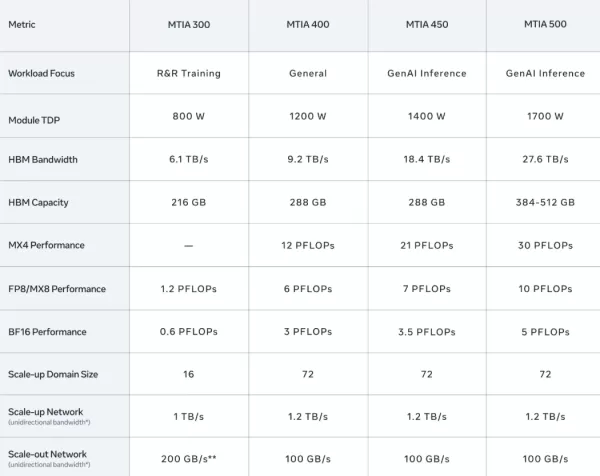
Customization Edge: Built for Recommendation Systems and Inference
Unlike NVIDIA's focus on general-purpose computing, Meta's new chip takes a "deeply customized" path. Its core mission is to optimize the massive recommendation algorithms powering Instagram and Facebook, along with real-time inference for the Llama series of large language models:
Major Gains in Energy Efficiency: By simplifying circuitry for targeted workloads, the MTIA3 consumes far less power than general-purpose GPUs when processing large-scale recommendation models.
Higher Compute Density: The new architecture improves memory bandwidth and interconnect efficiency, enabling a single rack to support more powerful computing clusters than previous setups.
Strategic Shift: From "Buyer" to a "Self-Built Ecosystem"
While Meta remains one of NVIDIA's largest customers, the robust launch of this chip sends a clear signal:
Lowering Operational Costs: Large-scale deployment of in-house chips will progressively cut Meta's enormous annual spending on AI infrastructure.
Hardware-Software Co-Optimization: By deeply integrating its chips with its own PyTorch framework at a foundational level, Meta can deploy the latest AI algorithms faster than its rivals.
Supply Chain Security: Amid tight computing supply, in-house development is Meta's key strategic moat, ensuring its global AI roadmap remains resilient to external disruptions.
Industry Impact: Tech Giants Dive Deeper into Chipmaking
Meta's breakthrough signifies that competition among Silicon Valley titans has fully extended from the software layer down to the transistor level. As the MTIA series continues to evolve, the AI chip market is transitioning from NVIDIA's "unipolar dominance" toward a diversified landscape where general-purpose and custom computing coexist.
Meta's chief scientist, Yann LeCun, stated that hardware autonomy is a necessary step on the path to Artificial General Intelligence (AGI). With the new chip entering mass production, Meta plans to migrate most of its inference workloads to its proprietary platform within the next year—a move poised to reshape the global dynamics of AI infrastructure.
Related article
 U.S. Stocks Hit Historic Milestone as AI and Aerospace Giants Prepare for Trillion-Dollar Debut
Elon Musk, Sam Altman, and Dario Amodei, three titans of the technology sector, are advancing toward initial public offerings for their respective ventures. With SpaceX, OpenAI, and Anthropic—three industry behemoths nearing trillion-dollar valuation
Swedish AI Startup Lovable Eyes $13.2 Billion Valuation After Major Funding Round
As AI-driven coding tools gain traction, Swedish startup Lovable has secured a major funding round. The company aims to raise $3 billion, potentially boosting its valuation to $13.2 billion—double the $6.6 billion recorded last December. Menlo Ventur
Google Tests Remy AI Agent for Gemini as Focus Shifts to User Control
According to Business Insider, Google is testing Remy, a new AI personal agent for Gemini. This tool aims to execute tasks on behalf of users, streamlining both professional workflows and daily routines.Currently, Remy is undergoing testing in an int
Related Special Topic Recommendations
writing
U.S. Stocks Hit Historic Milestone as AI and Aerospace Giants Prepare for Trillion-Dollar Debut
Elon Musk, Sam Altman, and Dario Amodei, three titans of the technology sector, are advancing toward initial public offerings for their respective ventures. With SpaceX, OpenAI, and Anthropic—three industry behemoths nearing trillion-dollar valuation
Swedish AI Startup Lovable Eyes $13.2 Billion Valuation After Major Funding Round
As AI-driven coding tools gain traction, Swedish startup Lovable has secured a major funding round. The company aims to raise $3 billion, potentially boosting its valuation to $13.2 billion—double the $6.6 billion recorded last December. Menlo Ventur
Google Tests Remy AI Agent for Gemini as Focus Shifts to User Control
According to Business Insider, Google is testing Remy, a new AI personal agent for Gemini. This tool aims to execute tasks on behalf of users, streamlining both professional workflows and daily routines.Currently, Remy is undergoing testing in an int
Related Special Topic Recommendations
writing
 Best AI Outline Generators for Long-Form SEO Articles
2026 Latest Best Top-Rated AI Outline Generators for Long-Form SEO Articles, meticulously curated by XIX.AI. These powerful tools offer game-changing assistance in creating high-quality content quickly, boosting writing efficiency significantly. Get a free vs paid comparison along with real-world tests and detailed rankings to help you find the must-try option that suits your needs. Explore now to unlock your AI edge.
 8 tools
 xix.ai
Education and Learning
AI Study Tools for Homework and Exam Prep
xix.ai
Education and Learning
AI Study Tools for Homework and Exam Prep
2026 Latest Best AI Study Tools for Homework and Exam Prep! XIX.AI curates a top-rated list of powerful, game-changing tools that help students boost productivity, streamline homework completion, and ace exams through real-world tests. Get a free vs paid comparison, detailed rankings, and must-try options to unlock your AI edge. Explore now!
10 tools
xix.ai
Music composition
AI Vocal Demo Tools for Songwriters, Hooks, Toplines, and Multilingual Draft Sessions
2026 Latest Best AI Vocal Demo Tools for Songwriters, Hook Creators, and Multi-Language Content Teams! XIX.AI has curated a top-rated list of powerful game-changing tools that go through rigorous real-world tests. You’ll find detailed free vs paid comparison data, comprehensive rankings, and must-try options to help you boost writing efficiency and unlock your creative potential. Explore now to discover your perfect tool for all your content needs!
9 tools
xix.ai
Business
Best AI Competitive Research Tools for Small Businesses
2026 Latest Best Top-rated AI Competitive Research Tools for Small Businesses! XIX.AI has curated a highly powerful game-changing collection, updated weekly with rigorous real-world tests and detailed rankings. You can find a comprehensive free vs paid comparison to help you identify the must-try tools that boost your productivity and give you a competitive edge. Explore now to discover your perfect tool!
9 tools
xix.ai
Image editing
Photoshop AI Retouch Tools for Ecommerce Apparel, Skin Cleanup, and Color Consistency
2026 Latest Best Photoshop AI retouch tools for ecommerce apparel, skin cleanup, and color consistency! This top-rated curated list features powerful game-changing solutions that help you boost writing efficiency, streamline content creation, and achieve perfect visual results effortlessly. Each tool has undergone real-world tests through weekly updated rankings, complete with free vs paid comparison details. Backed by XIX.AI, it’s the must-try guide for anyone aiming to unlock your AI edge. Explore now!
10 tools
xix.ai
Prompt
Best AI Prompt Libraries for ChatGPT Workflows
2026 Latest Best Top-Rated AI Prompt Libraries for optimizing all types of ChatGPT workflows. XIX.AI has curated a powerful, game-changing collection that goes through rigorous real-world tests to ensure top performance. You can find detailed free vs paid comparisons and expert rankings to help you choose the must-try tools that boost your productivity and unlock your AI edge. Explore now!
11 tools
xix.ai

 Comments (2)
0/500
Comments (2)
0/500
![KeithNelson]()
So Meta thinks they can just waltz in and take on NVIDIA? The H100 is a beast, but let's see if MTIA3 actually delivers in real-world workloads. Benchmarks are one thing, production scalability is another. Also, internal chip development sounds expensive—hope they don't just burn cash. 😅
![DonaldJackson]()
So Meta thinks they can just whip up a chip to beat NVIDIA? I'll believe it when I see real-world benchmarks, not just internal ones. 😏
To reduce its heavy reliance on external AI chip supply chains, social media leader Meta has officially launched its latest generation of in-house AI chips. Dubbed MTIA3, this accelerator not only excels in internal benchmarks, but Meta also claims in an official statement that its inference efficiency surpasses NVIDIA's flagship H100 GPU in specific workloads.
Customization Edge: Built for Recommendation Systems and Inference
Unlike NVIDIA's focus on general-purpose computing, Meta's new chip takes a "deeply customized" path. Its core mission is to optimize the massive recommendation algorithms powering Instagram and Facebook, along with real-time inference for the Llama series of large language models:
Major Gains in Energy Efficiency: By simplifying circuitry for targeted workloads, the MTIA3 consumes far less power than general-purpose GPUs when processing large-scale recommendation models.
Higher Compute Density: The new architecture improves memory bandwidth and interconnect efficiency, enabling a single rack to support more powerful computing clusters than previous setups.
Strategic Shift: From "Buyer" to a "Self-Built Ecosystem"
While Meta remains one of NVIDIA's largest customers, the robust launch of this chip sends a clear signal:
Lowering Operational Costs: Large-scale deployment of in-house chips will progressively cut Meta's enormous annual spending on AI infrastructure.
Hardware-Software Co-Optimization: By deeply integrating its chips with its own PyTorch framework at a foundational level, Meta can deploy the latest AI algorithms faster than its rivals.
Supply Chain Security: Amid tight computing supply, in-house development is Meta's key strategic moat, ensuring its global AI roadmap remains resilient to external disruptions.
Industry Impact: Tech Giants Dive Deeper into Chipmaking
Meta's breakthrough signifies that competition among Silicon Valley titans has fully extended from the software layer down to the transistor level. As the MTIA series continues to evolve, the AI chip market is transitioning from NVIDIA's "unipolar dominance" toward a diversified landscape where general-purpose and custom computing coexist.
Meta's chief scientist, Yann LeCun, stated that hardware autonomy is a necessary step on the path to Artificial General Intelligence (AGI). With the new chip entering mass production, Meta plans to migrate most of its inference workloads to its proprietary platform within the next year—a move poised to reshape the global dynamics of AI infrastructure.








 U.S. Stocks Hit Historic Milestone as AI and Aerospace Giants Prepare for Trillion-Dollar Debut
Elon Musk, Sam Altman, and Dario Amodei, three titans of the technology sector, are advancing toward initial public offerings for their respective ventures. With SpaceX, OpenAI, and Anthropic—three industry behemoths nearing trillion-dollar valuation
U.S. Stocks Hit Historic Milestone as AI and Aerospace Giants Prepare for Trillion-Dollar Debut
Elon Musk, Sam Altman, and Dario Amodei, three titans of the technology sector, are advancing toward initial public offerings for their respective ventures. With SpaceX, OpenAI, and Anthropic—three industry behemoths nearing trillion-dollar valuation
 Swedish AI Startup Lovable Eyes $13.2 Billion Valuation After Major Funding Round
As AI-driven coding tools gain traction, Swedish startup Lovable has secured a major funding round. The company aims to raise $3 billion, potentially boosting its valuation to $13.2 billion—double the $6.6 billion recorded last December. Menlo Ventur
Google Tests Remy AI Agent for Gemini as Focus Shifts to User Control
According to Business Insider, Google is testing Remy, a new AI personal agent for Gemini. This tool aims to execute tasks on behalf of users, streamlining both professional workflows and daily routines.Currently, Remy is undergoing testing in an int
Swedish AI Startup Lovable Eyes $13.2 Billion Valuation After Major Funding Round
As AI-driven coding tools gain traction, Swedish startup Lovable has secured a major funding round. The company aims to raise $3 billion, potentially boosting its valuation to $13.2 billion—double the $6.6 billion recorded last December. Menlo Ventur
Google Tests Remy AI Agent for Gemini as Focus Shifts to User Control
According to Business Insider, Google is testing Remy, a new AI personal agent for Gemini. This tool aims to execute tasks on behalf of users, streamlining both professional workflows and daily routines.Currently, Remy is undergoing testing in an int

2026 Latest Best Top-Rated AI Outline Generators for Long-Form SEO Articles, meticulously curated by XIX.AI. These powerful tools offer game-changing assistance in creating high-quality content quickly, boosting writing efficiency significantly. Get a free vs paid comparison along with real-world tests and detailed rankings to help you find the must-try option that suits your needs. Explore now to unlock your AI edge.
8 tools
xix.ai

2026 Latest Best AI Study Tools for Homework and Exam Prep! XIX.AI curates a top-rated list of powerful, game-changing tools that help students boost productivity, streamline homework completion, and ace exams through real-world tests. Get a free vs paid comparison, detailed rankings, and must-try options to unlock your AI edge. Explore now!
10 tools
xix.ai

2026 Latest Best AI Vocal Demo Tools for Songwriters, Hook Creators, and Multi-Language Content Teams! XIX.AI has curated a top-rated list of powerful game-changing tools that go through rigorous real-world tests. You’ll find detailed free vs paid comparison data, comprehensive rankings, and must-try options to help you boost writing efficiency and unlock your creative potential. Explore now to discover your perfect tool for all your content needs!
9 tools
xix.ai

2026 Latest Best Top-rated AI Competitive Research Tools for Small Businesses! XIX.AI has curated a highly powerful game-changing collection, updated weekly with rigorous real-world tests and detailed rankings. You can find a comprehensive free vs paid comparison to help you identify the must-try tools that boost your productivity and give you a competitive edge. Explore now to discover your perfect tool!
9 tools
xix.ai

2026 Latest Best Photoshop AI retouch tools for ecommerce apparel, skin cleanup, and color consistency! This top-rated curated list features powerful game-changing solutions that help you boost writing efficiency, streamline content creation, and achieve perfect visual results effortlessly. Each tool has undergone real-world tests through weekly updated rankings, complete with free vs paid comparison details. Backed by XIX.AI, it’s the must-try guide for anyone aiming to unlock your AI edge. Explore now!
10 tools
xix.ai

2026 Latest Best Top-Rated AI Prompt Libraries for optimizing all types of ChatGPT workflows. XIX.AI has curated a powerful, game-changing collection that goes through rigorous real-world tests to ensure top performance. You can find detailed free vs paid comparisons and expert rankings to help you choose the must-try tools that boost your productivity and unlock your AI edge. Explore now!
11 tools
xix.ai

So Meta thinks they can just waltz in and take on NVIDIA? The H100 is a beast, but let's see if MTIA3 actually delivers in real-world workloads. Benchmarks are one thing, production scalability is another. Also, internal chip development sounds expensive—hope they don't just burn cash. 😅
So Meta thinks they can just whip up a chip to beat NVIDIA? I'll believe it when I see real-world benchmarks, not just internal ones. 😏












