


 Home
HomeMeituan Open-Source Audio Model Sets New Voice Cloning Benchmark
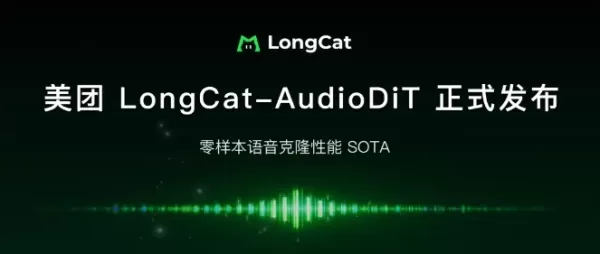
Audio generation is experiencing a fundamental shift from multi-stage cascade architectures to end-to-end models. To overcome the information loss and error accumulation inherent in the traditional "Mel spectrogram" intermediate representation used in TTS systems, the Meituan LongCat team has officially released and open-sourced LongCat-AudioDiT (available in 1B and 3.5B parameter versions). This model successfully surpasses previous performance limits in zero-shot voice cloning by performing direct waveform latent space modeling.
Core Architecture: Moving Beyond Mel Spectrograms
LongCat-AudioDiT discards the conventional multi-stage pipeline of "acoustic feature prediction + neural vocoder," establishing instead a streamlined minimal architecture built upon a Wav-VAE (Waveform Variational Autoencoder) and a DiT (Diffusion Transformer).
Efficient Wav-VAE: Utilizing a fully convolutional design, it compresses 24kHz waveforms by a factor of 2000x to an 11.7Hz frame rate. Through non-parametric shortcut branches and multi-objective adversarial training, it ensures the reconstructed waveform maintains precise time-frequency structure while delivering excellent natural listening quality.
Semantic-Enhanced DiT: The model innovatively fuses the original word embeddings from the UMT5 text encoder with its top-level hidden states. This compensates for phonetic details lost in high-level semantic representations, significantly boosting the intelligibility of the generated speech.
Inference Optimization: Precisely Correcting Voice Drift
To further enhance generation quality, the team implemented two critical technical refinements:
Dual Constraint Mechanism: This technique identifies and corrects the persistent "training-inference mismatch" problem in flow-matching TTS. By forcibly resetting the latent variables in the prompt area during inference, it completely resolves issues of speaker voice drift and instability.
Adaptive Projection Guidance (APG): APG replaces traditional classifier-free guidance (CFG). It can accurately filter beneficial components within the guidance signal while suppressing components that cause audio degradation, significantly improving speech naturalness without inducing spectral "over-saturation."
Performance: SOTA-Level Cloning Accuracy
In benchmark tests on the Seed dataset, LongCat-AudioDiT demonstrates dominant performance:
Similarity (SIM): The 3.5B model achieved a score of 0.818 on the Seed-ZH test set and 0.797 on the challenging Seed-Hard sentence set, outperforming notable models like Seed-TTS, CosyVoice3.5, and MiniMax-Speech.
Accuracy: It ranks among the industry's top performers across key metrics, including an English WER of 1.50% and a Chinese difficult sentence CER of 6.04%.
Remarkably, LongCat-AudioDiT achieves superior results compared to multi-stage trained models using only single-stage training on pre-processed ASR transcription data. The associated research paper, source code, and model weights are now fully open-sourced and available on GitHub and HuggingFace.
Project Links:
GitHub: https://github.com/meituan-longcat/LongCat-AudioDiT
HuggingFace: https://huggingface.co/meituan-longcat/LongCat-AudioDiT
Related article
 Swedish AI Startup Lovable Eyes $13.2 Billion Valuation After Major Funding Round
As AI-driven coding tools gain traction, Swedish startup Lovable has secured a major funding round. The company aims to raise $3 billion, potentially boosting its valuation to $13.2 billion—double the $6.6 billion recorded last December. Menlo Ventur
Google Tests Remy AI Agent for Gemini as Focus Shifts to User Control
According to Business Insider, Google is testing Remy, a new AI personal agent for Gemini. This tool aims to execute tasks on behalf of users, streamlining both professional workflows and daily routines.Currently, Remy is undergoing testing in an int
How to fix Core Web Vitals for better SEO rankings
Streamline Report Card Comments with AI ToolsIntroductionAI Tools for Generating Report Card CommentsMagic SchoolAlmanac AIChat GPTUsing Magic School to Generate Report Card CommentsLogging into Magic SchoolSelecting the Report Card Comments ToolCust
Related Special Topic Recommendations
writing
Swedish AI Startup Lovable Eyes $13.2 Billion Valuation After Major Funding Round
As AI-driven coding tools gain traction, Swedish startup Lovable has secured a major funding round. The company aims to raise $3 billion, potentially boosting its valuation to $13.2 billion—double the $6.6 billion recorded last December. Menlo Ventur
Google Tests Remy AI Agent for Gemini as Focus Shifts to User Control
According to Business Insider, Google is testing Remy, a new AI personal agent for Gemini. This tool aims to execute tasks on behalf of users, streamlining both professional workflows and daily routines.Currently, Remy is undergoing testing in an int
How to fix Core Web Vitals for better SEO rankings
Streamline Report Card Comments with AI ToolsIntroductionAI Tools for Generating Report Card CommentsMagic SchoolAlmanac AIChat GPTUsing Magic School to Generate Report Card CommentsLogging into Magic SchoolSelecting the Report Card Comments ToolCust
Related Special Topic Recommendations
writing
 Best AI Outline Generators for Long-Form SEO Articles
2026 Latest Best Top-Rated AI Outline Generators for Long-Form SEO Articles, meticulously curated by XIX.AI. These powerful tools offer game-changing assistance in creating high-quality content quickly, boosting writing efficiency significantly. Get a free vs paid comparison along with real-world tests and detailed rankings to help you find the must-try option that suits your needs. Explore now to unlock your AI edge.
 8 tools
 xix.ai
Education and Learning
AI Study Tools for Homework and Exam Prep
xix.ai
Education and Learning
AI Study Tools for Homework and Exam Prep
2026 Latest Best AI Study Tools for Homework and Exam Prep! XIX.AI curates a top-rated list of powerful, game-changing tools that help students boost productivity, streamline homework completion, and ace exams through real-world tests. Get a free vs paid comparison, detailed rankings, and must-try options to unlock your AI edge. Explore now!
10 tools
xix.ai
Music composition
AI Vocal Demo Tools for Songwriters, Hooks, Toplines, and Multilingual Draft Sessions
2026 Latest Best AI Vocal Demo Tools for Songwriters, Hook Creators, and Multi-Language Content Teams! XIX.AI has curated a top-rated list of powerful game-changing tools that go through rigorous real-world tests. You’ll find detailed free vs paid comparison data, comprehensive rankings, and must-try options to help you boost writing efficiency and unlock your creative potential. Explore now to discover your perfect tool for all your content needs!
9 tools
xix.ai
Business
Best AI Competitive Research Tools for Small Businesses
2026 Latest Best Top-rated AI Competitive Research Tools for Small Businesses! XIX.AI has curated a highly powerful game-changing collection, updated weekly with rigorous real-world tests and detailed rankings. You can find a comprehensive free vs paid comparison to help you identify the must-try tools that boost your productivity and give you a competitive edge. Explore now to discover your perfect tool!
9 tools
xix.ai
Image editing
Photoshop AI Retouch Tools for Ecommerce Apparel, Skin Cleanup, and Color Consistency
2026 Latest Best Photoshop AI retouch tools for ecommerce apparel, skin cleanup, and color consistency! This top-rated curated list features powerful game-changing solutions that help you boost writing efficiency, streamline content creation, and achieve perfect visual results effortlessly. Each tool has undergone real-world tests through weekly updated rankings, complete with free vs paid comparison details. Backed by XIX.AI, it’s the must-try guide for anyone aiming to unlock your AI edge. Explore now!
10 tools
xix.ai
Prompt
Best AI Prompt Libraries for ChatGPT Workflows
2026 Latest Best Top-Rated AI Prompt Libraries for optimizing all types of ChatGPT workflows. XIX.AI has curated a powerful, game-changing collection that goes through rigorous real-world tests to ensure top performance. You can find detailed free vs paid comparisons and expert rankings to help you choose the must-try tools that boost your productivity and unlock your AI edge. Explore now!
11 tools
xix.ai

 Comments (1)
0/500
Comments (1)
0/500
![FredGreen]()
Honestly, the switch from multi-stage cascades to end-to-end models in audio generation sounds like a huge leap forward. But I'm wondering—how do they ensure the cloned voice doesn't pick up weird artifacts or biases from the training data? Also, open-sourcing it is cool, but I hope they've thought about potential misuse, like deepfake audio scams. 😅
Audio generation is experiencing a fundamental shift from multi-stage cascade architectures to end-to-end models. To overcome the information loss and error accumulation inherent in the traditional "Mel spectrogram" intermediate representation used in TTS systems, the Meituan LongCat team has officially released and open-sourced LongCat-AudioDiT (available in 1B and 3.5B parameter versions). This model successfully surpasses previous performance limits in zero-shot voice cloning by performing direct waveform latent space modeling.
Core Architecture: Moving Beyond Mel Spectrograms
LongCat-AudioDiT discards the conventional multi-stage pipeline of "acoustic feature prediction + neural vocoder," establishing instead a streamlined minimal architecture built upon a Wav-VAE (Waveform Variational Autoencoder) and a DiT (Diffusion Transformer).
Efficient Wav-VAE: Utilizing a fully convolutional design, it compresses 24kHz waveforms by a factor of 2000x to an 11.7Hz frame rate. Through non-parametric shortcut branches and multi-objective adversarial training, it ensures the reconstructed waveform maintains precise time-frequency structure while delivering excellent natural listening quality.
Semantic-Enhanced DiT: The model innovatively fuses the original word embeddings from the UMT5 text encoder with its top-level hidden states. This compensates for phonetic details lost in high-level semantic representations, significantly boosting the intelligibility of the generated speech.
Inference Optimization: Precisely Correcting Voice Drift
To further enhance generation quality, the team implemented two critical technical refinements:
Dual Constraint Mechanism: This technique identifies and corrects the persistent "training-inference mismatch" problem in flow-matching TTS. By forcibly resetting the latent variables in the prompt area during inference, it completely resolves issues of speaker voice drift and instability.
Adaptive Projection Guidance (APG): APG replaces traditional classifier-free guidance (CFG). It can accurately filter beneficial components within the guidance signal while suppressing components that cause audio degradation, significantly improving speech naturalness without inducing spectral "over-saturation."
Performance: SOTA-Level Cloning Accuracy
In benchmark tests on the Seed dataset, LongCat-AudioDiT demonstrates dominant performance:
Similarity (SIM): The 3.5B model achieved a score of 0.818 on the Seed-ZH test set and 0.797 on the challenging Seed-Hard sentence set, outperforming notable models like Seed-TTS, CosyVoice3.5, and MiniMax-Speech.
Accuracy: It ranks among the industry's top performers across key metrics, including an English WER of 1.50% and a Chinese difficult sentence CER of 6.04%.
Remarkably, LongCat-AudioDiT achieves superior results compared to multi-stage trained models using only single-stage training on pre-processed ASR transcription data. The associated research paper, source code, and model weights are now fully open-sourced and available on GitHub and HuggingFace.
Project Links:
GitHub: https://github.com/meituan-longcat/LongCat-AudioDiT
HuggingFace: https://huggingface.co/meituan-longcat/LongCat-AudioDiT








 Swedish AI Startup Lovable Eyes $13.2 Billion Valuation After Major Funding Round
As AI-driven coding tools gain traction, Swedish startup Lovable has secured a major funding round. The company aims to raise $3 billion, potentially boosting its valuation to $13.2 billion—double the $6.6 billion recorded last December. Menlo Ventur
Google Tests Remy AI Agent for Gemini as Focus Shifts to User Control
According to Business Insider, Google is testing Remy, a new AI personal agent for Gemini. This tool aims to execute tasks on behalf of users, streamlining both professional workflows and daily routines.Currently, Remy is undergoing testing in an int
Swedish AI Startup Lovable Eyes $13.2 Billion Valuation After Major Funding Round
As AI-driven coding tools gain traction, Swedish startup Lovable has secured a major funding round. The company aims to raise $3 billion, potentially boosting its valuation to $13.2 billion—double the $6.6 billion recorded last December. Menlo Ventur
Google Tests Remy AI Agent for Gemini as Focus Shifts to User Control
According to Business Insider, Google is testing Remy, a new AI personal agent for Gemini. This tool aims to execute tasks on behalf of users, streamlining both professional workflows and daily routines.Currently, Remy is undergoing testing in an int
 How to fix Core Web Vitals for better SEO rankings
Streamline Report Card Comments with AI ToolsIntroductionAI Tools for Generating Report Card CommentsMagic SchoolAlmanac AIChat GPTUsing Magic School to Generate Report Card CommentsLogging into Magic SchoolSelecting the Report Card Comments ToolCust
How to fix Core Web Vitals for better SEO rankings
Streamline Report Card Comments with AI ToolsIntroductionAI Tools for Generating Report Card CommentsMagic SchoolAlmanac AIChat GPTUsing Magic School to Generate Report Card CommentsLogging into Magic SchoolSelecting the Report Card Comments ToolCust

2026 Latest Best Top-Rated AI Outline Generators for Long-Form SEO Articles, meticulously curated by XIX.AI. These powerful tools offer game-changing assistance in creating high-quality content quickly, boosting writing efficiency significantly. Get a free vs paid comparison along with real-world tests and detailed rankings to help you find the must-try option that suits your needs. Explore now to unlock your AI edge.
8 tools
xix.ai

2026 Latest Best AI Study Tools for Homework and Exam Prep! XIX.AI curates a top-rated list of powerful, game-changing tools that help students boost productivity, streamline homework completion, and ace exams through real-world tests. Get a free vs paid comparison, detailed rankings, and must-try options to unlock your AI edge. Explore now!
10 tools
xix.ai

2026 Latest Best AI Vocal Demo Tools for Songwriters, Hook Creators, and Multi-Language Content Teams! XIX.AI has curated a top-rated list of powerful game-changing tools that go through rigorous real-world tests. You’ll find detailed free vs paid comparison data, comprehensive rankings, and must-try options to help you boost writing efficiency and unlock your creative potential. Explore now to discover your perfect tool for all your content needs!
9 tools
xix.ai

2026 Latest Best Top-rated AI Competitive Research Tools for Small Businesses! XIX.AI has curated a highly powerful game-changing collection, updated weekly with rigorous real-world tests and detailed rankings. You can find a comprehensive free vs paid comparison to help you identify the must-try tools that boost your productivity and give you a competitive edge. Explore now to discover your perfect tool!
9 tools
xix.ai

2026 Latest Best Photoshop AI retouch tools for ecommerce apparel, skin cleanup, and color consistency! This top-rated curated list features powerful game-changing solutions that help you boost writing efficiency, streamline content creation, and achieve perfect visual results effortlessly. Each tool has undergone real-world tests through weekly updated rankings, complete with free vs paid comparison details. Backed by XIX.AI, it’s the must-try guide for anyone aiming to unlock your AI edge. Explore now!
10 tools
xix.ai
2026 Latest Best Top-Rated AI Prompt Libraries for optimizing all types of ChatGPT workflows. XIX.AI has curated a powerful, game-changing collection that goes through rigorous real-world tests to ensure top performance. You can find detailed free vs paid comparisons and expert rankings to help you choose the must-try tools that boost your productivity and unlock your AI edge. Explore now!
11 tools
xix.ai

Honestly, the switch from multi-stage cascades to end-to-end models in audio generation sounds like a huge leap forward. But I'm wondering—how do they ensure the cloned voice doesn't pick up weird artifacts or biases from the training data? Also, open-sourcing it is cool, but I hope they've thought about potential misuse, like deepfake audio scams. 😅












