


 Home
HomeMateClaw v1.5.0 delivers engineering-ready workflows for open-source AI agent runtime
Recently, the open-source AI Agent Runtime framework MateClaw released version 1.5.0. Rather than simply expanding the number of integrated models, this update focused on strengthening the essential infrastructure needed for Agents to work effectively in real-world teams. Its core improvements centered on three key areas: goal acceptability, knowledge base consistency, and multi-user memory isolation.
In real business settings, traditional agents often relied on a vague "completion score" to gauge task progress, leaving managers unable to pinpoint where a task was blocked. To solve this opacity, MateClaw v1.5.0 introduced a "Goal Checklist" mechanism. This mechanism enables the system or running large models to dynamically break down a macro goal into multiple independent verification criteria. A built-in evaluator then checks each criterion at various stages and logs corresponding evidence. Only when every item on the checklist is passed does the system mark the task as complete. This digital checklist makes task boundaries clearer while providing precise contextual input for automated agent follow-up.
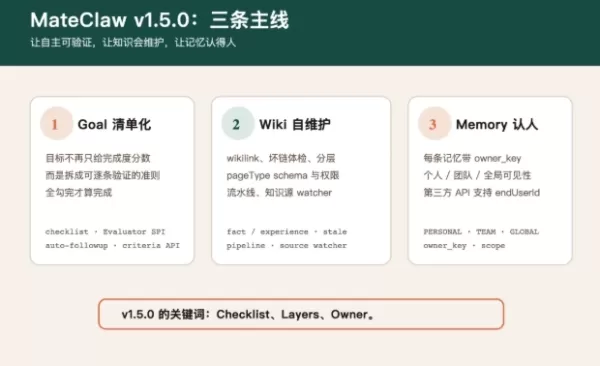
As the most significant engineering effort in this release, MateClaw evolved the traditional knowledge base (LLM Wiki) into a self-maintaining "Knowledge Engine." It now supports wiki-link functionality akin to Wikipedia, including cascading page renames, deletion cleanup, and broken link scanning to preserve consistency. More notably, the new system introduces a "knowledge hierarchy" that splits content into basic fact layers and experience summary layers. When a base "fact page" changes, all dependent "experience pages" are automatically flagged for review, addressing the classic problem of "facts changed, conclusions outdated." Additionally, the PageType Profile feature lets administrators configure structured fields and Markdown templates for each page type, and enforce fail-safe, fine-grained access control based on an "employee + knowledge base + page type" matrix.

To help AI agents integrate safely into multi-user collaboration environments, MateClaw v1.5.0 fully activated the multi-user memory isolation (Memory per-owner) feature. At its core, the system uses owner identifiers (owner_key) and three visibility scopes to ensure that the same agent serving multiple users through a web console, instant messaging (IM) channels, or third-party APIs never mixes personal privacy data or long-term memory.
In addition to these three main features, the new version delivers a series of production stability improvements. These include allowing employees to bind to a default Wiki knowledge base, optimizing the model selection chain so that preference provider routing works as intended, and adding a new Claude Opus4.8 model entry. On the engineering side, multimedia files generated by tools are now stored securely and automatically cleaned up via scheduled tasks. The MCP tool's default read timeout has been extended to 60 seconds to reduce false positives. Meanwhile, WeChat, Enterprise WeChat, and Feishu channels now feature a unified inbound media pipeline that determines file types using feature codes and implements exponential backoff retries, significantly improving the reliability of complex file interactions in group chats. The upgrade configuration of this version is fully compatible with historical data, and migrations are automatically executed by Flyway, accelerating AI agents' transition toward true industrial-level deployment.
Related article
 U.S. Stocks Hit Historic Milestone as AI and Aerospace Giants Prepare for Trillion-Dollar Debut
Elon Musk, Sam Altman, and Dario Amodei, three titans of the technology sector, are advancing toward initial public offerings for their respective ventures. With SpaceX, OpenAI, and Anthropic—three industry behemoths nearing trillion-dollar valuation
Swedish AI Startup Lovable Eyes $13.2 Billion Valuation After Major Funding Round
As AI-driven coding tools gain traction, Swedish startup Lovable has secured a major funding round. The company aims to raise $3 billion, potentially boosting its valuation to $13.2 billion—double the $6.6 billion recorded last December. Menlo Ventur
Google Tests Remy AI Agent for Gemini as Focus Shifts to User Control
According to Business Insider, Google is testing Remy, a new AI personal agent for Gemini. This tool aims to execute tasks on behalf of users, streamlining both professional workflows and daily routines.Currently, Remy is undergoing testing in an int
Related Special Topic Recommendations
Data Analysis
U.S. Stocks Hit Historic Milestone as AI and Aerospace Giants Prepare for Trillion-Dollar Debut
Elon Musk, Sam Altman, and Dario Amodei, three titans of the technology sector, are advancing toward initial public offerings for their respective ventures. With SpaceX, OpenAI, and Anthropic—three industry behemoths nearing trillion-dollar valuation
Swedish AI Startup Lovable Eyes $13.2 Billion Valuation After Major Funding Round
As AI-driven coding tools gain traction, Swedish startup Lovable has secured a major funding round. The company aims to raise $3 billion, potentially boosting its valuation to $13.2 billion—double the $6.6 billion recorded last December. Menlo Ventur
Google Tests Remy AI Agent for Gemini as Focus Shifts to User Control
According to Business Insider, Google is testing Remy, a new AI personal agent for Gemini. This tool aims to execute tasks on behalf of users, streamlining both professional workflows and daily routines.Currently, Remy is undergoing testing in an int
Related Special Topic Recommendations
Data Analysis
 Best AI Anomaly Detection Tools for KPI Monitoring across SaaS and Ecommerce Teams
2026 Latest Best Top-rated AI Anomaly Detection Tools for KPI Monitoring in SaaS and Ecommerce teams! XIX.AI has curated a powerful, game-changing collection based on rigorous real-world tests and weekly updated rankings. You’ll find detailed free vs paid comparison insights to help you identify the must-try solution that boosts productivity and unlocks your AI edge. Explore now!
 10 tools
 xix.ai
writing
Best AI Outline Generators for Long-Form SEO Articles
xix.ai
writing
Best AI Outline Generators for Long-Form SEO Articles
2026 Latest Best Top-Rated AI Outline Generators for Long-Form SEO Articles, meticulously curated by XIX.AI. These powerful tools offer game-changing assistance in creating high-quality content quickly, boosting writing efficiency significantly. Get a free vs paid comparison along with real-world tests and detailed rankings to help you find the must-try option that suits your needs. Explore now to unlock your AI edge.
8 tools
xix.ai
Education and Learning
AI Study Tools for Homework and Exam Prep
2026 Latest Best AI Study Tools for Homework and Exam Prep! XIX.AI curates a top-rated list of powerful, game-changing tools that help students boost productivity, streamline homework completion, and ace exams through real-world tests. Get a free vs paid comparison, detailed rankings, and must-try options to unlock your AI edge. Explore now!
10 tools
xix.ai
Music composition
AI Vocal Demo Tools for Songwriters, Hooks, Toplines, and Multilingual Draft Sessions
2026 Latest Best AI Vocal Demo Tools for Songwriters, Hook Creators, and Multi-Language Content Teams! XIX.AI has curated a top-rated list of powerful game-changing tools that go through rigorous real-world tests. You’ll find detailed free vs paid comparison data, comprehensive rankings, and must-try options to help you boost writing efficiency and unlock your creative potential. Explore now to discover your perfect tool for all your content needs!
9 tools
xix.ai
Business
Best AI Competitive Research Tools for Small Businesses
2026 Latest Best Top-rated AI Competitive Research Tools for Small Businesses! XIX.AI has curated a highly powerful game-changing collection, updated weekly with rigorous real-world tests and detailed rankings. You can find a comprehensive free vs paid comparison to help you identify the must-try tools that boost your productivity and give you a competitive edge. Explore now to discover your perfect tool!
9 tools
xix.ai
Image editing
Photoshop AI Retouch Tools for Ecommerce Apparel, Skin Cleanup, and Color Consistency
2026 Latest Best Photoshop AI retouch tools for ecommerce apparel, skin cleanup, and color consistency! This top-rated curated list features powerful game-changing solutions that help you boost writing efficiency, streamline content creation, and achieve perfect visual results effortlessly. Each tool has undergone real-world tests through weekly updated rankings, complete with free vs paid comparison details. Backed by XIX.AI, it’s the must-try guide for anyone aiming to unlock your AI edge. Explore now!
10 tools
xix.ai

 Comments (1)
0/500
Comments (1)
0/500
![FredYoung]()
Finally, a focus on infrastructure over model count! This is what we've been waiting for. 🚀 But does it actually improve stability in production? Curious to hear real-world experiences.
Recently, the open-source AI Agent Runtime framework
In real business settings, traditional agents often relied on a vague "completion score" to gauge task progress, leaving managers unable to pinpoint where a task was blocked. To solve this opacity,
As the most significant engineering effort in this release,
To help AI agents integrate safely into multi-user collaboration environments,
In addition to these three main features, the new version delivers a series of production stability improvements. These include allowing employees to bind to a default Wiki knowledge base, optimizing the model selection chain so that preference provider routing works as intended, and adding a new Claude Opus4.8 model entry. On the engineering side, multimedia files generated by tools are now stored securely and automatically cleaned up via scheduled tasks. The MCP tool's default read timeout has been extended to 60 seconds to reduce false positives. Meanwhile, WeChat, Enterprise WeChat, and Feishu channels now feature a unified inbound media pipeline that determines file types using feature codes and implements exponential backoff retries, significantly improving the reliability of complex file interactions in group chats. The upgrade configuration of this version is fully compatible with historical data, and migrations are automatically executed by Flyway, accelerating AI agents' transition toward true industrial-level deployment.








 U.S. Stocks Hit Historic Milestone as AI and Aerospace Giants Prepare for Trillion-Dollar Debut
Elon Musk, Sam Altman, and Dario Amodei, three titans of the technology sector, are advancing toward initial public offerings for their respective ventures. With SpaceX, OpenAI, and Anthropic—three industry behemoths nearing trillion-dollar valuation
U.S. Stocks Hit Historic Milestone as AI and Aerospace Giants Prepare for Trillion-Dollar Debut
Elon Musk, Sam Altman, and Dario Amodei, three titans of the technology sector, are advancing toward initial public offerings for their respective ventures. With SpaceX, OpenAI, and Anthropic—three industry behemoths nearing trillion-dollar valuation
 Swedish AI Startup Lovable Eyes $13.2 Billion Valuation After Major Funding Round
As AI-driven coding tools gain traction, Swedish startup Lovable has secured a major funding round. The company aims to raise $3 billion, potentially boosting its valuation to $13.2 billion—double the $6.6 billion recorded last December. Menlo Ventur
Google Tests Remy AI Agent for Gemini as Focus Shifts to User Control
According to Business Insider, Google is testing Remy, a new AI personal agent for Gemini. This tool aims to execute tasks on behalf of users, streamlining both professional workflows and daily routines.Currently, Remy is undergoing testing in an int
Swedish AI Startup Lovable Eyes $13.2 Billion Valuation After Major Funding Round
As AI-driven coding tools gain traction, Swedish startup Lovable has secured a major funding round. The company aims to raise $3 billion, potentially boosting its valuation to $13.2 billion—double the $6.6 billion recorded last December. Menlo Ventur
Google Tests Remy AI Agent for Gemini as Focus Shifts to User Control
According to Business Insider, Google is testing Remy, a new AI personal agent for Gemini. This tool aims to execute tasks on behalf of users, streamlining both professional workflows and daily routines.Currently, Remy is undergoing testing in an int

2026 Latest Best Top-rated AI Anomaly Detection Tools for KPI Monitoring in SaaS and Ecommerce teams! XIX.AI has curated a powerful, game-changing collection based on rigorous real-world tests and weekly updated rankings. You’ll find detailed free vs paid comparison insights to help you identify the must-try solution that boosts productivity and unlocks your AI edge. Explore now!
10 tools
xix.ai

2026 Latest Best Top-Rated AI Outline Generators for Long-Form SEO Articles, meticulously curated by XIX.AI. These powerful tools offer game-changing assistance in creating high-quality content quickly, boosting writing efficiency significantly. Get a free vs paid comparison along with real-world tests and detailed rankings to help you find the must-try option that suits your needs. Explore now to unlock your AI edge.
8 tools
xix.ai

2026 Latest Best AI Study Tools for Homework and Exam Prep! XIX.AI curates a top-rated list of powerful, game-changing tools that help students boost productivity, streamline homework completion, and ace exams through real-world tests. Get a free vs paid comparison, detailed rankings, and must-try options to unlock your AI edge. Explore now!
10 tools
xix.ai

2026 Latest Best AI Vocal Demo Tools for Songwriters, Hook Creators, and Multi-Language Content Teams! XIX.AI has curated a top-rated list of powerful game-changing tools that go through rigorous real-world tests. You’ll find detailed free vs paid comparison data, comprehensive rankings, and must-try options to help you boost writing efficiency and unlock your creative potential. Explore now to discover your perfect tool for all your content needs!
9 tools
xix.ai

2026 Latest Best Top-rated AI Competitive Research Tools for Small Businesses! XIX.AI has curated a highly powerful game-changing collection, updated weekly with rigorous real-world tests and detailed rankings. You can find a comprehensive free vs paid comparison to help you identify the must-try tools that boost your productivity and give you a competitive edge. Explore now to discover your perfect tool!
9 tools
xix.ai

2026 Latest Best Photoshop AI retouch tools for ecommerce apparel, skin cleanup, and color consistency! This top-rated curated list features powerful game-changing solutions that help you boost writing efficiency, streamline content creation, and achieve perfect visual results effortlessly. Each tool has undergone real-world tests through weekly updated rankings, complete with free vs paid comparison details. Backed by XIX.AI, it’s the must-try guide for anyone aiming to unlock your AI edge. Explore now!
10 tools
xix.ai

Finally, a focus on infrastructure over model count! This is what we've been waiting for. 🚀 But does it actually improve stability in production? Curious to hear real-world experiences.












