


 Home
HomeHigh-Performance Computing: The Engine for Knowledge Graphs and Graph AI
The integration of knowledge graphs, graph AI, and high-performance computing is fundamentally transforming how we interpret and utilize information in our data-centric environment. This piece examines the importance of these technologies and their diverse uses across multiple sectors. We'll explain why high-performance computing has become essential, not optional, for unlocking the complete capabilities of knowledge graphs and graph AI. Explore the world of interconnected data with us and learn about the effectiveness of solutions based on graphs.
Key Points
The rapid expansion of unstructured data requires advanced methods such as graph computing.
High-performance computing is vital for gaining timely insights from enormous knowledge graphs.
Knowledge graphs provide an adaptable structure for representing intricate relationships and various data forms.
Graph AI merges the strengths of graph architectures with artificial intelligence to address sophisticated challenges.
Numerous industries, such as pharmaceuticals, finance, and security, gain advantages from graph-based approaches.
Graph transformer networks (GTNs) are becoming influential resources for node classification tasks.
The Evolving Landscape of High-Performance Computing
From Computational Science to Graph Computing
Historically, high-performance computing was primarily associated with computational science, like simulating physical events through partial differential equations. A new model, however, is gaining traction: high-performance graph computing. This change is fueled by the necessity to examine and derive meaning from the continuously growing stream of unstructured data. Conventional techniques find it difficult to manage the complexity and interlinked nature of this information, elevating the importance of graph-based strategies. Knowledge graphs present a robust and flexible framework for depicting connections among entities. Graph AI integrates these graph models with advanced machine learning methods. This fusion enables us to solve complex problems in various fields, from pharmaceutical development to identifying fraudulent activities. Realizing this potential, however, demands substantial computational resources. The immense scale and intricacy of practical knowledge graphs make high-performance graph computing indispensable for achieving significant outcomes.
High-Performance Computing (HPC):
- Traditionally centered on resolving complex mathematical problems in scientific research.
- Manages structured data and clearly outlined computational operations.
- Frequently utilizes parallel processing and extensive computing clusters.
High-Performance Graph Computing (HPGC):
- Handles unstructured and interconnected information.
- Uses graph algorithms and graph AI methods for examination.
- Demands specialized hardware and software to process large graph datasets.
- Concentrates on identifying relationships and patterns within data.
The Data Deluge: Volume and Time to Insight
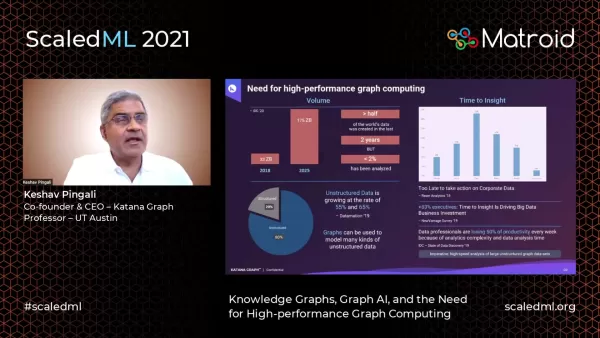
The globe is facing an extraordinary surge in data, frequently described as a "data tsunami" or "data deluge." Projections indicate that by 2025, global data generation will reach 175 zettabytes. Remarkably, half of all existing data was produced in the past two years, with under 2% having been thoroughly analyzed. Although structured data, such as that in relational databases, continues to be valuable, unstructured data—including text, images, and videos—is expanding at a remarkable pace. Graphs are particularly effective at modeling this unstructured data, enabling us to map complex connections and uncover hidden trends.
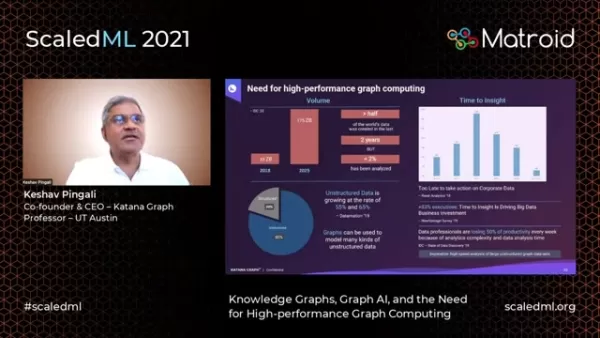
The primary difficulty is processing this vast quantity of unstructured data within a useful period. Conventional approaches are typically inadequate, resulting in lost opportunities and postponed actions. The importance of "time to insight" is critical; companies need to obtain practical intelligence from data while it remains relevant. Data experts waste 50% of their weekly productivity because of the intricacy and duration required for data analysis. This need for speed propels the adoption of high-performance graph computing systems that can analyze huge datasets almost instantly.
The table below highlights the main distinctions between conventional data processing and high-performance graph computing:
Feature Traditional Data Processing High-Performance Graph Computing Data Structure Structured Unstructured Analysis Focus Individual data points Relationships between entities Performance Goal Speed of data retrieval Speed of relationship discovery Key Metric Query response time Time to insight
Graph Technology and Its Applications
A Wide Range of Applications
Graph technology is being utilized in a broad spectrum of industries
:
- Pharma: Drug hypothesis generation and discovery, along with precision medicine, often employing medical knowledge graphs.
- Financial Services: Detecting payment fraud, preventing identity theft, and creating comprehensive customer profiles. Payment fraud detection utilizes role mining to combat money laundering.
- Information Security: Role mining and intrusion detection. These areas require intrusion detection systems to safeguard computer networks.
These uses frequently involve knowledge graphs, such as medical knowledge graphs, records of financial payments, and EDA circuit designs.
This approach requires the capacity and speed of high-performance graph computing to achieve insights rapidly.
Unlocking the Power of Knowledge Graphs: Key Tools and Techniques
Feature Engineering, Data Mining and Algorithm Design
To fully exploit the potential of data-driven AI, companies must adopt innovative approaches, including knowledge graphs and high-performance computing systems.
We will outline the technological framework that Katana Graph employs and the essential tools for managing large datasets and deriving insights from analytics and AI.
Katana Graph is an organization that offers graph-based solutions and support.
Its architecture is designed to manage very large graphs. Scalable graph engines are available on platforms like AWS, Azure, and Google Cloud. Graph analysis should be conducted using integrated AI/ML models through workflows involving querying, unsupervised learning, and supervised training.
Weighing the Benefits and Drawbacks of Knowledge Graphs and Graph AI
Pros
Superior data integration and compatibility
Advanced knowledge discovery and logical inference
Better decision-making and problem-resolution
Facilitation of tailored experiences and suggestions
Increased data accuracy and uniformity
Cons
Intricate design and deployment processes
Difficulties in combining data sources and extracting knowledge
Risk of embedded bias and ethical issues
Substantial computational expenses for extensive graphs
Requirement for specialized knowledge and skills
Frequently Asked Questions
What are knowledge graphs?
Knowledge graphs are structured models of linked entities and their relationships, offering an organized system for information storage and retrieval. They facilitate complex reasoning and knowledge acquisition by utilizing the connections among data elements.
How does graph AI enhance knowledge graphs?
Graph AI merges the capabilities of graph models with AI methodologies like machine learning and deep learning. This integration supports automated pattern recognition, relationship forecasting, and knowledge augmentation in knowledge graphs.
Why is high-performance computing essential for graph AI and knowledge graphs?
Practical knowledge graphs can be enormous, comprising billions of nodes and connections. Analyzing these extensive datasets and executing complex graph AI operations demands considerable computational capacity. High-performance computing facilitates prompt insights and practical intelligence by speeding up graph processing and analysis.
What are the key application areas for knowledge graphs and graph AI?
Knowledge graphs and graph AI are revolutionizing multiple sectors, including pharmaceuticals (for drug development and personalized medicine), financial services (for fraud prevention and complete customer views), and information security (for detecting intrusions and managing identities).
What is a graph transformer network (GTN)?
A graph transformer network is a neural network design specifically created for handling and learning from graph-based data. GTNs are especially proficient for functions like node classification and predicting relationships within knowledge graphs. They employ transformer technology to understand extensive dependencies and complex structures in graph data.
Related Questions
How do knowledge graphs differ from traditional relational databases?
Relational databases arrange data into tables with fixed structures, while knowledge graphs depict data as a network of interconnected entities and relationships. Knowledge graphs are adept at representing complex connections and managing unstructured data, whereas relational databases are best suited for storing and retrieving structured information.
What are the key challenges in building and maintaining knowledge graphs?
Developing and sustaining knowledge graphs pose several obstacles, such as: Data Integration: Merging data from multiple sources with different formats and structures. Knowledge Extraction: Automatically identifying entities and relationships from unstructured text and other data types. Ontology Development: Creating a uniform and detailed ontology to depict the domain's knowledge. Reasoning and Inference: Designing algorithms to deduce new knowledge from the existing graph. Scalability: Coping with the ongoing growth in size and complexity of knowledge graphs. Data Quality: Maintaining the precision and thoroughness of the information contained in the knowledge graph.
What are the ethical considerations surrounding knowledge graphs and graph AI?
Ethical issues are critically important when dealing with knowledge graphs and graph AI. Primary concerns include: Bias: Guaranteeing that the data used to construct knowledge graphs is unbiased to prevent unfair results. Privacy: Safeguarding confidential data and adhering to data protection laws. Transparency: Ensuring the logic and decision-making processes of graph AI models are clear and understandable. Accountability: Defining explicit responsibility for the results produced by graph AI applications.
Related article
 Anthropic Opens Doors to EU Cybersecurity Agency as Mythos5 Model Faces Compliance Exam
Artificial intelligence compliance regulations are advancing significantly. Leading AI firm Anthropic has officially granted the European Union's cybersecurity authority access to its Mythos AI model, a pivotal move for this advanced large language m
Lenovo Unveils AI Cutie at MWC 2026: Desktop Robotic Arm Becomes Your New Workplace Assistant
If AI in 2025 is still confined to screen-based chats, 2026 marks the shift toward tangible, desk-integrated intelligence. At MWC 2026 in Barcelona, Lenovo unveiled two groundbreaking AI hardware concepts: AI Workmate (an AI Office Partner) and AI Wo
TikTok Launches Voice Copyright Report Channel as AI Clone Voice Complaints Double
TikTok has introduced a dedicated reporting channel for voice-related intellectual property infringement, alongside enhanced rights protection mechanisms. The platform notes that as AI voice synthesis and imitation technologies become more accessible
Related Special Topic Recommendations
code
Anthropic Opens Doors to EU Cybersecurity Agency as Mythos5 Model Faces Compliance Exam
Artificial intelligence compliance regulations are advancing significantly. Leading AI firm Anthropic has officially granted the European Union's cybersecurity authority access to its Mythos AI model, a pivotal move for this advanced large language m
Lenovo Unveils AI Cutie at MWC 2026: Desktop Robotic Arm Becomes Your New Workplace Assistant
If AI in 2025 is still confined to screen-based chats, 2026 marks the shift toward tangible, desk-integrated intelligence. At MWC 2026 in Barcelona, Lenovo unveiled two groundbreaking AI hardware concepts: AI Workmate (an AI Office Partner) and AI Wo
TikTok Launches Voice Copyright Report Channel as AI Clone Voice Complaints Double
TikTok has introduced a dedicated reporting channel for voice-related intellectual property infringement, alongside enhanced rights protection mechanisms. The platform notes that as AI voice synthesis and imitation technologies become more accessible
Related Special Topic Recommendations
code
 AI Pull Request Review Tools for GitHub Teams Handling Refactors, Bugs, and Security Gaps
2026 Latest Best AI Pull Request Review Tools for GitHub Teams are here on XIX.AI! This top-rated curated list showcases powerful game-changing solutions that streamline refactoring, bug fixing, and security gap detection across all team workflows. Enjoy a free vs paid comparison along with real-world tests and detailed rankings to help you find the perfect tool that boosts productivity significantly. Explore now to unlock your AI edge!
 12 tools
 xix.ai
Text-to-speech
Best AI Text to Speech Tools for Natural Voiceovers
xix.ai
Text-to-speech
Best AI Text to Speech Tools for Natural Voiceovers
2026 Latest Best Top-rated AI Text to Speech Tools for Natural Voiceovers are here on XIX.AI! This curated list features powerful, game-changing options that deliver crystal-clear voices for every use case, backed by real-world tests and weekly updated rankings. Get a free vs paid comparison to find the must-try solution that boosts your productivity instantly. Explore now to Unlock your AI edge!
11 tools
xix.ai
Comic Creation
Manga AI Background Generators for Serialized Chapters, Covers, and Promo Art
2026 Latest Best Manga AI Background Generators Ranked Top-Rated! This curated collection showcases powerful game-changing tools perfect for creating high-quality chapter backgrounds, book covers, and promotional art. Every option has undergone rigorous real-world tests to ensure reliability. Get a free vs paid comparison along with detailed insights. Explore now to discover your perfect tool and unlock your AI edge in manga creation.
6 tools
xix.ai
Image editing
AI Object Removal Editors: Clean Up Portraits, Travel, and Product Shots
2026 Latest Best Top-rated AI Object Removal Editors for portraits travel product shots! XIX.AI curates a powerful game-changing collection regularly updated with weekly rankings. These tools offer real-world tests to help you quickly remove unwanted elements, boost content quality, and save tons of time without compromising results. Must-try for anyone aiming to unlock their AI creation edge. Explore now!
10 tools
xix.ai
Text-to-speech
Best AI Text to Speech Tools for Online Courses
2026 Latest Best Top-rated AI Text to Speech Tools for Online Courses are curated by XIX.AI based on rigorous real-world tests and weekly updated rankings. These powerful tools help creators deliver crystal-clear audio content effortlessly, boosting writing efficiency and streamlining course production. Check out the free vs paid comparison to find your perfect fit. Explore now to unlock your AI edge in online education.
10 tools
xix.ai
writing
AI Blog Title Tools for Higher Click Through Rates
2026 Latest Best Top-Rated AI Blog Title Tools for Higher Click Through Rates! XIX.AI has carefully curated a powerful, game-changing collection of top tools that go through rigorous real-world tests. You’ll find a free vs paid comparison, weekly updated rankings, and detailed insights to help you boost your blog’s traffic efficiently. Must-try options are highlighted to help you unlock your AI edge. Explore now!
10 tools
xix.ai

 Comments (0)
0/500
Comments (0)
0/500
The integration of knowledge graphs, graph AI, and high-performance computing is fundamentally transforming how we interpret and utilize information in our data-centric environment. This piece examines the importance of these technologies and their diverse uses across multiple sectors. We'll explain why high-performance computing has become essential, not optional, for unlocking the complete capabilities of knowledge graphs and graph AI. Explore the world of interconnected data with us and learn about the effectiveness of solutions based on graphs.
Key Points
The rapid expansion of unstructured data requires advanced methods such as graph computing.
High-performance computing is vital for gaining timely insights from enormous knowledge graphs.
Knowledge graphs provide an adaptable structure for representing intricate relationships and various data forms.
Graph AI merges the strengths of graph architectures with artificial intelligence to address sophisticated challenges.
Numerous industries, such as pharmaceuticals, finance, and security, gain advantages from graph-based approaches.
Graph transformer networks (GTNs) are becoming influential resources for node classification tasks.
The Evolving Landscape of High-Performance Computing
From Computational Science to Graph Computing
Historically, high-performance computing was primarily associated with computational science, like simulating physical events through partial differential equations. A new model, however, is gaining traction: high-performance graph computing. This change is fueled by the necessity to examine and derive meaning from the continuously growing stream of unstructured data. Conventional techniques find it difficult to manage the complexity and interlinked nature of this information, elevating the importance of graph-based strategies. Knowledge graphs present a robust and flexible framework for depicting connections among entities. Graph AI integrates these graph models with advanced machine learning methods. This fusion enables us to solve complex problems in various fields, from pharmaceutical development to identifying fraudulent activities. Realizing this potential, however, demands substantial computational resources. The immense scale and intricacy of practical knowledge graphs make high-performance graph computing indispensable for achieving significant outcomes.
High-Performance Computing (HPC):
- Traditionally centered on resolving complex mathematical problems in scientific research.
- Manages structured data and clearly outlined computational operations.
- Frequently utilizes parallel processing and extensive computing clusters.
High-Performance Graph Computing (HPGC):
- Handles unstructured and interconnected information.
- Uses graph algorithms and graph AI methods for examination.
- Demands specialized hardware and software to process large graph datasets.
- Concentrates on identifying relationships and patterns within data.
The Data Deluge: Volume and Time to Insight
The globe is facing an extraordinary surge in data, frequently described as a "data tsunami" or "data deluge." Projections indicate that by 2025, global data generation will reach 175 zettabytes. Remarkably, half of all existing data was produced in the past two years, with under 2% having been thoroughly analyzed. Although structured data, such as that in relational databases, continues to be valuable, unstructured data—including text, images, and videos—is expanding at a remarkable pace. Graphs are particularly effective at modeling this unstructured data, enabling us to map complex connections and uncover hidden trends.
The primary difficulty is processing this vast quantity of unstructured data within a useful period. Conventional approaches are typically inadequate, resulting in lost opportunities and postponed actions. The importance of "time to insight" is critical; companies need to obtain practical intelligence from data while it remains relevant. Data experts waste 50% of their weekly productivity because of the intricacy and duration required for data analysis. This need for speed propels the adoption of high-performance graph computing systems that can analyze huge datasets almost instantly.
The table below highlights the main distinctions between conventional data processing and high-performance graph computing:
| Feature | Traditional Data Processing | High-Performance Graph Computing |
|---|---|---|
| Data Structure | Structured | Unstructured |
| Analysis Focus | Individual data points | Relationships between entities |
| Performance Goal | Speed of data retrieval | Speed of relationship discovery |
| Key Metric | Query response time | Time to insight |
Graph Technology and Its Applications
A Wide Range of Applications
Graph technology is being utilized in a broad spectrum of industries
:
- Pharma: Drug hypothesis generation and discovery, along with precision medicine, often employing medical knowledge graphs.
- Financial Services: Detecting payment fraud, preventing identity theft, and creating comprehensive customer profiles. Payment fraud detection utilizes role mining to combat money laundering.
- Information Security: Role mining and intrusion detection. These areas require intrusion detection systems to safeguard computer networks.
These uses frequently involve knowledge graphs, such as medical knowledge graphs, records of financial payments, and EDA circuit designs.
This approach requires the capacity and speed of high-performance graph computing to achieve insights rapidly.
Unlocking the Power of Knowledge Graphs: Key Tools and Techniques
Feature Engineering, Data Mining and Algorithm Design
To fully exploit the potential of data-driven AI, companies must adopt innovative approaches, including knowledge graphs and high-performance computing systems.
We will outline the technological framework that Katana Graph employs and the essential tools for managing large datasets and deriving insights from analytics and AI.
Katana Graph is an organization that offers graph-based solutions and support.
Its architecture is designed to manage very large graphs. Scalable graph engines are available on platforms like AWS, Azure, and Google Cloud. Graph analysis should be conducted using integrated AI/ML models through workflows involving querying, unsupervised learning, and supervised training.
Weighing the Benefits and Drawbacks of Knowledge Graphs and Graph AI
Pros
Superior data integration and compatibility
Advanced knowledge discovery and logical inference
Better decision-making and problem-resolution
Facilitation of tailored experiences and suggestions
Increased data accuracy and uniformity
Cons
Intricate design and deployment processes
Difficulties in combining data sources and extracting knowledge
Risk of embedded bias and ethical issues
Substantial computational expenses for extensive graphs
Requirement for specialized knowledge and skills
Frequently Asked Questions
What are knowledge graphs?
Knowledge graphs are structured models of linked entities and their relationships, offering an organized system for information storage and retrieval. They facilitate complex reasoning and knowledge acquisition by utilizing the connections among data elements.
How does graph AI enhance knowledge graphs?
Graph AI merges the capabilities of graph models with AI methodologies like machine learning and deep learning. This integration supports automated pattern recognition, relationship forecasting, and knowledge augmentation in knowledge graphs.
Why is high-performance computing essential for graph AI and knowledge graphs?
Practical knowledge graphs can be enormous, comprising billions of nodes and connections. Analyzing these extensive datasets and executing complex graph AI operations demands considerable computational capacity. High-performance computing facilitates prompt insights and practical intelligence by speeding up graph processing and analysis.
What are the key application areas for knowledge graphs and graph AI?
Knowledge graphs and graph AI are revolutionizing multiple sectors, including pharmaceuticals (for drug development and personalized medicine), financial services (for fraud prevention and complete customer views), and information security (for detecting intrusions and managing identities).
What is a graph transformer network (GTN)?
A graph transformer network is a neural network design specifically created for handling and learning from graph-based data. GTNs are especially proficient for functions like node classification and predicting relationships within knowledge graphs. They employ transformer technology to understand extensive dependencies and complex structures in graph data.
Related Questions
How do knowledge graphs differ from traditional relational databases?
Relational databases arrange data into tables with fixed structures, while knowledge graphs depict data as a network of interconnected entities and relationships. Knowledge graphs are adept at representing complex connections and managing unstructured data, whereas relational databases are best suited for storing and retrieving structured information.
What are the key challenges in building and maintaining knowledge graphs?
Developing and sustaining knowledge graphs pose several obstacles, such as: Data Integration: Merging data from multiple sources with different formats and structures. Knowledge Extraction: Automatically identifying entities and relationships from unstructured text and other data types. Ontology Development: Creating a uniform and detailed ontology to depict the domain's knowledge. Reasoning and Inference: Designing algorithms to deduce new knowledge from the existing graph. Scalability: Coping with the ongoing growth in size and complexity of knowledge graphs. Data Quality: Maintaining the precision and thoroughness of the information contained in the knowledge graph.
What are the ethical considerations surrounding knowledge graphs and graph AI?
Ethical issues are critically important when dealing with knowledge graphs and graph AI. Primary concerns include: Bias: Guaranteeing that the data used to construct knowledge graphs is unbiased to prevent unfair results. Privacy: Safeguarding confidential data and adhering to data protection laws. Transparency: Ensuring the logic and decision-making processes of graph AI models are clear and understandable. Accountability: Defining explicit responsibility for the results produced by graph AI applications.








 Anthropic Opens Doors to EU Cybersecurity Agency as Mythos5 Model Faces Compliance Exam
Artificial intelligence compliance regulations are advancing significantly. Leading AI firm Anthropic has officially granted the European Union's cybersecurity authority access to its Mythos AI model, a pivotal move for this advanced large language m
Anthropic Opens Doors to EU Cybersecurity Agency as Mythos5 Model Faces Compliance Exam
Artificial intelligence compliance regulations are advancing significantly. Leading AI firm Anthropic has officially granted the European Union's cybersecurity authority access to its Mythos AI model, a pivotal move for this advanced large language m
 Lenovo Unveils AI Cutie at MWC 2026: Desktop Robotic Arm Becomes Your New Workplace Assistant
If AI in 2025 is still confined to screen-based chats, 2026 marks the shift toward tangible, desk-integrated intelligence. At MWC 2026 in Barcelona, Lenovo unveiled two groundbreaking AI hardware concepts: AI Workmate (an AI Office Partner) and AI Wo
Lenovo Unveils AI Cutie at MWC 2026: Desktop Robotic Arm Becomes Your New Workplace Assistant
If AI in 2025 is still confined to screen-based chats, 2026 marks the shift toward tangible, desk-integrated intelligence. At MWC 2026 in Barcelona, Lenovo unveiled two groundbreaking AI hardware concepts: AI Workmate (an AI Office Partner) and AI Wo
 TikTok Launches Voice Copyright Report Channel as AI Clone Voice Complaints Double
TikTok has introduced a dedicated reporting channel for voice-related intellectual property infringement, alongside enhanced rights protection mechanisms. The platform notes that as AI voice synthesis and imitation technologies become more accessible
TikTok Launches Voice Copyright Report Channel as AI Clone Voice Complaints Double
TikTok has introduced a dedicated reporting channel for voice-related intellectual property infringement, alongside enhanced rights protection mechanisms. The platform notes that as AI voice synthesis and imitation technologies become more accessible

2026 Latest Best AI Pull Request Review Tools for GitHub Teams are here on XIX.AI! This top-rated curated list showcases powerful game-changing solutions that streamline refactoring, bug fixing, and security gap detection across all team workflows. Enjoy a free vs paid comparison along with real-world tests and detailed rankings to help you find the perfect tool that boosts productivity significantly. Explore now to unlock your AI edge!
12 tools
xix.ai

2026 Latest Best Top-rated AI Text to Speech Tools for Natural Voiceovers are here on XIX.AI! This curated list features powerful, game-changing options that deliver crystal-clear voices for every use case, backed by real-world tests and weekly updated rankings. Get a free vs paid comparison to find the must-try solution that boosts your productivity instantly. Explore now to Unlock your AI edge!
11 tools
xix.ai

2026 Latest Best Manga AI Background Generators Ranked Top-Rated! This curated collection showcases powerful game-changing tools perfect for creating high-quality chapter backgrounds, book covers, and promotional art. Every option has undergone rigorous real-world tests to ensure reliability. Get a free vs paid comparison along with detailed insights. Explore now to discover your perfect tool and unlock your AI edge in manga creation.
6 tools
xix.ai

2026 Latest Best Top-rated AI Object Removal Editors for portraits travel product shots! XIX.AI curates a powerful game-changing collection regularly updated with weekly rankings. These tools offer real-world tests to help you quickly remove unwanted elements, boost content quality, and save tons of time without compromising results. Must-try for anyone aiming to unlock their AI creation edge. Explore now!
10 tools
xix.ai

2026 Latest Best Top-rated AI Text to Speech Tools for Online Courses are curated by XIX.AI based on rigorous real-world tests and weekly updated rankings. These powerful tools help creators deliver crystal-clear audio content effortlessly, boosting writing efficiency and streamlining course production. Check out the free vs paid comparison to find your perfect fit. Explore now to unlock your AI edge in online education.
10 tools
xix.ai

2026 Latest Best Top-Rated AI Blog Title Tools for Higher Click Through Rates! XIX.AI has carefully curated a powerful, game-changing collection of top tools that go through rigorous real-world tests. You’ll find a free vs paid comparison, weekly updated rankings, and detailed insights to help you boost your blog’s traffic efficiently. Must-try options are highlighted to help you unlock your AI edge. Explore now!
10 tools
xix.ai












