


 Home
HomeJedify nabs $24M to equip AI agents with business context
AI vendors often market their enterprise products as ready-to-deploy solutions, but the likelihood that AI agents will perform effectively from day one is low. Without customizing a model to your company's unique operations, it cannot grasp how your business defines revenue or which employees have access to specific files. This is one reason why AI companies are dispatching engineers to help integrate their tools into customer environments.
Jedify, a startup based in New York, is addressing this exact challenge. According to the company, its platform uses APIs to link to enterprise knowledge sources and create a "context graph" of their business, enabling AI agents to function more effectively. These sources include databases, data warehouses, data lakes, SaaS applications, BI tools, and unstructured sources like reports, documentation, code bases, Slack channels, and meeting recordings.
To support this development, Jedify has secured $24 million in Series A funding led by Norwest, as exclusively reported by TechCrunch. Returning investors S Capital VC and Cerca Partners joined the round, along with new backer Oceans Ventures. Data giant Snowflake also participated as a strategic investor and is integrating Jedify's technology into its own AI offerings, including Cortex AI, Semantic Views, and CoWork.
Jedify's core proposition is that AI agents must understand relationships among entities, data, permissions, domain knowledge, workflows, operational assumptions, and company-specific terminology to be truly valuable in an enterprise setting. This context, the company explains, enables an AI agent to focus on information relevant to a specific task rather than scanning the entire organization's data.
Co-founder and CEO Assaf Henkin (pictured above, far right) cited Kiteworks, a compliance company, as an example of how customers leverage Jedify. Kiteworks integrated Snowflake, Tableau, Notion, and internal playbooks—including documents and screenshots—with Jedify, and then developed agentic tools for various customer workflows.
"They aimed to equip their sales and account teams with a sophisticated application—imagine a dashboard combined with a real-time conversational tool. When they enter a customer discussion, Jedify dynamically generates everything they need to know. During the conversation, it proactively surfaces highly specific details in real time," Henkin said.
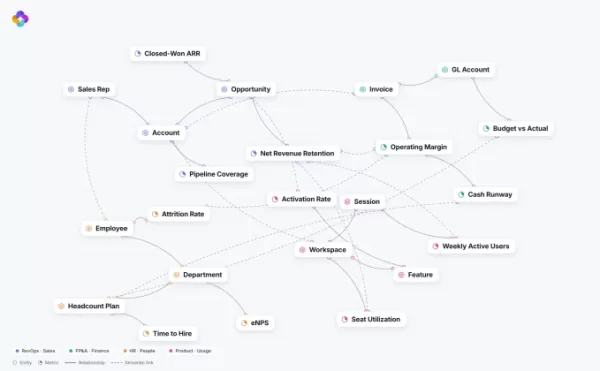
Jedify's context graph. Image Credits: JedifyImage Credits:Jedify /
Henkin argues that Jedify's context graph differs from existing semantic layers, metadata catalogs, and knowledge graphs because it is multi-dimensional—capturing relationships across entities, data, people, permissions, and customers. It is also model-agnostic and updates in real time as information flows in and out of connected systems.
"When you need an agentic solution to operate autonomously—making decisions across CRM data, Zendesk tickets, and maybe real-time telemetry data—a context graph offers far superior capabilities compared to a semantic layer," he said.
Permissions present a clear challenge. For instance, an agent should not grant an intern access to the CFO's revenue projections. Henkin explains that his platform addresses this by inheriting permissions from identity systems, file systems, SaaS tools, and databases—including row-, column-, and table-level rules—and then allows customers to create additional groups that specify what agents or workflows can access. The platform also provides observability and governance tools to help customers verify that their AI agents behave as expected.
Jedify currently targets mid-market and large enterprise customers with mature data stacks and multiple databases or data warehouses. According to Henkin, the company has between 10 and 20 early customers, including The Weather Company, and is attracting interest from data-intensive sectors like gaming, industrials, and consumer packaged goods.
Snowflake's investment and partnership are noteworthy, as major data platforms are also developing similar capabilities. However, Henkin maintains that Jedify complements these efforts because a significant portion of a company's data and most of its institutional knowledge typically reside across multiple providers, not a single cloud.
"[The large data companies] will tell you, 'Oh yeah, just bring everything.' But in reality, companies have multiple databases, warehouses, and data solutions. The key point is that not all your data lives in those environments, and most of your knowledge isn't there either, so it's actually a disadvantage for them," he said.
Henkin also pointed out that for companies attempting to build a comparable context layer independently, training an AI model can be prohibitively expensive, especially as businesses become more careful about their AI token consumption.
Moreover, the fast pace of AI model development supports the company's broader thesis: as models become more powerful and interchangeable, proprietary context that enhances their performance within businesses could become a valuable and enduring competitive advantage.
The startup plans to use the new capital for product development, hiring, and go-to-market activities. This brings the company's total funding to approximately $33 million.
Related article
 Google Tests Remy AI Agent for Gemini as Focus Shifts to User Control
According to Business Insider, Google is testing Remy, a new AI personal agent for Gemini. This tool aims to execute tasks on behalf of users, streamlining both professional workflows and daily routines.Currently, Remy is undergoing testing in an int
Sesame, AI Startup by Oculus Founders, Debuts on iOS
On Thursday, Sesame, an AI startup founded by the creators of Oculus and other former Meta VR team members, unveiled a public preview of its conversational AI agents, which have been in development for over a year. Through its new iOS application, Se
NEA’s Tiffany Luck: Enterprises Still Grappling With AI ROI
Loading the player…Earlier this year, “tokenmaxxing” dominated Silicon Valley, with CEOs urging staff to maximize AI usage. That enthusiasm quickly met reality. Uber reportedly exceeded its annual AI budget within months, some firms reduced Claude li
Related Special Topic Recommendations
writing
Google Tests Remy AI Agent for Gemini as Focus Shifts to User Control
According to Business Insider, Google is testing Remy, a new AI personal agent for Gemini. This tool aims to execute tasks on behalf of users, streamlining both professional workflows and daily routines.Currently, Remy is undergoing testing in an int
Sesame, AI Startup by Oculus Founders, Debuts on iOS
On Thursday, Sesame, an AI startup founded by the creators of Oculus and other former Meta VR team members, unveiled a public preview of its conversational AI agents, which have been in development for over a year. Through its new iOS application, Se
NEA’s Tiffany Luck: Enterprises Still Grappling With AI ROI
Loading the player…Earlier this year, “tokenmaxxing” dominated Silicon Valley, with CEOs urging staff to maximize AI usage. That enthusiasm quickly met reality. Uber reportedly exceeded its annual AI budget within months, some firms reduced Claude li
Related Special Topic Recommendations
writing
 Best AI Outline Generators for Long-Form SEO Articles
2026 Latest Best Top-Rated AI Outline Generators for Long-Form SEO Articles, meticulously curated by XIX.AI. These powerful tools offer game-changing assistance in creating high-quality content quickly, boosting writing efficiency significantly. Get a free vs paid comparison along with real-world tests and detailed rankings to help you find the must-try option that suits your needs. Explore now to unlock your AI edge.
 8 tools
 xix.ai
Education and Learning
AI Study Tools for Homework and Exam Prep
xix.ai
Education and Learning
AI Study Tools for Homework and Exam Prep
2026 Latest Best AI Study Tools for Homework and Exam Prep! XIX.AI curates a top-rated list of powerful, game-changing tools that help students boost productivity, streamline homework completion, and ace exams through real-world tests. Get a free vs paid comparison, detailed rankings, and must-try options to unlock your AI edge. Explore now!
10 tools
xix.ai
Music composition
AI Vocal Demo Tools for Songwriters, Hooks, Toplines, and Multilingual Draft Sessions
2026 Latest Best AI Vocal Demo Tools for Songwriters, Hook Creators, and Multi-Language Content Teams! XIX.AI has curated a top-rated list of powerful game-changing tools that go through rigorous real-world tests. You’ll find detailed free vs paid comparison data, comprehensive rankings, and must-try options to help you boost writing efficiency and unlock your creative potential. Explore now to discover your perfect tool for all your content needs!
9 tools
xix.ai
Business
Best AI Competitive Research Tools for Small Businesses
2026 Latest Best Top-rated AI Competitive Research Tools for Small Businesses! XIX.AI has curated a highly powerful game-changing collection, updated weekly with rigorous real-world tests and detailed rankings. You can find a comprehensive free vs paid comparison to help you identify the must-try tools that boost your productivity and give you a competitive edge. Explore now to discover your perfect tool!
9 tools
xix.ai
Image editing
Photoshop AI Retouch Tools for Ecommerce Apparel, Skin Cleanup, and Color Consistency
2026 Latest Best Photoshop AI retouch tools for ecommerce apparel, skin cleanup, and color consistency! This top-rated curated list features powerful game-changing solutions that help you boost writing efficiency, streamline content creation, and achieve perfect visual results effortlessly. Each tool has undergone real-world tests through weekly updated rankings, complete with free vs paid comparison details. Backed by XIX.AI, it’s the must-try guide for anyone aiming to unlock your AI edge. Explore now!
10 tools
xix.ai
Prompt
Best AI Prompt Libraries for ChatGPT Workflows
2026 Latest Best Top-Rated AI Prompt Libraries for optimizing all types of ChatGPT workflows. XIX.AI has curated a powerful, game-changing collection that goes through rigorous real-world tests to ensure top performance. You can find detailed free vs paid comparisons and expert rankings to help you choose the must-try tools that boost your productivity and unlock your AI edge. Explore now!
11 tools
xix.ai

 Comments (0)
0/500
Comments (0)
0/500
AI vendors often market their enterprise products as ready-to-deploy solutions, but the likelihood that AI agents will perform effectively from day one is low. Without customizing a model to your company's unique operations, it cannot grasp how your business defines revenue or which employees have access to specific files. This is one reason why AI companies are dispatching engineers to help integrate their tools into customer environments.
Jedify, a startup based in New York, is addressing this exact challenge. According to the company, its platform uses APIs to link to enterprise knowledge sources and create a "context graph" of their business, enabling AI agents to function more effectively. These sources include databases, data warehouses, data lakes, SaaS applications, BI tools, and unstructured sources like reports, documentation, code bases, Slack channels, and meeting recordings.
To support this development, Jedify has secured $24 million in Series A funding led by Norwest, as exclusively reported by TechCrunch. Returning investors S Capital VC and Cerca Partners joined the round, along with new backer Oceans Ventures. Data giant Snowflake also participated as a strategic investor and is integrating Jedify's technology into its own AI offerings, including Cortex AI, Semantic Views, and CoWork.
Jedify's core proposition is that AI agents must understand relationships among entities, data, permissions, domain knowledge, workflows, operational assumptions, and company-specific terminology to be truly valuable in an enterprise setting. This context, the company explains, enables an AI agent to focus on information relevant to a specific task rather than scanning the entire organization's data.
Co-founder and CEO Assaf Henkin (pictured above, far right) cited Kiteworks, a compliance company, as an example of how customers leverage Jedify. Kiteworks integrated Snowflake, Tableau, Notion, and internal playbooks—including documents and screenshots—with Jedify, and then developed agentic tools for various customer workflows.
"They aimed to equip their sales and account teams with a sophisticated application—imagine a dashboard combined with a real-time conversational tool. When they enter a customer discussion, Jedify dynamically generates everything they need to know. During the conversation, it proactively surfaces highly specific details in real time," Henkin said.
Jedify's context graph. Image Credits: JedifyImage Credits:Jedify /
Henkin argues that Jedify's context graph differs from existing semantic layers, metadata catalogs, and knowledge graphs because it is multi-dimensional—capturing relationships across entities, data, people, permissions, and customers. It is also model-agnostic and updates in real time as information flows in and out of connected systems.
"When you need an agentic solution to operate autonomously—making decisions across CRM data, Zendesk tickets, and maybe real-time telemetry data—a context graph offers far superior capabilities compared to a semantic layer," he said.
Permissions present a clear challenge. For instance, an agent should not grant an intern access to the CFO's revenue projections. Henkin explains that his platform addresses this by inheriting permissions from identity systems, file systems, SaaS tools, and databases—including row-, column-, and table-level rules—and then allows customers to create additional groups that specify what agents or workflows can access. The platform also provides observability and governance tools to help customers verify that their AI agents behave as expected.
Jedify currently targets mid-market and large enterprise customers with mature data stacks and multiple databases or data warehouses. According to Henkin, the company has between 10 and 20 early customers, including The Weather Company, and is attracting interest from data-intensive sectors like gaming, industrials, and consumer packaged goods.
Snowflake's investment and partnership are noteworthy, as major data platforms are also developing similar capabilities. However, Henkin maintains that Jedify complements these efforts because a significant portion of a company's data and most of its institutional knowledge typically reside across multiple providers, not a single cloud.
"[The large data companies] will tell you, 'Oh yeah, just bring everything.' But in reality, companies have multiple databases, warehouses, and data solutions. The key point is that not all your data lives in those environments, and most of your knowledge isn't there either, so it's actually a disadvantage for them," he said.
Henkin also pointed out that for companies attempting to build a comparable context layer independently, training an AI model can be prohibitively expensive, especially as businesses become more careful about their AI token consumption.
Moreover, the fast pace of AI model development supports the company's broader thesis: as models become more powerful and interchangeable, proprietary context that enhances their performance within businesses could become a valuable and enduring competitive advantage.
The startup plans to use the new capital for product development, hiring, and go-to-market activities. This brings the company's total funding to approximately $33 million.







 Google Tests Remy AI Agent for Gemini as Focus Shifts to User Control
According to Business Insider, Google is testing Remy, a new AI personal agent for Gemini. This tool aims to execute tasks on behalf of users, streamlining both professional workflows and daily routines.Currently, Remy is undergoing testing in an int
Google Tests Remy AI Agent for Gemini as Focus Shifts to User Control
According to Business Insider, Google is testing Remy, a new AI personal agent for Gemini. This tool aims to execute tasks on behalf of users, streamlining both professional workflows and daily routines.Currently, Remy is undergoing testing in an int
 Sesame, AI Startup by Oculus Founders, Debuts on iOS
On Thursday, Sesame, an AI startup founded by the creators of Oculus and other former Meta VR team members, unveiled a public preview of its conversational AI agents, which have been in development for over a year. Through its new iOS application, Se
Sesame, AI Startup by Oculus Founders, Debuts on iOS
On Thursday, Sesame, an AI startup founded by the creators of Oculus and other former Meta VR team members, unveiled a public preview of its conversational AI agents, which have been in development for over a year. Through its new iOS application, Se
 NEA’s Tiffany Luck: Enterprises Still Grappling With AI ROI
Loading the player…Earlier this year, “tokenmaxxing” dominated Silicon Valley, with CEOs urging staff to maximize AI usage. That enthusiasm quickly met reality. Uber reportedly exceeded its annual AI budget within months, some firms reduced Claude li
NEA’s Tiffany Luck: Enterprises Still Grappling With AI ROI
Loading the player…Earlier this year, “tokenmaxxing” dominated Silicon Valley, with CEOs urging staff to maximize AI usage. That enthusiasm quickly met reality. Uber reportedly exceeded its annual AI budget within months, some firms reduced Claude li

2026 Latest Best Top-Rated AI Outline Generators for Long-Form SEO Articles, meticulously curated by XIX.AI. These powerful tools offer game-changing assistance in creating high-quality content quickly, boosting writing efficiency significantly. Get a free vs paid comparison along with real-world tests and detailed rankings to help you find the must-try option that suits your needs. Explore now to unlock your AI edge.
8 tools
xix.ai

2026 Latest Best AI Study Tools for Homework and Exam Prep! XIX.AI curates a top-rated list of powerful, game-changing tools that help students boost productivity, streamline homework completion, and ace exams through real-world tests. Get a free vs paid comparison, detailed rankings, and must-try options to unlock your AI edge. Explore now!
10 tools
xix.ai

2026 Latest Best AI Vocal Demo Tools for Songwriters, Hook Creators, and Multi-Language Content Teams! XIX.AI has curated a top-rated list of powerful game-changing tools that go through rigorous real-world tests. You’ll find detailed free vs paid comparison data, comprehensive rankings, and must-try options to help you boost writing efficiency and unlock your creative potential. Explore now to discover your perfect tool for all your content needs!
9 tools
xix.ai

2026 Latest Best Top-rated AI Competitive Research Tools for Small Businesses! XIX.AI has curated a highly powerful game-changing collection, updated weekly with rigorous real-world tests and detailed rankings. You can find a comprehensive free vs paid comparison to help you identify the must-try tools that boost your productivity and give you a competitive edge. Explore now to discover your perfect tool!
9 tools
xix.ai

2026 Latest Best Photoshop AI retouch tools for ecommerce apparel, skin cleanup, and color consistency! This top-rated curated list features powerful game-changing solutions that help you boost writing efficiency, streamline content creation, and achieve perfect visual results effortlessly. Each tool has undergone real-world tests through weekly updated rankings, complete with free vs paid comparison details. Backed by XIX.AI, it’s the must-try guide for anyone aiming to unlock your AI edge. Explore now!
10 tools
xix.ai

2026 Latest Best Top-Rated AI Prompt Libraries for optimizing all types of ChatGPT workflows. XIX.AI has curated a powerful, game-changing collection that goes through rigorous real-world tests to ensure top performance. You can find detailed free vs paid comparisons and expert rankings to help you choose the must-try tools that boost your productivity and unlock your AI edge. Explore now!
11 tools
xix.ai












