


 Home
HomeAI Beats Olympiads Yet Struggles With Basic School Math
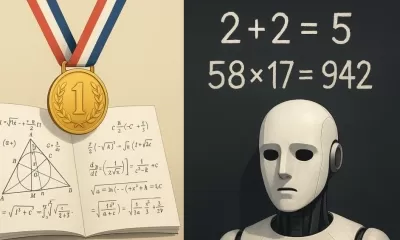
The year 2025 marked a remarkable milestone when Google DeepMind and OpenAI systems delivered gold medal performances at the International Mathematical Olympiad. These AI models solved problems typically cracked only by a select few of the world's brightest young mathematicians. Yet, these same systems frequently stumble over basic arithmetic that any middle school student could handle. This striking paradox reveals something fundamental about contemporary AI: we are witnessing the emergence of a jagged intelligence, where machines exhibit superhuman ability in specific domains while failing at tasks we deem elementary.
The Olympiad Triumph
The International Mathematical Olympiad represents the pinnacle of pre-university mathematical competition. Each year, top students tackle six problems requiring deep insight, creativity, and advanced proof techniques. In 2025, AI from both Google DeepMind and OpenAI scored 35 out of 42 points, securing gold medals. DeepMind’s AlphaGeometry 2 solved a complex geometry problem in just 19 seconds, while AlphaProof tackled number theory and algebra problems that stumped most human participants.
These breakthroughs build on years of steady progress. The systems utilize formal mathematical languages like Lean to construct rigorous proofs and employ methods such as curriculum learning, training on problems of increasing difficulty. This process enables AI to grasp complex relationships between mathematical objects, recognize subtle patterns, and formulate elegant proofs.
The Elementary Struggle
The very AI that triumphs at the Olympiad often falters on seemingly trivial tasks. Asked to multiply large numbers, it may confidently produce an incorrect answer. Its performance on other basic arithmetic operations can be similarly unpredictable. The issue extends beyond simple calculation. These systems often struggle with word problems that require tracking multiple quantities, understanding real-world context, or sequentially applying fundamental operations.
This weakness is rooted in how these models operate. Large language models predict the next piece of text based on patterns in their training data. When they see "2 + 2," they correctly output "4" not because they comprehend addition, but because this sequence appears ubiquitously in their training. Present them with unusual, rarely-seen calculations, and their performance plummets. They are pattern-matching engines, excelling with clear, consistent patterns but struggling when forced to compute something novel.
The Architecture Paradox
The contradiction between Olympiad success and arithmetic failure points to a deeper architectural issue. Modern AI excels at problems solvable through pattern recognition, logical deduction, and systematic exploration of solution spaces. Olympiad problems, though difficult, often possess elegant structures that AI can leverage. The systems can explore proof strategies, verify logical steps, and build upon established mathematical frameworks, operating in a world governed by symbols, rules, and logic.
Basic arithmetic, paradoxically, presents a different challenge. It demands precise manipulation of quantities, not pattern matching. It requires an understanding of numerical magnitude and relationships that cannot be approximated. When an AI model treats arithmetic as a language modeling task, it sees numbers as tokens to predict rather than quantities to compute. This fundamental mismatch between task requirement and model architecture creates the observed performance gap.
Training Data and Its Limitations
AI capabilities are heavily shaped by training data. Mathematical proofs and advanced problems often exist online in well-structured formats like academic papers, textbooks, and educational resources, which provide clear examples of reasoning. The internet abounds with discussions on mathematical concepts and problem-solving strategies, creating a rich corpus for learning advanced thinking.
Elementary mathematics faces a different issue. While basic arithmetic is common online, it's rarely accompanied by detailed explanations of the underlying process. Simple calculations are stated as facts, not explained as procedures. The training data contains the results of computations but not the step-by-step reasoning, creating a gap in understanding that manifests as poor performance on fundamental tasks.
Implications for AI Development
This jagged intelligence has crucial implications for AI design and deployment. Success in complex tasks does not guarantee competence in simpler ones. An AI that proves theorems might fail to balance a checkbook; a system that writes code might struggle with basic counting. This reality demands careful assessment of capabilities and limitations for real-world applications.
The phenomenon also underscores the value of hybrid approaches. Rather than expecting a single model to handle everything, we may need specialized systems for different tasks. Combining symbolic computation for arithmetic with language models for reasoning could yield more reliable solutions. The future may lie in orchestrating multiple specialized systems rather than pursuing a single, monolithic intelligence.
The Path Forward
Acknowledging jagged intelligence clarifies the path toward more capable AI. Researchers are developing ways to integrate computational tools into language models, allowing them to offload arithmetic to dedicated calculators. New training strategies teach models when to use external tools instead of internalizing every skill. This mirrors human intelligence, where we use tools for computation and focus our mental energy on higher-level reasoning.
Ultimately, the paradox of jagged intelligence teaches humility. These systems are neither universally superior nor uniformly limited. They possess a complex tapestry of strengths and weaknesses that we must understand to use and improve them effectively. Progress requires not just expanding AI's capabilities but also addressing its fundamental gaps. Machines that prove theorems yet fail at basic addition remind us that intelligence—artificial or human—remains a multifaceted phenomenon defying simple definition.
The Bottom Line
AI's ability to solve Olympiad problems but not simple math demonstrates that intelligence develops unevenly. A system can be brilliant in one area and surprisingly weak in another. Understanding this jagged profile is essential for designing and applying AI responsibly. Instead of a single model for all tasks, the solution may involve combining different approaches that leverage each system's strengths. Real-world progress will come from building AI that works reliably in practice, not from assuming it will excel at everything.
Related article
 Suno to Watermark Songs Amid Legal Battles
Suno, the platform enabling users to generate AI-created music, has unveiled new features to label platform-produced tracks, restrict downloads, and update community standards to curb unauthorized replicas. These updates arrive as Suno confronts mult
Musk Admits Grok Build Leaked User Code, Promises to Erase All Historical Data
Elon Musk directly addressed the privacy controversy surrounding Grok Build, beginning with a simple "True" to confirm the incident's validity. He pledged that all user data previously uploaded to SpaceXAI would be permanently erased, stating, "not a
U.S. Stocks Hit Historic Milestone as AI and Aerospace Giants Prepare for Trillion-Dollar Debut
Elon Musk, Sam Altman, and Dario Amodei, three titans of the technology sector, are advancing toward initial public offerings for their respective ventures. With SpaceX, OpenAI, and Anthropic—three industry behemoths nearing trillion-dollar valuation
Related Special Topic Recommendations
SEO
Suno to Watermark Songs Amid Legal Battles
Suno, the platform enabling users to generate AI-created music, has unveiled new features to label platform-produced tracks, restrict downloads, and update community standards to curb unauthorized replicas. These updates arrive as Suno confronts mult
Musk Admits Grok Build Leaked User Code, Promises to Erase All Historical Data
Elon Musk directly addressed the privacy controversy surrounding Grok Build, beginning with a simple "True" to confirm the incident's validity. He pledged that all user data previously uploaded to SpaceXAI would be permanently erased, stating, "not a
U.S. Stocks Hit Historic Milestone as AI and Aerospace Giants Prepare for Trillion-Dollar Debut
Elon Musk, Sam Altman, and Dario Amodei, three titans of the technology sector, are advancing toward initial public offerings for their respective ventures. With SpaceX, OpenAI, and Anthropic—three industry behemoths nearing trillion-dollar valuation
Related Special Topic Recommendations
SEO
 Best AI SERP Analysis Tools for Search Strategy
2026 Latest Best Top-rated AI SERP Analysis Tools for Search Strategy are curated by XIX.AI through rigorous real-world tests and weekly updated rankings. These powerful tools help you unlock hidden optimization opportunities, boost content performance, and gain a competitive edge in search. Discover your perfect tool to elevate your search strategy today. Explore now!
 13 tools
 xix.ai
Data Analysis
Best AI Anomaly Detection Tools for KPI Monitoring across SaaS and Ecommerce Teams
xix.ai
Data Analysis
Best AI Anomaly Detection Tools for KPI Monitoring across SaaS and Ecommerce Teams
2026 Latest Best Top-rated AI Anomaly Detection Tools for KPI Monitoring in SaaS and Ecommerce teams! XIX.AI has curated a powerful, game-changing collection based on rigorous real-world tests and weekly updated rankings. You’ll find detailed free vs paid comparison insights to help you identify the must-try solution that boosts productivity and unlocks your AI edge. Explore now!
10 tools
xix.ai
writing
Best AI Outline Generators for Long-Form SEO Articles
2026 Latest Best Top-Rated AI Outline Generators for Long-Form SEO Articles, meticulously curated by XIX.AI. These powerful tools offer game-changing assistance in creating high-quality content quickly, boosting writing efficiency significantly. Get a free vs paid comparison along with real-world tests and detailed rankings to help you find the must-try option that suits your needs. Explore now to unlock your AI edge.
8 tools
xix.ai
Education and Learning
AI Study Tools for Homework and Exam Prep
2026 Latest Best AI Study Tools for Homework and Exam Prep! XIX.AI curates a top-rated list of powerful, game-changing tools that help students boost productivity, streamline homework completion, and ace exams through real-world tests. Get a free vs paid comparison, detailed rankings, and must-try options to unlock your AI edge. Explore now!
10 tools
xix.ai
Music composition
AI Vocal Demo Tools for Songwriters, Hooks, Toplines, and Multilingual Draft Sessions
2026 Latest Best AI Vocal Demo Tools for Songwriters, Hook Creators, and Multi-Language Content Teams! XIX.AI has curated a top-rated list of powerful game-changing tools that go through rigorous real-world tests. You’ll find detailed free vs paid comparison data, comprehensive rankings, and must-try options to help you boost writing efficiency and unlock your creative potential. Explore now to discover your perfect tool for all your content needs!
9 tools
xix.ai
Business
Best AI Competitive Research Tools for Small Businesses
2026 Latest Best Top-rated AI Competitive Research Tools for Small Businesses! XIX.AI has curated a highly powerful game-changing collection, updated weekly with rigorous real-world tests and detailed rankings. You can find a comprehensive free vs paid comparison to help you identify the must-try tools that boost your productivity and give you a competitive edge. Explore now to discover your perfect tool!
9 tools
xix.ai

 Comments (2)
0/500
Comments (2)
0/500
![EricYoung]()
看到AI在奧數奪金卻卡在小學數學,真是有趣的反差!這是不是說明AI擅長複雜模式卻容易在基礎邏輯上翻車?讓人想起有些天才不也會忘記帶鑰匙嗎?😂 不過這也提醒我們,AI的「思考」方式可能和人類完全不同,未來教育是不是得調整方向了?
![JamesGreen]()
Interessant, dass KI bei Olympiaden glänzt, aber bei Schulmathe Probleme hat. Vielleicht liegt's daran, dass sie Muster in komplexen Aufgaben erkennt, aber das grundlegende Verständnis fehlt? 🤔 Erinnert mich an einen klugen Schüler, der komplizierte Formeln löst, aber beim Einkaufen nicht richtig rechnen kann. Die Prioritäten in der KI-Entwicklung sind manchmal echt kurios.
The year 2025 marked a remarkable milestone when Google DeepMind and OpenAI systems delivered gold medal performances at the International Mathematical Olympiad. These AI models solved problems typically cracked only by a select few of the world's brightest young mathematicians. Yet, these same systems frequently stumble over basic arithmetic that any middle school student could handle. This striking paradox reveals something fundamental about contemporary AI: we are witnessing the emergence of a jagged intelligence, where machines exhibit superhuman ability in specific domains while failing at tasks we deem elementary.
The Olympiad Triumph
The International Mathematical Olympiad represents the pinnacle of pre-university mathematical competition. Each year, top students tackle six problems requiring deep insight, creativity, and advanced proof techniques. In 2025, AI from both Google DeepMind and OpenAI scored 35 out of 42 points, securing gold medals. DeepMind’s AlphaGeometry 2 solved a complex geometry problem in just 19 seconds, while AlphaProof tackled number theory and algebra problems that stumped most human participants.
These breakthroughs build on years of steady progress. The systems utilize formal mathematical languages like Lean to construct rigorous proofs and employ methods such as curriculum learning, training on problems of increasing difficulty. This process enables AI to grasp complex relationships between mathematical objects, recognize subtle patterns, and formulate elegant proofs.
The Elementary Struggle
The very AI that triumphs at the Olympiad often falters on seemingly trivial tasks. Asked to multiply large numbers, it may confidently produce an incorrect answer. Its performance on other basic arithmetic operations can be similarly unpredictable. The issue extends beyond simple calculation. These systems often struggle with word problems that require tracking multiple quantities, understanding real-world context, or sequentially applying fundamental operations.
This weakness is rooted in how these models operate. Large language models predict the next piece of text based on patterns in their training data. When they see "2 + 2," they correctly output "4" not because they comprehend addition, but because this sequence appears ubiquitously in their training. Present them with unusual, rarely-seen calculations, and their performance plummets. They are pattern-matching engines, excelling with clear, consistent patterns but struggling when forced to compute something novel.
The Architecture Paradox
The contradiction between Olympiad success and arithmetic failure points to a deeper architectural issue. Modern AI excels at problems solvable through pattern recognition, logical deduction, and systematic exploration of solution spaces. Olympiad problems, though difficult, often possess elegant structures that AI can leverage. The systems can explore proof strategies, verify logical steps, and build upon established mathematical frameworks, operating in a world governed by symbols, rules, and logic.
Basic arithmetic, paradoxically, presents a different challenge. It demands precise manipulation of quantities, not pattern matching. It requires an understanding of numerical magnitude and relationships that cannot be approximated. When an AI model treats arithmetic as a language modeling task, it sees numbers as tokens to predict rather than quantities to compute. This fundamental mismatch between task requirement and model architecture creates the observed performance gap.
Training Data and Its Limitations
AI capabilities are heavily shaped by training data. Mathematical proofs and advanced problems often exist online in well-structured formats like academic papers, textbooks, and educational resources, which provide clear examples of reasoning. The internet abounds with discussions on mathematical concepts and problem-solving strategies, creating a rich corpus for learning advanced thinking.
Elementary mathematics faces a different issue. While basic arithmetic is common online, it's rarely accompanied by detailed explanations of the underlying process. Simple calculations are stated as facts, not explained as procedures. The training data contains the results of computations but not the step-by-step reasoning, creating a gap in understanding that manifests as poor performance on fundamental tasks.
Implications for AI Development
This jagged intelligence has crucial implications for AI design and deployment. Success in complex tasks does not guarantee competence in simpler ones. An AI that proves theorems might fail to balance a checkbook; a system that writes code might struggle with basic counting. This reality demands careful assessment of capabilities and limitations for real-world applications.
The phenomenon also underscores the value of hybrid approaches. Rather than expecting a single model to handle everything, we may need specialized systems for different tasks. Combining symbolic computation for arithmetic with language models for reasoning could yield more reliable solutions. The future may lie in orchestrating multiple specialized systems rather than pursuing a single, monolithic intelligence.
The Path Forward
Acknowledging jagged intelligence clarifies the path toward more capable AI. Researchers are developing ways to integrate computational tools into language models, allowing them to offload arithmetic to dedicated calculators. New training strategies teach models when to use external tools instead of internalizing every skill. This mirrors human intelligence, where we use tools for computation and focus our mental energy on higher-level reasoning.
Ultimately, the paradox of jagged intelligence teaches humility. These systems are neither universally superior nor uniformly limited. They possess a complex tapestry of strengths and weaknesses that we must understand to use and improve them effectively. Progress requires not just expanding AI's capabilities but also addressing its fundamental gaps. Machines that prove theorems yet fail at basic addition remind us that intelligence—artificial or human—remains a multifaceted phenomenon defying simple definition.
The Bottom Line
AI's ability to solve Olympiad problems but not simple math demonstrates that intelligence develops unevenly. A system can be brilliant in one area and surprisingly weak in another. Understanding this jagged profile is essential for designing and applying AI responsibly. Instead of a single model for all tasks, the solution may involve combining different approaches that leverage each system's strengths. Real-world progress will come from building AI that works reliably in practice, not from assuming it will excel at everything.








 Suno to Watermark Songs Amid Legal Battles
Suno, the platform enabling users to generate AI-created music, has unveiled new features to label platform-produced tracks, restrict downloads, and update community standards to curb unauthorized replicas. These updates arrive as Suno confronts mult
Suno to Watermark Songs Amid Legal Battles
Suno, the platform enabling users to generate AI-created music, has unveiled new features to label platform-produced tracks, restrict downloads, and update community standards to curb unauthorized replicas. These updates arrive as Suno confronts mult
 Musk Admits Grok Build Leaked User Code, Promises to Erase All Historical Data
Elon Musk directly addressed the privacy controversy surrounding Grok Build, beginning with a simple "True" to confirm the incident's validity. He pledged that all user data previously uploaded to SpaceXAI would be permanently erased, stating, "not a
Musk Admits Grok Build Leaked User Code, Promises to Erase All Historical Data
Elon Musk directly addressed the privacy controversy surrounding Grok Build, beginning with a simple "True" to confirm the incident's validity. He pledged that all user data previously uploaded to SpaceXAI would be permanently erased, stating, "not a
 U.S. Stocks Hit Historic Milestone as AI and Aerospace Giants Prepare for Trillion-Dollar Debut
Elon Musk, Sam Altman, and Dario Amodei, three titans of the technology sector, are advancing toward initial public offerings for their respective ventures. With SpaceX, OpenAI, and Anthropic—three industry behemoths nearing trillion-dollar valuation
U.S. Stocks Hit Historic Milestone as AI and Aerospace Giants Prepare for Trillion-Dollar Debut
Elon Musk, Sam Altman, and Dario Amodei, three titans of the technology sector, are advancing toward initial public offerings for their respective ventures. With SpaceX, OpenAI, and Anthropic—three industry behemoths nearing trillion-dollar valuation

2026 Latest Best Top-rated AI SERP Analysis Tools for Search Strategy are curated by XIX.AI through rigorous real-world tests and weekly updated rankings. These powerful tools help you unlock hidden optimization opportunities, boost content performance, and gain a competitive edge in search. Discover your perfect tool to elevate your search strategy today. Explore now!
13 tools
xix.ai

2026 Latest Best Top-rated AI Anomaly Detection Tools for KPI Monitoring in SaaS and Ecommerce teams! XIX.AI has curated a powerful, game-changing collection based on rigorous real-world tests and weekly updated rankings. You’ll find detailed free vs paid comparison insights to help you identify the must-try solution that boosts productivity and unlocks your AI edge. Explore now!
10 tools
xix.ai

2026 Latest Best Top-Rated AI Outline Generators for Long-Form SEO Articles, meticulously curated by XIX.AI. These powerful tools offer game-changing assistance in creating high-quality content quickly, boosting writing efficiency significantly. Get a free vs paid comparison along with real-world tests and detailed rankings to help you find the must-try option that suits your needs. Explore now to unlock your AI edge.
8 tools
xix.ai

2026 Latest Best AI Study Tools for Homework and Exam Prep! XIX.AI curates a top-rated list of powerful, game-changing tools that help students boost productivity, streamline homework completion, and ace exams through real-world tests. Get a free vs paid comparison, detailed rankings, and must-try options to unlock your AI edge. Explore now!
10 tools
xix.ai

2026 Latest Best AI Vocal Demo Tools for Songwriters, Hook Creators, and Multi-Language Content Teams! XIX.AI has curated a top-rated list of powerful game-changing tools that go through rigorous real-world tests. You’ll find detailed free vs paid comparison data, comprehensive rankings, and must-try options to help you boost writing efficiency and unlock your creative potential. Explore now to discover your perfect tool for all your content needs!
9 tools
xix.ai

2026 Latest Best Top-rated AI Competitive Research Tools for Small Businesses! XIX.AI has curated a highly powerful game-changing collection, updated weekly with rigorous real-world tests and detailed rankings. You can find a comprehensive free vs paid comparison to help you identify the must-try tools that boost your productivity and give you a competitive edge. Explore now to discover your perfect tool!
9 tools
xix.ai

看到AI在奧數奪金卻卡在小學數學,真是有趣的反差!這是不是說明AI擅長複雜模式卻容易在基礎邏輯上翻車?讓人想起有些天才不也會忘記帶鑰匙嗎?😂 不過這也提醒我們,AI的「思考」方式可能和人類完全不同,未來教育是不是得調整方向了?
Interessant, dass KI bei Olympiaden glänzt, aber bei Schulmathe Probleme hat. Vielleicht liegt's daran, dass sie Muster in komplexen Aufgaben erkennt, aber das grundlegende Verständnis fehlt? 🤔 Erinnert mich an einen klugen Schüler, der komplizierte Formeln löst, aber beim Einkaufen nicht richtig rechnen kann. Die Prioritäten in der KI-Entwicklung sind manchmal echt kurios.












