


 Home
HomeMeta Unveils Experimental Smart Glasses: Inside Look
Meta has shared additional details about Aria Gen 2, its experimental smart glasses designed as a platform for augmented reality, AI, and robotics research. The lightweight frame incorporates several enhancements with potential for future consumer products. These include a refined eye-tracking system capable of monitoring each eye's gaze, detecting blinks, and estimating pupil centers.
“These sophisticated signals offer deeper insights into the wearer’s visual focus and intent, opening up new avenues for human-computer interaction,” Meta states. First announced in February, Aria Gen 2 aims to “pave the way for innovations that will define the next computing platform.” It builds upon Meta’s initial research-only glasses from 2020.
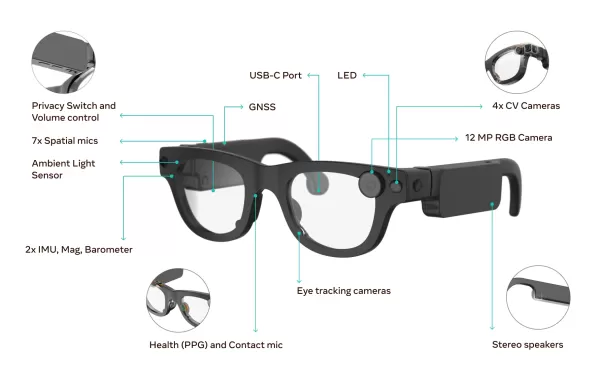 Image: Meta
In addition to the upgraded eye-tracking, Aria Gen 2 features four computer vision cameras that enable 3D hand and object tracking. According to Meta, this data can support highly precise applications, such as “dexterous robot hand manipulation.”
The glasses also integrate a photoplethysmography sensor in the nosepad to estimate the wearer’s heart rate, alongside a contact microphone said to improve audio clarity in noisy settings. A new ambient light sensor helps the device distinguish between indoor and outdoor lighting conditions.
Aria Gen 2 introduces folding arms for the first time, weighs approximately 75 grams, and is available in eight sizes. Meta plans to accept applications from researchers to work with the glasses later this year. This initiative follows the development of Meta’s Ray-Ban smart glasses and aligns with its broader efforts in wearable tech, including the rumored Orion AR glasses, a potential partnership with Oakley, and high-end “Hypernova” glasses featuring a built-in display.
Correction, June 4th: An earlier version of the headline mistakenly referred to the glasses as "AR" due to an editing error. This reference has been removed.
Related article
 Why Cognition Bought Poke: AI Personality Is Becoming a Competitive Advantage
Poke, the AI assistant designed to chat like a friend, is taking its next major step. The Interaction Company of California, the startup behind Poke, has been acquired by AI coding firm Cognition in a transaction valuing the company in the low nine f
IDC Releases China Generative AI Security Evaluation Platform Report; Ant Digital Ranks as a Leader
As enterprises increasingly integrate AI into core operations like customer service and management, security risks have grown more complex. Beyond traditional threats such as model jailbreaks and data leaks, new challenges like tool abuse, agent priv
Meta Tests AI Bedtime Story App StoryKit to Solve Parents’ Storytelling Challenges
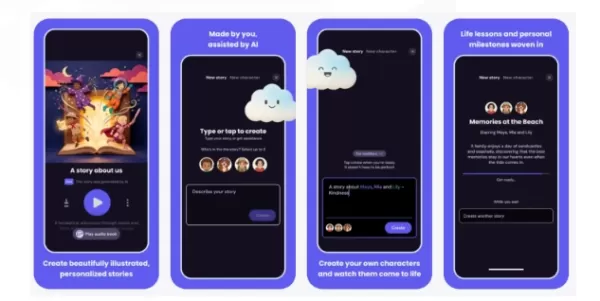
Designed to support busy parents, Meta is testing StoryKit, an AI-powered app that generates personalized bedtime stories for kids, complete with custom characters, scenes, and music.Parents simply upload photos of their child’s favorite toys to crea
Related Special Topic Recommendations
code
Why Cognition Bought Poke: AI Personality Is Becoming a Competitive Advantage
Poke, the AI assistant designed to chat like a friend, is taking its next major step. The Interaction Company of California, the startup behind Poke, has been acquired by AI coding firm Cognition in a transaction valuing the company in the low nine f
IDC Releases China Generative AI Security Evaluation Platform Report; Ant Digital Ranks as a Leader
As enterprises increasingly integrate AI into core operations like customer service and management, security risks have grown more complex. Beyond traditional threats such as model jailbreaks and data leaks, new challenges like tool abuse, agent priv
Meta Tests AI Bedtime Story App StoryKit to Solve Parents’ Storytelling Challenges
Designed to support busy parents, Meta is testing StoryKit, an AI-powered app that generates personalized bedtime stories for kids, complete with custom characters, scenes, and music.Parents simply upload photos of their child’s favorite toys to crea
Related Special Topic Recommendations
code
 ChatGPT Debugging Tools for Python Errors, API Logs, and Stack Trace Triage
2026 Latest Best ChatGPT debugging tools for Python errors, API logs, and stack trace triage are here on XIX.AI. This curated list of top-rated solutions offers a free vs paid comparison, real-world tests, and detailed rankings to help you find the most powerful tool that can significantly boost your productivity and help you solve complex technical issues faster. Explore now to discover your perfect solution!
 9 tools
 xix.ai
Text-to-speech
AI Voiceover Tools for Product Demo Videos
xix.ai
Text-to-speech
AI Voiceover Tools for Product Demo Videos
2026 Latest Best Top-Rated AI Voiceover Tools for Product Demo Videos are here on XIX.AI! This curated list features powerful, game-changing options that help you create professional-quality audio content fast, boosting your demo efficiency significantly. We conduct real-world tests and provide a free vs paid comparison along with weekly updated rankings to help you find the perfect fit. Explore now to Unlock your AI edge!
10 tools
xix.ai
Business
AI Business Plan Tools for Startup Validation
2026 Latest Best AI Business Plan Tools for Startup Validation! XIX.AI has curated a top-rated list of powerful game-changing tools that go through real-world tests to deliver accurate results. You’ll find a free vs paid comparison, detailed rankings, and easy-to-understand insights to help you choose the perfect solution and boost your startup’s success rate. Explore now to Unlock your AI edge!
9 tools
xix.ai
chatbot
AI Chat Apps for Roleplay and Conversation Practice
2026 Latest Best AI Chat Apps for Roleplay and Conversation Practice! XIX.AI curates a top-rated list of powerful must-try tools that go through rigorous real-world tests to deliver exceptional results. You’ll find detailed free vs paid comparison, comprehensive rankings, and insights into how these apps can boost your language skills and communication confidence effectively. Explore now to discover your perfect tool for practice!
10 tools
xix.ai
design
Best AI Wireframe Tools for Product Teams
2026 Latest Best Top-rated AI Wireframe Tools for Product Teams! This curated list showcases powerful, game-changing solutions that significantly boost productivity through real-world tests and rigorous rankings. It includes a detailed free vs paid comparison to help you find the perfect fit. XIX.AI provides expert insights to guide your decision. Explore now to Discover your perfect tool and Unlock your AI edge in product development!
8 tools
xix.ai
Software Development
Best AI DevOps Tools for Deployment Monitoring
2026 Latest Best Top-Rated AI DevOps Tools for Deployment Monitoring are featured here in our carefully curated list. These powerful tools help teams boost productivity significantly through real-world tests and rigorous rankings. Get a free vs paid comparison to find the perfect option that suits your needs. Explore now to unlock your AI edge!
11 tools
xix.ai

 Comments (0)
0/500
Comments (0)
0/500
Meta has shared additional details about Aria Gen 2, its experimental smart glasses designed as a platform for augmented reality, AI, and robotics research. The lightweight frame incorporates several enhancements with potential for future consumer products. These include a refined eye-tracking system capable of monitoring each eye's gaze, detecting blinks, and estimating pupil centers.
“These sophisticated signals offer deeper insights into the wearer’s visual focus and intent, opening up new avenues for human-computer interaction,” Meta states. First announced in February, Aria Gen 2 aims to “pave the way for innovations that will define the next computing platform.” It builds upon Meta’s initial research-only glasses from 2020.
Image: MetaIn addition to the upgraded eye-tracking, Aria Gen 2 features four computer vision cameras that enable 3D hand and object tracking. According to Meta, this data can support highly precise applications, such as “dexterous robot hand manipulation.”
The glasses also integrate a photoplethysmography sensor in the nosepad to estimate the wearer’s heart rate, alongside a contact microphone said to improve audio clarity in noisy settings. A new ambient light sensor helps the device distinguish between indoor and outdoor lighting conditions.
Aria Gen 2 introduces folding arms for the first time, weighs approximately 75 grams, and is available in eight sizes. Meta plans to accept applications from researchers to work with the glasses later this year. This initiative follows the development of Meta’s Ray-Ban smart glasses and aligns with its broader efforts in wearable tech, including the rumored Orion AR glasses, a potential partnership with Oakley, and high-end “Hypernova” glasses featuring a built-in display.
Correction, June 4th: An earlier version of the headline mistakenly referred to the glasses as "AR" due to an editing error. This reference has been removed.








 Why Cognition Bought Poke: AI Personality Is Becoming a Competitive Advantage
Poke, the AI assistant designed to chat like a friend, is taking its next major step. The Interaction Company of California, the startup behind Poke, has been acquired by AI coding firm Cognition in a transaction valuing the company in the low nine f
Why Cognition Bought Poke: AI Personality Is Becoming a Competitive Advantage
Poke, the AI assistant designed to chat like a friend, is taking its next major step. The Interaction Company of California, the startup behind Poke, has been acquired by AI coding firm Cognition in a transaction valuing the company in the low nine f
 IDC Releases China Generative AI Security Evaluation Platform Report; Ant Digital Ranks as a Leader
As enterprises increasingly integrate AI into core operations like customer service and management, security risks have grown more complex. Beyond traditional threats such as model jailbreaks and data leaks, new challenges like tool abuse, agent priv
IDC Releases China Generative AI Security Evaluation Platform Report; Ant Digital Ranks as a Leader
As enterprises increasingly integrate AI into core operations like customer service and management, security risks have grown more complex. Beyond traditional threats such as model jailbreaks and data leaks, new challenges like tool abuse, agent priv
 Meta Tests AI Bedtime Story App StoryKit to Solve Parents’ Storytelling Challenges
Designed to support busy parents, Meta is testing StoryKit, an AI-powered app that generates personalized bedtime stories for kids, complete with custom characters, scenes, and music.Parents simply upload photos of their child’s favorite toys to crea
Meta Tests AI Bedtime Story App StoryKit to Solve Parents’ Storytelling Challenges
Designed to support busy parents, Meta is testing StoryKit, an AI-powered app that generates personalized bedtime stories for kids, complete with custom characters, scenes, and music.Parents simply upload photos of their child’s favorite toys to crea

2026 Latest Best ChatGPT debugging tools for Python errors, API logs, and stack trace triage are here on XIX.AI. This curated list of top-rated solutions offers a free vs paid comparison, real-world tests, and detailed rankings to help you find the most powerful tool that can significantly boost your productivity and help you solve complex technical issues faster. Explore now to discover your perfect solution!
9 tools
xix.ai

2026 Latest Best Top-Rated AI Voiceover Tools for Product Demo Videos are here on XIX.AI! This curated list features powerful, game-changing options that help you create professional-quality audio content fast, boosting your demo efficiency significantly. We conduct real-world tests and provide a free vs paid comparison along with weekly updated rankings to help you find the perfect fit. Explore now to Unlock your AI edge!
10 tools
xix.ai

2026 Latest Best AI Business Plan Tools for Startup Validation! XIX.AI has curated a top-rated list of powerful game-changing tools that go through real-world tests to deliver accurate results. You’ll find a free vs paid comparison, detailed rankings, and easy-to-understand insights to help you choose the perfect solution and boost your startup’s success rate. Explore now to Unlock your AI edge!
9 tools
xix.ai

2026 Latest Best AI Chat Apps for Roleplay and Conversation Practice! XIX.AI curates a top-rated list of powerful must-try tools that go through rigorous real-world tests to deliver exceptional results. You’ll find detailed free vs paid comparison, comprehensive rankings, and insights into how these apps can boost your language skills and communication confidence effectively. Explore now to discover your perfect tool for practice!
10 tools
xix.ai

2026 Latest Best Top-rated AI Wireframe Tools for Product Teams! This curated list showcases powerful, game-changing solutions that significantly boost productivity through real-world tests and rigorous rankings. It includes a detailed free vs paid comparison to help you find the perfect fit. XIX.AI provides expert insights to guide your decision. Explore now to Discover your perfect tool and Unlock your AI edge in product development!
8 tools
xix.ai

2026 Latest Best Top-Rated AI DevOps Tools for Deployment Monitoring are featured here in our carefully curated list. These powerful tools help teams boost productivity significantly through real-world tests and rigorous rankings. Get a free vs paid comparison to find the perfect option that suits your needs. Explore now to unlock your AI edge!
11 tools
xix.ai












