


 Home
Home
Google Unveils Gemini-SQL2: Revolutionary AI Model Redefines Database Interaction Standards
As artificial intelligence continues to evolve at a rapid pace, enabling machines to accurately interpret and process database query requests has remained a critical priority for the industry. On June 12, Google Research unveiled a new model named Gemini-SQL2. Developed based on Gemini 3.1 Pro, this specialized model excels at handling text-to-SQL tasks and has successfully ranked highest in authoritative evaluation tests.
Text-to-SQL tasks involve allowing computers to comprehend natural language conversations and transform them into actionable database query commands. In applications such as enterprise systems, self-service data analysis tools, and SaaS platforms, this technology significantly lowers the barriers for users working with complex databases. Nevertheless, intricate table structures, unclear field definitions, and complex business logic have long posed significant challenges for AI systems attempting to perform such tasks.
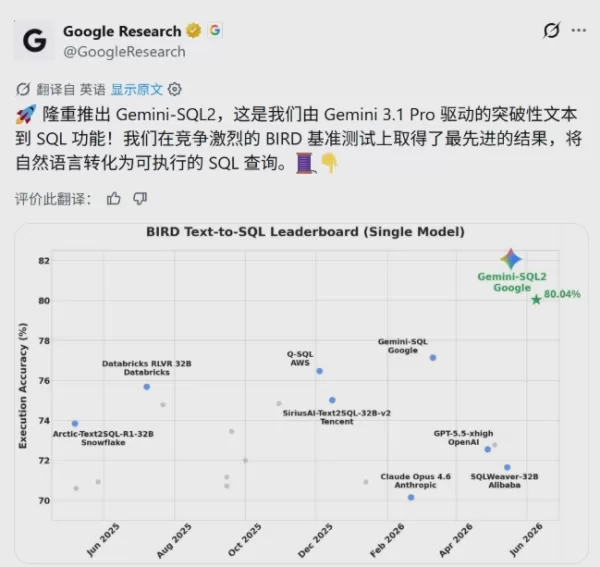
In this context, Gemini-SQL2 stands out due to its superior performance. According to the most recent results from the industry benchmarking platform BIRD, the model achieved an execution accuracy rate of 80.04% in single-model evaluations, surpassing even its predecessor developed by Google. It is worth noting that the BIRD evaluation set comprises 95 databases from 37 different professional fields, totaling over 12,000 test questions. This set not only replicates real-world enterprise environments but also includes scenarios with incomplete data and questions that require external knowledge, adding significant value to the assessments.
The potential applications of this model are extensive. In the future, enterprise employees will no longer need to be experts in complex coding languages. They will be able to simply pose questions in natural language—such as “What is the performance of regional sales losses over the last quarter?”—and the system will automatically retrieve the relevant data and generate accurate analytical reports.
While the industry holds high expectations for the practical deployment of this model, Google has not yet disclosed the specific model identifier, API details, or a comprehensive technical report for Gemini-SQL2. It has also not specified which products will be the first to incorporate this capability. How this advanced AI model will transform data analysis workflows remains a topic of great interest among industry professionals.
Related article
 ByteDance's Wang Changhu Raises $1.35B in 6 Months, Unlocking Billion-Dollar Valuation
In the rapidly evolving landscape of AI video generation, Wang Changhu stands out as a key figure to watch. As the former head of visual technology at ByteDance and the founder and CEO of Aishitech, he has demonstrated exceptional team execution and
BYD Unveils Xuanji A3, Its First Automotive-Grade 4nm AI Chip
The global race for the foundational computing power of intelligent vehicles has reached a pivotal moment. On May 29, BYD unveiled the "Xuanji A3," China’s first fully self-developed, designed, and supply-chain-tested 4nm vehicle-grade intelligent dr
OpenAI Launches Astra for Law, Indexing 230M URLs and Outperforming General Models in Legal Q&A
On September 17, OpenAI released a blog post detailing Astra for Law, an AI foundation platform tailored for legal applications. Its robustness stems from its extensive data scale: the legal search index encompasses over 230 million URLs and integrat
Related Special Topic Recommendations
Design & Art
ByteDance's Wang Changhu Raises $1.35B in 6 Months, Unlocking Billion-Dollar Valuation
In the rapidly evolving landscape of AI video generation, Wang Changhu stands out as a key figure to watch. As the former head of visual technology at ByteDance and the founder and CEO of Aishitech, he has demonstrated exceptional team execution and
BYD Unveils Xuanji A3, Its First Automotive-Grade 4nm AI Chip
The global race for the foundational computing power of intelligent vehicles has reached a pivotal moment. On May 29, BYD unveiled the "Xuanji A3," China’s first fully self-developed, designed, and supply-chain-tested 4nm vehicle-grade intelligent dr
OpenAI Launches Astra for Law, Indexing 230M URLs and Outperforming General Models in Legal Q&A
On September 17, OpenAI released a blog post detailing Astra for Law, an AI foundation platform tailored for legal applications. Its robustness stems from its extensive data scale: the legal search index encompasses over 230 million URLs and integrat
Related Special Topic Recommendations
Design & Art
 Top AI Illustration Tools: Create Editorial Scenes and Cover Art Faster
2026 Latest Top-rated AI Illustration Tools: Our curated list features the best powerfully designed tools for creating stunning editorial scenes and eye-catching cover art quickly. Each option has gone through rigorous real-world tests, offering a free vs paid comparison to help you find the perfect match for your workflow. Try these must-try solutions today to unlock your AI edge and boost your creative productivity. Explore now at XIX.AI.
 10 tools
 xix.ai
Education and Learning
Top AI Tutors for Exam Prep: Practice Math, Science, and English
xix.ai
Education and Learning
Top AI Tutors for Exam Prep: Practice Math, Science, and English
2026 Latest Top-Rated Best AI Tutors for Exam Prep are here on XIX.AI! Our curated list features powerful game-changing tools that offer free vs paid comparison, real-world tests, and weekly updated rankings. They help boost your writing efficiency, simplify complex topic learning, and unlock your academic potential. Explore now to Discover your perfect exam prep tool and Start creating today to Unlock your AI edge!
10 tools
xix.ai
Finance
AI Budget Planning Tools for Personal Money Management
2026 Latest Best Top-Rated AI Budget Planning Tools for Personal Money Management are here on XIX.AI! This curated collection features powerful, game-changing solutions that help you conduct real-world tests, understand spending habits, and create personalized plans to boost productivity. Enjoy a free vs paid comparison along with detailed rankings. Must-try tools designed to simplify money management and unlock your AI edge. Explore now!
11 tools
xix.ai
Health & Wellness
AI Sleep Tracking Assistants: Improve Recovery with Better Bedtime Habits
2026 Latest Best Top-Rated AI Sleep Tracking Assistants curated for ultimate recovery. This fully updated weekly guide features powerful tools that deliver real-world tests, free vs paid comparison, and detailed rankings to help you find the must-try solution that boosts sleep quality and supports better bedtime habits. Explore now at XIX.AI to Unlock your AI edge.
10 tools
xix.ai
Data Analysis
AI SQL Copilots for Product and Revenue Analytics
2026 Latest Best Top-Rated AI SQL Copilots for Product and Revenue Analytics! XIX.AI has curated a powerful, game-changing collection of must-try tools that undergo real-world tests through weekly updated rankings. These tools help users boost productivity significantly by accelerating data analysis, streamlining complex queries, and generating accurate insights to drive smarter business decisions. Explore now to Discover your perfect tool for unlocking your AI edge!
14 tools
xix.ai
Education and Learning
Best AI Homework Helpers That Teach: Learn Concepts, Not Just Answers
2026 Latest Best Top-Rated AI Homework Helpers That Teach Core Concepts Not Just Answers Powerful Tools for Students Must-Try Curated List Weekly Updated Free vs Paid Comparison Real-World Tests Accurate Rankings to Help You Unlock Your Full Learning Potential Explore now to Discover your perfect tool for smarter studying.
10 tools
xix.ai

 Comments (0)
0/500
Comments (0)
0/500
As artificial intelligence continues to evolve at a rapid pace, enabling machines to accurately interpret and process database query requests has remained a critical priority for the industry. On June 12, Google Research unveiled a new model named Gemini-SQL2. Developed based on Gemini 3.1 Pro, this specialized model excels at handling text-to-SQL tasks and has successfully ranked highest in authoritative evaluation tests.
Text-to-SQL tasks involve allowing computers to comprehend natural language conversations and transform them into actionable database query commands. In applications such as enterprise systems, self-service data analysis tools, and SaaS platforms, this technology significantly lowers the barriers for users working with complex databases. Nevertheless, intricate table structures, unclear field definitions, and complex business logic have long posed significant challenges for AI systems attempting to perform such tasks.
In this context, Gemini-SQL2 stands out due to its superior performance. According to the most recent results from the industry benchmarking platform BIRD, the model achieved an execution accuracy rate of 80.04% in single-model evaluations, surpassing even its predecessor developed by Google. It is worth noting that the BIRD evaluation set comprises 95 databases from 37 different professional fields, totaling over 12,000 test questions. This set not only replicates real-world enterprise environments but also includes scenarios with incomplete data and questions that require external knowledge, adding significant value to the assessments.
The potential applications of this model are extensive. In the future, enterprise employees will no longer need to be experts in complex coding languages. They will be able to simply pose questions in natural language—such as “What is the performance of regional sales losses over the last quarter?”—and the system will automatically retrieve the relevant data and generate accurate analytical reports.
While the industry holds high expectations for the practical deployment of this model, Google has not yet disclosed the specific model identifier, API details, or a comprehensive technical report for Gemini-SQL2. It has also not specified which products will be the first to incorporate this capability. How this advanced AI model will transform data analysis workflows remains a topic of great interest among industry professionals.








 ByteDance's Wang Changhu Raises $1.35B in 6 Months, Unlocking Billion-Dollar Valuation
In the rapidly evolving landscape of AI video generation, Wang Changhu stands out as a key figure to watch. As the former head of visual technology at ByteDance and the founder and CEO of Aishitech, he has demonstrated exceptional team execution and
ByteDance's Wang Changhu Raises $1.35B in 6 Months, Unlocking Billion-Dollar Valuation
In the rapidly evolving landscape of AI video generation, Wang Changhu stands out as a key figure to watch. As the former head of visual technology at ByteDance and the founder and CEO of Aishitech, he has demonstrated exceptional team execution and
 BYD Unveils Xuanji A3, Its First Automotive-Grade 4nm AI Chip
The global race for the foundational computing power of intelligent vehicles has reached a pivotal moment. On May 29, BYD unveiled the "Xuanji A3," China’s first fully self-developed, designed, and supply-chain-tested 4nm vehicle-grade intelligent dr
BYD Unveils Xuanji A3, Its First Automotive-Grade 4nm AI Chip
The global race for the foundational computing power of intelligent vehicles has reached a pivotal moment. On May 29, BYD unveiled the "Xuanji A3," China’s first fully self-developed, designed, and supply-chain-tested 4nm vehicle-grade intelligent dr
 OpenAI Launches Astra for Law, Indexing 230M URLs and Outperforming General Models in Legal Q&A
On September 17, OpenAI released a blog post detailing Astra for Law, an AI foundation platform tailored for legal applications. Its robustness stems from its extensive data scale: the legal search index encompasses over 230 million URLs and integrat
OpenAI Launches Astra for Law, Indexing 230M URLs and Outperforming General Models in Legal Q&A
On September 17, OpenAI released a blog post detailing Astra for Law, an AI foundation platform tailored for legal applications. Its robustness stems from its extensive data scale: the legal search index encompasses over 230 million URLs and integrat

2026 Latest Top-rated AI Illustration Tools: Our curated list features the best powerfully designed tools for creating stunning editorial scenes and eye-catching cover art quickly. Each option has gone through rigorous real-world tests, offering a free vs paid comparison to help you find the perfect match for your workflow. Try these must-try solutions today to unlock your AI edge and boost your creative productivity. Explore now at XIX.AI.
10 tools
xix.ai

2026 Latest Top-Rated Best AI Tutors for Exam Prep are here on XIX.AI! Our curated list features powerful game-changing tools that offer free vs paid comparison, real-world tests, and weekly updated rankings. They help boost your writing efficiency, simplify complex topic learning, and unlock your academic potential. Explore now to Discover your perfect exam prep tool and Start creating today to Unlock your AI edge!
10 tools
xix.ai

2026 Latest Best Top-Rated AI Budget Planning Tools for Personal Money Management are here on XIX.AI! This curated collection features powerful, game-changing solutions that help you conduct real-world tests, understand spending habits, and create personalized plans to boost productivity. Enjoy a free vs paid comparison along with detailed rankings. Must-try tools designed to simplify money management and unlock your AI edge. Explore now!
11 tools
xix.ai

2026 Latest Best Top-Rated AI Sleep Tracking Assistants curated for ultimate recovery. This fully updated weekly guide features powerful tools that deliver real-world tests, free vs paid comparison, and detailed rankings to help you find the must-try solution that boosts sleep quality and supports better bedtime habits. Explore now at XIX.AI to Unlock your AI edge.
10 tools
xix.ai

2026 Latest Best Top-Rated AI SQL Copilots for Product and Revenue Analytics! XIX.AI has curated a powerful, game-changing collection of must-try tools that undergo real-world tests through weekly updated rankings. These tools help users boost productivity significantly by accelerating data analysis, streamlining complex queries, and generating accurate insights to drive smarter business decisions. Explore now to Discover your perfect tool for unlocking your AI edge!
14 tools
xix.ai

2026 Latest Best Top-Rated AI Homework Helpers That Teach Core Concepts Not Just Answers Powerful Tools for Students Must-Try Curated List Weekly Updated Free vs Paid Comparison Real-World Tests Accurate Rankings to Help You Unlock Your Full Learning Potential Explore now to Discover your perfect tool for smarter studying.
10 tools
xix.ai












