


 Home
HomeGoogle harnesses historical news data and AI to forecast flash floods
Flash floods rank as some of the planet's most lethal weather phenomena, claiming over 5,000 lives annually. They are also notoriously challenging to forecast. Google, however, believes it has found a novel solution to this problem: by analyzing news reports.
While humanity has amassed vast amounts of meteorological data, flash floods are too brief and localized to be systematically measured, unlike temperature or river flow trends tracked over time. This data deficiency hinders deep learning models, even as they grow more adept at general weather prediction, from accurately forecasting flash floods.
To bridge this gap, Google researchers employed Gemini—the company's large language model—to sift through 5 million global news articles. The process identified reports of 2.6 million distinct flood events, converting them into a geotagged timeline named "Groundsource." According to Gila Loike, a Google Research product manager, this marks the company's first use of language models for such a purpose. The research and data set were made public on Thursday morning.
Using Groundsource as a real-world benchmark, the team trained a model based on a Long Short-Term Memory (LSTM) neural network. This model processes global weather forecasts to generate probability estimates for flash floods in specific locations.
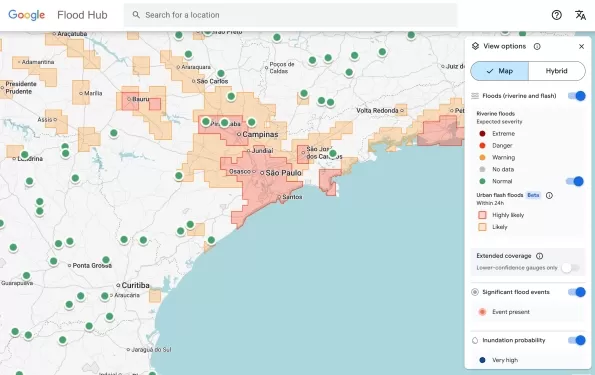
Google's flash flood forecasting model now identifies risks for urban areas across 150 countries on its Flood Hub platform and shares this data with emergency response agencies worldwide. António José Beleza, an emergency response official with the Southern African Development Community who participated in a trial of the model, stated it significantly improved his organization's response speed to flood events.
The model does have current limitations. Its resolution is relatively broad, assessing risk across 20-square-kilometer zones. It is also less precise than systems like the US National Weather Service's flood alerts, partly because it does not integrate local radar data for real-time precipitation tracking.
A key objective of the project, however, was to create a solution for regions where local governments lack the resources for costly weather-sensing infrastructure or detailed historical meteorological records.
"By aggregating millions of reports, the Groundsource data set helps rebalance the global map," explained Juliet Rothenberg, a program manager on Google's Resilience team. "It allows us to extrapolate insights to other regions with far less available information."
Rothenberg added that the team hopes this methodology—using LLMs to create quantitative data sets from qualitative, written sources—can be applied to other ephemeral but critical forecasting challenges, such as heat waves and mudslides.
Marshall Moutenot, CEO of Upstream Tech, a firm using similar deep learning for river flow forecasts for clients like hydropower companies, views Google's work as part of a broader push to compile data for AI-driven weather models. Moutenot also co-founded dynamical.org, a group curating machine learning-ready weather data for researchers and startups.
"Data scarcity remains one of the toughest hurdles in geophysics," Moutenot noted. "Paradoxically, there's an overabundance of Earth data, yet a shortage of validated ground truth for evaluation. This was a highly creative approach to acquiring that essential data."
Related article
 Swedish AI Startup Lovable Eyes $13.2 Billion Valuation After Major Funding Round
As AI-driven coding tools gain traction, Swedish startup Lovable has secured a major funding round. The company aims to raise $3 billion, potentially boosting its valuation to $13.2 billion—double the $6.6 billion recorded last December. Menlo Ventur
Google Tests Remy AI Agent for Gemini as Focus Shifts to User Control
According to Business Insider, Google is testing Remy, a new AI personal agent for Gemini. This tool aims to execute tasks on behalf of users, streamlining both professional workflows and daily routines.Currently, Remy is undergoing testing in an int
How to fix Core Web Vitals for better SEO rankings
Streamline Report Card Comments with AI ToolsIntroductionAI Tools for Generating Report Card CommentsMagic SchoolAlmanac AIChat GPTUsing Magic School to Generate Report Card CommentsLogging into Magic SchoolSelecting the Report Card Comments ToolCust
Related Special Topic Recommendations
writing
Swedish AI Startup Lovable Eyes $13.2 Billion Valuation After Major Funding Round
As AI-driven coding tools gain traction, Swedish startup Lovable has secured a major funding round. The company aims to raise $3 billion, potentially boosting its valuation to $13.2 billion—double the $6.6 billion recorded last December. Menlo Ventur
Google Tests Remy AI Agent for Gemini as Focus Shifts to User Control
According to Business Insider, Google is testing Remy, a new AI personal agent for Gemini. This tool aims to execute tasks on behalf of users, streamlining both professional workflows and daily routines.Currently, Remy is undergoing testing in an int
How to fix Core Web Vitals for better SEO rankings
Streamline Report Card Comments with AI ToolsIntroductionAI Tools for Generating Report Card CommentsMagic SchoolAlmanac AIChat GPTUsing Magic School to Generate Report Card CommentsLogging into Magic SchoolSelecting the Report Card Comments ToolCust
Related Special Topic Recommendations
writing
 Best AI Outline Generators for Long-Form SEO Articles
2026 Latest Best Top-Rated AI Outline Generators for Long-Form SEO Articles, meticulously curated by XIX.AI. These powerful tools offer game-changing assistance in creating high-quality content quickly, boosting writing efficiency significantly. Get a free vs paid comparison along with real-world tests and detailed rankings to help you find the must-try option that suits your needs. Explore now to unlock your AI edge.
 8 tools
 xix.ai
Education and Learning
AI Study Tools for Homework and Exam Prep
xix.ai
Education and Learning
AI Study Tools for Homework and Exam Prep
2026 Latest Best AI Study Tools for Homework and Exam Prep! XIX.AI curates a top-rated list of powerful, game-changing tools that help students boost productivity, streamline homework completion, and ace exams through real-world tests. Get a free vs paid comparison, detailed rankings, and must-try options to unlock your AI edge. Explore now!
10 tools
xix.ai
Music composition
AI Vocal Demo Tools for Songwriters, Hooks, Toplines, and Multilingual Draft Sessions
2026 Latest Best AI Vocal Demo Tools for Songwriters, Hook Creators, and Multi-Language Content Teams! XIX.AI has curated a top-rated list of powerful game-changing tools that go through rigorous real-world tests. You’ll find detailed free vs paid comparison data, comprehensive rankings, and must-try options to help you boost writing efficiency and unlock your creative potential. Explore now to discover your perfect tool for all your content needs!
9 tools
xix.ai
Business
Best AI Competitive Research Tools for Small Businesses
2026 Latest Best Top-rated AI Competitive Research Tools for Small Businesses! XIX.AI has curated a highly powerful game-changing collection, updated weekly with rigorous real-world tests and detailed rankings. You can find a comprehensive free vs paid comparison to help you identify the must-try tools that boost your productivity and give you a competitive edge. Explore now to discover your perfect tool!
9 tools
xix.ai
Image editing
Photoshop AI Retouch Tools for Ecommerce Apparel, Skin Cleanup, and Color Consistency
2026 Latest Best Photoshop AI retouch tools for ecommerce apparel, skin cleanup, and color consistency! This top-rated curated list features powerful game-changing solutions that help you boost writing efficiency, streamline content creation, and achieve perfect visual results effortlessly. Each tool has undergone real-world tests through weekly updated rankings, complete with free vs paid comparison details. Backed by XIX.AI, it’s the must-try guide for anyone aiming to unlock your AI edge. Explore now!
10 tools
xix.ai
Prompt
Best AI Prompt Libraries for ChatGPT Workflows
2026 Latest Best Top-Rated AI Prompt Libraries for optimizing all types of ChatGPT workflows. XIX.AI has curated a powerful, game-changing collection that goes through rigorous real-world tests to ensure top performance. You can find detailed free vs paid comparisons and expert rankings to help you choose the must-try tools that boost your productivity and unlock your AI edge. Explore now!
11 tools
xix.ai

 Comments (2)
0/500
Comments (2)
0/500
![JosephScott]()
So Google's basically using old news articles to predict floods? That's wild. I mean, if it works, it could save thousands of lives, but I wonder how much historical data is actually reliable when weather patterns are changing so fast. 🌊🤔
![RalphJohnson]()
ニュース記事をAIで分析して洪水を予測するなんて、Googleらしい発想だね。でも、データの偏りやプライバシーは大丈夫?特に途上国のニュース網が不十分な地域では、精度に影響が出そう。それに、この技術が有料サービス化されたら、災害予測にお金がかかる世の中になるのかな…ちょっと怖いかも😅
Flash floods rank as some of the planet's most lethal weather phenomena, claiming over 5,000 lives annually. They are also notoriously challenging to forecast. Google, however, believes it has found a novel solution to this problem: by analyzing news reports.
While humanity has amassed vast amounts of meteorological data, flash floods are too brief and localized to be systematically measured, unlike temperature or river flow trends tracked over time. This data deficiency hinders deep learning models, even as they grow more adept at general weather prediction, from accurately forecasting flash floods.
To bridge this gap, Google researchers employed Gemini—the company's large language model—to sift through 5 million global news articles. The process identified reports of 2.6 million distinct flood events, converting them into a geotagged timeline named "Groundsource." According to Gila Loike, a Google Research product manager, this marks the company's first use of language models for such a purpose. The research and data set were made public on Thursday morning.
Using Groundsource as a real-world benchmark, the team trained a model based on a Long Short-Term Memory (LSTM) neural network. This model processes global weather forecasts to generate probability estimates for flash floods in specific locations.
Google's flash flood forecasting model now identifies risks for urban areas across 150 countries on its Flood Hub platform and shares this data with emergency response agencies worldwide. António José Beleza, an emergency response official with the Southern African Development Community who participated in a trial of the model, stated it significantly improved his organization's response speed to flood events.
The model does have current limitations. Its resolution is relatively broad, assessing risk across 20-square-kilometer zones. It is also less precise than systems like the US National Weather Service's flood alerts, partly because it does not integrate local radar data for real-time precipitation tracking.
A key objective of the project, however, was to create a solution for regions where local governments lack the resources for costly weather-sensing infrastructure or detailed historical meteorological records.
"By aggregating millions of reports, the Groundsource data set helps rebalance the global map," explained Juliet Rothenberg, a program manager on Google's Resilience team. "It allows us to extrapolate insights to other regions with far less available information."
Rothenberg added that the team hopes this methodology—using LLMs to create quantitative data sets from qualitative, written sources—can be applied to other ephemeral but critical forecasting challenges, such as heat waves and mudslides.
Marshall Moutenot, CEO of Upstream Tech, a firm using similar deep learning for river flow forecasts for clients like hydropower companies, views Google's work as part of a broader push to compile data for AI-driven weather models. Moutenot also co-founded dynamical.org, a group curating machine learning-ready weather data for researchers and startups.
"Data scarcity remains one of the toughest hurdles in geophysics," Moutenot noted. "Paradoxically, there's an overabundance of Earth data, yet a shortage of validated ground truth for evaluation. This was a highly creative approach to acquiring that essential data."








 Swedish AI Startup Lovable Eyes $13.2 Billion Valuation After Major Funding Round
As AI-driven coding tools gain traction, Swedish startup Lovable has secured a major funding round. The company aims to raise $3 billion, potentially boosting its valuation to $13.2 billion—double the $6.6 billion recorded last December. Menlo Ventur
Google Tests Remy AI Agent for Gemini as Focus Shifts to User Control
According to Business Insider, Google is testing Remy, a new AI personal agent for Gemini. This tool aims to execute tasks on behalf of users, streamlining both professional workflows and daily routines.Currently, Remy is undergoing testing in an int
Swedish AI Startup Lovable Eyes $13.2 Billion Valuation After Major Funding Round
As AI-driven coding tools gain traction, Swedish startup Lovable has secured a major funding round. The company aims to raise $3 billion, potentially boosting its valuation to $13.2 billion—double the $6.6 billion recorded last December. Menlo Ventur
Google Tests Remy AI Agent for Gemini as Focus Shifts to User Control
According to Business Insider, Google is testing Remy, a new AI personal agent for Gemini. This tool aims to execute tasks on behalf of users, streamlining both professional workflows and daily routines.Currently, Remy is undergoing testing in an int
 How to fix Core Web Vitals for better SEO rankings
Streamline Report Card Comments with AI ToolsIntroductionAI Tools for Generating Report Card CommentsMagic SchoolAlmanac AIChat GPTUsing Magic School to Generate Report Card CommentsLogging into Magic SchoolSelecting the Report Card Comments ToolCust
How to fix Core Web Vitals for better SEO rankings
Streamline Report Card Comments with AI ToolsIntroductionAI Tools for Generating Report Card CommentsMagic SchoolAlmanac AIChat GPTUsing Magic School to Generate Report Card CommentsLogging into Magic SchoolSelecting the Report Card Comments ToolCust

2026 Latest Best Top-Rated AI Outline Generators for Long-Form SEO Articles, meticulously curated by XIX.AI. These powerful tools offer game-changing assistance in creating high-quality content quickly, boosting writing efficiency significantly. Get a free vs paid comparison along with real-world tests and detailed rankings to help you find the must-try option that suits your needs. Explore now to unlock your AI edge.
8 tools
xix.ai

2026 Latest Best AI Study Tools for Homework and Exam Prep! XIX.AI curates a top-rated list of powerful, game-changing tools that help students boost productivity, streamline homework completion, and ace exams through real-world tests. Get a free vs paid comparison, detailed rankings, and must-try options to unlock your AI edge. Explore now!
10 tools
xix.ai

2026 Latest Best AI Vocal Demo Tools for Songwriters, Hook Creators, and Multi-Language Content Teams! XIX.AI has curated a top-rated list of powerful game-changing tools that go through rigorous real-world tests. You’ll find detailed free vs paid comparison data, comprehensive rankings, and must-try options to help you boost writing efficiency and unlock your creative potential. Explore now to discover your perfect tool for all your content needs!
9 tools
xix.ai

2026 Latest Best Top-rated AI Competitive Research Tools for Small Businesses! XIX.AI has curated a highly powerful game-changing collection, updated weekly with rigorous real-world tests and detailed rankings. You can find a comprehensive free vs paid comparison to help you identify the must-try tools that boost your productivity and give you a competitive edge. Explore now to discover your perfect tool!
9 tools
xix.ai

2026 Latest Best Photoshop AI retouch tools for ecommerce apparel, skin cleanup, and color consistency! This top-rated curated list features powerful game-changing solutions that help you boost writing efficiency, streamline content creation, and achieve perfect visual results effortlessly. Each tool has undergone real-world tests through weekly updated rankings, complete with free vs paid comparison details. Backed by XIX.AI, it’s the must-try guide for anyone aiming to unlock your AI edge. Explore now!
10 tools
xix.ai
2026 Latest Best Top-Rated AI Prompt Libraries for optimizing all types of ChatGPT workflows. XIX.AI has curated a powerful, game-changing collection that goes through rigorous real-world tests to ensure top performance. You can find detailed free vs paid comparisons and expert rankings to help you choose the must-try tools that boost your productivity and unlock your AI edge. Explore now!
11 tools
xix.ai

So Google's basically using old news articles to predict floods? That's wild. I mean, if it works, it could save thousands of lives, but I wonder how much historical data is actually reliable when weather patterns are changing so fast. 🌊🤔
ニュース記事をAIで分析して洪水を予測するなんて、Googleらしい発想だね。でも、データの偏りやプライバシーは大丈夫?特に途上国のニュース網が不十分な地域では、精度に影響が出そう。それに、この技術が有料サービス化されたら、災害予測にお金がかかる世の中になるのかな…ちょっと怖いかも😅












