


 Home
Home
Deep Cogito Unveils Four Open-Source Hybrid Reasoning Models Featuring Self-Improving Intuition
Deep Cogito, a San Francisco-based AI research startup founded by former Google engineers, has released four new 'open-ish' large language models (LLMs). These models tackle a key challenge: learning to reason more effectively over time and become more capable autonomously.
Collectively known as the Cogito v2 family, these models range from 70 billion to 671 billion parameters. They are available to AI developers and companies under a mix of permissive and fully open licenses. The release includes:
- Cogito v2-70B (Dense)
- Cogito v2-109B (Mixture-of-Experts)
- Cogito v2-405B (Dense)
- Cogito v2-671B (MoE)
Dense and MoE models serve distinct purposes. The dense variants (70B and 405B) activate all parameters for every input, making them predictable and easier to deploy across diverse hardware setups.
They are ideal for low-latency tasks, fine-tuning, and environments with constrained GPU capacity. In contrast, MoE models (109B and 671B) use a sparse routing mechanism, activating only a subset of specialized "expert" subnetworks per query. This design supports vastly larger total model sizes without proportionally increasing computational costs.
As such, MoE models excel at high-performance inference and complex reasoning research, delivering top-tier accuracy with lower runtime expense. Within the Cogito v2 lineup, the 671B MoE model is the flagship, using its scale and efficient routing to match or surpass leading open models on benchmarks—often with much shorter reasoning chains.
The models are now accessible via Hugging Face for enterprise use and Unsloth for local deployment. For those unable to self-host, API access is provided by Together AI, Baseten, and RunPod.
A quantized FP8 (8-bit floating point) version of the 671B model is also available. By reducing parameter precision from 16-bit to 8-bit, this version enables faster, cheaper, and more accessible hardware deployment, typically maintaining 95–99% of the original performance. However, accuracy may slightly degrade on tasks requiring high precision, such as certain math or reasoning problems.
All four Cogito v2 models are hybrid reasoning systems: they can answer instantly or, when necessary, engage in internal reflection before responding.
This reflection is not merely a inference-time feature—it is integral to the training process itself.
The models are trained to internalize their reasoning pathways. The steps they take to reach solutions—their internal "thoughts"—are distilled back into the model's foundational weights.
Over time, they learn to distinguish productive lines of reasoning from irrelevant ones.
As explained in Deep Cogito's blog, the researchers discourage the model from "meandering more" to find an answer. Instead, they encourage it to develop a stronger intuition for the most efficient reasoning path.
The outcome, Deep Cogito states, is reasoning that is both faster and more efficient, leading to broad performance gains even in standard operating mode.
The Path to Self-Improving AI
While relatively new to the broader AI community, Deep Cogito has been developing its technology for over a year.
The company launched from stealth in April 2025 with open-source models based on Meta's Llama 3.2. These initial models delivered promising results, following a $13 million seed funding round led by Benchmark in November 2024. Benchmark's Eric Vishria joined the company's board.
As previously covered by VentureBeat, the smallest Cogito v1 models (3B and 8B) consistently outperformed comparable Llama 3 models across various benchmarks, often by significant margins.
Deep Cogito's CEO and co-founder, Drishan Arora—a former lead LLM engineer at Google—describes the company's vision as building models that refine their reasoning with each iteration, akin to how AlphaGo improved through self-play.
At the core of this approach is Iterated Distillation and Amplification (IDA), a method that replaces static training prompts with the model's own evolving insights.
Understanding Machine Intuition
The Cogito v2 release scales this self-improvement loop dramatically. The foundational idea is straightforward: reasoning should be woven into the model's core intelligence, not just activated during inference.
To achieve this, the company implemented a system where models generate reasoning chains during training and then learn from their own intermediate thought processes.
Internal benchmarks confirm tangible improvements. The flagship 671B MoE model surpasses DeepSeek R1 on reasoning tasks, matching or exceeding its latest 0528 model while using reasoning chains 60% shorter on average.
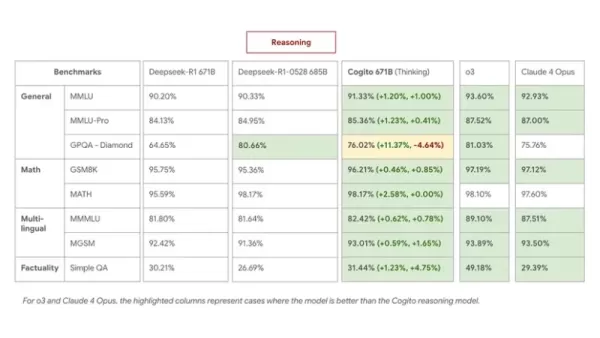
On benchmarks like MMLU, GSM8K, and MGSM, the Cogito 671B MoE performs competitively with leading open models such as Qwen1.5-72B and DeepSeek v3, nearing the performance level of closed models like Claude 4 Opus and o3.
Key findings include:
- In reasoning mode, Cogito 671B MoE matched DeepSeek R1 0528 on multilingual QA and general knowledge, and outperformed it in strategy and logical deduction.
- In standard (non-reasoning) mode, it exceeded DeepSeek v3 0324, demonstrating that the distilled intuition provides a performance boost even without extended reasoning steps.
- Completing reasoning in fewer steps yields practical benefits: lower inference costs and faster response times for complex queries.
Arora likens this to the difference between searching for a destination and already having a strong sense of where it lies.
"Because Cogito models develop a better intuition for the right search trajectory during inference, their reasoning chains are 60% shorter than DeepSeek R1's," he explained in a post on X.
Where Deep Cogito's Models Excel: Machine Intuition in Action
Examples from Cogito v2's internal testing illustrate this capability. In one math problem, a user asks if a train traveling 80 mph can cover 240 miles in under 2.5 hours.
While many models perform detailed, step-by-step calculations and can make errors, Cogito 671B completes a brief internal reflection, calculates 240 ÷ 80 = 3 hours, and correctly concludes the train cannot arrive in time. It uses fewer than 100 internal tokens, compared to over 200 used by DeepSeek R1 for the same answer.
In a legal reasoning example about a U.S. Supreme Court ruling's applicability, Cogito's reasoning mode applies a clear, two-step logic: first determining if the hypothetical case matches the precedent, then justifying its conclusion. This nuanced, interpretive reasoning remains a challenge for many LLMs.
The models also show improved handling of ambiguity. On multi-hop questions like determining familial relationships (e.g., "Alice is Bob's mother, Bob is Charlie's father. What is Alice to Charlie?"), Cogito v2 models correctly identify "grandmother," even when phrasing is subtly altered—a point where other open models often stumble.
Achieving Efficiency at Scale
Remarkably, Deep Cogito reports training all eight of its Cogito models (including the v1 series) for a total cost under $3.5 million—a fraction of the reported nine-figure budgets for some leading frontier models.
This budget covered extensive data generation, synthetic reinforcement, infrastructure, and over 1,000 training experiments.
Arora attributes this cost-effectiveness to a core principle: building smarter models depends on better foundational understanding ("priors"), not simply feeding them more data.
By teaching models to avoid redundant or misleading reasoning paths, Cogito v2 delivers robust performance without inflating inference time or cost—a critical advantage for API-based services or edge-device deployment where latency and expense are key considerations.
Looking Ahead: Deep Cogito's Roadmap
Cogito v2 represents an iterative step, not a final product. Arora describes the company's approach as "hill climbing": running models, learning from their reasoning, distilling those lessons, and repeating the cycle. Each model release builds upon its predecessor.
Deep Cogito remains committed to open source for all its models, present and future. Its work has already garnered support from investors like Benchmark's Eric Vishria and South Park Commons’ Aditya Agarwal.
Infrastructure partners include Hugging Face, Together AI, RunPod, Baseten, Meta's Llama team, and Unsloth.
For developers, researchers, and enterprises, the models are available today for local use, multimodal comparison, and domain-specific fine-tuning.
For the open-source AI community, Cogito v2 offers more than a benchmark milestone. It presents a new paradigm for building intelligence: one focused not on thinking harder, but on learning how to think better.
Related article
 How to fix Core Web Vitals for better SEO rankings
Streamline Report Card Comments with AI ToolsIntroductionAI Tools for Generating Report Card CommentsMagic SchoolAlmanac AIChat GPTUsing Magic School to Generate Report Card CommentsLogging into Magic SchoolSelecting the Report Card Comments ToolCust
Slackbot Becomes an AI Agent
Slackbot, the automated assistant embedded in Salesforce’s corporate messaging platform Slack, is evolving into an AI agent. Salesforce CTO Parker Harris envisions it achieving viral status comparable to OpenAI’s ChatGPT.The cloud software giant laun
ByteDance Boosts Core AI Incentives as Doubao Surges 14.6%
ByteDance recently convened a DouBao equity briefing to unveil fresh incentive policies for staff involved in the DouBao division. The strike price for DouBao shares has been lifted from $14.85 in June 2026 to $17.02, marking an approximate 14.6% inc
Related Special Topic Recommendations
Education and Learning
How to fix Core Web Vitals for better SEO rankings
Streamline Report Card Comments with AI ToolsIntroductionAI Tools for Generating Report Card CommentsMagic SchoolAlmanac AIChat GPTUsing Magic School to Generate Report Card CommentsLogging into Magic SchoolSelecting the Report Card Comments ToolCust
Slackbot Becomes an AI Agent
Slackbot, the automated assistant embedded in Salesforce’s corporate messaging platform Slack, is evolving into an AI agent. Salesforce CTO Parker Harris envisions it achieving viral status comparable to OpenAI’s ChatGPT.The cloud software giant laun
ByteDance Boosts Core AI Incentives as Doubao Surges 14.6%
ByteDance recently convened a DouBao equity briefing to unveil fresh incentive policies for staff involved in the DouBao division. The strike price for DouBao shares has been lifted from $14.85 in June 2026 to $17.02, marking an approximate 14.6% inc
Related Special Topic Recommendations
Education and Learning
 AI Study Tools for Homework and Exam Prep
2026 Latest Best AI Study Tools for Homework and Exam Prep! XIX.AI curates a top-rated list of powerful, game-changing tools that help students boost productivity, streamline homework completion, and ace exams through real-world tests. Get a free vs paid comparison, detailed rankings, and must-try options to unlock your AI edge. Explore now!
 10 tools
 xix.ai
Music composition
AI Vocal Demo Tools for Songwriters, Hooks, Toplines, and Multilingual Draft Sessions
xix.ai
Music composition
AI Vocal Demo Tools for Songwriters, Hooks, Toplines, and Multilingual Draft Sessions
2026 Latest Best AI Vocal Demo Tools for Songwriters, Hook Creators, and Multi-Language Content Teams! XIX.AI has curated a top-rated list of powerful game-changing tools that go through rigorous real-world tests. You’ll find detailed free vs paid comparison data, comprehensive rankings, and must-try options to help you boost writing efficiency and unlock your creative potential. Explore now to discover your perfect tool for all your content needs!
9 tools
xix.ai
Business
Best AI Competitive Research Tools for Small Businesses
2026 Latest Best Top-rated AI Competitive Research Tools for Small Businesses! XIX.AI has curated a highly powerful game-changing collection, updated weekly with rigorous real-world tests and detailed rankings. You can find a comprehensive free vs paid comparison to help you identify the must-try tools that boost your productivity and give you a competitive edge. Explore now to discover your perfect tool!
9 tools
xix.ai
Image editing
Photoshop AI Retouch Tools for Ecommerce Apparel, Skin Cleanup, and Color Consistency
2026 Latest Best Photoshop AI retouch tools for ecommerce apparel, skin cleanup, and color consistency! This top-rated curated list features powerful game-changing solutions that help you boost writing efficiency, streamline content creation, and achieve perfect visual results effortlessly. Each tool has undergone real-world tests through weekly updated rankings, complete with free vs paid comparison details. Backed by XIX.AI, it’s the must-try guide for anyone aiming to unlock your AI edge. Explore now!
10 tools
xix.ai
Prompt
Best AI Prompt Libraries for ChatGPT Workflows
2026 Latest Best Top-Rated AI Prompt Libraries for optimizing all types of ChatGPT workflows. XIX.AI has curated a powerful, game-changing collection that goes through rigorous real-world tests to ensure top performance. You can find detailed free vs paid comparisons and expert rankings to help you choose the must-try tools that boost your productivity and unlock your AI edge. Explore now!
11 tools
xix.ai
Education and Learning
AI Quiz Builder Platforms for Teachers, Tutors, and Cohort-Based Learning Programs
2026 Latest Best AI Quiz Builder Platforms for Teachers, Tutors, and Cohort-Based Learning Programs! XIX.AI has curated a top-rated list of powerful game-changing tools that go through real-world tests to deliver accurate rankings. These must-try platforms help boost writing efficiency, streamline content creation, and simplify quiz design across all learning scenarios. Explore now to discover your perfect tool for unlocking your AI edge in teaching!
13 tools
xix.ai

 Comments (3)
0/500
Comments (3)
0/500
![LarryMitchell]()
Interesting move by Deep Cogito. But 'open-ish' sounds like a marketing term—how open is it really? Also, self-improving intuition sounds spooky. Are we building AI that can rewrite its own reasoning without oversight? 🤔
![JamesCarter]()
Interesting approach, but 'open-ish' sounds like a marketing gimmick. If the weights aren't fully open, how can the community truly verify their 'self-improving' claims? Feels like another startup trying to have its cake and eat it too. The intuition part is fascinating, though. 🤔
![WillieJones]()
¿Modelos auto-mejorables? Parece prometedor, pero siempre me pregunto: ¿cómo verifican que la intuición emergente no genere sesgos peligrosos o alucinaciones más sofisticadas? 🤔 Sería bueno ver más transparencia en los datos de entrenamiento.
Deep Cogito, a San Francisco-based AI research startup founded by former Google engineers, has released four new 'open-ish' large language models (LLMs). These models tackle a key challenge: learning to reason more effectively over time and become more capable autonomously.
Collectively known as the Cogito v2 family, these models range from 70 billion to 671 billion parameters. They are available to AI developers and companies under a mix of permissive and fully open licenses. The release includes:
- Cogito v2-70B (Dense)
- Cogito v2-109B (Mixture-of-Experts)
- Cogito v2-405B (Dense)
- Cogito v2-671B (MoE)
Dense and MoE models serve distinct purposes. The dense variants (70B and 405B) activate all parameters for every input, making them predictable and easier to deploy across diverse hardware setups.
They are ideal for low-latency tasks, fine-tuning, and environments with constrained GPU capacity. In contrast, MoE models (109B and 671B) use a sparse routing mechanism, activating only a subset of specialized "expert" subnetworks per query. This design supports vastly larger total model sizes without proportionally increasing computational costs.
As such, MoE models excel at high-performance inference and complex reasoning research, delivering top-tier accuracy with lower runtime expense. Within the Cogito v2 lineup, the 671B MoE model is the flagship, using its scale and efficient routing to match or surpass leading open models on benchmarks—often with much shorter reasoning chains.
The models are now accessible via Hugging Face for enterprise use and Unsloth for local deployment. For those unable to self-host, API access is provided by Together AI, Baseten, and RunPod.
A quantized FP8 (8-bit floating point) version of the 671B model is also available. By reducing parameter precision from 16-bit to 8-bit, this version enables faster, cheaper, and more accessible hardware deployment, typically maintaining 95–99% of the original performance. However, accuracy may slightly degrade on tasks requiring high precision, such as certain math or reasoning problems.
All four Cogito v2 models are hybrid reasoning systems: they can answer instantly or, when necessary, engage in internal reflection before responding.
This reflection is not merely a inference-time feature—it is integral to the training process itself.
The models are trained to internalize their reasoning pathways. The steps they take to reach solutions—their internal "thoughts"—are distilled back into the model's foundational weights.
Over time, they learn to distinguish productive lines of reasoning from irrelevant ones.
As explained in Deep Cogito's blog, the researchers discourage the model from "meandering more" to find an answer. Instead, they encourage it to develop a stronger intuition for the most efficient reasoning path.
The outcome, Deep Cogito states, is reasoning that is both faster and more efficient, leading to broad performance gains even in standard operating mode.
The Path to Self-Improving AI
While relatively new to the broader AI community, Deep Cogito has been developing its technology for over a year.
The company launched from stealth in April 2025 with open-source models based on Meta's Llama 3.2. These initial models delivered promising results, following a $13 million seed funding round led by Benchmark in November 2024. Benchmark's Eric Vishria joined the company's board.
As previously covered by VentureBeat, the smallest Cogito v1 models (3B and 8B) consistently outperformed comparable Llama 3 models across various benchmarks, often by significant margins.
Deep Cogito's CEO and co-founder, Drishan Arora—a former lead LLM engineer at Google—describes the company's vision as building models that refine their reasoning with each iteration, akin to how AlphaGo improved through self-play.
At the core of this approach is Iterated Distillation and Amplification (IDA), a method that replaces static training prompts with the model's own evolving insights.
Understanding Machine Intuition
The Cogito v2 release scales this self-improvement loop dramatically. The foundational idea is straightforward: reasoning should be woven into the model's core intelligence, not just activated during inference.
To achieve this, the company implemented a system where models generate reasoning chains during training and then learn from their own intermediate thought processes.
Internal benchmarks confirm tangible improvements. The flagship 671B MoE model surpasses DeepSeek R1 on reasoning tasks, matching or exceeding its latest 0528 model while using reasoning chains 60% shorter on average.
On benchmarks like MMLU, GSM8K, and MGSM, the Cogito 671B MoE performs competitively with leading open models such as Qwen1.5-72B and DeepSeek v3, nearing the performance level of closed models like Claude 4 Opus and o3.
Key findings include:
- In reasoning mode, Cogito 671B MoE matched DeepSeek R1 0528 on multilingual QA and general knowledge, and outperformed it in strategy and logical deduction.
- In standard (non-reasoning) mode, it exceeded DeepSeek v3 0324, demonstrating that the distilled intuition provides a performance boost even without extended reasoning steps.
- Completing reasoning in fewer steps yields practical benefits: lower inference costs and faster response times for complex queries.
Arora likens this to the difference between searching for a destination and already having a strong sense of where it lies.
"Because Cogito models develop a better intuition for the right search trajectory during inference, their reasoning chains are 60% shorter than DeepSeek R1's," he explained in a post on X.
Where Deep Cogito's Models Excel: Machine Intuition in Action
Examples from Cogito v2's internal testing illustrate this capability. In one math problem, a user asks if a train traveling 80 mph can cover 240 miles in under 2.5 hours.
While many models perform detailed, step-by-step calculations and can make errors, Cogito 671B completes a brief internal reflection, calculates 240 ÷ 80 = 3 hours, and correctly concludes the train cannot arrive in time. It uses fewer than 100 internal tokens, compared to over 200 used by DeepSeek R1 for the same answer.
In a legal reasoning example about a U.S. Supreme Court ruling's applicability, Cogito's reasoning mode applies a clear, two-step logic: first determining if the hypothetical case matches the precedent, then justifying its conclusion. This nuanced, interpretive reasoning remains a challenge for many LLMs.
The models also show improved handling of ambiguity. On multi-hop questions like determining familial relationships (e.g., "Alice is Bob's mother, Bob is Charlie's father. What is Alice to Charlie?"), Cogito v2 models correctly identify "grandmother," even when phrasing is subtly altered—a point where other open models often stumble.
Achieving Efficiency at Scale
Remarkably, Deep Cogito reports training all eight of its Cogito models (including the v1 series) for a total cost under $3.5 million—a fraction of the reported nine-figure budgets for some leading frontier models.
This budget covered extensive data generation, synthetic reinforcement, infrastructure, and over 1,000 training experiments.
Arora attributes this cost-effectiveness to a core principle: building smarter models depends on better foundational understanding ("priors"), not simply feeding them more data.
By teaching models to avoid redundant or misleading reasoning paths, Cogito v2 delivers robust performance without inflating inference time or cost—a critical advantage for API-based services or edge-device deployment where latency and expense are key considerations.
Looking Ahead: Deep Cogito's Roadmap
Cogito v2 represents an iterative step, not a final product. Arora describes the company's approach as "hill climbing": running models, learning from their reasoning, distilling those lessons, and repeating the cycle. Each model release builds upon its predecessor.
Deep Cogito remains committed to open source for all its models, present and future. Its work has already garnered support from investors like Benchmark's Eric Vishria and South Park Commons’ Aditya Agarwal.
Infrastructure partners include Hugging Face, Together AI, RunPod, Baseten, Meta's Llama team, and Unsloth.
For developers, researchers, and enterprises, the models are available today for local use, multimodal comparison, and domain-specific fine-tuning.
For the open-source AI community, Cogito v2 offers more than a benchmark milestone. It presents a new paradigm for building intelligence: one focused not on thinking harder, but on learning how to think better.








 How to fix Core Web Vitals for better SEO rankings
Streamline Report Card Comments with AI ToolsIntroductionAI Tools for Generating Report Card CommentsMagic SchoolAlmanac AIChat GPTUsing Magic School to Generate Report Card CommentsLogging into Magic SchoolSelecting the Report Card Comments ToolCust
How to fix Core Web Vitals for better SEO rankings
Streamline Report Card Comments with AI ToolsIntroductionAI Tools for Generating Report Card CommentsMagic SchoolAlmanac AIChat GPTUsing Magic School to Generate Report Card CommentsLogging into Magic SchoolSelecting the Report Card Comments ToolCust
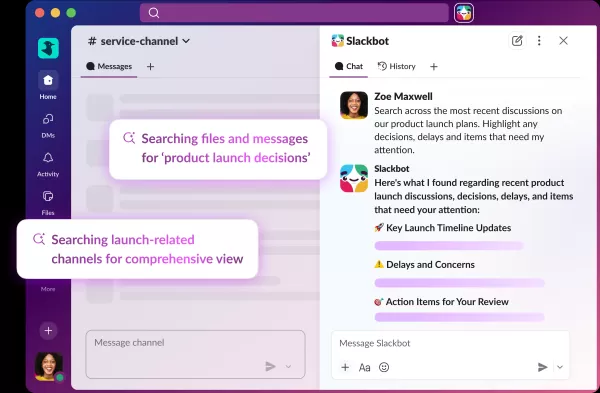 Slackbot Becomes an AI Agent
Slackbot, the automated assistant embedded in Salesforce’s corporate messaging platform Slack, is evolving into an AI agent. Salesforce CTO Parker Harris envisions it achieving viral status comparable to OpenAI’s ChatGPT.The cloud software giant laun
Slackbot Becomes an AI Agent
Slackbot, the automated assistant embedded in Salesforce’s corporate messaging platform Slack, is evolving into an AI agent. Salesforce CTO Parker Harris envisions it achieving viral status comparable to OpenAI’s ChatGPT.The cloud software giant laun
 ByteDance Boosts Core AI Incentives as Doubao Surges 14.6%
ByteDance recently convened a DouBao equity briefing to unveil fresh incentive policies for staff involved in the DouBao division. The strike price for DouBao shares has been lifted from $14.85 in June 2026 to $17.02, marking an approximate 14.6% inc
ByteDance Boosts Core AI Incentives as Doubao Surges 14.6%
ByteDance recently convened a DouBao equity briefing to unveil fresh incentive policies for staff involved in the DouBao division. The strike price for DouBao shares has been lifted from $14.85 in June 2026 to $17.02, marking an approximate 14.6% inc

2026 Latest Best AI Study Tools for Homework and Exam Prep! XIX.AI curates a top-rated list of powerful, game-changing tools that help students boost productivity, streamline homework completion, and ace exams through real-world tests. Get a free vs paid comparison, detailed rankings, and must-try options to unlock your AI edge. Explore now!
10 tools
xix.ai

2026 Latest Best AI Vocal Demo Tools for Songwriters, Hook Creators, and Multi-Language Content Teams! XIX.AI has curated a top-rated list of powerful game-changing tools that go through rigorous real-world tests. You’ll find detailed free vs paid comparison data, comprehensive rankings, and must-try options to help you boost writing efficiency and unlock your creative potential. Explore now to discover your perfect tool for all your content needs!
9 tools
xix.ai

2026 Latest Best Top-rated AI Competitive Research Tools for Small Businesses! XIX.AI has curated a highly powerful game-changing collection, updated weekly with rigorous real-world tests and detailed rankings. You can find a comprehensive free vs paid comparison to help you identify the must-try tools that boost your productivity and give you a competitive edge. Explore now to discover your perfect tool!
9 tools
xix.ai

2026 Latest Best Photoshop AI retouch tools for ecommerce apparel, skin cleanup, and color consistency! This top-rated curated list features powerful game-changing solutions that help you boost writing efficiency, streamline content creation, and achieve perfect visual results effortlessly. Each tool has undergone real-world tests through weekly updated rankings, complete with free vs paid comparison details. Backed by XIX.AI, it’s the must-try guide for anyone aiming to unlock your AI edge. Explore now!
10 tools
xix.ai

2026 Latest Best Top-Rated AI Prompt Libraries for optimizing all types of ChatGPT workflows. XIX.AI has curated a powerful, game-changing collection that goes through rigorous real-world tests to ensure top performance. You can find detailed free vs paid comparisons and expert rankings to help you choose the must-try tools that boost your productivity and unlock your AI edge. Explore now!
11 tools
xix.ai

2026 Latest Best AI Quiz Builder Platforms for Teachers, Tutors, and Cohort-Based Learning Programs! XIX.AI has curated a top-rated list of powerful game-changing tools that go through real-world tests to deliver accurate rankings. These must-try platforms help boost writing efficiency, streamline content creation, and simplify quiz design across all learning scenarios. Explore now to discover your perfect tool for unlocking your AI edge in teaching!
13 tools
xix.ai

Interesting move by Deep Cogito. But 'open-ish' sounds like a marketing term—how open is it really? Also, self-improving intuition sounds spooky. Are we building AI that can rewrite its own reasoning without oversight? 🤔
Interesting approach, but 'open-ish' sounds like a marketing gimmick. If the weights aren't fully open, how can the community truly verify their 'self-improving' claims? Feels like another startup trying to have its cake and eat it too. The intuition part is fascinating, though. 🤔
¿Modelos auto-mejorables? Parece prometedor, pero siempre me pregunto: ¿cómo verifican que la intuición emergente no genere sesgos peligrosos o alucinaciones más sofisticadas? 🤔 Sería bueno ver más transparencia en los datos de entrenamiento.












