


 Home
Home
Claude Voice Mode Now Uses Opus: From Q&A to Real-Time Advisor with Tool Calling and Language Switching
Certain challenges require more than typing. Anthropic has upgraded Claude's voice mode to support three models—Opus, Sonnet, and Haiku—rather than just the lightweight Haiku. It also integrates with tools like Gmail and Slack, and now supports additional languages.
There's a reason behind this update. Earlier this year, after Claude introduced hands-free conversation, users quickly adopted voice mode for more complex scenarios—longer conversations where they spoke instead of typing to address real business problems. At the time, voice mode only used Haiku, chosen for its speed. Conversations were fast, but often lacked depth. Now, Opus and Sonnet, built for solving tough problems, are available in voice mode. Users can switch models at any time using the model selector during a conversation; voice mode automatically selects the fastest version of the chosen model to keep the flow smooth, and it defaults to the model last used in text chats, allowing seamless switching between voice and text without restarting.
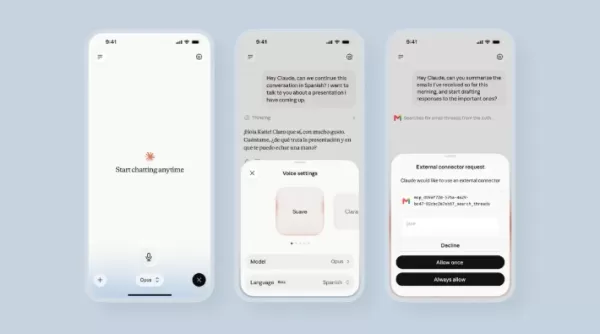
With stronger models, you can now voice half-formed ideas and let Claude help you develop genuine insights. It asks probing questions and builds on your thinking instead of offering a standard answer. The voice mode operates in a turn-based manner: Claude listens, pauses to think, then responds. Anthropic provides several scenarios worth trying—practice an important conversation and ask for feedback on your communication style; organize a client proposal and have it identify logical gaps; brainstorm a product roadmap and ask it to conduct competitive research for validation; or ask it to evaluate different hypotheses about why a particular video went viral.
Once you have a clear plan, you can ask Claude to execute it. If you're running late, ask it to reschedule a meeting on Google Calendar by 30 minutes; convert a client proposal discussion directly into a Canva document; ask it to summarize today's emails and draft responses for the most important ones. Before using connected tools, Claude requests permission. New tools can be added in "Settings > Connectors" on mobile, desktop, or web.
Regarding language support, voice mode now supports more languages across all plans. You can speak in the language you naturally think in, and switch languages during a conversation. However, Claude does not automatically detect the language—you must either request it verbally or manually select it in the voice settings. Additionally, voice mode language settings are independent; previous language preferences are not carried over automatically.
This update is now in beta for all chat users on mobile, desktop, and web, with the best experience on mobile. Free plans can use Haiku, one connected tool, and all supported languages; paid plans can access more models and all connected tools, and voice conversations count toward regular usage limits. Tap the sound wave icon in the Claude mobile app to begin.
Related article
 ByteDance’s Seed launches global campus drive, offering virtual shares to win top large model talent
In the competitive landscape of large language models, securing top-tier talent remains the most critical strategic asset.On April 1st, ByteDance announced the launch of its Seed global campus recruitment initiative, part of its large model talent de
Suno to Watermark Songs Amid Legal Battles
Suno, the platform enabling users to generate AI-created music, has unveiled new features to label platform-produced tracks, restrict downloads, and update community standards to curb unauthorized replicas. These updates arrive as Suno confronts mult
Musk Admits Grok Build Leaked User Code, Promises to Erase All Historical Data
Elon Musk directly addressed the privacy controversy surrounding Grok Build, beginning with a simple "True" to confirm the incident's validity. He pledged that all user data previously uploaded to SpaceXAI would be permanently erased, stating, "not a
Related Special Topic Recommendations
Design & Art
ByteDance’s Seed launches global campus drive, offering virtual shares to win top large model talent
In the competitive landscape of large language models, securing top-tier talent remains the most critical strategic asset.On April 1st, ByteDance announced the launch of its Seed global campus recruitment initiative, part of its large model talent de
Suno to Watermark Songs Amid Legal Battles
Suno, the platform enabling users to generate AI-created music, has unveiled new features to label platform-produced tracks, restrict downloads, and update community standards to curb unauthorized replicas. These updates arrive as Suno confronts mult
Musk Admits Grok Build Leaked User Code, Promises to Erase All Historical Data
Elon Musk directly addressed the privacy controversy surrounding Grok Build, beginning with a simple "True" to confirm the incident's validity. He pledged that all user data previously uploaded to SpaceXAI would be permanently erased, stating, "not a
Related Special Topic Recommendations
Design & Art
 AI Visual Style Reference Tools for Character Sheets, Moodboards, and Pitch Decks
2026 Latest Best AI Visual Style Reference Tools for Character Sheets, Moodboards, and Pitch Decks are here on XIX.AI! This curated top-rated list features powerful game-changing tools that go through rigorous real-world tests. You’ll find a free vs paid comparison, detailed rankings, and must-try options to help you boost creativity and streamline your workflow. Explore now to discover your perfect tool for boosting productivity!
 11 tools
 xix.ai
SEO
Best AI SERP Analysis Tools for Search Strategy
xix.ai
SEO
Best AI SERP Analysis Tools for Search Strategy
2026 Latest Best Top-rated AI SERP Analysis Tools for Search Strategy are curated by XIX.AI through rigorous real-world tests and weekly updated rankings. These powerful tools help you unlock hidden optimization opportunities, boost content performance, and gain a competitive edge in search. Discover your perfect tool to elevate your search strategy today. Explore now!
13 tools
xix.ai
Data Analysis
Best AI Anomaly Detection Tools for KPI Monitoring across SaaS and Ecommerce Teams
2026 Latest Best Top-rated AI Anomaly Detection Tools for KPI Monitoring in SaaS and Ecommerce teams! XIX.AI has curated a powerful, game-changing collection based on rigorous real-world tests and weekly updated rankings. You’ll find detailed free vs paid comparison insights to help you identify the must-try solution that boosts productivity and unlocks your AI edge. Explore now!
10 tools
xix.ai
writing
Best AI Outline Generators for Long-Form SEO Articles
2026 Latest Best Top-Rated AI Outline Generators for Long-Form SEO Articles, meticulously curated by XIX.AI. These powerful tools offer game-changing assistance in creating high-quality content quickly, boosting writing efficiency significantly. Get a free vs paid comparison along with real-world tests and detailed rankings to help you find the must-try option that suits your needs. Explore now to unlock your AI edge.
8 tools
xix.ai
Education and Learning
AI Study Tools for Homework and Exam Prep
2026 Latest Best AI Study Tools for Homework and Exam Prep! XIX.AI curates a top-rated list of powerful, game-changing tools that help students boost productivity, streamline homework completion, and ace exams through real-world tests. Get a free vs paid comparison, detailed rankings, and must-try options to unlock your AI edge. Explore now!
10 tools
xix.ai
Music composition
AI Vocal Demo Tools for Songwriters, Hooks, Toplines, and Multilingual Draft Sessions
2026 Latest Best AI Vocal Demo Tools for Songwriters, Hook Creators, and Multi-Language Content Teams! XIX.AI has curated a top-rated list of powerful game-changing tools that go through rigorous real-world tests. You’ll find detailed free vs paid comparison data, comprehensive rankings, and must-try options to help you boost writing efficiency and unlock your creative potential. Explore now to discover your perfect tool for all your content needs!
9 tools
xix.ai

 Comments (0)
0/500
Comments (0)
0/500
Certain challenges require more than typing. Anthropic has upgraded Claude's voice mode to support three models—Opus, Sonnet, and Haiku—rather than just the lightweight Haiku. It also integrates with tools like Gmail and Slack, and now supports additional languages.
There's a reason behind this update. Earlier this year, after Claude introduced hands-free conversation, users quickly adopted voice mode for more complex scenarios—longer conversations where they spoke instead of typing to address real business problems. At the time, voice mode only used Haiku, chosen for its speed. Conversations were fast, but often lacked depth. Now, Opus and Sonnet, built for solving tough problems, are available in voice mode. Users can switch models at any time using the model selector during a conversation; voice mode automatically selects the fastest version of the chosen model to keep the flow smooth, and it defaults to the model last used in text chats, allowing seamless switching between voice and text without restarting.
With stronger models, you can now voice half-formed ideas and let Claude help you develop genuine insights. It asks probing questions and builds on your thinking instead of offering a standard answer. The voice mode operates in a turn-based manner: Claude listens, pauses to think, then responds. Anthropic provides several scenarios worth trying—practice an important conversation and ask for feedback on your communication style; organize a client proposal and have it identify logical gaps; brainstorm a product roadmap and ask it to conduct competitive research for validation; or ask it to evaluate different hypotheses about why a particular video went viral.
Once you have a clear plan, you can ask Claude to execute it. If you're running late, ask it to reschedule a meeting on Google Calendar by 30 minutes; convert a client proposal discussion directly into a Canva document; ask it to summarize today's emails and draft responses for the most important ones. Before using connected tools, Claude requests permission. New tools can be added in "Settings > Connectors" on mobile, desktop, or web.
Regarding language support, voice mode now supports more languages across all plans. You can speak in the language you naturally think in, and switch languages during a conversation. However, Claude does not automatically detect the language—you must either request it verbally or manually select it in the voice settings. Additionally, voice mode language settings are independent; previous language preferences are not carried over automatically.
This update is now in beta for all chat users on mobile, desktop, and web, with the best experience on mobile. Free plans can use Haiku, one connected tool, and all supported languages; paid plans can access more models and all connected tools, and voice conversations count toward regular usage limits. Tap the sound wave icon in the Claude mobile app to begin.








 ByteDance’s Seed launches global campus drive, offering virtual shares to win top large model talent
In the competitive landscape of large language models, securing top-tier talent remains the most critical strategic asset.On April 1st, ByteDance announced the launch of its Seed global campus recruitment initiative, part of its large model talent de
ByteDance’s Seed launches global campus drive, offering virtual shares to win top large model talent
In the competitive landscape of large language models, securing top-tier talent remains the most critical strategic asset.On April 1st, ByteDance announced the launch of its Seed global campus recruitment initiative, part of its large model talent de
 Suno to Watermark Songs Amid Legal Battles
Suno, the platform enabling users to generate AI-created music, has unveiled new features to label platform-produced tracks, restrict downloads, and update community standards to curb unauthorized replicas. These updates arrive as Suno confronts mult
Suno to Watermark Songs Amid Legal Battles
Suno, the platform enabling users to generate AI-created music, has unveiled new features to label platform-produced tracks, restrict downloads, and update community standards to curb unauthorized replicas. These updates arrive as Suno confronts mult
 Musk Admits Grok Build Leaked User Code, Promises to Erase All Historical Data
Elon Musk directly addressed the privacy controversy surrounding Grok Build, beginning with a simple "True" to confirm the incident's validity. He pledged that all user data previously uploaded to SpaceXAI would be permanently erased, stating, "not a
Musk Admits Grok Build Leaked User Code, Promises to Erase All Historical Data
Elon Musk directly addressed the privacy controversy surrounding Grok Build, beginning with a simple "True" to confirm the incident's validity. He pledged that all user data previously uploaded to SpaceXAI would be permanently erased, stating, "not a

2026 Latest Best AI Visual Style Reference Tools for Character Sheets, Moodboards, and Pitch Decks are here on XIX.AI! This curated top-rated list features powerful game-changing tools that go through rigorous real-world tests. You’ll find a free vs paid comparison, detailed rankings, and must-try options to help you boost creativity and streamline your workflow. Explore now to discover your perfect tool for boosting productivity!
11 tools
xix.ai

2026 Latest Best Top-rated AI SERP Analysis Tools for Search Strategy are curated by XIX.AI through rigorous real-world tests and weekly updated rankings. These powerful tools help you unlock hidden optimization opportunities, boost content performance, and gain a competitive edge in search. Discover your perfect tool to elevate your search strategy today. Explore now!
13 tools
xix.ai

2026 Latest Best Top-rated AI Anomaly Detection Tools for KPI Monitoring in SaaS and Ecommerce teams! XIX.AI has curated a powerful, game-changing collection based on rigorous real-world tests and weekly updated rankings. You’ll find detailed free vs paid comparison insights to help you identify the must-try solution that boosts productivity and unlocks your AI edge. Explore now!
10 tools
xix.ai

2026 Latest Best Top-Rated AI Outline Generators for Long-Form SEO Articles, meticulously curated by XIX.AI. These powerful tools offer game-changing assistance in creating high-quality content quickly, boosting writing efficiency significantly. Get a free vs paid comparison along with real-world tests and detailed rankings to help you find the must-try option that suits your needs. Explore now to unlock your AI edge.
8 tools
xix.ai

2026 Latest Best AI Study Tools for Homework and Exam Prep! XIX.AI curates a top-rated list of powerful, game-changing tools that help students boost productivity, streamline homework completion, and ace exams through real-world tests. Get a free vs paid comparison, detailed rankings, and must-try options to unlock your AI edge. Explore now!
10 tools
xix.ai

2026 Latest Best AI Vocal Demo Tools for Songwriters, Hook Creators, and Multi-Language Content Teams! XIX.AI has curated a top-rated list of powerful game-changing tools that go through rigorous real-world tests. You’ll find detailed free vs paid comparison data, comprehensive rankings, and must-try options to help you boost writing efficiency and unlock your creative potential. Explore now to discover your perfect tool for all your content needs!
9 tools
xix.ai












