


 Home
HomeChrome Launches Prompt API, Ushering Native Browser AI Era with Gemini Nano
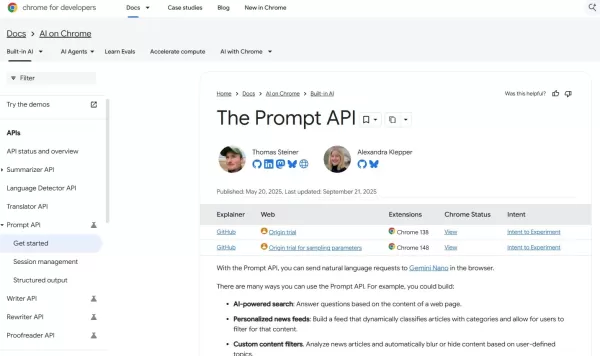
The Google Chrome browser has officially launched the Prompt API, enabling developers to directly invoke the built-in Gemini Nano model with simple JavaScript code on web pages, bringing AI capabilities directly to the client side. This announcement has sparked significant discussion on Hacker News and is quickly gaining widespread attention, viewed as a major step in democratizing AI within the browser.
What is the Prompt API?
The Prompt API is a component of Chrome's built-in AI framework. It allows web applications to send natural language instructions to the Gemini Nano lightweight language model embedded directly in the browser. Gemini Nano is a compact model from Google, optimized for on-device use, and runs locally on the user's machine without requiring cloud servers.
This represents a fundamental shift from traditional AI integration methods. Previously, developers had to rely on external APIs like OpenAI or Claude, navigating challenges such as cross-origin restrictions, API key management, costs, and data privacy. Now, similar functionality can be achieved with just a few lines of code:
constsession=awaitai.languageModel.create();
The model operates within the browser via technologies like WebAssembly or WebGPU. All data remains on the user's device, significantly enhancing privacy protection and enabling offline use cases.
Core Advantages: Privacy, Security, and Ease of Use
Local Execution with Privacy First: The Gemini Nano model downloads automatically based on the user's device (with a size of several gigabytes). All inference happens locally, meaning user input is never sent to the cloud. This directly addresses widespread concerns among businesses and individuals about data leakage with cloud-based AI.
Lower Development Barrier: There's no need to budget for server costs, manage API keys, or account for network latency. AI capability becomes a native browser feature, akin to the foundational role of JavaScript. Developers can quickly implement features like text translation, summarization, content rewriting, and semantic search, paving the way for more complex local AI applications.
Broad Application Potential: This capability can be leveraged everywhere from browser extensions to standard web pages. Early innovations are already emerging, such as real-time content summarization, offline chatbots, and client-side semantic filtering.
Current Status and Limitations
Currently, the Prompt API is in an experimental/early availability phase. It is primarily accessible by enabling experimental flags (via chrome://flags) in Chrome Canary, the Dev channel, or specific versions like Chrome 137+. The model's capabilities are more limited compared to cloud-based large language models, and sufficient device performance (including memory and GPU acceleration) is required. Google has launched an Origin Trial, allowing developers to test and provide feedback in production environments.
Official Chrome documentation notes that the browser handles model downloads automatically, with a potential short wait on first use. This feature is expected to gradually roll out to stable channels and potentially expand to more platforms in the future.
Industry Impact: AI as a Foundational Browser Capability
Industry observers see the Prompt API as a turning point for browser-based AI. As AI becomes a standard web capability like JavaScript, a new wave of innovation in web applications is anticipated. Microsoft Edge is exploring similar interfaces, accelerating the industry-wide shift toward "on-device AI."
This development not only lowers the barrier to using AI but also promotes the creation of privacy-conscious, offline-friendly web experiences. Future browsers may integrate more AI primitives, making intelligent features accessible to both end-users and developers.
AIbase Commentary: Chrome's move accelerates the shift of AI from the cloud to the edge. While current capabilities are limited, its symbolic importance is substantial—browsers are evolving from mere presentation tools into intelligent platforms. Developers are encouraged to monitor progress closely and engage in early testing to seize opportunities in the next generation of web AI applications.
Link: https://developer.chrome.com/docs/ai/prompt-api
Related article
 ByteDance’s Seed launches global campus drive, offering virtual shares to win top large model talent
In the competitive landscape of large language models, securing top-tier talent remains the most critical strategic asset.On April 1st, ByteDance announced the launch of its Seed global campus recruitment initiative, part of its large model talent de
Suno to Watermark Songs Amid Legal Battles
Suno, the platform enabling users to generate AI-created music, has unveiled new features to label platform-produced tracks, restrict downloads, and update community standards to curb unauthorized replicas. These updates arrive as Suno confronts mult
Musk Admits Grok Build Leaked User Code, Promises to Erase All Historical Data
Elon Musk directly addressed the privacy controversy surrounding Grok Build, beginning with a simple "True" to confirm the incident's validity. He pledged that all user data previously uploaded to SpaceXAI would be permanently erased, stating, "not a
Related Special Topic Recommendations
Design & Art
ByteDance’s Seed launches global campus drive, offering virtual shares to win top large model talent
In the competitive landscape of large language models, securing top-tier talent remains the most critical strategic asset.On April 1st, ByteDance announced the launch of its Seed global campus recruitment initiative, part of its large model talent de
Suno to Watermark Songs Amid Legal Battles
Suno, the platform enabling users to generate AI-created music, has unveiled new features to label platform-produced tracks, restrict downloads, and update community standards to curb unauthorized replicas. These updates arrive as Suno confronts mult
Musk Admits Grok Build Leaked User Code, Promises to Erase All Historical Data
Elon Musk directly addressed the privacy controversy surrounding Grok Build, beginning with a simple "True" to confirm the incident's validity. He pledged that all user data previously uploaded to SpaceXAI would be permanently erased, stating, "not a
Related Special Topic Recommendations
Design & Art
 AI Visual Style Reference Tools for Character Sheets, Moodboards, and Pitch Decks
2026 Latest Best AI Visual Style Reference Tools for Character Sheets, Moodboards, and Pitch Decks are here on XIX.AI! This curated top-rated list features powerful game-changing tools that go through rigorous real-world tests. You’ll find a free vs paid comparison, detailed rankings, and must-try options to help you boost creativity and streamline your workflow. Explore now to discover your perfect tool for boosting productivity!
 11 tools
 xix.ai
SEO
Best AI SERP Analysis Tools for Search Strategy
xix.ai
SEO
Best AI SERP Analysis Tools for Search Strategy
2026 Latest Best Top-rated AI SERP Analysis Tools for Search Strategy are curated by XIX.AI through rigorous real-world tests and weekly updated rankings. These powerful tools help you unlock hidden optimization opportunities, boost content performance, and gain a competitive edge in search. Discover your perfect tool to elevate your search strategy today. Explore now!
13 tools
xix.ai
Data Analysis
Best AI Anomaly Detection Tools for KPI Monitoring across SaaS and Ecommerce Teams
2026 Latest Best Top-rated AI Anomaly Detection Tools for KPI Monitoring in SaaS and Ecommerce teams! XIX.AI has curated a powerful, game-changing collection based on rigorous real-world tests and weekly updated rankings. You’ll find detailed free vs paid comparison insights to help you identify the must-try solution that boosts productivity and unlocks your AI edge. Explore now!
10 tools
xix.ai
writing
Best AI Outline Generators for Long-Form SEO Articles
2026 Latest Best Top-Rated AI Outline Generators for Long-Form SEO Articles, meticulously curated by XIX.AI. These powerful tools offer game-changing assistance in creating high-quality content quickly, boosting writing efficiency significantly. Get a free vs paid comparison along with real-world tests and detailed rankings to help you find the must-try option that suits your needs. Explore now to unlock your AI edge.
8 tools
xix.ai
Education and Learning
AI Study Tools for Homework and Exam Prep
2026 Latest Best AI Study Tools for Homework and Exam Prep! XIX.AI curates a top-rated list of powerful, game-changing tools that help students boost productivity, streamline homework completion, and ace exams through real-world tests. Get a free vs paid comparison, detailed rankings, and must-try options to unlock your AI edge. Explore now!
10 tools
xix.ai
Music composition
AI Vocal Demo Tools for Songwriters, Hooks, Toplines, and Multilingual Draft Sessions
2026 Latest Best AI Vocal Demo Tools for Songwriters, Hook Creators, and Multi-Language Content Teams! XIX.AI has curated a top-rated list of powerful game-changing tools that go through rigorous real-world tests. You’ll find detailed free vs paid comparison data, comprehensive rankings, and must-try options to help you boost writing efficiency and unlock your creative potential. Explore now to discover your perfect tool for all your content needs!
9 tools
xix.ai

 Comments (0)
0/500
Comments (0)
0/500
The Google Chrome browser has officially launched the Prompt API, enabling developers to directly invoke the built-in Gemini Nano model with simple JavaScript code on web pages, bringing AI capabilities directly to the client side. This announcement has sparked significant discussion on Hacker News and is quickly gaining widespread attention, viewed as a major step in democratizing AI within the browser.
What is the Prompt API?
The Prompt API is a component of Chrome's built-in AI framework. It allows web applications to send natural language instructions to the Gemini Nano lightweight language model embedded directly in the browser. Gemini Nano is a compact model from Google, optimized for on-device use, and runs locally on the user's machine without requiring cloud servers.
This represents a fundamental shift from traditional AI integration methods. Previously, developers had to rely on external APIs like OpenAI or Claude, navigating challenges such as cross-origin restrictions, API key management, costs, and data privacy. Now, similar functionality can be achieved with just a few lines of code:
constsession=awaitai.languageModel.create();
The model operates within the browser via technologies like WebAssembly or WebGPU. All data remains on the user's device, significantly enhancing privacy protection and enabling offline use cases.
Core Advantages: Privacy, Security, and Ease of Use
Local Execution with Privacy First: The Gemini Nano model downloads automatically based on the user's device (with a size of several gigabytes). All inference happens locally, meaning user input is never sent to the cloud. This directly addresses widespread concerns among businesses and individuals about data leakage with cloud-based AI.
Lower Development Barrier: There's no need to budget for server costs, manage API keys, or account for network latency. AI capability becomes a native browser feature, akin to the foundational role of JavaScript. Developers can quickly implement features like text translation, summarization, content rewriting, and semantic search, paving the way for more complex local AI applications.
Broad Application Potential: This capability can be leveraged everywhere from browser extensions to standard web pages. Early innovations are already emerging, such as real-time content summarization, offline chatbots, and client-side semantic filtering.
Current Status and Limitations
Currently, the Prompt API is in an experimental/early availability phase. It is primarily accessible by enabling experimental flags (via chrome://flags) in Chrome Canary, the Dev channel, or specific versions like Chrome 137+. The model's capabilities are more limited compared to cloud-based large language models, and sufficient device performance (including memory and GPU acceleration) is required. Google has launched an Origin Trial, allowing developers to test and provide feedback in production environments.
Official Chrome documentation notes that the browser handles model downloads automatically, with a potential short wait on first use. This feature is expected to gradually roll out to stable channels and potentially expand to more platforms in the future.
Industry Impact: AI as a Foundational Browser Capability
Industry observers see the Prompt API as a turning point for browser-based AI. As AI becomes a standard web capability like JavaScript, a new wave of innovation in web applications is anticipated. Microsoft Edge is exploring similar interfaces, accelerating the industry-wide shift toward "on-device AI."
This development not only lowers the barrier to using AI but also promotes the creation of privacy-conscious, offline-friendly web experiences. Future browsers may integrate more AI primitives, making intelligent features accessible to both end-users and developers.
AIbase Commentary: Chrome's move accelerates the shift of AI from the cloud to the edge. While current capabilities are limited, its symbolic importance is substantial—browsers are evolving from mere presentation tools into intelligent platforms. Developers are encouraged to monitor progress closely and engage in early testing to seize opportunities in the next generation of web AI applications.
Link: https://developer.chrome.com/docs/ai/prompt-api








 ByteDance’s Seed launches global campus drive, offering virtual shares to win top large model talent
In the competitive landscape of large language models, securing top-tier talent remains the most critical strategic asset.On April 1st, ByteDance announced the launch of its Seed global campus recruitment initiative, part of its large model talent de
ByteDance’s Seed launches global campus drive, offering virtual shares to win top large model talent
In the competitive landscape of large language models, securing top-tier talent remains the most critical strategic asset.On April 1st, ByteDance announced the launch of its Seed global campus recruitment initiative, part of its large model talent de
 Suno to Watermark Songs Amid Legal Battles
Suno, the platform enabling users to generate AI-created music, has unveiled new features to label platform-produced tracks, restrict downloads, and update community standards to curb unauthorized replicas. These updates arrive as Suno confronts mult
Suno to Watermark Songs Amid Legal Battles
Suno, the platform enabling users to generate AI-created music, has unveiled new features to label platform-produced tracks, restrict downloads, and update community standards to curb unauthorized replicas. These updates arrive as Suno confronts mult
 Musk Admits Grok Build Leaked User Code, Promises to Erase All Historical Data
Elon Musk directly addressed the privacy controversy surrounding Grok Build, beginning with a simple "True" to confirm the incident's validity. He pledged that all user data previously uploaded to SpaceXAI would be permanently erased, stating, "not a
Musk Admits Grok Build Leaked User Code, Promises to Erase All Historical Data
Elon Musk directly addressed the privacy controversy surrounding Grok Build, beginning with a simple "True" to confirm the incident's validity. He pledged that all user data previously uploaded to SpaceXAI would be permanently erased, stating, "not a

2026 Latest Best AI Visual Style Reference Tools for Character Sheets, Moodboards, and Pitch Decks are here on XIX.AI! This curated top-rated list features powerful game-changing tools that go through rigorous real-world tests. You’ll find a free vs paid comparison, detailed rankings, and must-try options to help you boost creativity and streamline your workflow. Explore now to discover your perfect tool for boosting productivity!
11 tools
xix.ai

2026 Latest Best Top-rated AI SERP Analysis Tools for Search Strategy are curated by XIX.AI through rigorous real-world tests and weekly updated rankings. These powerful tools help you unlock hidden optimization opportunities, boost content performance, and gain a competitive edge in search. Discover your perfect tool to elevate your search strategy today. Explore now!
13 tools
xix.ai

2026 Latest Best Top-rated AI Anomaly Detection Tools for KPI Monitoring in SaaS and Ecommerce teams! XIX.AI has curated a powerful, game-changing collection based on rigorous real-world tests and weekly updated rankings. You’ll find detailed free vs paid comparison insights to help you identify the must-try solution that boosts productivity and unlocks your AI edge. Explore now!
10 tools
xix.ai

2026 Latest Best Top-Rated AI Outline Generators for Long-Form SEO Articles, meticulously curated by XIX.AI. These powerful tools offer game-changing assistance in creating high-quality content quickly, boosting writing efficiency significantly. Get a free vs paid comparison along with real-world tests and detailed rankings to help you find the must-try option that suits your needs. Explore now to unlock your AI edge.
8 tools
xix.ai

2026 Latest Best AI Study Tools for Homework and Exam Prep! XIX.AI curates a top-rated list of powerful, game-changing tools that help students boost productivity, streamline homework completion, and ace exams through real-world tests. Get a free vs paid comparison, detailed rankings, and must-try options to unlock your AI edge. Explore now!
10 tools
xix.ai

2026 Latest Best AI Vocal Demo Tools for Songwriters, Hook Creators, and Multi-Language Content Teams! XIX.AI has curated a top-rated list of powerful game-changing tools that go through rigorous real-world tests. You’ll find detailed free vs paid comparison data, comprehensive rankings, and must-try options to help you boost writing efficiency and unlock your creative potential. Explore now to discover your perfect tool for all your content needs!
9 tools
xix.ai












