


 Home
Besxar Builds Orbital Semiconductor Factory With SpaceX Rockets
Manufacturing in space and returning products to Earth currently relies on a narrow set of approaches: waiting for access to the International Space Station or partnering with select startups that launch spacecraft capable of returning payloads from orbit.
However, the most frequent round-trip vehicle between space and Earth is the SpaceX Falcon 9 booster, which completed 163 such missions last year and has already flown over 100 times this year. A new startup claims it has secured an agreement with Musk’s company to prototype an orbital semiconductor factory across multiple booster flights.
Besxar, founded by former OpenAI employee Ashley Pilipiszyn, aims to produce key semiconductor precursors by leveraging the vacuum of space. A major reason terrestrial chip fabrication requires massive infrastructure is the need for pressurized clean rooms to exclude microscopic dust and contaminants that can ruin chips during production. Pilipiszyn argues that next-generation rockets offer a viable alternative to this costly infrastructure. To pursue this, she has raised nearly $14 million, including a $9 million seed round led by Dauntless Ventures and Overture VC.
“We are at a point where it is more cost-effective to utilize environments where physics already works,” she told TechCrunch. “Avoid doing it on Earth, where you are constantly fighting against physical constraints.”
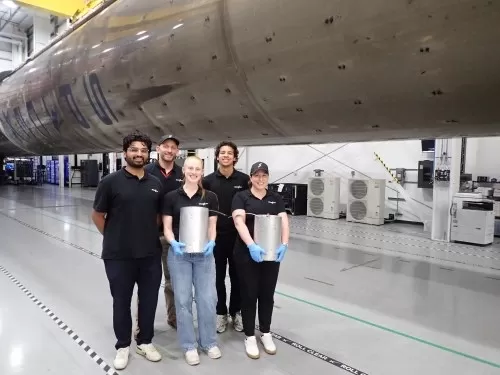
The company’s initial two “fabships”—compact canisters designed to transport and test semiconductor materials in orbit—launched on a Starlink mission in July. These tests aimed to verify that the canisters could withstand launch, protect wafer samples from contamination, and expose them to the space vacuum. Besxar achieved these objectives despite a flight data system malfunction in one canister, which the company is currently investigating.
“The flown samples were the cleanest and contained the least particulate matter compared to … non-flown terrestrial wafers, which is excellent for our scaling efforts,” Pilipiszyn told TechCrunch.
Besxar plans to iterate over the next two years, with the ultimate goal of deploying larger fabrication units on vehicles like SpaceX’s Starship, its next-generation rocket still under development. Pilipiszyn first approached SpaceX three years ago to discuss purchasing Starship flights, eventually settling on the booster payload deal as a strategy to de-risk her technology in the interim. The next steps involve heating wafers, then depositing one material, followed by two materials, and so on.
Once producing qualification samples, Besxar—named after “beskar,” the metal used in Star Wars to create Mandalorian armor—aims to supply leading chipmakers with wafers used to manufacture advanced chips that regulate electrical power in data centers, robots, and electric vehicles.
Several companies, including United Semiconductors and Space Forge, are working to leverage the space environment for higher-quality semiconductors, but all face the same challenge: the limited capacity to return significant volumes of product. Pilipiszyn expects to scale up to hundreds, and eventually thousands, of wafers per fab, a path that depends on affordable rocket access. This, in turn, requires SpaceX to operationalize Starship or for competitors like Rocket Lab and Stoke Space to launch their own next-generation rockets.
“We believe there is now a robust transport layer, allowing us to focus on the application layer,” she told TechCrunch. “We can concentrate on core manufacturing and getting our products back to Earth for market as quickly as possible.”
Related article
 How AMD’s World Labs Acquisition Shapes AI’s Future
AMD CEO Lisa Su stands alongside Fei-Fei Li, CEO of World Labs. Photo courtesy: Fei-Fei Li/SubstackAMD has finalized a definitive agreement with World Labs to bolster its standing in hardware, software, and emerging AI models and applications.US semi
Xiaomi unveils new AI strategy to build future intelligent infrastructure and reshape the industry
As smart technology advances at an unprecedented pace, Xiaomi is recalibrating its strategic roadmap to harness the power of large AI models. The company recently restructured the engineering team behind Xiaoi, aiming to embed AI deeply into every fa
Liang Wenfeng on Open Source: 6x Profits Without Overtime, 100x Gains Tied to Open Source
Following a recent leak of internal discussions from DeepSeek’s investor exchange, founder Liang Wenfeng clarified the strategic reasoning behind their open-source approach. He firmly stated, “We will definitely open-source, including our most powerf
Related Special Topic Recommendations
Design & Art
 Top AI Illustration Tools: Create Editorial Scenes and Cover Art Faster
2026 Latest Top-rated AI Illustration Tools: Our curated list features the best powerfully designed tools for creating stunning editorial scenes and eye-catching cover art quickly. Each option has gone through rigorous real-world tests, offering a free vs paid comparison to help you find the perfect match for your workflow. Try these must-try solutions today to unlock your AI edge and boost your creative productivity. Explore now at XIX.AI.
 10 tools
 xix.ai
Education and Learning
Top AI Tutors for Exam Prep: Practice Math, Science, and English
2026 Latest Top-Rated Best AI Tutors for Exam Prep are here on XIX.AI! Our curated list features powerful game-changing tools that offer free vs paid comparison, real-world tests, and weekly updated rankings. They help boost your writing efficiency, simplify complex topic learning, and unlock your academic potential. Explore now to Discover your perfect exam prep tool and Start creating today to Unlock your AI edge!
10 tools
xix.ai
Finance
AI Budget Planning Tools for Personal Money Management
2026 Latest Best Top-Rated AI Budget Planning Tools for Personal Money Management are here on XIX.AI! This curated collection features powerful, game-changing solutions that help you conduct real-world tests, understand spending habits, and create personalized plans to boost productivity. Enjoy a free vs paid comparison along with detailed rankings. Must-try tools designed to simplify money management and unlock your AI edge. Explore now!
11 tools
xix.ai
Health & Wellness
AI Sleep Tracking Assistants: Improve Recovery with Better Bedtime Habits
2026 Latest Best Top-Rated AI Sleep Tracking Assistants curated for ultimate recovery. This fully updated weekly guide features powerful tools that deliver real-world tests, free vs paid comparison, and detailed rankings to help you find the must-try solution that boosts sleep quality and supports better bedtime habits. Explore now at XIX.AI to Unlock your AI edge.
10 tools
xix.ai
Data Analysis
AI SQL Copilots for Product and Revenue Analytics
2026 Latest Best Top-Rated AI SQL Copilots for Product and Revenue Analytics! XIX.AI has curated a powerful, game-changing collection of must-try tools that undergo real-world tests through weekly updated rankings. These tools help users boost productivity significantly by accelerating data analysis, streamlining complex queries, and generating accurate insights to drive smarter business decisions. Explore now to Discover your perfect tool for unlocking your AI edge!
14 tools
xix.ai
Education and Learning
Best AI Homework Helpers That Teach: Learn Concepts, Not Just Answers
2026 Latest Best Top-Rated AI Homework Helpers That Teach Core Concepts Not Just Answers Powerful Tools for Students Must-Try Curated List Weekly Updated Free vs Paid Comparison Real-World Tests Accurate Rankings to Help You Unlock Your Full Learning Potential Explore now to Discover your perfect tool for smarter studying.
10 tools
xix.ai

 Comments (0)
0/500
Manufacturing in space and returning products to Earth currently relies on a narrow set of approaches: waiting for access to the International Space Station or partnering with select startups that launch spacecraft capable of returning payloads from orbit.
However, the most frequent round-trip vehicle between space and Earth is the SpaceX Falcon 9 booster, which completed 163 such missions last year and has already flown over 100 times this year. A new startup claims it has secured an agreement with Musk’s company to prototype an orbital semiconductor factory across multiple booster flights.
Besxar, founded by former OpenAI employee Ashley Pilipiszyn, aims to produce key semiconductor precursors by leveraging the vacuum of space. A major reason terrestrial chip fabrication requires massive infrastructure is the need for pressurized clean rooms to exclude microscopic dust and contaminants that can ruin chips during production. Pilipiszyn argues that next-generation rockets offer a viable alternative to this costly infrastructure. To pursue this, she has raised nearly $14 million, including a $9 million seed round led by Dauntless Ventures and Overture VC.
“We are at a point where it is more cost-effective to utilize environments where physics already works,” she told TechCrunch. “Avoid doing it on Earth, where you are constantly fighting against physical constraints.”
The company’s initial two “fabships”—compact canisters designed to transport and test semiconductor materials in orbit—launched on a Starlink mission in July. These tests aimed to verify that the canisters could withstand launch, protect wafer samples from contamination, and expose them to the space vacuum. Besxar achieved these objectives despite a flight data system malfunction in one canister, which the company is currently investigating.
“The flown samples were the cleanest and contained the least particulate matter compared to … non-flown terrestrial wafers, which is excellent for our scaling efforts,” Pilipiszyn told TechCrunch.
Besxar plans to iterate over the next two years, with the ultimate goal of deploying larger fabrication units on vehicles like SpaceX’s Starship, its next-generation rocket still under development. Pilipiszyn first approached SpaceX three years ago to discuss purchasing Starship flights, eventually settling on the booster payload deal as a strategy to de-risk her technology in the interim. The next steps involve heating wafers, then depositing one material, followed by two materials, and so on.
Once producing qualification samples, Besxar—named after “beskar,” the metal used in Star Wars to create Mandalorian armor—aims to supply leading chipmakers with wafers used to manufacture advanced chips that regulate electrical power in data centers, robots, and electric vehicles.
Several companies, including United Semiconductors and Space Forge, are working to leverage the space environment for higher-quality semiconductors, but all face the same challenge: the limited capacity to return significant volumes of product. Pilipiszyn expects to scale up to hundreds, and eventually thousands, of wafers per fab, a path that depends on affordable rocket access. This, in turn, requires SpaceX to operationalize Starship or for competitors like Rocket Lab and Stoke Space to launch their own next-generation rockets.
“We believe there is now a robust transport layer, allowing us to focus on the application layer,” she told TechCrunch. “We can concentrate on core manufacturing and getting our products back to Earth for market as quickly as possible.”








 How AMD’s World Labs Acquisition Shapes AI’s Future
AMD CEO Lisa Su stands alongside Fei-Fei Li, CEO of World Labs. Photo courtesy: Fei-Fei Li/SubstackAMD has finalized a definitive agreement with World Labs to bolster its standing in hardware, software, and emerging AI models and applications.US semi
 Xiaomi unveils new AI strategy to build future intelligent infrastructure and reshape the industry
As smart technology advances at an unprecedented pace, Xiaomi is recalibrating its strategic roadmap to harness the power of large AI models. The company recently restructured the engineering team behind Xiaoi, aiming to embed AI deeply into every fa
 Liang Wenfeng on Open Source: 6x Profits Without Overtime, 100x Gains Tied to Open Source
Following a recent leak of internal discussions from DeepSeek’s investor exchange, founder Liang Wenfeng clarified the strategic reasoning behind their open-source approach. He firmly stated, “We will definitely open-source, including our most powerf

2026 Latest Top-rated AI Illustration Tools: Our curated list features the best powerfully designed tools for creating stunning editorial scenes and eye-catching cover art quickly. Each option has gone through rigorous real-world tests, offering a free vs paid comparison to help you find the perfect match for your workflow. Try these must-try solutions today to unlock your AI edge and boost your creative productivity. Explore now at XIX.AI.
10 tools
xix.ai

2026 Latest Top-Rated Best AI Tutors for Exam Prep are here on XIX.AI! Our curated list features powerful game-changing tools that offer free vs paid comparison, real-world tests, and weekly updated rankings. They help boost your writing efficiency, simplify complex topic learning, and unlock your academic potential. Explore now to Discover your perfect exam prep tool and Start creating today to Unlock your AI edge!
10 tools
xix.ai

2026 Latest Best Top-Rated AI Budget Planning Tools for Personal Money Management are here on XIX.AI! This curated collection features powerful, game-changing solutions that help you conduct real-world tests, understand spending habits, and create personalized plans to boost productivity. Enjoy a free vs paid comparison along with detailed rankings. Must-try tools designed to simplify money management and unlock your AI edge. Explore now!
11 tools
xix.ai

2026 Latest Best Top-Rated AI Sleep Tracking Assistants curated for ultimate recovery. This fully updated weekly guide features powerful tools that deliver real-world tests, free vs paid comparison, and detailed rankings to help you find the must-try solution that boosts sleep quality and supports better bedtime habits. Explore now at XIX.AI to Unlock your AI edge.
10 tools
xix.ai

2026 Latest Best Top-Rated AI SQL Copilots for Product and Revenue Analytics! XIX.AI has curated a powerful, game-changing collection of must-try tools that undergo real-world tests through weekly updated rankings. These tools help users boost productivity significantly by accelerating data analysis, streamlining complex queries, and generating accurate insights to drive smarter business decisions. Explore now to Discover your perfect tool for unlocking your AI edge!
14 tools
xix.ai

2026 Latest Best Top-Rated AI Homework Helpers That Teach Core Concepts Not Just Answers Powerful Tools for Students Must-Try Curated List Weekly Updated Free vs Paid Comparison Real-World Tests Accurate Rankings to Help You Unlock Your Full Learning Potential Explore now to Discover your perfect tool for smarter studying.
10 tools
xix.ai












