


 Home
HomeAMD Launches vLLM-ATOM Plugin to Accelerate Large Model Inference

Recently, AMD officially unveiled a new plugin called vLLM-ATOM. Its core goal is to unlock more hardware potential without altering existing workflows, delivering significant inference speedups for mainstream large language models like DeepSeek-R1, Kimi-K2, and gpt-oss-120B.
For developers, vLLM is an open-source framework designed to optimize throughput and GPU memory usage in high-concurrency settings. Unlike traditional single-request tools, it focuses on request scheduling and cache management. AMD's new ATOM plugin is a deeply customized solution built specifically for Instinct GPUs. Its standout feature is "seamless migration": enterprise users don't need to modify existing API interfaces, commands, or end-to-end workflows; the plugin automatically handles underlying performance optimization in the background.
From a technical architecture perspective, vLLM-ATOM employs a precise three-layer design. The top layer retains vLLM's request scheduling and compatibility interface. The middle layer, the ATOM plugin, manages model implementation and kernel optimization. The bottom layer, AITER, connects directly to the GPU hardware, providing core acceleration capabilities such as Flash Attention, quantized GEMM, and fused MoE.
This plugin primarily targets high-performance GPU computing cards like Instinct MI350, MI400, and MI355X. Its support list includes flagship models such as Qwen3, GLM, and DeepSeek, and achieves full coverage of various architectures, including MoE (Mixture of Experts), dense models, and vision-language models (VLM).
Industry analysts note that the core value of this solution lies in greatly lowering the deployment barriers of high-performance computing. Through this zero-learning-curve, smooth migration approach, enterprises can more easily move AI services to the AMD hardware backend, maintaining inference efficiency while effectively improving the stability and response speed of large model online services.
Related article
 Slackbot Becomes an AI Agent
Slackbot, the automated assistant embedded in Salesforce’s corporate messaging platform Slack, is evolving into an AI agent. Salesforce CTO Parker Harris envisions it achieving viral status comparable to OpenAI’s ChatGPT.The cloud software giant laun
ByteDance Boosts Core AI Incentives as Doubao Surges 14.6%
ByteDance recently convened a DouBao equity briefing to unveil fresh incentive policies for staff involved in the DouBao division. The strike price for DouBao shares has been lifted from $14.85 in June 2026 to $17.02, marking an approximate 14.6% inc
MiniMax Unveils 10x Team Program to Incentivize Global AI Experts
MiniMax (Xiyu Technology), the General Artificial Intelligence Lab, has officially launched "10x Team," a global talent collaboration initiative. This program aims to recruit top experts across industries to explore the deep application of large mode
Related Special Topic Recommendations
Education and Learning
Slackbot Becomes an AI Agent
Slackbot, the automated assistant embedded in Salesforce’s corporate messaging platform Slack, is evolving into an AI agent. Salesforce CTO Parker Harris envisions it achieving viral status comparable to OpenAI’s ChatGPT.The cloud software giant laun
ByteDance Boosts Core AI Incentives as Doubao Surges 14.6%
ByteDance recently convened a DouBao equity briefing to unveil fresh incentive policies for staff involved in the DouBao division. The strike price for DouBao shares has been lifted from $14.85 in June 2026 to $17.02, marking an approximate 14.6% inc
MiniMax Unveils 10x Team Program to Incentivize Global AI Experts
MiniMax (Xiyu Technology), the General Artificial Intelligence Lab, has officially launched "10x Team," a global talent collaboration initiative. This program aims to recruit top experts across industries to explore the deep application of large mode
Related Special Topic Recommendations
Education and Learning
 AI Study Tools for Homework and Exam Prep
2026 Latest Best AI Study Tools for Homework and Exam Prep! XIX.AI curates a top-rated list of powerful, game-changing tools that help students boost productivity, streamline homework completion, and ace exams through real-world tests. Get a free vs paid comparison, detailed rankings, and must-try options to unlock your AI edge. Explore now!
 10 tools
 xix.ai
Music composition
AI Vocal Demo Tools for Songwriters, Hooks, Toplines, and Multilingual Draft Sessions
xix.ai
Music composition
AI Vocal Demo Tools for Songwriters, Hooks, Toplines, and Multilingual Draft Sessions
2026 Latest Best AI Vocal Demo Tools for Songwriters, Hook Creators, and Multi-Language Content Teams! XIX.AI has curated a top-rated list of powerful game-changing tools that go through rigorous real-world tests. You’ll find detailed free vs paid comparison data, comprehensive rankings, and must-try options to help you boost writing efficiency and unlock your creative potential. Explore now to discover your perfect tool for all your content needs!
9 tools
xix.ai
Business
Best AI Competitive Research Tools for Small Businesses
2026 Latest Best Top-rated AI Competitive Research Tools for Small Businesses! XIX.AI has curated a highly powerful game-changing collection, updated weekly with rigorous real-world tests and detailed rankings. You can find a comprehensive free vs paid comparison to help you identify the must-try tools that boost your productivity and give you a competitive edge. Explore now to discover your perfect tool!
9 tools
xix.ai
Image editing
Photoshop AI Retouch Tools for Ecommerce Apparel, Skin Cleanup, and Color Consistency
2026 Latest Best Photoshop AI retouch tools for ecommerce apparel, skin cleanup, and color consistency! This top-rated curated list features powerful game-changing solutions that help you boost writing efficiency, streamline content creation, and achieve perfect visual results effortlessly. Each tool has undergone real-world tests through weekly updated rankings, complete with free vs paid comparison details. Backed by XIX.AI, it’s the must-try guide for anyone aiming to unlock your AI edge. Explore now!
10 tools
xix.ai
Prompt
Best AI Prompt Libraries for ChatGPT Workflows
2026 Latest Best Top-Rated AI Prompt Libraries for optimizing all types of ChatGPT workflows. XIX.AI has curated a powerful, game-changing collection that goes through rigorous real-world tests to ensure top performance. You can find detailed free vs paid comparisons and expert rankings to help you choose the must-try tools that boost your productivity and unlock your AI edge. Explore now!
11 tools
xix.ai
Education and Learning
AI Quiz Builder Platforms for Teachers, Tutors, and Cohort-Based Learning Programs
2026 Latest Best AI Quiz Builder Platforms for Teachers, Tutors, and Cohort-Based Learning Programs! XIX.AI has curated a top-rated list of powerful game-changing tools that go through real-world tests to deliver accurate rankings. These must-try platforms help boost writing efficiency, streamline content creation, and simplify quiz design across all learning scenarios. Explore now to discover your perfect tool for unlocking your AI edge in teaching!
13 tools
xix.ai

 Comments (1)
0/500
Comments (1)
0/500
![StephenGreen]()
AMDのvLLM-ATOMプラグイン、DeepSeek-R1の推論速度を大幅に向上させるらしい。既存のワークフローを変えずにハードウェアの潜在能力を引き出すってのは嬉しい限りだ。GPUの性能を最大限に活かせるなら、ローカルでLLMを動かす際の待ち時間も減るはず。競合他社との差が開くか注目!🚀 #AMD #LLM
Recently, AMD officially unveiled a new plugin called vLLM-ATOM. Its core goal is to unlock more hardware potential without altering existing workflows, delivering significant inference speedups for mainstream large language models like DeepSeek-R1, Kimi-K2, and gpt-oss-120B.
For developers, vLLM is an open-source framework designed to optimize throughput and GPU memory usage in high-concurrency settings. Unlike traditional single-request tools, it focuses on request scheduling and cache management. AMD's new ATOM plugin is a deeply customized solution built specifically for Instinct GPUs. Its standout feature is "seamless migration": enterprise users don't need to modify existing API interfaces, commands, or end-to-end workflows; the plugin automatically handles underlying performance optimization in the background.
From a technical architecture perspective, vLLM-ATOM employs a precise three-layer design. The top layer retains vLLM's request scheduling and compatibility interface. The middle layer, the ATOM plugin, manages model implementation and kernel optimization. The bottom layer, AITER, connects directly to the GPU hardware, providing core acceleration capabilities such as Flash Attention, quantized GEMM, and fused MoE.
This plugin primarily targets high-performance GPU computing cards like Instinct MI350, MI400, and MI355X. Its support list includes flagship models such as Qwen3, GLM, and DeepSeek, and achieves full coverage of various architectures, including MoE (Mixture of Experts), dense models, and vision-language models (VLM).
Industry analysts note that the core value of this solution lies in greatly lowering the deployment barriers of high-performance computing. Through this zero-learning-curve, smooth migration approach, enterprises can more easily move AI services to the AMD hardware backend, maintaining inference efficiency while effectively improving the stability and response speed of large model online services.








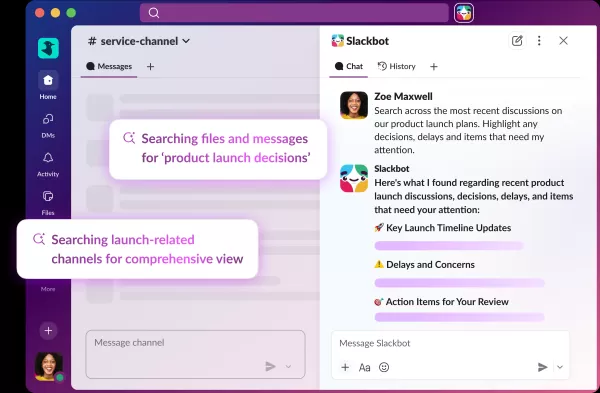 Slackbot Becomes an AI Agent
Slackbot, the automated assistant embedded in Salesforce’s corporate messaging platform Slack, is evolving into an AI agent. Salesforce CTO Parker Harris envisions it achieving viral status comparable to OpenAI’s ChatGPT.The cloud software giant laun
Slackbot Becomes an AI Agent
Slackbot, the automated assistant embedded in Salesforce’s corporate messaging platform Slack, is evolving into an AI agent. Salesforce CTO Parker Harris envisions it achieving viral status comparable to OpenAI’s ChatGPT.The cloud software giant laun
 ByteDance Boosts Core AI Incentives as Doubao Surges 14.6%
ByteDance recently convened a DouBao equity briefing to unveil fresh incentive policies for staff involved in the DouBao division. The strike price for DouBao shares has been lifted from $14.85 in June 2026 to $17.02, marking an approximate 14.6% inc
ByteDance Boosts Core AI Incentives as Doubao Surges 14.6%
ByteDance recently convened a DouBao equity briefing to unveil fresh incentive policies for staff involved in the DouBao division. The strike price for DouBao shares has been lifted from $14.85 in June 2026 to $17.02, marking an approximate 14.6% inc
 MiniMax Unveils 10x Team Program to Incentivize Global AI Experts
MiniMax (Xiyu Technology), the General Artificial Intelligence Lab, has officially launched "10x Team," a global talent collaboration initiative. This program aims to recruit top experts across industries to explore the deep application of large mode
MiniMax Unveils 10x Team Program to Incentivize Global AI Experts
MiniMax (Xiyu Technology), the General Artificial Intelligence Lab, has officially launched "10x Team," a global talent collaboration initiative. This program aims to recruit top experts across industries to explore the deep application of large mode

2026 Latest Best AI Study Tools for Homework and Exam Prep! XIX.AI curates a top-rated list of powerful, game-changing tools that help students boost productivity, streamline homework completion, and ace exams through real-world tests. Get a free vs paid comparison, detailed rankings, and must-try options to unlock your AI edge. Explore now!
10 tools
xix.ai

2026 Latest Best AI Vocal Demo Tools for Songwriters, Hook Creators, and Multi-Language Content Teams! XIX.AI has curated a top-rated list of powerful game-changing tools that go through rigorous real-world tests. You’ll find detailed free vs paid comparison data, comprehensive rankings, and must-try options to help you boost writing efficiency and unlock your creative potential. Explore now to discover your perfect tool for all your content needs!
9 tools
xix.ai

2026 Latest Best Top-rated AI Competitive Research Tools for Small Businesses! XIX.AI has curated a highly powerful game-changing collection, updated weekly with rigorous real-world tests and detailed rankings. You can find a comprehensive free vs paid comparison to help you identify the must-try tools that boost your productivity and give you a competitive edge. Explore now to discover your perfect tool!
9 tools
xix.ai

2026 Latest Best Photoshop AI retouch tools for ecommerce apparel, skin cleanup, and color consistency! This top-rated curated list features powerful game-changing solutions that help you boost writing efficiency, streamline content creation, and achieve perfect visual results effortlessly. Each tool has undergone real-world tests through weekly updated rankings, complete with free vs paid comparison details. Backed by XIX.AI, it’s the must-try guide for anyone aiming to unlock your AI edge. Explore now!
10 tools
xix.ai
2026 Latest Best Top-Rated AI Prompt Libraries for optimizing all types of ChatGPT workflows. XIX.AI has curated a powerful, game-changing collection that goes through rigorous real-world tests to ensure top performance. You can find detailed free vs paid comparisons and expert rankings to help you choose the must-try tools that boost your productivity and unlock your AI edge. Explore now!
11 tools
xix.ai

2026 Latest Best AI Quiz Builder Platforms for Teachers, Tutors, and Cohort-Based Learning Programs! XIX.AI has curated a top-rated list of powerful game-changing tools that go through real-world tests to deliver accurate rankings. These must-try platforms help boost writing efficiency, streamline content creation, and simplify quiz design across all learning scenarios. Explore now to discover your perfect tool for unlocking your AI edge in teaching!
13 tools
xix.ai

AMDのvLLM-ATOMプラグイン、DeepSeek-R1の推論速度を大幅に向上させるらしい。既存のワークフローを変えずにハードウェアの潜在能力を引き出すってのは嬉しい限りだ。GPUの性能を最大限に活かせるなら、ローカルでLLMを動かす際の待ち時間も減るはず。競合他社との差が開くか注目!🚀 #AMD #LLM












