


 Home
HomeAI Assistant Streamlines Legal Document Creation and Review
Imagine being able to navigate complex legal contracts with ease. An AI-powered legal documentation assistant is changing the way individuals and businesses interact with legal paperwork. This advanced technology demystifies complicated legal jargon, making it understandable for everyone, regardless of their legal background. It also boosts the productivity and effectiveness of legal professionals by automating tedious tasks and providing intelligent insights. This article examines the transformative potential and real-world advantages of using AI for legal documentation.
Key Points
AI translates intricate legal terms and jargon into simple, clear language.
AI delivers customized legal documents designed for specific situations.
AI offers a platform that is valuable for both individual users and legal experts.
AI supports case flow management, helping users efficiently track active cases.
AI implementation is built on industry-standard cloud architecture for better performance and security.
The Challenge of Understanding Legal Documentation
Why Legal Documents Are Difficult to Decipher
Legal documents are often excessively long and dense with specialized terminology, making them hard to understand for those without a legal background
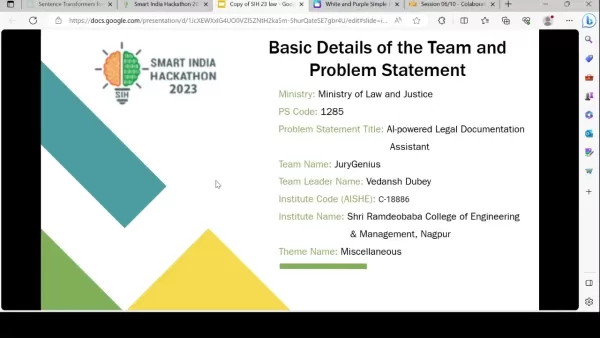
. This complexity poses a major hurdle for individuals and small businesses, who might feel compelled to hire an attorney just to interpret a basic agreement. Unfortunately, this situation is not uncommon; it's a standard part of today's business environment. Contracts and legal agreements typically demand specialized knowledge to be properly understood, resulting in higher costs and possible misinterpretations. An AI-powered legal documentation assistant helps close this divide by converting dense legal text into clear, easy-to-understand information.
How AI is Transforming Legal Documentation
AI is reshaping legal documentation by offering tools that simplify, analyze, and manage intricate legal content. The objective is to make legal procedures more efficient and accessible for everyone. An AI legal documentation assistant can summarize long documents, explain legal terms in plain language, and highlight key provisions. It creates a more level playing field, giving individuals and small businesses greater confidence in managing their legal matters. Furthermore, it allows legal professionals to dedicate more time to strategic, high-value work that demands their expertise. The adoption of AI in this field represents a major move toward a more open and approachable legal system.
Technology Stack and Backend Architecture
Cloud-Based Architecture
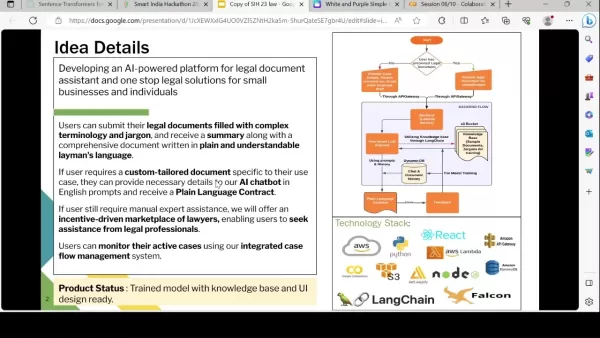
The platform employs a cloud-based architecture, using Amazon Web Services (AWS) to guarantee scalability, dependability, and security
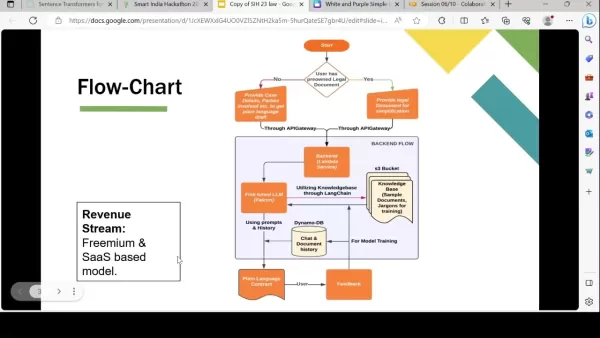
. AWS delivers a full range of services for backend operations, covering data storage (S3), serverless computing (Lambda), and database management (DynamoDB). This strong infrastructure ensures the platform can support a expanding user base and rising data volumes without sacrificing performance.
Falcon LLM and LangChain
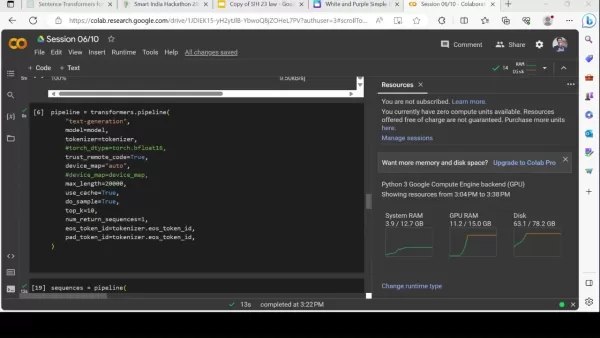
The core of the AI legal document assistant is the Falcon LLM (Language Model) and LangChain
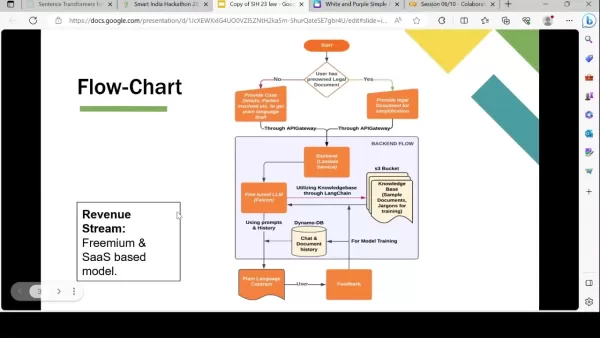
. These technologies enable the processing and creation of legal documents. LangChain is used to access the Knowledge Base via an S3 bucket. Falcon LLM is fine-tuned to work with prompts and historical data.
Data Storage and Security
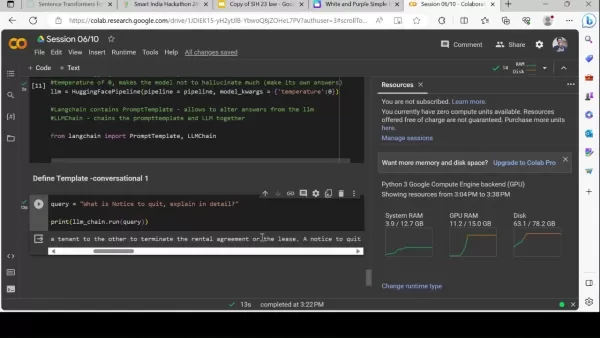
DynamoDB is utilized for chat and document history, with data stored in a hashed format to increase security. The platform securely saves chat logs and document histories to train, refine, and manage case information in detail
.
How to Use the AI-Powered Legal Documentation Assistant
Step 1: Account Creation and Login
The initial step is to create an account on the platform, which gives users access to its various features. Users can register with their email and a secure password, or choose a faster sign-up using their Google or Facebook accounts. The login page is built for ease of use, offering a straightforward and trouble-free experience. After logging in, users are taken to the homepage where they can browse the available services.
Step 2: Navigating the Homepage
The homepage is laid out to provide simple access to the main features of the AI-powered legal documentation assistant. The homepage clearly displays three key options: AI Chatbot, Expert Legal Assistance, and Case Flow Management. These choices are arranged intuitively, making it easy for users to pick the service they require. Selecting any of these options takes the user to the relevant section for more detailed support.
Step 3: Using the AI Chatbot
To simplify or create a legal document using the AI chatbot, choose the 'AI Chatbot' option from the homepage . This leads users to the drafting assistant interface. Here, users can upload an existing legal document for simplification or ask for a new document to be generated by supplying specific details and needs. The AI Chatbot analyzes the input and produces a plain language version of the document or creates a bespoke contract. This structured method ensures that even users unfamiliar with legal terminology can easily follow the process and get the help they need.
Pricing and Revenue Model
Freemium and SaaS-Based Model
The AI-powered legal documentation assistant functions on a freemium and SaaS (Software as a Service) model
. This model lets users utilize basic services for free while providing premium features and enhanced functionality through paid subscriptions. Some services available at no cost include document simplification or generating a set number of custom documents. For users with more extensive requirements, a premium subscription provides additional benefits, such as unlimited document generation and access to expert legal help.
Commercial Use for Legal Advisors
Legal advisors who want to use the legal documentation services for commercial purposes can subscribe to specialized SaaS plans designed for their needs. These plans grant access to advanced documentation tools and support, which come with separate fees that ensure commercial viability.
Pros and Cons of Using an AI Legal Documentation Assistant
Pros
Simplifies complex legal language, making it understandable for non-specialists.
Delivers customized legal documents tailored to user requirements.
Provides an incentive-based marketplace of lawyers for those needing further legal support.
It facilitates case flow management and the effective tracking of current cases.
It operates on a robust, industry-standard cloud-based architecture for superior performance and security.
Cons
Over-reliance on AI might reduce the demand for human legal expertise.
Risk of inaccuracies if the AI model is not sufficiently trained.
Dependence on technology and a stable internet connection.
Needs continuous updates to stay current with evolving laws and regulations.
Core Features of the AI-Powered Legal Documentation Assistant
Plain Language Summarization
The AI-powered legal documentation assistant is highly effective at converting complex legal documents into clear, easy-to-understand summaries
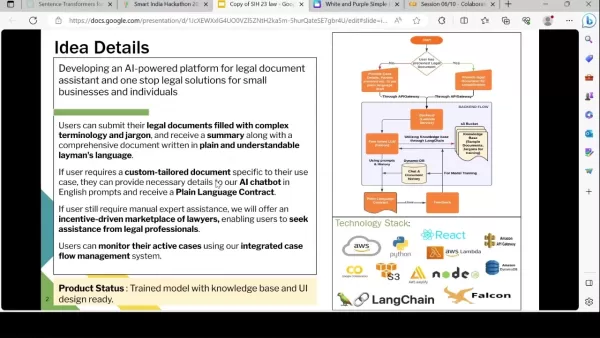
. Users can submit legal documents packed with complex terms and receive both a summary and a full document written in simple, everyday language. This capability ensures that anyone can understand the essential elements of a legal agreement without legal training.
Custom-Tailored Documentation
For users who need documents customized for their specific situation, the AI chatbot provides the necessary support. Users can input details using English prompts and get a contract in plain language in response. This tailored approach guarantees that legal documents are accurately suited to individual circumstances
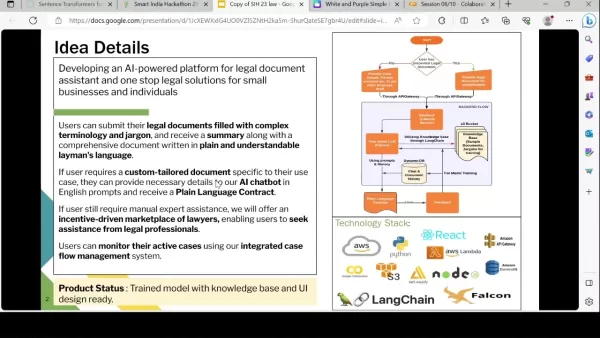
.
Incentive-Driven Marketplace for Lawyers
If users need help from a human expert, the platform features an incentive-driven marketplace of lawyers. This marketplace allows users to find and consult with legal professionals, ensuring expert advice is available when necessary. The incentive structure benefits both users and lawyers, creating a mutually advantageous arrangement
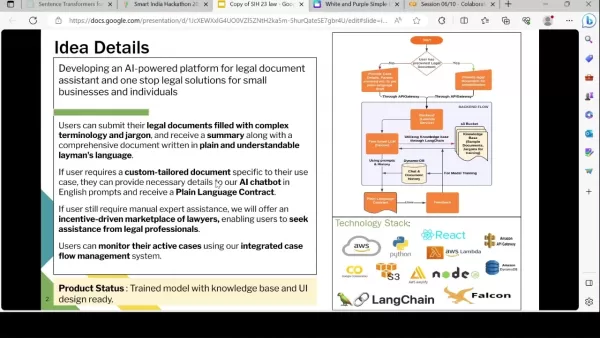
.
Integrated Case Flow Management
Users can keep track of their active cases using the integrated case flow management system. This system offers detailed information on each case, including summaries and histories, helping users stay informed and handle their legal matters efficiently
.
Frequently Asked Questions (FAQ)
What types of legal documents can the AI assistant help with?
The AI assistant can help with various legal documents, such as contracts, agreements, leases, and legal notices. It provides both simplification of existing documents and the creation of new ones based on user-provided information.
Is the AI-powered legal documentation assistant suitable for small businesses?
Yes, the AI assistant is especially useful for small businesses, offering cost-effective and accessible legal support that can minimize the need for expensive legal advice. It assists small businesses in comprehending and managing their legal responsibilities more efficiently.
How does the AI chatbot customize legal documents for specific use cases?
The AI chatbot customizes legal documents by collecting specific information and requirements from the user through English prompts. It then uses this data to generate a personalized contract that fits the user's unique situation.
Related Questions
How does AI enhance data security within legal documentation systems?
AI strengthens data security in legal documentation systems through techniques like encryption, access controls, and anomaly detection. Encryption protects sensitive data during transmission and while stored. Access controls restrict who can view or edit documents, preventing unauthorized use. Anomaly detection systems spot unusual patterns that may signal a security threat, allowing for quick action. These security measures help maintain confidentiality and compliance, protecting sensitive legal information from unauthorized access or cyberattacks.
Can AI tools ensure compliance with constantly evolving legal standards?
To maintain compliance with changing legal standards, AI tools need regular updates with the latest laws and guidelines. This involves consistently training the AI models on up-to-date legal information, integrating feedback from legal experts, and deploying automated monitoring to track changes in the legal field. The AI systems must also be flexible enough to quickly adapt to new rules and regulations to remain compliant.
What is the role of machine learning in improving the accuracy of AI legal tools?
Machine learning is essential for boosting the accuracy of AI legal tools, as it lets them learn from data and enhance their performance continuously. Using methods like supervised learning, the AI can be trained on extensive collections of legal documents and case law, enabling it to recognize patterns, connections, and subtleties in legal language. This continuous learning process ensures the AI's analyses and outputs become progressively more accurate, dependable, and in line with legal principles.
Related article
 Swedish AI Startup Lovable Eyes $13.2 Billion Valuation After Major Funding Round
As AI-driven coding tools gain traction, Swedish startup Lovable has secured a major funding round. The company aims to raise $3 billion, potentially boosting its valuation to $13.2 billion—double the $6.6 billion recorded last December. Menlo Ventur
Google Tests Remy AI Agent for Gemini as Focus Shifts to User Control
According to Business Insider, Google is testing Remy, a new AI personal agent for Gemini. This tool aims to execute tasks on behalf of users, streamlining both professional workflows and daily routines.Currently, Remy is undergoing testing in an int
How to fix Core Web Vitals for better SEO rankings
Streamline Report Card Comments with AI ToolsIntroductionAI Tools for Generating Report Card CommentsMagic SchoolAlmanac AIChat GPTUsing Magic School to Generate Report Card CommentsLogging into Magic SchoolSelecting the Report Card Comments ToolCust
Related Special Topic Recommendations
writing
Swedish AI Startup Lovable Eyes $13.2 Billion Valuation After Major Funding Round
As AI-driven coding tools gain traction, Swedish startup Lovable has secured a major funding round. The company aims to raise $3 billion, potentially boosting its valuation to $13.2 billion—double the $6.6 billion recorded last December. Menlo Ventur
Google Tests Remy AI Agent for Gemini as Focus Shifts to User Control
According to Business Insider, Google is testing Remy, a new AI personal agent for Gemini. This tool aims to execute tasks on behalf of users, streamlining both professional workflows and daily routines.Currently, Remy is undergoing testing in an int
How to fix Core Web Vitals for better SEO rankings
Streamline Report Card Comments with AI ToolsIntroductionAI Tools for Generating Report Card CommentsMagic SchoolAlmanac AIChat GPTUsing Magic School to Generate Report Card CommentsLogging into Magic SchoolSelecting the Report Card Comments ToolCust
Related Special Topic Recommendations
writing
 Best AI Outline Generators for Long-Form SEO Articles
2026 Latest Best Top-Rated AI Outline Generators for Long-Form SEO Articles, meticulously curated by XIX.AI. These powerful tools offer game-changing assistance in creating high-quality content quickly, boosting writing efficiency significantly. Get a free vs paid comparison along with real-world tests and detailed rankings to help you find the must-try option that suits your needs. Explore now to unlock your AI edge.
 8 tools
 xix.ai
Education and Learning
AI Study Tools for Homework and Exam Prep
xix.ai
Education and Learning
AI Study Tools for Homework and Exam Prep
2026 Latest Best AI Study Tools for Homework and Exam Prep! XIX.AI curates a top-rated list of powerful, game-changing tools that help students boost productivity, streamline homework completion, and ace exams through real-world tests. Get a free vs paid comparison, detailed rankings, and must-try options to unlock your AI edge. Explore now!
10 tools
xix.ai
Music composition
AI Vocal Demo Tools for Songwriters, Hooks, Toplines, and Multilingual Draft Sessions
2026 Latest Best AI Vocal Demo Tools for Songwriters, Hook Creators, and Multi-Language Content Teams! XIX.AI has curated a top-rated list of powerful game-changing tools that go through rigorous real-world tests. You’ll find detailed free vs paid comparison data, comprehensive rankings, and must-try options to help you boost writing efficiency and unlock your creative potential. Explore now to discover your perfect tool for all your content needs!
9 tools
xix.ai
Business
Best AI Competitive Research Tools for Small Businesses
2026 Latest Best Top-rated AI Competitive Research Tools for Small Businesses! XIX.AI has curated a highly powerful game-changing collection, updated weekly with rigorous real-world tests and detailed rankings. You can find a comprehensive free vs paid comparison to help you identify the must-try tools that boost your productivity and give you a competitive edge. Explore now to discover your perfect tool!
9 tools
xix.ai
Image editing
Photoshop AI Retouch Tools for Ecommerce Apparel, Skin Cleanup, and Color Consistency
2026 Latest Best Photoshop AI retouch tools for ecommerce apparel, skin cleanup, and color consistency! This top-rated curated list features powerful game-changing solutions that help you boost writing efficiency, streamline content creation, and achieve perfect visual results effortlessly. Each tool has undergone real-world tests through weekly updated rankings, complete with free vs paid comparison details. Backed by XIX.AI, it’s the must-try guide for anyone aiming to unlock your AI edge. Explore now!
10 tools
xix.ai
Prompt
Best AI Prompt Libraries for ChatGPT Workflows
2026 Latest Best Top-Rated AI Prompt Libraries for optimizing all types of ChatGPT workflows. XIX.AI has curated a powerful, game-changing collection that goes through rigorous real-world tests to ensure top performance. You can find detailed free vs paid comparisons and expert rankings to help you choose the must-try tools that boost your productivity and unlock your AI edge. Explore now!
11 tools
xix.ai

 Comments (4)
0/500
Comments (4)
0/500
![StevenGonzalez]()
Honestly, I'm both excited and a bit scared. AI breaking down legal jargon? Great, but what if it misses some nuance? 😅
![JasonHill]()
這工具真的能看懂那些繞來繞去的法律條文嗎?有點懷疑,但如果是真的就太方便了,以後自己看租約或許不用再求人了。😅
![RichardSmith]()
This is a game-changer for small businesses! No more paying lawyers just to understand basic contracts. But I'm curious, how does it handle jurisdiction-specific clauses? 🤔
![CharlesYoung]()
Ya se habían tardado en digitalizar los trámites legales tan complejos... ¡Esto facilita mucho el papeleo! Sin embargo, me pregunto si algún día necesitaremos abogados humanos cuando la IA sea capaz de manejarlo todo desde contratos normales hasta litigios complicados. 😅
Imagine being able to navigate complex legal contracts with ease. An AI-powered legal documentation assistant is changing the way individuals and businesses interact with legal paperwork. This advanced technology demystifies complicated legal jargon, making it understandable for everyone, regardless of their legal background. It also boosts the productivity and effectiveness of legal professionals by automating tedious tasks and providing intelligent insights. This article examines the transformative potential and real-world advantages of using AI for legal documentation.
Key Points
AI translates intricate legal terms and jargon into simple, clear language.
AI delivers customized legal documents designed for specific situations.
AI offers a platform that is valuable for both individual users and legal experts.
AI supports case flow management, helping users efficiently track active cases.
AI implementation is built on industry-standard cloud architecture for better performance and security.
The Challenge of Understanding Legal Documentation
Why Legal Documents Are Difficult to Decipher
Legal documents are often excessively long and dense with specialized terminology, making them hard to understand for those without a legal background
. This complexity poses a major hurdle for individuals and small businesses, who might feel compelled to hire an attorney just to interpret a basic agreement. Unfortunately, this situation is not uncommon; it's a standard part of today's business environment. Contracts and legal agreements typically demand specialized knowledge to be properly understood, resulting in higher costs and possible misinterpretations. An AI-powered legal documentation assistant helps close this divide by converting dense legal text into clear, easy-to-understand information.
How AI is Transforming Legal Documentation
AI is reshaping legal documentation by offering tools that simplify, analyze, and manage intricate legal content. The objective is to make legal procedures more efficient and accessible for everyone. An AI legal documentation assistant can summarize long documents, explain legal terms in plain language, and highlight key provisions. It creates a more level playing field, giving individuals and small businesses greater confidence in managing their legal matters. Furthermore, it allows legal professionals to dedicate more time to strategic, high-value work that demands their expertise. The adoption of AI in this field represents a major move toward a more open and approachable legal system.
Technology Stack and Backend Architecture
Cloud-Based Architecture
The platform employs a cloud-based architecture, using Amazon Web Services (AWS) to guarantee scalability, dependability, and security
. AWS delivers a full range of services for backend operations, covering data storage (S3), serverless computing (Lambda), and database management (DynamoDB). This strong infrastructure ensures the platform can support a expanding user base and rising data volumes without sacrificing performance.
Falcon LLM and LangChain
The core of the AI legal document assistant is the Falcon LLM (Language Model) and LangChain
. These technologies enable the processing and creation of legal documents. LangChain is used to access the Knowledge Base via an S3 bucket. Falcon LLM is fine-tuned to work with prompts and historical data.
Data Storage and Security
DynamoDB is utilized for chat and document history, with data stored in a hashed format to increase security. The platform securely saves chat logs and document histories to train, refine, and manage case information in detail
.
How to Use the AI-Powered Legal Documentation Assistant
Step 1: Account Creation and Login
The initial step is to create an account on the platform, which gives users access to its various features. Users can register with their email and a secure password, or choose a faster sign-up using their Google or Facebook accounts. The login page is built for ease of use, offering a straightforward and trouble-free experience. After logging in, users are taken to the homepage where they can browse the available services.
Step 2: Navigating the Homepage
The homepage is laid out to provide simple access to the main features of the AI-powered legal documentation assistant. The homepage clearly displays three key options: AI Chatbot, Expert Legal Assistance, and Case Flow Management. These choices are arranged intuitively, making it easy for users to pick the service they require. Selecting any of these options takes the user to the relevant section for more detailed support.
Step 3: Using the AI Chatbot
To simplify or create a legal document using the AI chatbot, choose the 'AI Chatbot' option from the homepage . This leads users to the drafting assistant interface. Here, users can upload an existing legal document for simplification or ask for a new document to be generated by supplying specific details and needs. The AI Chatbot analyzes the input and produces a plain language version of the document or creates a bespoke contract. This structured method ensures that even users unfamiliar with legal terminology can easily follow the process and get the help they need.
Pricing and Revenue Model
Freemium and SaaS-Based Model
The AI-powered legal documentation assistant functions on a freemium and SaaS (Software as a Service) model
. This model lets users utilize basic services for free while providing premium features and enhanced functionality through paid subscriptions. Some services available at no cost include document simplification or generating a set number of custom documents. For users with more extensive requirements, a premium subscription provides additional benefits, such as unlimited document generation and access to expert legal help.
Commercial Use for Legal Advisors
Legal advisors who want to use the legal documentation services for commercial purposes can subscribe to specialized SaaS plans designed for their needs. These plans grant access to advanced documentation tools and support, which come with separate fees that ensure commercial viability.
Pros and Cons of Using an AI Legal Documentation Assistant
Pros
Simplifies complex legal language, making it understandable for non-specialists.
Delivers customized legal documents tailored to user requirements.
Provides an incentive-based marketplace of lawyers for those needing further legal support.
It facilitates case flow management and the effective tracking of current cases.
It operates on a robust, industry-standard cloud-based architecture for superior performance and security.
Cons
Over-reliance on AI might reduce the demand for human legal expertise.
Risk of inaccuracies if the AI model is not sufficiently trained.
Dependence on technology and a stable internet connection.
Needs continuous updates to stay current with evolving laws and regulations.
Core Features of the AI-Powered Legal Documentation Assistant
Plain Language Summarization
The AI-powered legal documentation assistant is highly effective at converting complex legal documents into clear, easy-to-understand summaries
. Users can submit legal documents packed with complex terms and receive both a summary and a full document written in simple, everyday language. This capability ensures that anyone can understand the essential elements of a legal agreement without legal training.
Custom-Tailored Documentation
For users who need documents customized for their specific situation, the AI chatbot provides the necessary support. Users can input details using English prompts and get a contract in plain language in response. This tailored approach guarantees that legal documents are accurately suited to individual circumstances
.
Incentive-Driven Marketplace for Lawyers
If users need help from a human expert, the platform features an incentive-driven marketplace of lawyers. This marketplace allows users to find and consult with legal professionals, ensuring expert advice is available when necessary. The incentive structure benefits both users and lawyers, creating a mutually advantageous arrangement
.
Integrated Case Flow Management
Users can keep track of their active cases using the integrated case flow management system. This system offers detailed information on each case, including summaries and histories, helping users stay informed and handle their legal matters efficiently
.
Frequently Asked Questions (FAQ)
What types of legal documents can the AI assistant help with?
The AI assistant can help with various legal documents, such as contracts, agreements, leases, and legal notices. It provides both simplification of existing documents and the creation of new ones based on user-provided information.
Is the AI-powered legal documentation assistant suitable for small businesses?
Yes, the AI assistant is especially useful for small businesses, offering cost-effective and accessible legal support that can minimize the need for expensive legal advice. It assists small businesses in comprehending and managing their legal responsibilities more efficiently.
How does the AI chatbot customize legal documents for specific use cases?
The AI chatbot customizes legal documents by collecting specific information and requirements from the user through English prompts. It then uses this data to generate a personalized contract that fits the user's unique situation.
Related Questions
How does AI enhance data security within legal documentation systems?
AI strengthens data security in legal documentation systems through techniques like encryption, access controls, and anomaly detection. Encryption protects sensitive data during transmission and while stored. Access controls restrict who can view or edit documents, preventing unauthorized use. Anomaly detection systems spot unusual patterns that may signal a security threat, allowing for quick action. These security measures help maintain confidentiality and compliance, protecting sensitive legal information from unauthorized access or cyberattacks.
Can AI tools ensure compliance with constantly evolving legal standards?
To maintain compliance with changing legal standards, AI tools need regular updates with the latest laws and guidelines. This involves consistently training the AI models on up-to-date legal information, integrating feedback from legal experts, and deploying automated monitoring to track changes in the legal field. The AI systems must also be flexible enough to quickly adapt to new rules and regulations to remain compliant.
What is the role of machine learning in improving the accuracy of AI legal tools?
Machine learning is essential for boosting the accuracy of AI legal tools, as it lets them learn from data and enhance their performance continuously. Using methods like supervised learning, the AI can be trained on extensive collections of legal documents and case law, enabling it to recognize patterns, connections, and subtleties in legal language. This continuous learning process ensures the AI's analyses and outputs become progressively more accurate, dependable, and in line with legal principles.








 Swedish AI Startup Lovable Eyes $13.2 Billion Valuation After Major Funding Round
As AI-driven coding tools gain traction, Swedish startup Lovable has secured a major funding round. The company aims to raise $3 billion, potentially boosting its valuation to $13.2 billion—double the $6.6 billion recorded last December. Menlo Ventur
Google Tests Remy AI Agent for Gemini as Focus Shifts to User Control
According to Business Insider, Google is testing Remy, a new AI personal agent for Gemini. This tool aims to execute tasks on behalf of users, streamlining both professional workflows and daily routines.Currently, Remy is undergoing testing in an int
Swedish AI Startup Lovable Eyes $13.2 Billion Valuation After Major Funding Round
As AI-driven coding tools gain traction, Swedish startup Lovable has secured a major funding round. The company aims to raise $3 billion, potentially boosting its valuation to $13.2 billion—double the $6.6 billion recorded last December. Menlo Ventur
Google Tests Remy AI Agent for Gemini as Focus Shifts to User Control
According to Business Insider, Google is testing Remy, a new AI personal agent for Gemini. This tool aims to execute tasks on behalf of users, streamlining both professional workflows and daily routines.Currently, Remy is undergoing testing in an int
 How to fix Core Web Vitals for better SEO rankings
Streamline Report Card Comments with AI ToolsIntroductionAI Tools for Generating Report Card CommentsMagic SchoolAlmanac AIChat GPTUsing Magic School to Generate Report Card CommentsLogging into Magic SchoolSelecting the Report Card Comments ToolCust
How to fix Core Web Vitals for better SEO rankings
Streamline Report Card Comments with AI ToolsIntroductionAI Tools for Generating Report Card CommentsMagic SchoolAlmanac AIChat GPTUsing Magic School to Generate Report Card CommentsLogging into Magic SchoolSelecting the Report Card Comments ToolCust

2026 Latest Best Top-Rated AI Outline Generators for Long-Form SEO Articles, meticulously curated by XIX.AI. These powerful tools offer game-changing assistance in creating high-quality content quickly, boosting writing efficiency significantly. Get a free vs paid comparison along with real-world tests and detailed rankings to help you find the must-try option that suits your needs. Explore now to unlock your AI edge.
8 tools
xix.ai

2026 Latest Best AI Study Tools for Homework and Exam Prep! XIX.AI curates a top-rated list of powerful, game-changing tools that help students boost productivity, streamline homework completion, and ace exams through real-world tests. Get a free vs paid comparison, detailed rankings, and must-try options to unlock your AI edge. Explore now!
10 tools
xix.ai

2026 Latest Best AI Vocal Demo Tools for Songwriters, Hook Creators, and Multi-Language Content Teams! XIX.AI has curated a top-rated list of powerful game-changing tools that go through rigorous real-world tests. You’ll find detailed free vs paid comparison data, comprehensive rankings, and must-try options to help you boost writing efficiency and unlock your creative potential. Explore now to discover your perfect tool for all your content needs!
9 tools
xix.ai

2026 Latest Best Top-rated AI Competitive Research Tools for Small Businesses! XIX.AI has curated a highly powerful game-changing collection, updated weekly with rigorous real-world tests and detailed rankings. You can find a comprehensive free vs paid comparison to help you identify the must-try tools that boost your productivity and give you a competitive edge. Explore now to discover your perfect tool!
9 tools
xix.ai

2026 Latest Best Photoshop AI retouch tools for ecommerce apparel, skin cleanup, and color consistency! This top-rated curated list features powerful game-changing solutions that help you boost writing efficiency, streamline content creation, and achieve perfect visual results effortlessly. Each tool has undergone real-world tests through weekly updated rankings, complete with free vs paid comparison details. Backed by XIX.AI, it’s the must-try guide for anyone aiming to unlock your AI edge. Explore now!
10 tools
xix.ai

2026 Latest Best Top-Rated AI Prompt Libraries for optimizing all types of ChatGPT workflows. XIX.AI has curated a powerful, game-changing collection that goes through rigorous real-world tests to ensure top performance. You can find detailed free vs paid comparisons and expert rankings to help you choose the must-try tools that boost your productivity and unlock your AI edge. Explore now!
11 tools
xix.ai

Honestly, I'm both excited and a bit scared. AI breaking down legal jargon? Great, but what if it misses some nuance? 😅
這工具真的能看懂那些繞來繞去的法律條文嗎?有點懷疑,但如果是真的就太方便了,以後自己看租約或許不用再求人了。😅
This is a game-changer for small businesses! No more paying lawyers just to understand basic contracts. But I'm curious, how does it handle jurisdiction-specific clauses? 🤔
Ya se habían tardado en digitalizar los trámites legales tan complejos... ¡Esto facilita mucho el papeleo! Sin embargo, me pregunto si algún día necesitaremos abogados humanos cuando la IA sea capaz de manejarlo todo desde contratos normales hasta litigios complicados. 😅












