


 Home
HomeKhan Academy Launches AI Math Tutor for Personalized Learning
Artificial intelligence is rapidly reshaping the educational landscape, introducing new methods to tailor learning to each student. Khan Academy, a pioneer in digital education, has collaborated with OpenAI to create an AI math tutor. This technology delivers individualized support, helping students master challenging mathematical topics more efficiently. This article explores the inner workings of this tutor, its advantages, and its potential to influence the future of math education.
Key Points
Khan Academy is piloting a new AI-powered math tutor developed with OpenAI.
The tutor offers personalized, step-by-step assistance to learners.
It emphasizes conceptual understanding over simply giving answers.
The tool engages in direct dialogue with students, posing questions to steer their thinking.
It effectively helps learners pinpoint and rectify their own errors.
AI enriches the overall learning experience on the Khan Academy platform.
Understanding the AI Math Tutor
What is the AI Math Tutor?
The AI Math Tutor is an experimental feature on Khan Academy that uses artificial intelligence to deliver customized math instruction.
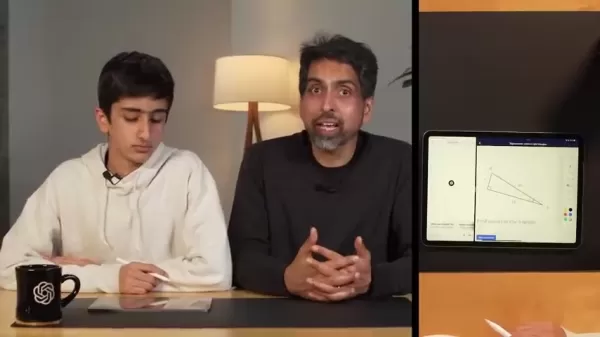
Built in partnership with OpenAI, this tool simulates a one-on-one tutoring session. Rather than just supplying answers, it focuses on guiding students through the entire problem-solving journey.
The tutor is designed to interact with learners, asking probing questions and offering hints to lead them to correct solutions independently. It identifies areas of difficulty and provides targeted support. The ultimate aim is to cultivate a deep, lasting grasp of mathematical principles.
Khan Academy's AI math tutor operates by:
- Analyzing Student Input: Assessing responses to uncover errors and misunderstandings.
- Providing Step-by-Step Guidance: Deconstructing complex problems into smaller, achievable steps.
- Asking Guiding Questions: Encouraging critical thinking at each stage of the process.
- Offering Personalized Hints: Delivering tailored suggestions based on the learner's specific needs.
- Encouraging Self-Correction: Empowering students to recognize and fix their own mistakes.
The Technology Behind the Tutor
The AI Math Tutor utilizes advanced AI technology from OpenAI, including natural language processing (NLP) and machine learning (ML). These algorithms allow the tutor to comprehend student queries, generate relevant responses, and personalize instruction.
Key technological components include:
- Natural Language Processing (NLP): Enables the AI to understand and interpret student questions and answers in everyday language.
- Machine Learning (ML): Allows the tutor to learn from interactions and refine its teaching strategies over time.
- Adaptive Learning Algorithms: Adjust the difficulty and focus of sessions based on student performance.
- Knowledge Base: A comprehensive repository of mathematical concepts and problem-solving methods.
- Feedback Loops: Systems to continuously assess and enhance the tutor's effectiveness using student feedback.
By integrating these technologies, the AI Math Tutor provides a highly personalized and impactful learning experience. The objective is to make math education more accessible and engaging for every student.
Detailed Examples of AI Tutoring in Action
Identifying Opposite, Adjacent, and Hypotenuse Sides in a Triangle
Here is an example of how the AI tutor might assist a student with a trigonometry problem.
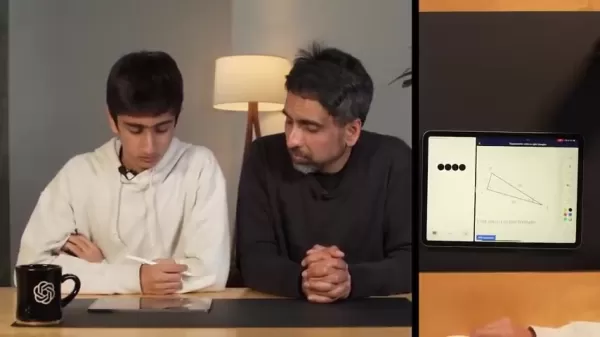
The task is to find the sine of angle α in a right triangle. The tutor begins by asking the student to identify the opposite, adjacent, and hypotenuse sides relative to angle α.
The AI tutor might prompt with questions like:
First, can you identify which sides of the triangle are the opposite, adjacent, and hypotenuse in relation to angle alpha?
After the student correctly locates angle alpha in the diagram, the tutor confirms this and asks for the hypotenuse.
If the student hesitates, the AI tutor offers a hint instead of the answer:
Recall that the hypotenuse is the longest side of a right triangle and is always opposite the right angle.
This helps the student remember the definition and apply it. The student then correctly identifies the hypotenuse.
Next, the tutor asks the student to name the side opposite angle alpha. This incremental approach ensures comprehension of each concept before proceeding.
Once all sides are correctly identified, the tutor prompts the student to recall the sine formula:
Do you remember the formula for calculating the sine of an angle in a right triangle?
With guidance, the student recalls that sine equals opposite over hypotenuse. Applying this to the given triangle, where the opposite side is 7 and the hypotenuse is 25, they determine that sin α = 7/25.
The AI tutor confirms the correct answer, reinforcing the student's understanding.
How to Interact with the AI Tutor
Accessing the AI Tutor
The AI Tutor is built directly into Khan Academy's math exercises. Access it by:
- Navigating to a Math Exercise: Select a math topic and go to the related exercise.
- Starting the Exercise: Begin working on the problems as normal.
- Engaging with the AI Tutor: The AI tutor will automatically offer help if it detects you're stuck, prompting you to accept assistance.
- Asking Questions: You can directly ask the AI tutor questions in the chat window about the problem or concepts.
- Following the Guidance: The tutor provides step-by-step hints and suggestions. Follow its instructions and request clarification when needed.
- Practicing and Reinforcing: After solving a problem with help, practice similar problems to solidify your understanding. The AI tutor adapts to your progress.
Tips for Effective Interaction
Maximize your experience with the AI Tutor by following these tips:
- Be Specific: Ask clear, detailed questions for more relevant assistance.
- Show Your Work: Share the steps you've already attempted so the tutor can pinpoint where you're stuck.
- Review Feedback: Pay close attention to the tutor's feedback, which highlights areas for improvement.
- Don't Rely Solely on the Tutor: Use it as a supplement to textbooks, videos, and other learning materials.
- Practice Regularly: Consistent practice with the tutor builds problem-solving skills and confidence.
- Be Patient: As a new technology, it may not be perfect. Your feedback helps it improve.
Khan Academy's Pricing Model
Accessing Khan Academy's Resources for Free
A major benefit of Khan Academy is its dedication to free education. As a non-profit, it offers all learning materials, including the AI Math Tutor, at no cost. This is a significant support for students and educators and helps promote educational equity by providing high-quality learning resources to all, regardless of economic background.
Supported by donations and grants, Khan Academy maintains its extensive content library and develops innovative tools like the AI Math Tutor. By making education freely accessible, it fosters lifelong learning and helps students reach their potential.
Pros and Cons of Using Khan Academy's AI Math Tutor
Pros
Personalized learning experience
Step-by-step guidance
Interactive questioning
Error analysis
Progress tracking
Free access
Cons
Limited subject coverage (currently focused on math)
Potential for technical issues or glitches
May not be suitable for all learning styles
Requires internet access
Core Features of Khan Academy's AI Math Tutor
Personalized Learning Paths
The AI Math Tutor adapts to each student's pace and style, creating a customized learning journey. It identifies knowledge gaps and adjusts problem difficulty to keep students appropriately challenged.
Step-by-Step Guidance
The tutor breaks down complex problems into manageable steps, offering clear explanations and hints to foster understanding of core concepts and techniques.
Interactive Questioning
By engaging students in a dialogue and asking guiding questions, the tutor promotes critical thinking and active learning.
Error Analysis
The tool analyzes responses to identify common errors and misconceptions, providing targeted feedback to help students correct mistakes.
Progress Tracking
Students can monitor their improvement over time. The tutor provides detailed performance reports, showing strengths and areas needing more support.
Use Cases for Khan Academy's AI Math Tutor
Supporting Individual Learning
Ideal for self-paced study, the tutor provides personalized support to keep independent learners motivated and on track with challenging material.
Enhancing Classroom Instruction
Teachers can use the tutor to supplement lessons, offering extra support to struggling students and freeing up time for advanced topics and individual attention.
Providing Remedial Support
The tutor is a valuable resource for catching up on missed concepts and building a strong math foundation.
Preparing for Standardized Tests
Students can use the tutor to prepare for tests like the SAT and ACT, with practice problems and detailed explanations to boost confidence and scores.
Promoting Lifelong Learning
Khan Academy's AI tutor makes math more accessible and engaging, encouraging a lasting interest in learning and exploration of math and science.
FAQ
Is the AI Math Tutor free?
Yes, the AI Math Tutor is completely free on Khan Academy. Khan Academy is committed to providing free educational resources to everyone.
How do I access the AI Math Tutor?
Access the AI Math Tutor by going to any math exercise on Khan Academy. The tutor will appear to offer support if you encounter difficulties.
What subjects does the AI Math Tutor cover?
The tutor covers a broad spectrum of math, including arithmetic, algebra, geometry, trigonometry, and calculus. Khan Academy continues to expand its content and features.
How does the AI Math Tutor personalize the learning experience?
It adapts to each student's learning pace and style, creating a customized path. It identifies knowledge gaps and tailors problem difficulty to maintain an optimal challenge level.
Can the AI Math Tutor help me prepare for standardized tests?
Absolutely. The AI Math Tutor can assist with standardized test preparation like the SAT and ACT by providing relevant practice problems and detailed explanations to build skills and confidence.
Related Questions
How does Khan Academy ensure the accuracy of the AI Math Tutor's guidance?
Khan Academy employs experienced educators and subject experts to review and validate the AI tutor's guidance. It also incorporates feedback from students and teachers for continuous improvement, ensuring high-quality, reliable assistance.
What other AI-powered educational tools are available?
Beyond Khan Academy's tutor, several other AI-powered learning tools exist, including:Duolingo: An AI-driven platform for personalized language lessons.Quizlet: A study tool that uses AI to create customized flashcards and quizzes.Gradescope: An automated grading tool that uses AI to assess assignments.Brainly: A social learning platform that uses AI to connect students with expert answers.These examples highlight the growing range of AI educational tools transforming how we learn.
Related article
 Swedish AI Startup Lovable Eyes $13.2 Billion Valuation After Major Funding Round
As AI-driven coding tools gain traction, Swedish startup Lovable has secured a major funding round. The company aims to raise $3 billion, potentially boosting its valuation to $13.2 billion—double the $6.6 billion recorded last December. Menlo Ventur
Google Tests Remy AI Agent for Gemini as Focus Shifts to User Control
According to Business Insider, Google is testing Remy, a new AI personal agent for Gemini. This tool aims to execute tasks on behalf of users, streamlining both professional workflows and daily routines.Currently, Remy is undergoing testing in an int
How to fix Core Web Vitals for better SEO rankings
Streamline Report Card Comments with AI ToolsIntroductionAI Tools for Generating Report Card CommentsMagic SchoolAlmanac AIChat GPTUsing Magic School to Generate Report Card CommentsLogging into Magic SchoolSelecting the Report Card Comments ToolCust
Related Special Topic Recommendations
writing
Swedish AI Startup Lovable Eyes $13.2 Billion Valuation After Major Funding Round
As AI-driven coding tools gain traction, Swedish startup Lovable has secured a major funding round. The company aims to raise $3 billion, potentially boosting its valuation to $13.2 billion—double the $6.6 billion recorded last December. Menlo Ventur
Google Tests Remy AI Agent for Gemini as Focus Shifts to User Control
According to Business Insider, Google is testing Remy, a new AI personal agent for Gemini. This tool aims to execute tasks on behalf of users, streamlining both professional workflows and daily routines.Currently, Remy is undergoing testing in an int
How to fix Core Web Vitals for better SEO rankings
Streamline Report Card Comments with AI ToolsIntroductionAI Tools for Generating Report Card CommentsMagic SchoolAlmanac AIChat GPTUsing Magic School to Generate Report Card CommentsLogging into Magic SchoolSelecting the Report Card Comments ToolCust
Related Special Topic Recommendations
writing
 Best AI Outline Generators for Long-Form SEO Articles
2026 Latest Best Top-Rated AI Outline Generators for Long-Form SEO Articles, meticulously curated by XIX.AI. These powerful tools offer game-changing assistance in creating high-quality content quickly, boosting writing efficiency significantly. Get a free vs paid comparison along with real-world tests and detailed rankings to help you find the must-try option that suits your needs. Explore now to unlock your AI edge.
 8 tools
 xix.ai
Education and Learning
AI Study Tools for Homework and Exam Prep
xix.ai
Education and Learning
AI Study Tools for Homework and Exam Prep
2026 Latest Best AI Study Tools for Homework and Exam Prep! XIX.AI curates a top-rated list of powerful, game-changing tools that help students boost productivity, streamline homework completion, and ace exams through real-world tests. Get a free vs paid comparison, detailed rankings, and must-try options to unlock your AI edge. Explore now!
10 tools
xix.ai
Music composition
AI Vocal Demo Tools for Songwriters, Hooks, Toplines, and Multilingual Draft Sessions
2026 Latest Best AI Vocal Demo Tools for Songwriters, Hook Creators, and Multi-Language Content Teams! XIX.AI has curated a top-rated list of powerful game-changing tools that go through rigorous real-world tests. You’ll find detailed free vs paid comparison data, comprehensive rankings, and must-try options to help you boost writing efficiency and unlock your creative potential. Explore now to discover your perfect tool for all your content needs!
9 tools
xix.ai
Business
Best AI Competitive Research Tools for Small Businesses
2026 Latest Best Top-rated AI Competitive Research Tools for Small Businesses! XIX.AI has curated a highly powerful game-changing collection, updated weekly with rigorous real-world tests and detailed rankings. You can find a comprehensive free vs paid comparison to help you identify the must-try tools that boost your productivity and give you a competitive edge. Explore now to discover your perfect tool!
9 tools
xix.ai
Image editing
Photoshop AI Retouch Tools for Ecommerce Apparel, Skin Cleanup, and Color Consistency
2026 Latest Best Photoshop AI retouch tools for ecommerce apparel, skin cleanup, and color consistency! This top-rated curated list features powerful game-changing solutions that help you boost writing efficiency, streamline content creation, and achieve perfect visual results effortlessly. Each tool has undergone real-world tests through weekly updated rankings, complete with free vs paid comparison details. Backed by XIX.AI, it’s the must-try guide for anyone aiming to unlock your AI edge. Explore now!
10 tools
xix.ai
Prompt
Best AI Prompt Libraries for ChatGPT Workflows
2026 Latest Best Top-Rated AI Prompt Libraries for optimizing all types of ChatGPT workflows. XIX.AI has curated a powerful, game-changing collection that goes through rigorous real-world tests to ensure top performance. You can find detailed free vs paid comparisons and expert rankings to help you choose the must-try tools that boost your productivity and unlock your AI edge. Explore now!
11 tools
xix.ai

 Comments (1)
0/500
Comments (1)
0/500
![KeithGonzález]()
Honestly, I'm a bit skeptical about an AI tutor replacing human intuition in math. Sure, Khan Academy's track record is solid, but what happens when a kid just doesn't click with the bot's explanation? 🤨 Does it pivot or just keep hammering the same example? Would love to see real classroom results before jumping on the hype train.
Artificial intelligence is rapidly reshaping the educational landscape, introducing new methods to tailor learning to each student. Khan Academy, a pioneer in digital education, has collaborated with OpenAI to create an AI math tutor. This technology delivers individualized support, helping students master challenging mathematical topics more efficiently. This article explores the inner workings of this tutor, its advantages, and its potential to influence the future of math education.
Key Points
Khan Academy is piloting a new AI-powered math tutor developed with OpenAI.
The tutor offers personalized, step-by-step assistance to learners.
It emphasizes conceptual understanding over simply giving answers.
The tool engages in direct dialogue with students, posing questions to steer their thinking.
It effectively helps learners pinpoint and rectify their own errors.
AI enriches the overall learning experience on the Khan Academy platform.
Understanding the AI Math Tutor
What is the AI Math Tutor?
The AI Math Tutor is an experimental feature on Khan Academy that uses artificial intelligence to deliver customized math instruction.
Built in partnership with OpenAI, this tool simulates a one-on-one tutoring session. Rather than just supplying answers, it focuses on guiding students through the entire problem-solving journey.
The tutor is designed to interact with learners, asking probing questions and offering hints to lead them to correct solutions independently. It identifies areas of difficulty and provides targeted support. The ultimate aim is to cultivate a deep, lasting grasp of mathematical principles.
Khan Academy's AI math tutor operates by:
- Analyzing Student Input: Assessing responses to uncover errors and misunderstandings.
- Providing Step-by-Step Guidance: Deconstructing complex problems into smaller, achievable steps.
- Asking Guiding Questions: Encouraging critical thinking at each stage of the process.
- Offering Personalized Hints: Delivering tailored suggestions based on the learner's specific needs.
- Encouraging Self-Correction: Empowering students to recognize and fix their own mistakes.
The Technology Behind the Tutor
The AI Math Tutor utilizes advanced AI technology from OpenAI, including natural language processing (NLP) and machine learning (ML). These algorithms allow the tutor to comprehend student queries, generate relevant responses, and personalize instruction.
Key technological components include:
- Natural Language Processing (NLP): Enables the AI to understand and interpret student questions and answers in everyday language.
- Machine Learning (ML): Allows the tutor to learn from interactions and refine its teaching strategies over time.
- Adaptive Learning Algorithms: Adjust the difficulty and focus of sessions based on student performance.
- Knowledge Base: A comprehensive repository of mathematical concepts and problem-solving methods.
- Feedback Loops: Systems to continuously assess and enhance the tutor's effectiveness using student feedback.
By integrating these technologies, the AI Math Tutor provides a highly personalized and impactful learning experience. The objective is to make math education more accessible and engaging for every student.
Detailed Examples of AI Tutoring in Action
Identifying Opposite, Adjacent, and Hypotenuse Sides in a Triangle
Here is an example of how the AI tutor might assist a student with a trigonometry problem.
The task is to find the sine of angle α in a right triangle. The tutor begins by asking the student to identify the opposite, adjacent, and hypotenuse sides relative to angle α.
The AI tutor might prompt with questions like:
First, can you identify which sides of the triangle are the opposite, adjacent, and hypotenuse in relation to angle alpha?
After the student correctly locates angle alpha in the diagram, the tutor confirms this and asks for the hypotenuse.
If the student hesitates, the AI tutor offers a hint instead of the answer:
Recall that the hypotenuse is the longest side of a right triangle and is always opposite the right angle.
This helps the student remember the definition and apply it. The student then correctly identifies the hypotenuse.
Next, the tutor asks the student to name the side opposite angle alpha. This incremental approach ensures comprehension of each concept before proceeding.
Once all sides are correctly identified, the tutor prompts the student to recall the sine formula:
Do you remember the formula for calculating the sine of an angle in a right triangle?
With guidance, the student recalls that sine equals opposite over hypotenuse. Applying this to the given triangle, where the opposite side is 7 and the hypotenuse is 25, they determine that sin α = 7/25.
The AI tutor confirms the correct answer, reinforcing the student's understanding.
How to Interact with the AI Tutor
Accessing the AI Tutor
The AI Tutor is built directly into Khan Academy's math exercises. Access it by:
- Navigating to a Math Exercise: Select a math topic and go to the related exercise.
- Starting the Exercise: Begin working on the problems as normal.
- Engaging with the AI Tutor: The AI tutor will automatically offer help if it detects you're stuck, prompting you to accept assistance.
- Asking Questions: You can directly ask the AI tutor questions in the chat window about the problem or concepts.
- Following the Guidance: The tutor provides step-by-step hints and suggestions. Follow its instructions and request clarification when needed.
- Practicing and Reinforcing: After solving a problem with help, practice similar problems to solidify your understanding. The AI tutor adapts to your progress.
Tips for Effective Interaction
Maximize your experience with the AI Tutor by following these tips:
- Be Specific: Ask clear, detailed questions for more relevant assistance.
- Show Your Work: Share the steps you've already attempted so the tutor can pinpoint where you're stuck.
- Review Feedback: Pay close attention to the tutor's feedback, which highlights areas for improvement.
- Don't Rely Solely on the Tutor: Use it as a supplement to textbooks, videos, and other learning materials.
- Practice Regularly: Consistent practice with the tutor builds problem-solving skills and confidence.
- Be Patient: As a new technology, it may not be perfect. Your feedback helps it improve.
Khan Academy's Pricing Model
Accessing Khan Academy's Resources for Free
A major benefit of Khan Academy is its dedication to free education. As a non-profit, it offers all learning materials, including the AI Math Tutor, at no cost. This is a significant support for students and educators and helps promote educational equity by providing high-quality learning resources to all, regardless of economic background.
Supported by donations and grants, Khan Academy maintains its extensive content library and develops innovative tools like the AI Math Tutor. By making education freely accessible, it fosters lifelong learning and helps students reach their potential.
Pros and Cons of Using Khan Academy's AI Math Tutor
Pros
Personalized learning experience
Step-by-step guidance
Interactive questioning
Error analysis
Progress tracking
Free access
Cons
Limited subject coverage (currently focused on math)
Potential for technical issues or glitches
May not be suitable for all learning styles
Requires internet access
Core Features of Khan Academy's AI Math Tutor
Personalized Learning Paths
The AI Math Tutor adapts to each student's pace and style, creating a customized learning journey. It identifies knowledge gaps and adjusts problem difficulty to keep students appropriately challenged.
Step-by-Step Guidance
The tutor breaks down complex problems into manageable steps, offering clear explanations and hints to foster understanding of core concepts and techniques.
Interactive Questioning
By engaging students in a dialogue and asking guiding questions, the tutor promotes critical thinking and active learning.
Error Analysis
The tool analyzes responses to identify common errors and misconceptions, providing targeted feedback to help students correct mistakes.
Progress Tracking
Students can monitor their improvement over time. The tutor provides detailed performance reports, showing strengths and areas needing more support.
Use Cases for Khan Academy's AI Math Tutor
Supporting Individual Learning
Ideal for self-paced study, the tutor provides personalized support to keep independent learners motivated and on track with challenging material.
Enhancing Classroom Instruction
Teachers can use the tutor to supplement lessons, offering extra support to struggling students and freeing up time for advanced topics and individual attention.
Providing Remedial Support
The tutor is a valuable resource for catching up on missed concepts and building a strong math foundation.
Preparing for Standardized Tests
Students can use the tutor to prepare for tests like the SAT and ACT, with practice problems and detailed explanations to boost confidence and scores.
Promoting Lifelong Learning
Khan Academy's AI tutor makes math more accessible and engaging, encouraging a lasting interest in learning and exploration of math and science.
FAQ
Is the AI Math Tutor free?
Yes, the AI Math Tutor is completely free on Khan Academy. Khan Academy is committed to providing free educational resources to everyone.
How do I access the AI Math Tutor?
Access the AI Math Tutor by going to any math exercise on Khan Academy. The tutor will appear to offer support if you encounter difficulties.
What subjects does the AI Math Tutor cover?
The tutor covers a broad spectrum of math, including arithmetic, algebra, geometry, trigonometry, and calculus. Khan Academy continues to expand its content and features.
How does the AI Math Tutor personalize the learning experience?
It adapts to each student's learning pace and style, creating a customized path. It identifies knowledge gaps and tailors problem difficulty to maintain an optimal challenge level.
Can the AI Math Tutor help me prepare for standardized tests?
Absolutely. The AI Math Tutor can assist with standardized test preparation like the SAT and ACT by providing relevant practice problems and detailed explanations to build skills and confidence.
Related Questions
How does Khan Academy ensure the accuracy of the AI Math Tutor's guidance?
Khan Academy employs experienced educators and subject experts to review and validate the AI tutor's guidance. It also incorporates feedback from students and teachers for continuous improvement, ensuring high-quality, reliable assistance.
What other AI-powered educational tools are available?
Beyond Khan Academy's tutor, several other AI-powered learning tools exist, including:Duolingo: An AI-driven platform for personalized language lessons.Quizlet: A study tool that uses AI to create customized flashcards and quizzes.Gradescope: An automated grading tool that uses AI to assess assignments.Brainly: A social learning platform that uses AI to connect students with expert answers.These examples highlight the growing range of AI educational tools transforming how we learn.








 Swedish AI Startup Lovable Eyes $13.2 Billion Valuation After Major Funding Round
As AI-driven coding tools gain traction, Swedish startup Lovable has secured a major funding round. The company aims to raise $3 billion, potentially boosting its valuation to $13.2 billion—double the $6.6 billion recorded last December. Menlo Ventur
Google Tests Remy AI Agent for Gemini as Focus Shifts to User Control
According to Business Insider, Google is testing Remy, a new AI personal agent for Gemini. This tool aims to execute tasks on behalf of users, streamlining both professional workflows and daily routines.Currently, Remy is undergoing testing in an int
Swedish AI Startup Lovable Eyes $13.2 Billion Valuation After Major Funding Round
As AI-driven coding tools gain traction, Swedish startup Lovable has secured a major funding round. The company aims to raise $3 billion, potentially boosting its valuation to $13.2 billion—double the $6.6 billion recorded last December. Menlo Ventur
Google Tests Remy AI Agent for Gemini as Focus Shifts to User Control
According to Business Insider, Google is testing Remy, a new AI personal agent for Gemini. This tool aims to execute tasks on behalf of users, streamlining both professional workflows and daily routines.Currently, Remy is undergoing testing in an int
 How to fix Core Web Vitals for better SEO rankings
Streamline Report Card Comments with AI ToolsIntroductionAI Tools for Generating Report Card CommentsMagic SchoolAlmanac AIChat GPTUsing Magic School to Generate Report Card CommentsLogging into Magic SchoolSelecting the Report Card Comments ToolCust
How to fix Core Web Vitals for better SEO rankings
Streamline Report Card Comments with AI ToolsIntroductionAI Tools for Generating Report Card CommentsMagic SchoolAlmanac AIChat GPTUsing Magic School to Generate Report Card CommentsLogging into Magic SchoolSelecting the Report Card Comments ToolCust

2026 Latest Best Top-Rated AI Outline Generators for Long-Form SEO Articles, meticulously curated by XIX.AI. These powerful tools offer game-changing assistance in creating high-quality content quickly, boosting writing efficiency significantly. Get a free vs paid comparison along with real-world tests and detailed rankings to help you find the must-try option that suits your needs. Explore now to unlock your AI edge.
8 tools
xix.ai

2026 Latest Best AI Study Tools for Homework and Exam Prep! XIX.AI curates a top-rated list of powerful, game-changing tools that help students boost productivity, streamline homework completion, and ace exams through real-world tests. Get a free vs paid comparison, detailed rankings, and must-try options to unlock your AI edge. Explore now!
10 tools
xix.ai

2026 Latest Best AI Vocal Demo Tools for Songwriters, Hook Creators, and Multi-Language Content Teams! XIX.AI has curated a top-rated list of powerful game-changing tools that go through rigorous real-world tests. You’ll find detailed free vs paid comparison data, comprehensive rankings, and must-try options to help you boost writing efficiency and unlock your creative potential. Explore now to discover your perfect tool for all your content needs!
9 tools
xix.ai

2026 Latest Best Top-rated AI Competitive Research Tools for Small Businesses! XIX.AI has curated a highly powerful game-changing collection, updated weekly with rigorous real-world tests and detailed rankings. You can find a comprehensive free vs paid comparison to help you identify the must-try tools that boost your productivity and give you a competitive edge. Explore now to discover your perfect tool!
9 tools
xix.ai

2026 Latest Best Photoshop AI retouch tools for ecommerce apparel, skin cleanup, and color consistency! This top-rated curated list features powerful game-changing solutions that help you boost writing efficiency, streamline content creation, and achieve perfect visual results effortlessly. Each tool has undergone real-world tests through weekly updated rankings, complete with free vs paid comparison details. Backed by XIX.AI, it’s the must-try guide for anyone aiming to unlock your AI edge. Explore now!
10 tools
xix.ai

2026 Latest Best Top-Rated AI Prompt Libraries for optimizing all types of ChatGPT workflows. XIX.AI has curated a powerful, game-changing collection that goes through rigorous real-world tests to ensure top performance. You can find detailed free vs paid comparisons and expert rankings to help you choose the must-try tools that boost your productivity and unlock your AI edge. Explore now!
11 tools
xix.ai

Honestly, I'm a bit skeptical about an AI tutor replacing human intuition in math. Sure, Khan Academy's track record is solid, but what happens when a kid just doesn't click with the bot's explanation? 🤨 Does it pivot or just keep hammering the same example? Would love to see real classroom results before jumping on the hype train.












